Research Article | | Peer-Reviewed

Use of Fluorescence Spectroscopy Combined with Chemometric Tools for the Quality Assessment of Fermented Parkia Biglobosa Seeds During Storage

Received: 25 October 2024     Accepted: 8 November 2024     Published: 28 November 2024
Views:       Downloads:
Abstract

Fermented Parkia biglobosa seed is a food of high nutritional value that plays a vital role in the diet of many populations, particularly in West Africa. This food offers a combination of proteins, vitamins, minerals and fibers, while having beneficial properties for the health of consumers. Thus, this study aimed to investigate the feasibility of using front face fluorescence (FFFS) to assess the quality of dry fermented seed of Parkia biglobosa (Soumbara) during storage. In this study, the physicochemical parameters (pH, fat and peroxide value (PV)) were determined. The obtained results showed that the pH, fat and PV values varied with the storage duration. For example, from day 1 to day 30, the pH values increased from 6.130 ± 0.05 to 6.723 ± 0.07. By applying principal component analysis (PCA) and factorial discriminant analysis (FDA) on the emission spectra acquired after excitation wavelengths fixed at 250 nm, 340 nm, 360 nm, 290, 290 nm and 410 nm, a perfect discrimination of the soumbara samples according to the storage times. In addition, the factorial discriminant analysis allowed to obtain a correct classification rate between 90 and 100. Regarding the prediction of the pH, fat and PV level, the partial least squares regression (PLSR) applied to the FFFS spectra data gave an excellent prediction with R2 values of 0.99. The results obtained in this study show that the FFFS method coupled with descriptive and predictive chemometric tools could be applied as an effective, rapid and non-destructive method for monitoring the quality of fermented Parkia biglobosa (soumbara) seeds during storage.

Published in International Journal of Nutrition and Food Sciences (Volume 13, Issue 6)
DOI 10.11648/j.ijnfs.20241306.14
Page(s) 270-282
Creative Commons

This is an Open Access article, distributed under the terms of the Creative Commons Attribution 4.0 International License (http://creativecommons.org/licenses/by/4.0/), which permits unrestricted use, distribution and reproduction in any medium or format, provided the original work is properly cited.

Copyright

Copyright © The Author(s), 2024. Published by Science Publishing Group

Keywords

Fluorescence Spectroscopy, Parkia biglobosa, Chemometric, Quality, Soumbara

1. Introduction
The seed of Parkia biglobosa, also known as African breadfruit or "néré in French" is a source of bioactive compounds, such as flavonoids, polyphenols and other secondary metabolites. These constituents give this foodstuff the powerful positive health properties Nowadays, attention is paid to underutilized legumes in order to find new alternative sources of proteins to meet the increasing demand for plant proteins . As such, the seeds of Acacia nilotica and P. biglobosa are considered as underutilized legumes with remarkable dietary values for the health of consumers . Regarding the fermented and dried seed of P. biglobosa, it is widely consumed in several countries of sub-Saharan Africa, and it is known under various names . It is known as Soumbara in Bambara (Guinea, Mali, Ivory Coast), soumbara in Burkina Faso. Its transformation is done by alkaline fermentation involving the use of many microorganisms responsible for this fermentation, such as lactic acid bacteria, staphylococci and micrococci . Indeed, the main biochemical reaction that occurs during alkaline fermentation is proteolysis which results in the release of peptides and essential amino acids, and part of the amino acids obtained is degraded into alkaline components such as ammonia which are responsible for its strong odors, leading to an increase in the pH of the final product which varies between 8 to 10 . Moreover, reported that the strong flavor and odor of soumbara are due to the presence of molecules such as ammonia, pyrazines, esters, acids and ketones which are produced during fermentation. In addition, lipolysis and carbohydrate degradation also occur, making this condiment an important source of essential fatty acids and amino acids. The technology of obtaining soumbara is often carried out in conditions where good hygiene practice methods and good manufacturing practice methods are not well mastered and respected. This makes it imperative to develop reliable methods for assessing their quality. In this context, used physicochemical methods to evaluate the quality of P. biglobosa seed powder. The results obtained showed that this product contains, in addition to alkaloids, polyphenols and terpenes, proteins (28.60%), lipids (35.03%), total carbohydrates (18.50%) and fibers (10.49%) with an energy value of 503.67 kcals. The authors also determined the levels of acid index (8.7 mg KOH/g), peroxide (2.66 mEq O2/Kg), iodine (101.03 g I2/100g) and saponification (162.69 mg KOH/g oil). In addition, Souley & Diadié also used physicochemical methods to evaluate the quality of soumbara; In their study, they concluded that the average water, protein, lipid, carbohydrate, energy and mineral contents of the samples analyzed varied depending on the typology of the soumbala and their environment of origin. In addition to these physicochemical methods, several authors have used chromatographic methods to evaluate the quality of fermented seeds of P. biglobosa . Despite the interest of researchers in evaluating the quality of P. biglobosa seeds, to our knowledge, no study has yet focused on the use of fluorescence spectroscopy. However, fluorescence spectroscopy can be used to monitor the evolution of quality by providing information on the nutritional value and antioxidant properties of foods. Despite these advantages, to our knowledge, no study has yet investigated the use of the potential of fluorescence spectroscopy to monitor the evolution of the quality of soumbara during storage. Thus, the present study aims to explore the potential of fluorescence spectroscopy, and to couple this potential with chemometric tools to evaluate the evolution of the quality of soumbara during storage.
2. Materiel and Methods
2.1. Preparation of Cloves and Sesame Flour
Dry fermented seeds of Parkia biglobosa were purchased from the Aviation market in Conakry (Guinea). These seeds were carefully sorted and reduced to fine powder using the mixer (Valentin mini-chopper, Made in France). The powder obtained was subdivided into 7 batches, then vacuum-packed and covered with aluminum foil and stored at room temperature. This condition was similar to that of sale. The analyses were carried out every 5 days of storage (days 1, 5, 10, 15, 20, 25 and 30). All the parameters evaluated were carried out in triplicate.
2.2. Physico-chemical Measurements
The evaluation of physicochemical parameters of P. biglobosa samples included the determination of pH value, fat content, and peroxide value (PV). Five grams (5g) of sample were dissolved in 50 ml of distilled water. The obtained solution was filtered out with Whatman paper 4. The pH of the solution was measured using a pH meter (Germany model). The AOAC method was used to extract the total lipid content. The peroxide value (PV) was established according to the method described by Wenjiao et al. . All measurements were determined in triplicate after 1, 5, 10, and 15 days of fermentation.
2.3. Fluorescence Spectroscopy
Fluorescence spectra were recorded using a Fluoromax-4 spectrofluorometer (Jobin Yvon, Horiba, NJ, USA) equipped with a thermostat at 20 °C. The incidence angle of the excitation radiation was set at 60° to ensure that reflected light scattered radiation and depolarization phenomena were minimised. The spectrofluorometer was equipped with a thermostated cell and the temperature was controlled by a Haake A25 AC 200 temperature controller (Thermo-Scientific, France). Finely homogeneous P. biglobosa powders were placed in a quartz cuvette and fluorescence spectra were recorded at 20 °C. The emission spectra of aromatic amino acids and nucleic acids (AAA+NA) (290–400), tryptophan (305–450 nm), nicotinamide adenine dinucleotide (NADH) (370–600 nm), fluorescent Maillard Reaction Products (FMRP) (400-600 nm), and polyphenols (290–520 nm) were acquired with the excitation wavelengths set at 250, 290, 340 nm, 360 nm, and 270 nm, respectively. The vitamin A excitation spectra (250–370 nm) were scanned after the emission wavelength set at 410 nm.
2.4. Statistical Analyses
Different pre-processings were applied to the fluorescence spectra to discriminate P biglobosa samples. For this, a normalization by reducing the area under each spectrum to a value of 1 in order to reduce scattering effects was applied to the fluorescence spectra . Subsequently, the relevant information was extracted for sample identification from a data table, and a descriptive chemometric method (PCA) was applied to reduce the dimensionality by projecting each data point onto only the first few principal components to get lower-dimensional data while keeping as much of the data's change as possible . To confirm the PCA and increase the discrimination between samples, an FDA was performed with leave-one-out cross-validation on the first 5 principal components of the PCA from the spectral data as a function of storage time. Finally, the ability of fluorescence spectroscopies to predict lipid oxidation levels was evaluated by applying PLSR. This approach aimed to find the best regression model that would allow us to better understand the oxidation levels. The 21 spectral measurements that constitute the set were divided into two sets of 14 and 07 spectra. The first group was used to develop statistical models called calibration models, while the second group was used to validate the models previously developed. The first group (14 spectra) designated as the calibration set and representing samples belonging to the different classes was used. The calibration equation was determined for each parameter. To validate the calibration, an independent set of 07 samples was randomly selected from all the sets representing the different classes. The coefficient of determination (R2), the root mean square error of calibration (RMSEC) and the root mean square error of prediction (RMSEP) were calculated to assess the robustness of the models . ANOVA and FDA were carried out with XLSTAT 2016 (Addinsoft SARL USA, New York, NY, USA), while the PCA and PLSR were performed using MATLAB software (Matlab, Version 6.5, Release 12, The MathWorks) and Unscramble X Software (V.10.4. Camo Software AS, Oslo, Norway), respectively.
3. Results and Discussion
3.1. Evolution of Physico-chemical Parameters
The results of the physicochemical analyses obtained on the samples of the fermented seed powder of Parkia biglobosa during storage are recorded in Table 1.
Table 1. Physicochemical composition of Parkia biglobosa seed samples during storage for 30 days.

Storage duration (day)

pH

Fat (%)

PV (mEq O2/Kg fat)

1

6.130 ± 0.05c

20.003 ± 0.19c

2.00 ± 0.07a

5

6.323 ± 0.01bc

20.107 ± 1.23c

2.583 ± 0.15b

10

6.313 ±0.03bc

20.190 ± 0.21c

2.510 ± 0.41b

15

6.307 ± 0.01bc

20.288 ± 0.59bc

2.363 ± 0.05c

20

6.247 ± 0.06c

20.719 ± 0.20bc

2.310 ± 0.01c

25

6.507 ± 0.17ab

21.747 ± 0.12ab

2.333 ± 0.10c

30

6.723 ± 0.07a

22.101 ± 0.08a

2.017 ± 0.06a

The values mentioned in the table are means of triplicate determinations (n=3) ± standard deviation. The small letters represent the statistical differences observed between the samples according to the storage duration. We considered that a difference was significant only when the p-value is greater than 0.05. PV: peroxide value.
The values of the parameters determined varied significantly during the storage period. For instance, on days 1, 5, 10, 15, 20, 25 and 30 the pH values are 6.130 ± 0.05, 6.323 ± 0.01, 6.313 ± 0.03, 6.307 ± 0.01, 6.247 ± 0.06, 6.507 ± 0.17 and 6.723 ± 0.07. These values are similar to those found by Cissé et al. in the fermented seed powder of P. biglobosa (pH = 6.21 ± 0.02). Furthermore, these values show that the storage duration had an impact, since a significant difference (p > 0.05) was observed on days 25 and 30. On the other hand, the pH levels remained relatively stable on the first fifteen days of storage. Indeed, the evolution of pH with the storage duration could be attributed to the biochemical reactions due to the proteolytic bacteria that degrade the amino acids leading to an evolution of pH as reported by Ouoba et al. . In addition, the pH values found are within the range of values found by Kambire et al. , who obtained a pH value between 6.05 and 6.8 in three types of soumbara (granuleted, paste and powder).
The fat contents found in the samples at days 1, 5, 10, 15, 20, 25, and 30 were 20.003 ± 0.19%, 20.107 ± 1.23%, 20.190 ± 0.21%, 20.288 ± 0.59%, 20.719 ± 0.20%, 21.747 ± 0.12%, and 22.101 ± 0.08%, respectively (Table 1). Statistical tests (Fisher, Tukey, and Bonferroni) showed no significant difference (p<0.05) between the samples during the first 10 days of storage; on the other hand, a slight increase was observed at days 15 and 20. It was only at days 25 and 30 that fat values increased significantly (p>0.05). The results are similar to those obtained by Koura et al. who found total lipid values of 19.39 to 22.56% in P. boglobosa seeds from different localities in Benin. On the other hand, they are lower than those obtained by Cissé et al. who found 35.03 ± 0.07% lipids in P. biglobosa seed powder.
Regarding the peroxide value (PV) obtained (Table 1), it allows to highlight the level of oxidation of the oils . Indeed, in the oils extracted from the fermented seeds of P. biglobosa throughout storage (Table 1) show some variation in the PV levels. However, the values remained lower than the regulation set by the FAO which sets 15 mEq O2/kg of oil as the recommended limit value for vegetable oils intended for human consumption. These results show that soumbara oil would be less rancid, which is consistent with the conclusion of Nkafamiya et al. who noted in their study that soumbara oil would be less rancid than other edible oils. Despite the conformity to this FAO regulation, it should be noted that the PV value obtained in our study were affected by the storage duration; for example, the values increased significantly (p>0.05) during the first ten days of storage, from 2.00 ± 0.07 mEq O2/kg oil at day 1 to 2.510 ± 0.41 mEq O2/kg oil at day 10. Subsequently, a drastic decrease was observed from 2.510 ± 0.41 mEq O2/kg oil at day 10 to 2.017 ± 0.06 mEq O2/kg oil at day 30. This decrease could be due to the decomposition of primary oxidation products to secondary products.
3.2. Analysis of Fluorescence Spectra
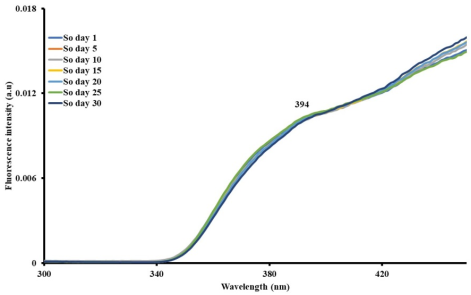
Fluorescence spectroscopy is a very sensitive analytical method capable of measuring trace substances in foods containing at least one fluorescent chemical molecule . In this context, several fluorophores relevant for food products, including aromatic amino acids and nucleic acids (AAA+NA), NADH, tryptophan, polyphenol and vitamin A, have been studied. Indeed, the emission spectra obtained after the excitation was fixed at 250 nm showed the same pattern with the highest fluorescence intensity located at 394 nm (Figure 1).
Figure 1. Normalized emission spectra acquired on emission spectra after excitation set at 250 nm on soumbara samples (fermented seeds of Parkia biglobosa) during storage for 30 days.
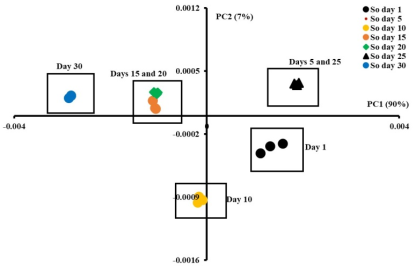
These results show a stability of the proteins during storage for 30. These results are in agreement with the protein contents (data not shown), where no significant difference was observed between the soumbara samples. When the principal component analysis (PCA) was applied to the spectra acquired after excitation fixed at 250 nm (Figure 2), a clear differentiation was observed between the samples according to the storage time.
Figure 2. Principal Component Analysis (PCA) map recorded on the emission spectra after excitation set at 250 nm on soumbara samples (fermented seeds of Parkia biglobosa) during storage for 30 days.
This observation was confirmed by the discriminant factor analysis (FDA) applied to the first 5 PCs of the PCA, since the samples on days 1, 10, 15, 20 and 30 were correctly classified (100% correct classification); on the other hand, on days 5 and 25, the samples were not classified. It should be noted that an overall rate of 70% of correct classification (Table 2) was obtained. These results showed that fluorescence spectroscopy coupled with chemometric tools (PCA and FDA) could be used to monitor the quality of dry fermented P. biglobosa seed samples during storage.
Table 2. Classification table of factor discriminant analysis (FDA) with leave-one-out cross-validation obtained on soumbara samples (dry fermented seeds of Parkia biglobosa) at different storage times for fluorescence spectroscopy data.

Predited/Observation

So day 1

So day 15

So day 20

So day 25

So day 30

So day 5

So day10

% correct classification

Fluorescence emission spectra acquired after excitation at 250 nm (AAA+AN)

So day 1

3

0

0

0

0

0

0

100.00%

So day 10

0

3

0

0

0

0

0

100.00%

So day 15

0

0

3

0

0

0

0

100.00%

So day 20

0

0

0

2

1

0

0

66.67%

So day 25

0

0

0

0

3

0

0

100.00%

So day 30

0

0

0

0

0

3

0

100.00%

So day 5

0

0

0

0

0

0

3

100.00%

Total

3

3

3

2

4

3

3

95.24%

Fluorescence emission spectra of nicotinamide adenine dinucleotide (NADH) acquired after excitation at 340 nm

So day 1

3

0

0

0

0

0

0

100.00%

So day 15

0

3

0

0

0

0

0

100.00%

So day 20

0

0

3

0

0

0

0

100.00%

So day 25

0

0

0

1

2

0

0

33.33%

So day 30

0

0

0

0

3

0

0

100.00%

So day 5

0

0

0

0

0

3

0

100.00%

So day10

0

0

0

0

0

0

3

100.00%

Total

3

3

3

1

5

3

3

90.48%

Fluorescence emission spectra acquired after excitation at 360 nm (fluorescent Maillard Reaction Products: FMRP)

So day 011

3

0

0

0

0

0

0

100.00%

So day 051

0

3

0

0

0

0

0

100.00%

So day 101

0

0

3

0

0

0

0

100.00%

So day 151

0

0

0

3

0

0

0

100.00%

So day 201

0

0

0

0

3

0

0

100.00%

So day 251

0

0

0

0

0

3

0

100.00%

So day 301

0

1

0

0

0

0

2

66.67%

Total

3

4

3

3

3

3

2

95.24%

Fluorescence emission spectra acquired after excitation at 290 nm (Polyphénol)

So day 1

3

0

0

0

0

0

0

100.00%

So day 10

0

3

0

0

0

0

0

100.00%

So day 15

0

0

3

0

0

0

0

100.00%

So day 20

0

0

0

3

0

0

0

100.00%

So day 25

0

0

0

0

3

0

0

100.00%

So day 30

0

0

0

0

0

3

0

100.00%

So day 5

0

0

0

0

0

0

3

100.00%

Total

3

3

3

3

3

3

3

100.00%

Fluorescence emission spectra acquired after excitation at 290 nm (Tryptophan)

So day 1

3

0

0

0

0

0

0

100.00%

So day 10

0

3

0

0

0

0

0

100.00%

So day 15

0

0

2

1

0

0

0

66.67%

So day 20

0

0

1

2

0

0

0

66.67%

So day 25

0

0

0

0

3

0

0

100.00%

So day 30

0

0

0

0

0

3

0

100.00%

So day 5

0

0

0

0

0

0

3

100.00%

Total

3

3

3

3

3

3

3

90.48%

Fluorescence emission spectra acquired after emission at 410 nm (Vitamin A)

So day 1

3

0

0

0

0

0

0

100.00%

So day 10

0

3

0

0

0

0

0

100.00%

So day 15

0

0

3

0

0

0

0

100.00%

So day 20

0

0

0

3

0

0

0

100.00%

So day 25

0

0

0

0

3

0

0

100.00%

So day 30

0

0

0

0

0

3

0

100.00%

So day 5

0

0

0

0

0

0

3

100.00%

Total

3

3

3

3

3

3

3

100.00%

So: Soumbara sample; day: storage day
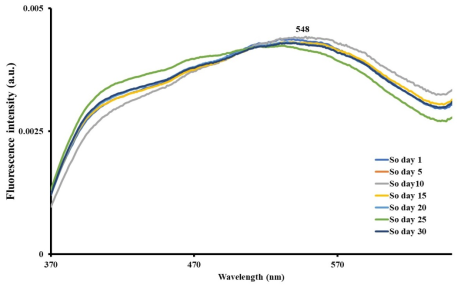
As shown in Figure 3, the normalized NADH emission spectra recorded on soumbara samples during storage show a maximum located at ~548 nm. A shift in the maximum NADH emission towards higher wavelengths was observed as a function of storage time, indicating changes in the molecular environment of the samples.
Figure 3. Normalized emission spectra acquired on emission spectra after excitation set at 340 nm on soumbara samples (fermented seeds of Parkia biglobosa) during storage for 30 days.
The PCA similarity map was able to differentiate the samples based on storage duration into four groups (Data not shown). These results show that PCA can be coupled with NADH spectra to differentiate the dry fermented P. biglobosa seed samples during storage. By applying FDA to NADH spectra, it was found that all samples were correctly classified (100%) except samples at days 5 and 25 which were not classified at all. Furthermore, an overall rate of 70% was obtained (Table 2).
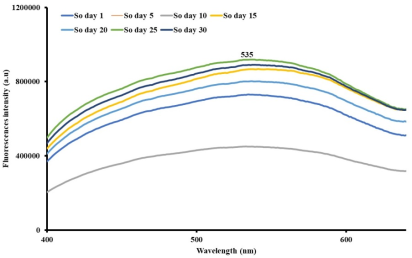
The PFRM fluorescence spectra (Figure 4) show the same pattern with a maximum intensity located at approximately 535 nm for all samples, regardless of the storage time. Still, the spectra are clearly visible depending on the samples. However, the spectra are well separated depending on the storage days (days 1, 5, 10, 15, 20, 25 and 30). These peaks could be attributed to FMRP from the reaction between free amino groups and the carbonyl compound .
Figure 4. Normalized emission spectra acquired on emission spectra after excitation set at 360 nm on soumbara samples (fermented seeds of Parkia biglobosa) during storage for 30 days.
PCA applied to PFRM emission spectra showed discrimination between samples during storage. When FDA was applied to the 5 PCs of the PCA, all samples were correctly classified (100% correct classification) except samples at day 30 where 66.67% correct classification was obtained. The overall rate of 95.24% was obtained for all samples (Table 2).
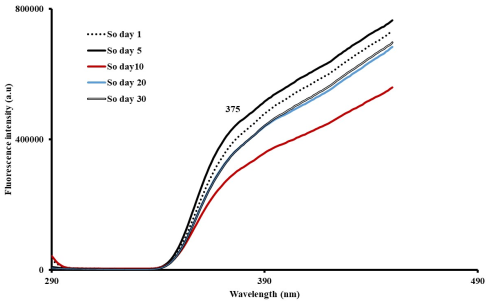
Polyphenols are chemical compounds that are very beneficial to human health; they are present in many plant products such as the dry fermented seed of P. biglobosa . These compounds are characterized by their fluorescent properties with the excitation wavelength set at 270 nm and the emission wavelengths between 375 and 425 nm . During the storage period of the soumbara samples, the normalized emission spectra acquired after the excitation wavelength set at 290 nm show the same appearance. For example, the spectra shown in Figure 5, show the maximum fluorescence intensity at 375 nm which is attributable to polyphenols.
Figure 5. Normalized emission spectra acquired on emission spectra after excitation set at 290 nm on soumbara samples (fermented seeds of Parkia biglobosa) during storage for 30 days.
Although the appearance of all the spectra is the same, a shift was observed on days 1, 5, 10, 20 and 30 (Figure 5) and the same is true for days 15 and 25.
A clear differentiation was also observed between the samples depending on the storage duration following the application of the PCA (Data not shown). Indeed, the samples at days 15, 20 and 25 have positive scores at PC1, on the other hand, at days 1 and 10, the samples show negative scores compared to PC2. Only samples belonging to day 5 and 25 were positioned negatively of CP1 and positively of CP2. These results show that PCA can be applied on polyphenol spectra to clearly differentiate soumbara samples during storage. This trend was confirmed following the application of FDA where 100% of correct classification was obtained for all samples (Table 2).
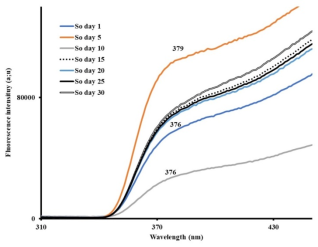
As shown in Figure 6, the normalized emission spectra recorded on soumbara samples between 305 and 450 nm after an excitation set at ~290 nm showed a peak at ~379 nm corresponding to the maximum emission of tryptophan . As illustrated in this figure, the spectra show a visible difference between the samples depending on the storage time.
Figure 6. Normalized emission spectra acquired on emission spectra after excitation set at 290 nm (tryptophan) on soumbara samples (fermented seeds of Parkia biglobosa) during storage for 30 days.
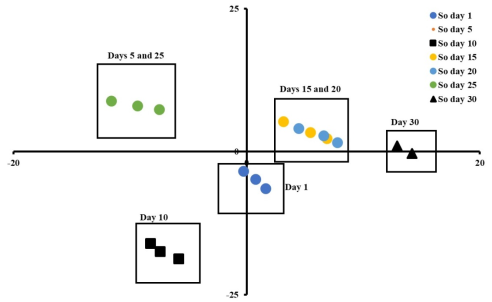
The findings in this figure are that a decrease in fluorescence intensity proportional to the storage time was observed, which could probably be due to lipid oxidation reactions. This explanation is similar to those given by Hassoun & Karoui who found a strong correlation between tryptophan fluorescence intensity and thiobarbituric acid reactive substances (TBARS) level. In addition, this variation could be due to the interactions of chemical constituents, such as lipid-lipid and/or lipid-protein interactions, as described by Viljanen et al. . In light of these results, it was found that storage time promotes lipid oxidation, thus causing a degradation of the quality of soumbara. Furthermore, a decrease in fluorescence intensity was observed at days 10, 15, 20, 25 and 30. This could be explained by the fact that during the storage period of soumbara, the protein could undergo oxidative reactions such as loss of functional groups by degradation of amino acid residues, modification of side chains and aggregation and/or polymerization of the protein, which could lead to a decrease in the fluorescence quantum yield of tryptophan, and this is consistent with that reported by Ganhão et al. . In view of these results, it can be concluded that tryptophan was in a more polar environment for samples with a storage time of 10 to 30 days, since it is known that in a more polar environment, tryptophan in an excited state will relax to a lower energy state. Furthermore, in order to better exploit the information contained in the dataset tables, a PCA was applied (Figure 7), and the obtained results in this framework allowed to discriminate the samples into 4 groups according to the storage time.
Figure 7. Principal Component Analysis (PCA) map recorded on the emission spectra after excitation set at 290 (tryptophan) nm on soumbara samples (fermented seeds of Parkia biglobosa) during storage for 30 days.
Indeed, the samples of days 15, 20 and 30 presented positive scores compared to PC1 and 2, which is totally contrary to the samples of days 1, 5, 10 and 25 which are positioned on the negative side of PC2. Subsequently, an FDA was applied to confirm this trend. These results allowed to classify the samples according to the storage time with a correct classification rate of 100 for all samples, except for the samples of days 5 and 20, where 66.66% were obtained (Table 2).
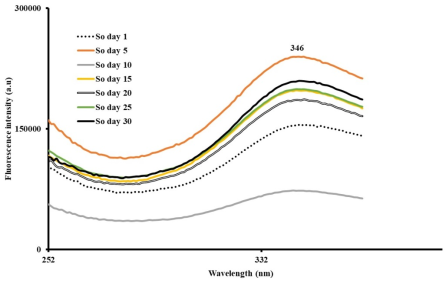
The vitamin A excitation spectra scanned on fermented dry sausages between 252 and 390 nm with an emission wavelength set at 410 nm are presented in Figure 8. These excitation spectra showed a maximum located at about 288 nm and another located at about 346 nm for all samples during storage with the same spectra shape. In addition, the spectra show visible differences depending on the storage time. These observations are similar to those found by Karoui et al. who recorded a maximum fluorescence intensity of the excitation spectra of vitamin A scanned on different varieties of soft cheese after emission at 410 nm was located at about 322 and 305 nm. The observed variations in the appearance of the could be due on the one hand to the increase in the viscosity of the triglycerides, and on the other hand to the crystallization of the triglycerides during the storage period; these results are in agreement with the previous results of Charlotte Møller Andersen & Mortensen .
Figure 8. Normalized excitation spectra after emission set at 410 nm of soumbara samples (dry fermented seeds of Parkia biglobosa) for 30 days of storage.

PCA applied to the normalized spectra allowed a clear discrimination of samples according to recipes and fermentation stage (data not shown). When FDA was applied, all samples were correctly classified (100% correct classification) (Table 2).
3.3. Performance of PLSR Models to Predict the Physicochemical Parameters Determined on Soumbara Samples
The results of the prediction of physicochemical parameters from fluorescence spectra are shown in Table 3.
Table 3. Cross-validation results of pH, fat and peroxide value (PV) levels using partial least squares regression (PLSR) of calibration and validation models.

Calibration

Validation

R2

RPD

RMSEC

R2

RPD

RMSEP

Fluorescence emission spectra of aromatic amino acid and nucleic acid (AAA+NN) acquired after excitation at 250 nm

pH

0.99

0.50

0.21

0.99

1.76

0.30

Fat

0.99

2.32

0.30

0.99

2.71

0.11

PV

0.98

2.53

0.36

0.99

3.1

0.28

Fluorescence emission spectra of nicotinamide adenine dinucleotide (NADH) acquired after excitation at 340 nm

pH

0.97

0.45

0.02

0.99

1.88

0.23

Fat

0.98

2.74

0.08

0.99

4.12

0.09

PV

0.98

2.92

0.28

0.99

2.39

0.39

Fluorescence emission spectra fluorescent Maillard reaction products (FMRP) acquired after excitation at 360 nm

pH

0.98

2.01

0.2

0.99

2.57

0.21

Fat

0.96

2.20

0.11

0.99

2.80

0.15

PV

0.97

2.16

0.24

0.99

2.30

2.19

Fluorescence emission spectra of polyphenol acquired after excitation at 290 nm

pH

0.98

2.01

0.23

0.99

2.37

0.21

Fat

0.97

2.20

0.11

0.99

2.80

0.25

PV

0.99

2.16

0.24

0.99

2.30

2.07

Fluorescence emission spectra of tryptophan acquired after excitation at 290 nm

pH

0.98

2.46

0.32

0.90

2.32

0.4

Fat

0.97

3.37

0.45

0.99

1.09

0.35

PV

0.99

4.22

3.62

0.99

2.15

2.44

Fluorescence excitation spectra of vitamin A acquired after emission at 410 nm

pH

0.98

2.50

0.21

0.99

2.65

0.24

Fat

0.98

3.60

0.24

0.99

1.68

0.76

PV

0.99

5.81

0.32

0.99

2.54

0.31

RMSEC: Root mean square error of calibration; RMSEP: Root mean square error of prediction; RPD: Ratio of prediction deviation; PV: peroxide value.
Considering the validation model and all the fluorophores used in this study, an R2 of 0.99 was obtained. The prediction of the validation set gave a model with R2 = 0.99, indicating the ability of FFFS to differentiate soumbara samples stored at room temperature with excellent accuracy. In addition, the prediction of the calibration set gave a model with R2 greater than 0.96. These two models sufficiently show that FFFS coupled with PLSR is an excellent possibility to predict the physicochemical parameters (pH, fat and peroxide value) of soumbara during storage. The main conclusion of this section is that all the studied parameters were excellently predicted by PLSR from fluorescence spectra. Indeed, despite the relatively small number of samples, the performance of the model developed and applied for the first time to soumbara samples, was very satisfactory and suggested the potential use of FFFS as a powerful tool to rapidly screen the differentiation between soumbara samples according to storage duration. This hypothesis should be confirmed on a large number of samples sampled over a long period.
4. Conclusion
This study determined the physochemical composition of fermented Parkia biglobosa seeds during storage for 30 days at room temperature. The results obtained showed that the storage duration induced a variation in the physicochemical quality. In addition, the potential of FFFS spectroscopies used to monitor the evolution of soumbara quality in this original study was successful. By combining these methods with various chemometric tools such as PCA and FDA, an excellent classification of soumbara samples according to storage duration was obtained, with an accuracy rate of 100%. Regarding the prediction of pH, fat et PV levels, FFFS demonstrated its high ability to predict these values with R2 of 0.99. In conclusion, it can be confirmed that fluorescence spectroscopy coupled with chemometric tools can be considered as a rapid, efficient and non-destructive method to assess the evolution of soumbara quality during storage. Moreover, compared to traditional chemical measurements, the technique has the potential to significantly reduce analysis time and the use of chemicals.
Abbreviations

FFFS

Front Face Fluorescence

PCA

Principal Component Analysis

PLSR

Partial Least Squares Regression

FDA

Discriminant Factor Analysis

FMRP

Fluorescent Maillard Reaction Products

TBARS

Thiobarbituric Acid Reactive Susbtances

RMSEC

Root Mean Square Error of Calibration

RMSEP

Root Mean Square Error of Prediction

RPD

Ratio of Prediction Deviation

PV

Peroxide Value

Acknowledgments
The authors thank the Ministry of Higher Education, Scientific Research and Innovation of the Republic of Guinea for its financial support.
Declarations
Compliance with Ethical Requirements
Not Applicable.
Informed Consent
Informed consent was obtained from all individual participants included in the study.
Author Contributions
Moriken Sangaré: Conceptualization, Data curation, Formal Analysis, Funding acquisition, Investigation, Methodology, Project administration, Resources, Software, Writing – original draft
Mamadou Lamarana Souaré: Data curation, Investigation, Supervision, Writing – review & editing
Mamady Diawara: Formal Analysis, Investigation, Resources, Supervision, Visualization, Writing – review & editing
Vamougna Soumaoro: Formal Analysis, Writing – original draft, Writing – review & editing
Romdhane Karoui: Conceptualization, Funding acquisition, Project administration, Software, Validation, Visualization, Writing – review & editing
Data Availability Statement
The data that support the findings of this study are available on request from the corresponding author.
Conflicts of Interest
The authors declare no conflicts of interest.
References
[1] Ajayi, K., Adepoju, O. T., Taiwo, O. M., Omojola, S. T., & Aladetuyi, M. E. (2018). Nutritional potential of underutilized gum arabic tree seeds (acacia nilotica) and locust bean seeds (Parkia biglobosa). African Journal of Food Science, 12(8), 196–203.
[2] Andersen, C. M., & Mortensen, G. (2008). Fluorescence spectroscopy: A rapid tool for analyzing dairy products. Journal of Agricultural and Food Chemistry, 56(3), 720–729.
[3] AOAC. (2005). Association Official Analytical Chemist. International Gaitherburg, MD.
[4] Aremu, M. O., Awala, E. Y., Opaluwa, O. D., Odoh, R., & Bamidele, T. O. (2015). Effect of Processing on Nutritional Composition of African Locust Bean (Parkia biglobosa) and Mesquite Bean (Prosopis africana) Seeds. Communications in Applied Sciences, 3(1), 22–41.
[5] Boughattas, F., Vilkova, D., Kondratenko, E., & Karoui, R. (2020). Targeted and untargeted techniques coupled with chemometric tools for the evaluation of sturgeon (Acipenser gueldenstaedtii) freshness during storage at 4°C. Food Chemistry, 312(December 2019), In press.
[6] Cissé, I., Emmanuel, K. N. D., Léonce, N. G., Syndoux, D., Boniface, K. K., & Louise, A. A. (2021). Composition phytochimique et nutritionnelle des graines fermentées de Parkia biglobosa issues du Nord de la Côte d ’ Ivoire. Journal of Applied Biosciences, 168, 17507 – 17519.
[7] Ganhão, R., Estévez, M., & Morcuende, D. (2011). Suitability of the TBA method for assessing lipid oxidation in a meat system with added phenolic-rich materials. Food Chemistry, 126(2), 772–778.
[8] Hassoun, A., & Karoui, R. (2015). Front-face fluorescence spectroscopy coupled with chemometric tools for monitoring fish freshness stored under different refrigerated conditions. Food Control, 54, 240–249.
[9] Hassoun, A., & Karoui, R. (2016). Monitoring changes in whiting (Merlangius merlangus) fillets stored under modified atmosphere packaging by front face fluorescence spectroscopy and instrumental techniques. Food Chemistry, 200, 343–353.
[10] Kabré, E., Bandé, M., Karfo, R., Bazié, R., Soulama, D., Nikiéma, F., & Sakandé, J. (2020). Quantitative determination of chemical and biochemical parameters during «soumbala» manufacturing process in two communities of Burkina Faso. International Journal of Biological and Chemical Sciences, 14(9), 3001–3017.
[11] Kambire, O., Yao, K. M., Sika, A. E., Coulibaly, A., Boli, Z. B. I. A., & Koffi-Nevry, R. (2021). Microbiological and Physicochemical Characteristics of Three Types of “soumbara” from Seeds of African Locust Bean in Korhogo Markets, Côte d’Ivoire. International Journal of Food Science, 2021.
[12] Karoui, R., Boughattas, F., & Chèné, C. (2021). Classification of sea bream (Sparus aurata) fillets subjected to freeze-thaw cycles by using front-face fluorescence spectroscopy. Journal of Food Engineering, 308(March), 110678.
[13] Karoui, R., Dufour, É., Pillonel, L., Picque, D., Cattenoz, T., & Bosset, J. O. (2004). Determining the geographic origin of Emmental cheeses produced during winter and summer using a technique based on the concatenation of MIR and fluorescence spectroscopic data. European Food Research and Technology, 219(2), 184–189.
[14] Karoui, R., Martin, B., & Dufour, É. (2005). Potentiality of front-face fluorescence spectroscopy to determine the geographic origin of milks from the Haute-Loire department (France). Dairy Science and Technology, 85, 223–236.
[15] Kharbach, M., Yu, H., Kamal, R., Barra, I., Marmouzi, I., Cherrah, Y., Alaoui, K., Bouklouze, A., & Heyden, Y. Vander. (2021). New insights into the Argan oil categories characterization: Chemical descriptors, FTIR fingerprints, and chemometric approaches. Talanta, 225(October 2020), 122073.
[16] Koura, K., Ibilola, P., Ouidoh, G., Azokpota, P., & Cossi, J. (2014). Caractérisation physique et composition chimique des graines de Parkia biglobosa (Jacq.) R. Br. en usage au Nord-Bénin. Journal of Applied Biosciences, 75, 6239–6249.
[17] Ndir, B., Lognay, G., Wathelet, B., Cornelius, C., Marlier, M., & Thonart, P. (2000). composition chimique du nététu, condiment alimentaire produit par fermentation des graines du caroubier africain Parkia biglobosa (Jacq.) benth. Biotechnology, Agronomy and Society and Environment, 4(2), 101–105.
[18] Nkafamiya, I. I., Maina, H. M., Osemeahon, S. A., & Modibbo, U. U. (2010). Percentage oil yield and physiochemical properties of different groundnut species (Arachis hypogaea). African Journal of Food Science, 4(7), 418–421.
[19] Ouoba, L. I. I., Diawara, B., Jespersen, L., & Jakobsen, M. (2007). Antimicrobial activity of Bacillus subtilis and Bacillus pumilus during the fermentation of African locust bean (Parkia biglobosa) for Soumbala production. Journal of Applied Microbiology, 102(4), 963–970.
[20] Parkouda, C., Nielsen, D. S., Azokpota, P., Ivette Iréne Ouoba, L., Amoa-Awua, W. K., Thorsen, L., Hounhouigan, J. D., Jensen, J. S., Tano-Debrah, K., Diawara, B., & Jakobsen, M. (2009). The microbiology of alkaline-fermentation of indigenous seeds used as food condiments in Africa and Asia. Critical Reviews in Microbiology, 35(2), 139–156.
[21] Pugalenthi, M., Vadivel, V., & Siddhuraju, P. (2005). Alternative food/feed perspectives of an underutilized legume Mucuna pruriens var. utilis - A review. Plant Foods for Human Nutrition, 60(4), 201–218.
[22] Souley, R. A., & Diadié, H. O. (2020). Caractérisation Biochimique et Microbiologique de Soumbala de néré (Parkia biglobosa) et d ’ oseille de Guinée (Hibiscus sabdariffa) Produits au Niger. European Scientific Journal, 16(3), 224–243.
[23] Viljanen, K., Halmos, A. L., Sinclair, A., & Heinonen, M. (2005). Effect of blackberry and raspberry juice on whey protein emulsion stability. European Food Research and Technology, 221(5), 602–609.
[24] Wenjiao, F., Yongkui, Z., Yunchuan, C., Junxiu, S., & Yuwen, Y. (2014). TBARS content was determined colorimetrically by the method of Pokorny and Dieffenbacher (Kirk & Sawyer, 1991), which is based on the spectrophotometric determination of the pink complex formed after the reaction of one molecule of malondialdehyde (MDA) w. Meat Science, 96(1), 1–4.
[25] Zaroual, H., El Hadrami, E. M., & Karoui, R. (2021). A preliminary study on the potential of front face fluorescence spectroscopy for the discrimination of Moroccan virgin olive oils and the prediction of their quality. Analytical Methods, 13(3), 345–358.
Cite This Article
  • APA Style

    Sangaré, M., Souaré, M. L., Diawara, M., Soumaoro, V., Karoui, R. (2024). Use of Fluorescence Spectroscopy Combined with Chemometric Tools for the Quality Assessment of Fermented Parkia Biglobosa Seeds During Storage. International Journal of Nutrition and Food Sciences, 13(6), 270-282. https://doi.org/10.11648/j.ijnfs.20241306.14

    Copy | Download

    ACS Style

    Sangaré, M.; Souaré, M. L.; Diawara, M.; Soumaoro, V.; Karoui, R. Use of Fluorescence Spectroscopy Combined with Chemometric Tools for the Quality Assessment of Fermented Parkia Biglobosa Seeds During Storage. Int. J. Nutr. Food Sci. 2024, 13(6), 270-282. doi: 10.11648/j.ijnfs.20241306.14

    Copy | Download

    AMA Style

    Sangaré M, Souaré ML, Diawara M, Soumaoro V, Karoui R. Use of Fluorescence Spectroscopy Combined with Chemometric Tools for the Quality Assessment of Fermented Parkia Biglobosa Seeds During Storage. Int J Nutr Food Sci. 2024;13(6):270-282. doi: 10.11648/j.ijnfs.20241306.14

    Copy | Download

  • @article{10.11648/j.ijnfs.20241306.14,
      author = {Moriken Sangaré and Mamadou Lamarana Souaré and Mamady Diawara and Vamougna Soumaoro and Romdhane Karoui},
      title = {Use of Fluorescence Spectroscopy Combined with Chemometric Tools for the Quality Assessment of Fermented Parkia Biglobosa Seeds During Storage
    },
      journal = {International Journal of Nutrition and Food Sciences},
      volume = {13},
      number = {6},
      pages = {270-282},
      doi = {10.11648/j.ijnfs.20241306.14},
      url = {https://doi.org/10.11648/j.ijnfs.20241306.14},
      eprint = {https://article.sciencepublishinggroup.com/pdf/10.11648.j.ijnfs.20241306.14},
      abstract = {Fermented Parkia biglobosa seed is a food of high nutritional value that plays a vital role in the diet of many populations, particularly in West Africa. This food offers a combination of proteins, vitamins, minerals and fibers, while having beneficial properties for the health of consumers. Thus, this study aimed to investigate the feasibility of using front face fluorescence (FFFS) to assess the quality of dry fermented seed of Parkia biglobosa (Soumbara) during storage. In this study, the physicochemical parameters (pH, fat and peroxide value (PV)) were determined. The obtained results showed that the pH, fat and PV values varied with the storage duration. For example, from day 1 to day 30, the pH values increased from 6.130 ± 0.05 to 6.723 ± 0.07. By applying principal component analysis (PCA) and factorial discriminant analysis (FDA) on the emission spectra acquired after excitation wavelengths fixed at 250 nm, 340 nm, 360 nm, 290, 290 nm and 410 nm, a perfect discrimination of the soumbara samples according to the storage times. In addition, the factorial discriminant analysis allowed to obtain a correct classification rate between 90 and 100. Regarding the prediction of the pH, fat and PV level, the partial least squares regression (PLSR) applied to the FFFS spectra data gave an excellent prediction with R2 values of 0.99. The results obtained in this study show that the FFFS method coupled with descriptive and predictive chemometric tools could be applied as an effective, rapid and non-destructive method for monitoring the quality of fermented Parkia biglobosa (soumbara) seeds during storage.
    },
     year = {2024}
    }
    

    Copy | Download

  • TY  - JOUR
    T1  - Use of Fluorescence Spectroscopy Combined with Chemometric Tools for the Quality Assessment of Fermented Parkia Biglobosa Seeds During Storage
    
    AU  - Moriken Sangaré
    AU  - Mamadou Lamarana Souaré
    AU  - Mamady Diawara
    AU  - Vamougna Soumaoro
    AU  - Romdhane Karoui
    Y1  - 2024/11/28
    PY  - 2024
    N1  - https://doi.org/10.11648/j.ijnfs.20241306.14
    DO  - 10.11648/j.ijnfs.20241306.14
    T2  - International Journal of Nutrition and Food Sciences
    JF  - International Journal of Nutrition and Food Sciences
    JO  - International Journal of Nutrition and Food Sciences
    SP  - 270
    EP  - 282
    PB  - Science Publishing Group
    SN  - 2327-2716
    UR  - https://doi.org/10.11648/j.ijnfs.20241306.14
    AB  - Fermented Parkia biglobosa seed is a food of high nutritional value that plays a vital role in the diet of many populations, particularly in West Africa. This food offers a combination of proteins, vitamins, minerals and fibers, while having beneficial properties for the health of consumers. Thus, this study aimed to investigate the feasibility of using front face fluorescence (FFFS) to assess the quality of dry fermented seed of Parkia biglobosa (Soumbara) during storage. In this study, the physicochemical parameters (pH, fat and peroxide value (PV)) were determined. The obtained results showed that the pH, fat and PV values varied with the storage duration. For example, from day 1 to day 30, the pH values increased from 6.130 ± 0.05 to 6.723 ± 0.07. By applying principal component analysis (PCA) and factorial discriminant analysis (FDA) on the emission spectra acquired after excitation wavelengths fixed at 250 nm, 340 nm, 360 nm, 290, 290 nm and 410 nm, a perfect discrimination of the soumbara samples according to the storage times. In addition, the factorial discriminant analysis allowed to obtain a correct classification rate between 90 and 100. Regarding the prediction of the pH, fat and PV level, the partial least squares regression (PLSR) applied to the FFFS spectra data gave an excellent prediction with R2 values of 0.99. The results obtained in this study show that the FFFS method coupled with descriptive and predictive chemometric tools could be applied as an effective, rapid and non-destructive method for monitoring the quality of fermented Parkia biglobosa (soumbara) seeds during storage.
    
    VL  - 13
    IS  - 6
    ER  - 

    Copy | Download

Author Information
  • Abstract
  • Keywords
  • Document Sections

    1. 1. Introduction
    2. 2. Materiel and Methods
    3. 3. Results and Discussion
    4. 4. Conclusion
    Show Full Outline
  • Abbreviations
  • Acknowledgments
  • Declarations
  • Author Contributions
  • Data Availability Statement
  • Conflicts of Interest
  • References
  • Cite This Article
  • Author Information