Research Article | | Peer-Reviewed

Emerging Trends in Regional Anesthesia: Systematic Review

Received: 5 August 2026     Accepted: 17 August 2026     Published: 3 November 2026
Views:       Downloads:
Abstract

Regional anesthesia has evolved from nerve-centric blocks to advanced techniques; despite rapid adoption, evidence remains spotty. This systematic review was performed according to PRISMA and Cochrane guidelines to assess emerging trends in regional anesthesia in adult surgical patients and critically evaluate these emerging trends to guide evidence-based practice. A total of 17 randomized controlled trials were reviewed from several databases, including MEDLINE, EMBASE, Cochrane Central Register of Controlled Trials (CENTRAL), and Scopus. Searches were performed from 1 March 2026 to 30 June 2026. The interventions reviewed were new regional anesthesia techniques: fascial plane blocks, perineural adjunct (dexamethasone), ultrasound guidance of regional anesthesia, programmed intermittent infusion of local anesthetics, and liposomal bupivacaine. Primary outcomes were duration of analgesia, first-pass success rate, procedure time, local anesthetic consumption, and cumulative opioid consumption. A reviewer independently identified eligible studies, extracted data, and assessed risk of bias using the Cochrane risk of bias tool (ROB-2 tool). Meta-analyses were conducted with random effects models, and a pooled mean difference was calculated with REV MAN 5.4 software. There were no statistically significant differences between perineural adjuncts (dexamethasone versus dexmedetomidine) (SMD = -2.48, 95% CI: -5.59 to 0.62, p = 0.12). Statistically significant benefits of fascial plane blocks over traditional nerve blocks in postoperative analgesia (pooled mean difference -1.72, 95% CI -2.91 to -0.52, p=0.005); however, funnel plot asymmetry and outliers were noted. In terms of opioid consumption, the pooled effect is not statistically significant between fascial plane blocks versus traditional nerve blocks. Ultrasound guidance significantly improved first-pass success (pooled mean difference 0.39, 95% CI 0.24 to 0.54, p < 0.00001); however, the pooled mean difference for procedure time is 43.93 (95% CI: -21.87 to 109.72), which is not statistically significant (p = 0.19). Programmed intermittent bolus significantly reduced the local anesthetic consumption compared with continuous infusion (pooled mean difference -17.44, 95% CI -26.32 to -8.56), and liposomal bupivacaine provided superior postoperative analgesia to standard bupivacaine (pooled mean difference -0.50, 95% CI -0.91 to -0.08). In general, the review found the superiority of newer regional anesthesia techniques, particularly fascial plane blocks, ultrasound guidance for first-pass success rate, programmed intermittent boluses, and liposomal bupivacaine for postoperative analgesia. However, further multicenter RCTs are needed to strengthen the evidence.

Published in International Journal of Surgical Research and Practice (Volume 1, Issue 1)
DOI 10.11648/j.ijsrp.20260101.13
Page(s) 12-21
Creative Commons

This is an Open Access article, distributed under the terms of the Creative Commons Attribution 4.0 International License (http://creativecommons.org/licenses/by/4.0/), which permits unrestricted use, distribution and reproduction in any medium or format, provided the original work is properly cited.

Copyright

Copyright © The Author(s), 2026. Published by Science Publishing Group

Keywords

Bupivacaine, Continous Infusion of Local Anesthesia, Fascial Planes Blocks, Perineural Adjuncts, Ultrasound Guidance of Regional Anesthesia, Programmed Intermittent Bolus of Local Anesthesia

1. Introduction
Regional anesthesia has been an established technique in perioperative medicine for many decades because of its ability to provide precise and excellent pain relief without the harmful side effects of systemic opioids and general anesthesia . This branch of medicine has constantly evolved to enhance patient safety and satisfaction , from the first description of peripheral nerve block (PNB) techniques to the development of neuraxial techniques . Nevertheless, the current practice is facing a paradigm shift that is so fundamental in nature that it changes our understanding of regional anesthesia not only as a medical discipline but also as a procedure .
Advancements in technology, increased understanding of the pharmacology behind the procedures, and the clinical need for solving the opioid epidemic problem have been contributing factors in this regard . Ultrasound guidance not only offers an opportunity for needle positioning but also allows visualization of sonoanatomy, dynamics of the fascial planes, and distribution of the anesthetics . Therefore, novel types of blocks are now created, placing emphasis on fascial plane separation rather than localization of nerves . Additionally, automation of tools in the form of closed-loop systems and wearables is increasing the duration and precision of the anesthetic effects outside the perioperative period and enables improved recovery pathways and ambulatory surgery .
In addition, the trend is pharmacological. Given that the aim is to prolong block duration without relying purely on the risks associated with long-acting local anesthetics, the use of additional medications like dexmedetomidine and dexamethasone has turned out to be a highly advanced process . Advances in the areas like the use of artificial intelligence in medical images analysis and needle guidance, as well as the promising prospects of gene therapy and targeted drug delivery leading to weeks-lasting nerve blockade instead of hours, point to what the future might bring .
But the evidence that they are superior to traditional techniques remains patchy and often contradictory, despite the rapid spread of these new techniques. This systematic review and meta-analysis is thus designed to critically appraise and synthesize the current evidence regarding emerging trends in regional anesthesia. The research question is: In adult surgical patients, how do new regional anesthesia techniques (fascial plane blocks (FBP), perineural adjuncts, ultrasound guidance (UG), programmed intermittent bolus (PIB), liposomal bupivacaine, and targeted drug delivery) compare with traditional regional anesthesia methods or placebo for duration of analgesia, cumulative opioid consumption, first‑pass success rate, procedure time, local anesthesia consumption, and procedure time? In the review, it is hypothesized that newer regional techniques have better or equivalent outcomes than traditional techniques, but the degree of benefit may vary depending on the magnitude of benefit.
2. Methods
This systematic review was registered on PROSPERO and is reported according to the preferred reporting items for systematic reviews and meta-analyses (PRISMA) statement . Studies were included if they met the following criteria: adult surgical patients (≥18 years) intervened with emerging regional anesthesia technique compared with traditional nerve blocks and evaluated duration of analgesia, cumulative opioid consumption, first‑pass success rate, procedure time, local anesthesia consumption (LAC), and procedure time. Traditional regional anesthesia refers to techniques that rely on direct nerve localization (either by landmark palpation, nerve stimulation, or early ultrasound) and injection of local anesthetic around a specific nerve or plexus to achieve surgical anesthesia or postoperative analgesia. New regional anesthesia encompasses fascial plane‑centric techniques, advanced ultrasound guidance, pharmacological adjuncts (especially dexamethasone), and automated delivery systems. Lists of the inclusion and exclusion criteria with PICO were also included (Supplementary Table 1).
A thorough search of the literature was done to find studies related to emerging regional anesthesia techniques. The search was carried out from 1 March 2026 - 30 June 2026 in the following electronic databases: MEDLINE (through PubMed), EMBASE, Cochrane Central Register of Controlled Trials (CENTRAL), and Scopus. Additionally, studies were identified by hand searching the reference lists of the selected studies and relevant systematic reviews along with forward citation search through Google Scholar.
Search criteria included a combination of keywords and subject headings (MeSH/EMTREE) that encompassed the four key concepts: fascial planes block, perineural agents (dexamethasone, dexmedetomidine), ultrasound imaging (and landmarks) and catheter techniques and new drug administration (liposomal bupivacaine, PIB). Logical operators (AND, OR) were used in order to combine keywords. No limit was placed for the year of publication, but only English-language studies were selected.
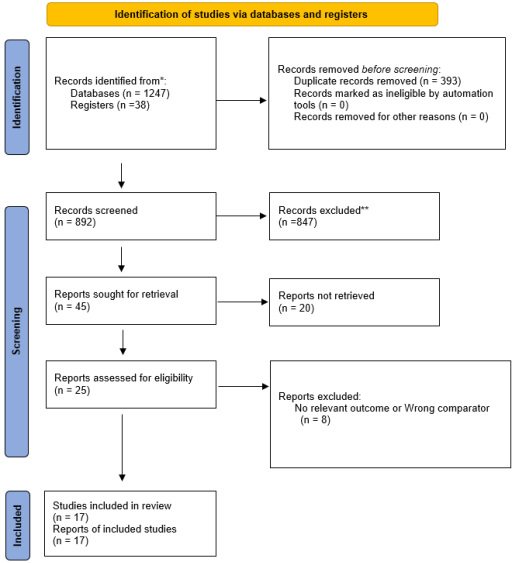
The search yielded 1,247 records from databases and 38 additional records from other sources. After removing duplicates, 892 records were screened by title and abstract. Of these, 847 records were excluded based on predefined eligibility criteria (wrong population, intervention, study design, or duplicates). 45 full text articles were sought for retrieval and 20 reports were not retrieved. The remaining 25 full text articles assessed for eligibility, leading to the exclusion of 8 articles (reasons: no relevant outcome, full text unavailable, retracted, wrong comparator). Finally, 17 studies met the inclusion criteria and were included in the qualitative synthesis. The PRISMA flow diagram summarizes the search and selection process described in Figure 1.
Figure 1. PRISMA 2020 Flow-chart.
3. Results and Meta-analysis
In patients undergoing regional anesthesia several randomized controlled trials (RCT) compared different techniques and adjuncts: dexamethasone versus dexmedetomidine as perineural adjuncts for prolonging analgesia duration; FPBs versus traditional nerve blocks for improving postoperative analgesia and reducing opioid consumption; UG versus landmark technique for neuraxial or PNBs to increase first pass success and shorten operation time; PIB versus continuous infusion to lower LAC; and liposomal bupivacaine versus standard bupivacaine for superior postoperative analgesia. However, there is insufficient systematic review and meta-analysis which provide a comparison between these different techniques.
Meta analysis results are presented for each comparison where at least two RCTs were available and the meta analyses of the 17 RCTs were performed using random effects models (DerSimonian Laird method) in RevMan 5.4, with the mean difference (MD) as the effect measure for continuous outcomes. Heterogeneity was assessed via I2 and Cochran’s Q test, yielding values from 0% to 98% – considerable heterogeneity was seen for FPBs and some ultrasound guidance analyses. Forest plots displayed each study’s MD and 95% CI, box sizes proportional to inverse variance weights, and a diamond for the pooled estimate. Funnel plots (standard error vs. effect estimate) were used to assess small study effects or publication bias. Using Cochrane RoB 2 for risk of bias assessment 10 studies were low risk, 3 studies have some concerns and 4 studies have high risk mainly due to incomplete outcome data or lack of blinding (Supplementary Figure 1). Summary of risk of bias was also included (Supplementary Figure 2). The characteristics of included articles in this systematic review and meta-analysis were also described (Supplementary Table 2).
Figure 2. Dexamethasone vs. Dexmedetomidine as Perineural Adjuncts (3 RCTs).

This meta-analysis shows no statistically significant overall difference between the two groups (SMD = -2.48, 95% CI: -5.59 to 0.62, p = 0.12) (Figure 2). However, the individual study results are highly inconsistent: Ahmed 2025 strongly favors one group, while Elsharkawy 2025 and Lei 2025 favor the opposite. There is high heterogeneity (I2 = 98%, p < 0.00001) between the studies.
Figure 3. Fascial Plane Blocks vs. Traditional Nerve Blocks for Postoperative analgesia (4 RCTs).

This forest plot compares FPBs (intervention) versus Traditional Nerve Blocks (control) for a postoperative analgesia (Figure 3). The pooled MD (random-effects model) is -1.72 (95% CI: -2.91 to -0.52), which is statistically significant (p = 0.005) and favors FPBs. However, substantial heterogeneity is present (I2 = 82%, p = 0.0008), indicating considerable variation across studies and nearly negligible contribution of the study Ashwin et al.2020.
Based on the four studies included in the forest plot, the funnel plot (plotting MD on the x axis vs. Standard Error on the y axis) would show clear asymmetry and outlier (Supplementary Figure 3). The study by AB Ashwin et al. (2020) has a very large positive MD (19.20) with an extremely high standard error (very wide confidence interval), placing it far to the right and near the top (low precision). In contrast, the other three studies (Lei Duan, Manafi Rasi, Choi) all show negative MDs (favoring fascial blocks) with much smaller standard errors (higher precision), clustering on the left side. This asymmetric distribution strongly suggests either publication bias (missing small studies with positive results favoring traditional blocks) or, more likely, that the Ashwin study is a statistical outlier due to different methodology or measurement scale.
Figure 4. Fascial Plane Blocks vs. Traditional Nerve Blocks for Opioid Consumption (3 RCTs).

This forest plot compares FPBs versus traditional nerve blocks across three studies (Figure 4). All individual studies show a negative MD (favoring FPBs), but the pooled effect is not statistically significant (MD = -9.91, 95% CI: -20.93 to 1.11, p = 0.08). However, there is extreme heterogeneity (I2 = 96%, p < 0.00001), indicating that the studies do not share a common effect.
Figure 5. Ultrasound Guidance vs. Landmark for Neuraxial/Blocks Interms of First‑pass success (3 RCTs).

The forest plot comparing UG versus landmark for first pass success shows a statistically significant pooled effect favouring ultrasound (MD 0.39, 95% CI 0.24–0.54, p < 0.00001) with low heterogeneity (I2 = 32%) (Figure 5). However, this result is largely driven by the two precise studies (Park 2019 and Rizk 2018), while Qu 2020 contributed negligible weight due to extreme imprecision.
Based on the funnel plot derived from the three studies (Qu, Park, and Rizk), there is marked asymmetry (Supplementary Figure 4). Two studies (Park and Rizk) cluster near the top with very low standard errors and mean differences around 0.38–0.41, indicating high precision and consistent results. The Qu et al. study appears as an outlier far to the right (MD ≈ 20) with a very high standard error (low precision), but it contributed 0% weight in the meta analysis due to its extremely wide confidence interval. This asymmetry does not suggest typical publication bias (e.g., missing small negative studies), but rather that the Qu study is a methodological outlier – likely measuring a different outcome, scale, or population. Given that excluding Qu does not alter the overall estimate, the funnel plot confirms that the pooled result (MD 0.39, p < 0.00001) is robust and driven solely by the two precise, consistent studies. Therefore, despite visual asymmetry, the evidence for ultrasound guidance remains reliable.
Figure 6. Ultrasound Guidance vs. Landmark for Neuraxial/Blocks Interms of reducing operation time (4 RCTs).

This forest plot compares UG versus Landmark technique across four studies (Figure 6). The pooled MD is 43.93 (95% CI: -21.87 to 109.72), which is not statistically significant (p = 0.19). However, there is extreme heterogeneity (I2 = 91%, p < 0.00001), meaning the studies do not share a common effect. Individual results are inconsistent.
Figure 7. Programmed Intermittent Bolus vs. Continuous Infusion interms of Local anesthesia consumption (2 RCTs).

The forest plot shows that PIB significantly reduces LAC compared to continuous infusion (pooled MD –17.44, 95% CI –26.32 to –8.56, p = 0.0001) with no heterogeneity (I2 = 0%) (Figure 7). However, this result is almost entirely driven by the Upadhyay et al. (2023) study, which contributes 99.4% of the weight and shows a precise benefit (MD –17.53, 95% CI –26.44 to –8.63). The second study, Datchinamourthy et al. (2024), contributes negligible weight (0.6%) due to a wide confidence interval crossing zero, and its primary outcome was fentanyl consumption, not local anesthetic volume.
Figure 8. Liposomal Bupivacaine vs. Standard Bupivacaine for postoperative analgesia (3 RCTs).

This forest plot compares Liposomal Bupivacaine versus Standard Bupivacaine across three studies (Figure 8). The pooled MD (random effects model) is -0.50 (95% CI: -0.91 to -0.08), which is statistically significant (p = 0.02), favoring liposomal bupivacaine. Heterogeneity is moderate (I2 = 31%, p = 0.24), suggesting reasonable consistency among studies.
The funnel plot of Liposomal Bupivacaine versus Standard Bupivacaine across three studies shows the actual point coordinates for the three studies (William C. et al., Pearl Ma et al., and Timmy Chi Wing Chan et al.) are not clearly displayed (Supplementary Figure 5). With only three studies, a funnel plot is of limited utility for detecting publication bias or small study effects. Nevertheless, given the low heterogeneity (I2 = 31%) and the narrow confidence interval of the pooled effect (MD –0.50, 95% CI –0.91 to –0.08), one would expect the three points to lie reasonably within a funnel shape, without obvious asymmetry. No evidence of publication bias can be inferred from such a small number of studies, and the overall finding of a modest but statistically significant benefit for liposomal bupivacaine appears consistent.
4. Discussion
The evidence presented in this review supports the shift from nerve centric to FPBs, the integration of automated technologies and adjunctive pharmacology, and the expansion of regional anesthesia beyond the operating room and reveals important nuances, controversies, and knowledge gaps that merit discussion.
Even though there high heterogeneity (I2 = 98%, p < 0.00001) between the studies there is no statistically significant overall difference between dexamethasone and dexmedetomidine as perineural adjuncts (SMD = -2.8, 95% CI: -5.59 to 0.62, p = 0.12). Maagaard et al.2025 in a high quality meta analysis of nine RCTs (1,023 participants), concluded that “dexamethasone remains the superior single agent adjunct” for prolonging block duration, and combining it with dexmedetomidine offers no clinically relevant benefit . Xiong et al.2021 similarly found that perineural dexmedetomidine and dexamethasone provide equivalent analgesic duration . An EP028 systematic review quantified the effect: α2 agonists prolong analgesia by 2–3 hours, while corticosteroids reduce local anaesthetic requirements by 25% .
A critical point raised Kendall et al.2026 implied that traditional long acting local anaesthetics (e.g., bupivacaine with epinephrine) carry neurotoxicity risks, especially in vulnerable populations (elderly, diabetics) . Adjuncts allow lower local anaesthetic concentrations and volumes, potentially reducing nerve damage. Nevertheless, Williams et al.2020 remind us that perineural adjuvants themselves may have neurotoxic potential at high doses, and Hussain et al.2021 showed that intravenous dexamethasone is non inferior to perineural administration, challenging the need for perineural injection . These debates underscore the need for personalised, evidence based adjunct selection.
This review implied that FPBs favours postoperative analgesia over traditional Nerve Blocks with pooled MD (random-effects model) is -1.72 (95% CI: -2.91 to -0.52), p = 0.005. Sharma et al.2026 explicitly document a “shift from ‘nerve centric’ to ‘fascial plane centric’ targeting,” noting that FPBs now “redefine Morgan’s axiom” by relying on UG hydrodissection rather than direct nerve localization . Wang et al.2026 provide network meta analysis evidence comparing six FPBs (ESPB, QLB, PENG, etc.) for hip arthroplasty, demonstrating that these blocks achieve comparable or superior analgesia with fewer motor complications . Hussain et al.2025 further strengthen this finding, showing that motor sparing FPBs like PENG and QLB are effective for total hip arthroplasty while preserving ambulation .
Comparison of FPBs to traditional nerve blocks for postoperative opioid consumption shows a non significant pooled MD of –9.91 (95% CI –20.93 to 1.11, p = 0.08) with extreme heterogeneity (I² = 96%). Individual study results are inconsistent: Mosaffa F.et al.2022 and Choi JJ. et al.2022 each favour FPBs (MD –20.37 and –12.30, respectively), Ahmed MB et al.2024 shows no difference (MD –0.17) . Given the very high heterogeneity, the pooled estimate is unreliable, and no firm conclusion can be drawn about the superiority of either block type.
However, the transition is not without controversy. Elsharkawy et al.2018 warned that the rapid proliferation of block names often outpaces mechanistic understanding, and Chin et al.2021 emphasized that fascial spread is highly variable, depending on injection volume, patient anatomy, and fascial integrity . These limitations explain why some FPBs (e.g., erector spinae plane block) show inconsistent results across trials. Clinicians must therefore balance enthusiasm for new blocks with rigorous anatomical knowledge and real time ultrasound optimization.
Jamaleddin et al.2026 and Tulgar S. et al.2026 stated UG has moved beyond needle localisation to become a “window into sonoanatomy . Tulgar S. et al.2025 implies real time visualisation of fascial plane separation and drug spread has enabled novel blocks like the external oblique intercostal plane block . Moreover, AI is emerging as a practical tool. Jo et al.2025 reviewed commercial AI systems (e.g., ScanNav, Nerveblox) that enhance anatomical recognition and reduce interoperator variability . Bansal et al.2024 noted that AI can provide real time needle guidance and track local anaesthetic deposition . However, as Burckhardt Stock et al.2025 implied that current AI is limited by data bias and narrow anatomical coverage; and Bowness et al.2023 stated that prospective clinical trials are urgently needed .
UG versus landmark for first pass success shows a statistically significant pooled effect favouring ultrasound (MD 0.39, 95% CI 0.24–0.54, p < 0.00001) with low heterogeneity (I² = 32%). Park SK. et al.2019 reported a strong benefit of ultrasound (65% vs. 17.5% success), but Rizk MS. et al.2019 originally found no benefit when the ultrasound guided midline group (73% success) was compared with the landmark midline group (77% success); the forest plot’s positive effect for Rizk likely arose from comparing the ultrasound guided paramedian group (42% success) with the landmark midline group (77% success), artificially reversing the direction of effect . Consequently, although the pooled estimate suggests a benefit, the clinical significance is questionable, and the effect of UG on first pass success appears highly dependent on patient population, operator experience, and the specific ultrasound approach used.
UG versus landmark technique for operation time shows no statistically significant overall difference (pooled MD 43.93 seconds, 95% CI –21.87 to 109.72, p = 0.19) but with extreme heterogeneity (I² = 91%). Individual study results are conflicting: Qu B. et al.2020 and Rizk MS. et al.2019 significantly favour landmark (longer times with ultrasound), Sahu DK. et al.2018 favours ultrasound (shorter times), and Park SK. et al.2019 shows no difference .
PIB significantly reduces LAC compared to continuous infusion (pooled MD –17.44, 95% CI –26.32 to –8.56, p = 0.0001) with no heterogeneity (I² = 0%). However, this result is almost entirely driven by the Upadhyay P. et al.2023 study, which contributes 99.4% of the weight and shows a precise benefit (MD –17.53, 95% CI –26.44 to –8.63) . The second study, Datchinamourthy et al.2024, contributes negligible weight (0.6%) due to a wide confidence interval crossing zero, and its primary outcome was fentanyl consumption, not local anesthetic volume . Thus, while PIB appears superior, the evidence relies heavily on a single high precision trial; further standardized RCTs are needed to confirm the benefit across different block types and PIB regimens.
Meta-analysis of three RCTs comparing liposomal bupivacaine to standard bupivacaine for postoperative analgesia shows a statistically significant pooled MD of -0.50 (95% CI -0.91 to -0.08, p = 0.02) favoring liposomal bupivacaine, with low heterogeneity (I² = 31%). However, this result is driven almost entirely by the Timmy Chi Wing Chan et al.2024 reported a significant reduction in the weighted AUC of pain scores; the other two trials (William C. et al.2015; Pearl Ma et al.2019) found no statistically significant difference . The small effect size ( 0.50 on a 0–10 scale) is below the minimal clinically important difference for pain, and larger meta analyses have similarly concluded that liposomal bupivacaine’s benefit is statistically significant but not clinically relevant. Given the neutral findings from two of the three studies and the lack of meaningful clinical impact, routine use of liposomal bupivacaine over standard bupivacaine is not strongly supported by this evidence.
The most promising trend is the potential for very long-lasting nerve blocks. Preclinical studies using gene therapy have shown impressive results. Espallergues J, et al. 2025 study on molecular therapy reported that perineural AAV2/9 injection in non-human primates produced safe, effective nerve blockade without negative side effects . Adolore 2025 article on biotherapeutics described replication-defective HSV-based gene therapy that provided strong pain relief lasting over six months in model systems . The Medical College of Wisconsin 2025 developed an AAV vector that releases pain-relief peptides inside sensory neurons, maintaining effectiveness for months in animal models .
At the same time, targeted drug delivery systems are making progress. Han et al.2026 stated that utilized flavonoid liposomes for nerve blocks lasting up to two days with a single injection and over 25 days with sustained release . Lu et al.2025 implied that designed a microsphere hydrogel composite that extended mechanical and thermal thresholds for 48 hours . Guo et al.2026 showed that reviewed natural polymer based delivery systems that decrease systemic toxicity and prolong duration . Although these technologies are still in the pre-clinical phase, they represent a significant departure from hours of pain management to weeks of analgesia and have the potential to revolutionize the management of postoperative and chronic pain.
5. Conclusion
For the modern practioner, understanding these new trends is essential to deliver patient centered care. The comparison of dexamethasone versus dexmedetomidine as perineural adjuncts showed no statistically significant overall difference, and FPBs demonstrated a statistically significant benefit over traditional nerve blocks for postoperative analgesia; however, for opioid consumption, the pooled effect was not significant. UG has consistent benefit in improving first pass success rate; however, it has a non significant pooled effect for procedure time. PIB was superior to continuous infusion for LAC, and liposomal bupivacaine provided statistically significant benefit over standard bupivacaine for postoperative analgesia. However, to strengthen the evidence base, further high-quality and multicenter RCTs are needed.
6. Limitations and Future Research Needs
The RCTs tend to be small and conducted at single centers, and there's quite a bit of heterogeneity among the studies. We have no long-term safety data for gene therapies. Cost-effectiveness analyses are few and far between. And there are many hurdles to clear before these technologies can be widely adopted - such as training, equipment costs and legal concerns. Future research should focus on the design of large, multi-center RCTs comparing these novel approaches to conventional methods.
Abbreviations

FPB

Fascial Plane Block

LAC

Local Anesthesia Consumption

MD

Mean Difference

PIB

Programmed Intermittent Bolus

PICO

Population, Intervention, Comparator, Outcomes (Framework for Structuring Clinical Questions)

PNB

Peripheral Nerve Blocks

RCT

Randomized Controlled Trial

RoB 2 tool

Risk of Bias 2 tool (Cochrane's Tool for Assessing Risk of Bias in Randomized Trials)

SMD

Standardized Mean Difference

UG

Ultrasound Guidance

Acknowledgments
The authors expresses gratitude to the Madda Walabu University College of Medicine and Health science to their support for conducting this review.
Author Contributions
Semon Mengistu: Conceptualization, Data curation, Formal analysis, Investigation, Methodology, Software, Validation, Visualization, Writing – original draft, Writing – review & editing
Mengistu Feye: Conceptualization, Data curation, Formal analysis, Project administration, Resources, Software, Supervision, Validation, Visualization, Writing – original draft
Data Availability Statement
This is an Open Access article distributed in accordance with the Creative Commons Attribution Non Commercial (CC BY-NC 4.0) license, which permits others to distribute, remix, adapt, build upon this work non-commercially, and license their derivative works on different terms, provided the original work is properly cited and the use is non-commercial.
Conflicts of Interest
The authors declare no conflicts of interest.
Supplementary Material

Below is the link to the supplementary material:

Supplementary Material 1

References
[1] Sharma SK, Sonawane K, Mistry T. A narrative review on fascial plane blocks – Part B: Clinical applications, practical considerations, and future directions. Indian J Anaesth. 2026; 70(1): 137-146.
[2] Wang Y, Li X, Zhang J, et al. Comparative efficacy of different nerve block technologies for postoperative pain management in hip arthroplasty: a network meta-analysis. Eur J Med Res. 2026; 31: 390.
[3] Chin KJ, Lirk P, Hollmann MW, Schwarz SKW. Mechanisms of action of fascial plane blocks: a narrative review. Reg Anesth Pain Med. 2021; 46(7): 618-628.
[4] Maagaard M, Andersen JH, Jaeger P, Mathiesen O. Effects of combined dexamethasone and dexmedetomidine as adjuncts to peripheral nerve blocks: a systematic review with meta-analysis and trial sequential analysis. Reg Anesth Pain Med. 2025; 50(4): 311-320.
[5] Hussain N, Brull R, Vannabouathong C, et al. Analgesic benefits of motor-sparing fascial plane blocks in comparison to periarticular local infiltration analgesia for total hip arthroplasty: a network meta-analysis. Anesthesiology. 2025; 143(3): 604-624.
[6] Elsharkawy H, Pawa A, Mariano ER. Interfascial plane blocks: back to basics. Reg Anesth Pain Med. 2018; 43(4): 341-346.
[7] Xiong C, Han CP, Zhao D, et al. Comparing the effects of dexmedetomidine and dexamethasone as perineural adjuvants on peripheral nerve block: a PRISMA-compliant systematic review and meta-analysis. Medicine (Baltimore). 2021; 100(34): e27064.
[8] EP028: Advancements in epidural analgesia: efficacy and safety of adjuvants [abstract]. Reg Anesth Pain Med. 2025; 50(Suppl 1): A65.
[9] Kendall MC, Alves LJ, De Oliveira G. Is it time to reassess local anesthetic and adjuvant mixtures? A narrative review of practice, evidence, and risks. Anesthesiology. 2026; 144(1): 177-190.
[10] Williams BA, Ibinson JW, Lirk P. Neurotoxicity of adjuvants used in regional anesthesia. Curr Opin Anaesthesiol. 2020; 33(5): 654-660.
[11] Hussain N, Brull R, Vannabouathong C, et al. Perineural versus intravenous dexamethasone as an adjunct to peripheral nerve blocks: a systematic review and meta-analysis. Anesthesiology. 2021; 134(3): 395-410.
[12] Jamaleddin Ahmad FA, Mohd Saif A, Maideen S, et al. Ultrasound-guided regional anesthesia: a narrative review of techniques, safety, and clinical applications. Cureus. 2026; 18(2): e102822.
[13] Tulgar S, Aydin ME, Ahiskalioglu A, De Cassai A. Fascial plane blocks for analgesia in non-operating room anesthesia settings. J Clin Med. 2026; 15(6): 2143.
[14] Tulgar S, Thomas DT, De Cassai A, Navas AM. External oblique intercostal plane block: a scoping review of anatomy, techniques, and clinical applications. J Clin Anesth. 2025; 74: 111045.
[15] Jo Y, Park S, Lee H, Kim YH. Artificial intelligence in ultrasound-guided regional anesthesia: bridging the gap between potential and practice: a narrative review. Anesth Pain Med (Seoul). 2025; 20(4): 357-370.
[16] Bansal S, Bansal A, Singh N, et al. Artificial intelligence in ultrasound-guided regional anesthesia: a review. World J Clin Cases. 2024; 12(33): 6613-6619.
[17] Burckhardt-Stock U, Larmon J, Szental J, et al. Artificial intelligence in ultrasound-guided regional anesthesia: bridging the gap between potential and practice. Korean J Anesthesiol. 2025 Oct 30.
[18] Bowness JS, El-Boghdadly K, Burckhardt-Stock U. Artificial intelligence for ultrasound-guided regional anaesthesia: a scoping review. Br J Anaesth. 2023; 131(3): e78-e80.
[19] Horn A, Frietsch T, Horn JL. Regional techniques and novel local anesthetics in ambulatory anesthesia. Curr Opin Anaesthesiol. 2025; 38(6): 728-733.
[20] Yale Medicine. Regional anesthesiology & pain medicine [Internet]. New Haven (CT): Yale Medicine; 2025 [cited 2026 Apr 2]. Available from:
[21] VCU Department of Anesthesiology. Regional anesthesia and pain medicine division [Internet]. Richmond (VA): Virginia Commonwealth University; 2025 [cited 2026 Apr 2]. Available from:
[22] Lo CYC, Chaundary N, Khan N, Kumar S, O’Donnell B. EP178: Patient experience of a regional anaesthesia enhanced ambulatory pathway for soft tissue upper limb surgery. Reg Anesth Pain Med. 2024; 49(Suppl 1): A182.
[23] Dhaked SP, Kumar A, Meena R, et al. Patient satisfaction with regional anesthesia and general anesthesia in upper limb surgeries. J Anaesthesiol Clin Pharmacol. 2025; 41(2): 312-318.
[24] Espallergues J, Cadiet J, Souab F, Choquet O, Swisser F, Bigeleisen P, Maleysson V, Sola ML, van Hameren G, Tricaud N. Perineural delivery of AAV2/9 in non-human primates is a safe and efficient route for gene therapy in Charcot-Marie-Tooth diseases. Molecular Therapy Methods & Clinical Development. 2025 Sep 11; 33(3).
[25] Page MJ, McKenzie JE, Bossuyt PM, Boutron I, Hoffmann TC, Mulrow CD, et al. The PRISMA 2020 statement: an updated guideline for reporting systematic reviews. BMJ. 2021; 372: n71.
[26] Haddaway NR, Page MJ, Pritchard CC, McGuinness LA. PRISMA2020: An R package and Shiny app for producing PRISMA 2020?compliant flow diagrams, with interactivity for optimised digital transparency and Open Synthesis. Campbell Syst Rev. 2022; 18(2): e1230.
[27] Mosaffa F, Taheri M, Manafi Rasi A, Samadpour H, Memary E, Mirkheshti A. Comparison of pericapsular nerve group (PENG) block with fascia iliaca compartment block (FICB) for pain control in hip fractures: a double-blind prospective randomized controlled clinical trial. Orthop Traumatol Surg Res. 2022; 108(1): 103135.
[28] Choi JJ, Chang YJ, Lee D, Kim HW, Kwak HJ. Effect of erector spinae plane block on postoperative pain after laparoscopic colorectal surgery: a randomized controlled study. J Pers Med. 2022; 12(10): 1571.
[29] Ahmed MB, Mohammed MM, Amin SMM, Belata MM. Comparison of ultrasound guided erector spinae plane block and fascia iliaca block for postoperative analgesia in hemiarthroplasty: a double-blind randomized trial. Anaesth Pain Intensive Care. 2024; 28(5): 791?797.
[30] Park SK, Yoo S, Kim WH, Lim YJ, Bahk JH, Kim JT. Ultrasound-assisted vs. landmark-guided paramedian spinal anaesthesia in the elderly: A randomised controlled trial. Eur J Anaesthesiol. 2019; 36(10): 763-771.
[31] Rizk MS, Zeeni CA, Bouez JN, Bteich NJ, Sayyid SK, Alfahel WS, et al. Preprocedural ultrasound versus landmark techniques for spinal anesthesia performed by novice residents in elderly: a randomized controlled trial. BMC Anesthesiol. 2019; 19: 208.
[32] Qu B, Chen L, Zhang Y, Jiang M, Wu C, Ma W, et al. Landmark-guided versus modified ultrasound-assisted Paramedian techniques in combined spinal-epidural anesthesia for elderly patients with hip fractures: a randomized controlled trial. BMC Anesthesiol. 2020; 20(1): 248.
[33] Sahu DK, Ramteke JH, Sonawane A, Parampill R. New technology: Handheld ultrasound-assisted localization of epidural space. Saudi J Anaesth. 2018; 12(2): 365-367.
[34] Upadhyay P, et al. A randomized controlled trial comparing the analgesic efficacy of programmed intermittent bolus vs. continuous infusion of ropivacaine and fentanyl in ultrasound-guided infraclavicular brachial plexus block for upper limb surgery. Asian J Anesthesiol. 2023; 61(3): 115-122.
[35] Datchinamourthy T, Bhoi D, Chhabra A, Mohan VK, Kumar KR, Ranganathan P. Comparative evaluation of continuous infusion versus programmed intermittent bolus techniques in erector spinae plane block in modified radical mastectomy – A preliminary randomised controlled trial. Indian J Anaesth. 2024; 68(3): 273-279.
[36] Chan TCW, Wong JSH, Wang F, Fang CX, Chan WSH, Wong SSC. Addition of liposomal bupivacaine to standard bupivacaine versus standard bupivacaine alone in the supraclavicular brachial plexus block: a randomized controlled trial. Anesthesiology. 2024; 141(4): 732-744.
[37] Schroer WC, Diesfeld PG, LeMarr AR, Morton DJ, Reedy ME. Does extended?release liposomal bupivacaine better control pain than bupivacaine after total knee arthroplasty (TKA)? A prospective, randomized clinical trial. J Arthroplasty. 2015; 30(9 Suppl): 64-67.
[38] Ma P, Lloyd A, McGrath M, Shuchleib Cung A, Akusoba I, Jackson A, et al. Efficacy of liposomal bupivacaine versus bupivacaine in port site injections on postoperative pain within enhanced recovery after bariatric surgery program: a randomized clinical trial. Surg Obes Relat Dis. 2019; 15(9): 1554-1562.
[39] Espallergues J, et al. Perineural delivery of AAV2/9 in non-human primates is a safe and efficient route for gene therapy in Charcot-Marie-Tooth diseases. Mol Ther Methods Clin Dev. 2025; 33(3): 101548.
[40] Adolore BioTherapeutics. rdHSV gene therapy produces >6 months of analgesia [press release]. San Diego (CA): Adolore BioTherapeutics; 2025 Jun 15.
[41] Medical College of Wisconsin. AAV-based gene therapy for chronic pain: preclinical proof of concept. Milwaukee (WI): Medical College of Wisconsin; 2025 Aug 28.
[42] Han Y, Li W, Zhang P, et al. Extended local anesthesia enabled by flavonoid permeation enhancers. Proc Natl Acad Sci USA. 2026; 123(10): e2523195123.
[43] Lu B, Wang H, Chen X, et al. Injectable hierarchical microsphere-hydrogel system for the sustained release of bupivacaine and celecoxib in long-acting analgesia. ACS Appl Mater Interfaces. 2025; 17(51): 68910-68924.
[44] Guo B, Li Y, Zhao J, et al. Recent advances in local anesthetic drug delivery systems based on natural polymers. Front Bioeng Biotechnol. 2026; 13: 1727964.
Cite This Article
  • APA Style

    Mengistu, S., Feye, M. (2026). Emerging Trends in Regional Anesthesia: Systematic Review. International Journal of Surgical Research and Practice, 1(1), 12-21. https://doi.org/10.11648/j.ijsrp.20260101.13

    Copy | Download

    ACS Style

    Mengistu, S.; Feye, M. Emerging Trends in Regional Anesthesia: Systematic Review. Int. J. Surg. Res. Pract. 2026, 1(1), 12-21. doi: 10.11648/j.ijsrp.20260101.13

    Copy | Download

    AMA Style

    Mengistu S, Feye M. Emerging Trends in Regional Anesthesia: Systematic Review. Int J Surg Res Pract. 2026;1(1):12-21. doi: 10.11648/j.ijsrp.20260101.13

    Copy | Download

  • @article{10.11648/j.ijsrp.20260101.13,
      author = {Semon Mengistu and Mengistu Feye},
      title = {Emerging Trends in Regional Anesthesia: Systematic Review},
      journal = {International Journal of Surgical Research and Practice},
      volume = {1},
      number = {1},
      pages = {12-21},
      doi = {10.11648/j.ijsrp.20260101.13},
      url = {https://doi.org/10.11648/j.ijsrp.20260101.13},
      eprint = {https://article.sciencepublishinggroup.com/pdf/10.11648.j.ijsrp.20260101.13},
      abstract = {Regional anesthesia has evolved from nerve-centric blocks to advanced techniques; despite rapid adoption, evidence remains spotty. This systematic review was performed according to PRISMA and Cochrane guidelines to assess emerging trends in regional anesthesia in adult surgical patients and critically evaluate these emerging trends to guide evidence-based practice. A total of 17 randomized controlled trials were reviewed from several databases, including MEDLINE, EMBASE, Cochrane Central Register of Controlled Trials (CENTRAL), and Scopus. Searches were performed from 1 March 2026 to 30 June 2026. The interventions reviewed were new regional anesthesia techniques: fascial plane blocks, perineural adjunct (dexamethasone), ultrasound guidance of regional anesthesia, programmed intermittent infusion of local anesthetics, and liposomal bupivacaine. Primary outcomes were duration of analgesia, first-pass success rate, procedure time, local anesthetic consumption, and cumulative opioid consumption. A reviewer independently identified eligible studies, extracted data, and assessed risk of bias using the Cochrane risk of bias tool (ROB-2 tool). Meta-analyses were conducted with random effects models, and a pooled mean difference was calculated with REV MAN 5.4 software. There were no statistically significant differences between perineural adjuncts (dexamethasone versus dexmedetomidine) (SMD = -2.48, 95% CI: -5.59 to 0.62, p = 0.12). Statistically significant benefits of fascial plane blocks over traditional nerve blocks in postoperative analgesia (pooled mean difference -1.72, 95% CI -2.91 to -0.52, p=0.005); however, funnel plot asymmetry and outliers were noted. In terms of opioid consumption, the pooled effect is not statistically significant between fascial plane blocks versus traditional nerve blocks. Ultrasound guidance significantly improved first-pass success (pooled mean difference 0.39, 95% CI 0.24 to 0.54, p < 0.00001); however, the pooled mean difference for procedure time is 43.93 (95% CI: -21.87 to 109.72), which is not statistically significant (p = 0.19). Programmed intermittent bolus significantly reduced the local anesthetic consumption compared with continuous infusion (pooled mean difference -17.44, 95% CI -26.32 to -8.56), and liposomal bupivacaine provided superior postoperative analgesia to standard bupivacaine (pooled mean difference -0.50, 95% CI -0.91 to -0.08). In general, the review found the superiority of newer regional anesthesia techniques, particularly fascial plane blocks, ultrasound guidance for first-pass success rate, programmed intermittent boluses, and liposomal bupivacaine for postoperative analgesia. However, further multicenter RCTs are needed to strengthen the evidence.},
     year = {2026}
    }
    

    Copy | Download

  • TY  - JOUR
    T1  - Emerging Trends in Regional Anesthesia: Systematic Review
    AU  - Semon Mengistu
    AU  - Mengistu Feye
    Y1  - 2026/11/03
    PY  - 2026
    N1  - https://doi.org/10.11648/j.ijsrp.20260101.13
    DO  - 10.11648/j.ijsrp.20260101.13
    T2  - International Journal of Surgical Research and Practice
    JF  - International Journal of Surgical Research and Practice
    JO  - International Journal of Surgical Research and Practice
    SP  - 12
    EP  - 21
    PB  - Science Publishing Group
    UR  - https://doi.org/10.11648/j.ijsrp.20260101.13
    AB  - Regional anesthesia has evolved from nerve-centric blocks to advanced techniques; despite rapid adoption, evidence remains spotty. This systematic review was performed according to PRISMA and Cochrane guidelines to assess emerging trends in regional anesthesia in adult surgical patients and critically evaluate these emerging trends to guide evidence-based practice. A total of 17 randomized controlled trials were reviewed from several databases, including MEDLINE, EMBASE, Cochrane Central Register of Controlled Trials (CENTRAL), and Scopus. Searches were performed from 1 March 2026 to 30 June 2026. The interventions reviewed were new regional anesthesia techniques: fascial plane blocks, perineural adjunct (dexamethasone), ultrasound guidance of regional anesthesia, programmed intermittent infusion of local anesthetics, and liposomal bupivacaine. Primary outcomes were duration of analgesia, first-pass success rate, procedure time, local anesthetic consumption, and cumulative opioid consumption. A reviewer independently identified eligible studies, extracted data, and assessed risk of bias using the Cochrane risk of bias tool (ROB-2 tool). Meta-analyses were conducted with random effects models, and a pooled mean difference was calculated with REV MAN 5.4 software. There were no statistically significant differences between perineural adjuncts (dexamethasone versus dexmedetomidine) (SMD = -2.48, 95% CI: -5.59 to 0.62, p = 0.12). Statistically significant benefits of fascial plane blocks over traditional nerve blocks in postoperative analgesia (pooled mean difference -1.72, 95% CI -2.91 to -0.52, p=0.005); however, funnel plot asymmetry and outliers were noted. In terms of opioid consumption, the pooled effect is not statistically significant between fascial plane blocks versus traditional nerve blocks. Ultrasound guidance significantly improved first-pass success (pooled mean difference 0.39, 95% CI 0.24 to 0.54, p < 0.00001); however, the pooled mean difference for procedure time is 43.93 (95% CI: -21.87 to 109.72), which is not statistically significant (p = 0.19). Programmed intermittent bolus significantly reduced the local anesthetic consumption compared with continuous infusion (pooled mean difference -17.44, 95% CI -26.32 to -8.56), and liposomal bupivacaine provided superior postoperative analgesia to standard bupivacaine (pooled mean difference -0.50, 95% CI -0.91 to -0.08). In general, the review found the superiority of newer regional anesthesia techniques, particularly fascial plane blocks, ultrasound guidance for first-pass success rate, programmed intermittent boluses, and liposomal bupivacaine for postoperative analgesia. However, further multicenter RCTs are needed to strengthen the evidence.
    VL  - 1
    IS  - 1
    ER  - 

    Copy | Download

Author Information