
Microfinance banking industry is critical cog in the economic wheel as it contributes to the Gross Domestic Product, generation of employment and enhancement of socio-economic status in its pursuit for financial inclusivity for the segment of the Kenyan adult population that has been ignored by the conventional banking products and services. However, the over-reliance of microfinance banks on traditional product design and service delivery models with glaring absence of customized solutions and overdependence on conventional financing methods has greatly eroded their competitiveness. Thus, this study investigated the effect of learning orientation on competitiveness of Microfinance banks in Kenya. The study was underpinned on dynamic capabilities theory and resource-based view. Positivism research paradigm and explanatory research design were adopted as the overarching research strategy. The units of analysis and observation were microfinance banks and management personnel respectively, with a population of 616 management staff. Proportionate stratified and simple random sampling techniques was used for choosing the study sample of 243 management staff from which data was obtained using a structured questionnaire. A pilot study was performed on randomly chosen 25 management assistants or their equivalent. Linear regression was applied as the empirical model, whereby the decision rule for statistical inferences was based on a confidence level of ninety-five percent. Underlying assumptions of linear regression were evaluated. Data was subjected to descriptive analysis based on frequency count, measures of central tendency and measures of spread. Causal inference was analysed using simple linear regression at 95 percent confidence interval. The results thereof were presented in graphical form or tabulated. Learning orientation was determined to have a positive effect on firm competitiveness. The Head of Human Capital should review and strengthen the existing institutional learning and development framework to promote employees’ participation in identifying skills gaps. The Head of Operations should formulate clear institutional guidelines for sharing work-related experiences, facilitating information flow, capturing knowledge generated through stakeholder interactions, and establishing mechanisms for translating the know-how of high-performing employees into accessible and transferable formats.
| Published in | Journal of Business and Economic Development (Volume 11, Issue 4) |
| DOI | 10.11648/j.jbed.20261104.12 |
| Page(s) | 172-185 |
| Creative Commons |
This is an Open Access article, distributed under the terms of the Creative Commons Attribution 4.0 International License (http://creativecommons.org/licenses/by/4.0/), which permits unrestricted use, distribution and reproduction in any medium or format, provided the original work is properly cited. |
| Copyright |
Copyright © The Author(s), 2026. Published by Science Publishing Group |
Commitment to Learning, Firm Competitiveness, Intra-Organizational Knowledge Sharing, Learning Orientation, Open-Mindedness and Shared Vision
Inter-item Correlations Coefficients | ||
|---|---|---|
Construct | Inter-item Correlation Range | Decision |
Learning Orientation | 0.334 - 0.577 | Satisfactory Convergence |
Firm Competitiveness | 0.376 - 0.579 | Satisfactory Convergence |
Item-Total Correlation Coefficients | ||
Construct | Corrected Item-Total Correlation Range | Decision |
Learning Orientation | 0.403 - 0.692 | Satisfactory Consistency |
Firm Competitiveness | 0.378 - 0.790 | Satisfactory Consistency |
Reliability Statistics | ||
Construct | Cronbach's Alpha | Decision |
Learning Orientation | 0.764 | Reliable |
Firm Competitiveness | 0.851 | Reliable |
Variable | Mean | Standard deviation | Variability |
|---|---|---|---|
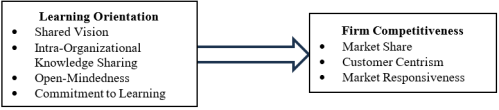
Shared Vision | 6.408 | 0.698 | 0.109 |
Open-Mindedness | 6.499 | 0.628 | 0.097 |
Commitment to Learning | 6.436 | 0.658 | 0.102 |
Intra-Organizational Knowledge Sharing | 6.333 | 0.689 | 0.109 |
Learning Orientation | 6.419 | 0.668 | 0.104 |
Variable | Mean | Standard deviation | Variability |
|---|---|---|---|
Repeat purchases are closely monitored | 6.324 | .582 | .092 |
Client onboarding is embedded in institutional practices | 6.453 | .697 | .108 |
Customer needs are the primary organizational focus | 6.435 | .605 | .094 |
Responsiveness to customer needs is vital for outperforming competitors | 6.459 | .672 | .104 |
Customer-valued features are continuously integrated into products | 6.406 | .611 | .095 |
Environmental insights are used to develop user-friendly processes | 6.447 | .616 | .096 |
Innovative platforms are used to reach potential customers | 6.488 | .588 | .091 |
Technology is used to enhance company visibility | 6.547 | .635 | .097 |
Firm Competitiveness | 6.445 | .626 | .097 |
Model Summary | ||||||||
|---|---|---|---|---|---|---|---|---|
Model | R | R Square | Adjusted R Square | Std. Error of the Estimate | ||||
1 | .777a | .604 | .601 | .21237 | ||||
a. Predictor: (Constant), Learning Orientation | ||||||||
ANOVAa | ||||||||
Model | Sum of Squares | df | Mean Square | F | Sig. | |||
1 | Regression | 11.546 | 1 | 11.546 | 255.998 | .000b | ||
Residual | 7.577 | 168 | .045 | |||||
Total | 19.123 | 169 | ||||||
a. Dependent Variable: Firm Competitiveness | ||||||||
b. Predictor: (Constant), Learning Orientation | ||||||||
Coefficientsa | ||||||||
Model | Unstandardized Coefficients | Standardized Coefficients | t | Sig. | 95% CI | |||
β | Std. Error | Beta | ||||||
1 | (Constant) | 1.797 | .291 | 6.174 | .000 | 1.222 – 2.371 | ||
Learning Orientation | .726 | .045 | .777 | 16.000 | .000 | 0.636 – 0.815 | ||
a. Dependent Variable: Firm Competitiveness | ||||||||
ANOVA | Analysis of Variance |
CBK | Central Bank of Kenya |
KBA | Kenya Bankers Association |
| [1] | Ahmed, K., & Khan, R. (2016). Disclosure Practices and Governance Quality: Evidence from Micro Finance Institutions. Journal of Accounting and Organizational Change, 12(3): 325-350. |
| [2] | Ahuja, G. & Katila, R. (2004). Where Do Resources Come from? The Role of Idiosyncratic Situations. Strategic Management Journal, 25: 887-907. |
| [3] | Ali, A. E. E. (2015). The Regulatory and Supervision Framework of Microfinance in Kenya. International Journal of Social Science Studies, 3(5): 1-8. |
| [4] | Association of Microfinance Institutions Kenya. (2024). State of Microfinance Industry Report 2024. Nairobi, Kenya: Association of Microfinance Institutions Kenya. |
| [5] | Baker, W. E., Mukherjee, D. & Perin, M. G. (2022). Learning Orientation and Competitive Advantage: A Critical Synthesis and Future Directions. Journal of Business Research, 144: 863-873. |
| [6] | Barney J. B. & Clark, D. N. (2007). Resource-Based Theory: Creating and Sustaining Competitive Advantage, Oxford University Press, Oxford: United Kingdom. |
| [7] | Barney, J. B., (1991). Firm Resources and Sustained Competitive Advantage. Journal of Management, 15: 175-190. |
| [8] | Bontis, N., Crossan, M., & Hulland, J. (2002). Managing an Organizational Learning System by Aligning Stocks and Flows. Journal of Management Studies, 39(4): 437-469. |
| [9] | Calantone, R., Cavusgil, S. T. & Zhao, Y. (2002). Learning Orientation, Firm Innovation Capability, and Firm Performance. Industrial Marketing Management, 31(6): 515-524. |
| [10] | Central Bank of Kenya (2018). Bank Supervision Annual Report 2018. Central Bank of Kenya, Nairobi. |
| [11] | Central Bank of Kenya (2023). Bank Supervision Annual Report 2023. Central Bank of Kenya, Nairobi. |
| [12] | Central Bank of Kenya (2024). Bank Supervision Annual Report 2023. Central Bank of Kenya, Nairobi. |
| [13] | Chigara, H. (2021). Resource Based View and Competitiveness: An Empirical Study of the Algerian SME. International Journal of Economic Performance, 4(1): 431 - 443. |
| [14] | Cooper, D. R. & Schindler, P. S. (2011). Business Research Methods. McGraw -Hill: New York, United State of America. |
| [15] | Creswell, J. W. (2009). Research Design: Qualitative, Quantitative and Mixed Methods Approach (3rd ed.). Sage Publications: Thousand Oaks, CA, United State of America. |
| [16] | Creswell, J. W. (2014). Research Design: Qualitative, Quantitative and Mixed Method Approaches (4th Ed.). SAGE Publications, Inc.: Los Angeles, United State of America. |
| [17] | D’Angelo, A., & Presutti, M. (2019). SMEs international growth: The Moderating Role of Experience on Entrepreneurial and Learning Orientations. International Business Review, 28(3): 613-624. |
| [18] | Deena, B., Jenny, M. & Sharon, D. (2011). Promoting Innovation in Microfinance: The Role of Associations. Citi Foundation. Washington, DC; United States of America. |
| [19] | Dehning B., Stratopoulos T. (2003). Determinants of A Sustainable Competitive Advantage Due to an IT-Enabled Strategy. Journal of Strategic Information Systems, 12(1): 7-28. |
| [20] | Demirgüç-Kunt, A., Klapper, L. & Singer. D. (2017). Financial Inclusion and Inclusive Growth: A Review of Recent Empirical Evidence. Policy Research Working Paper 8040, World Bank, Washington, DC., United State of America. |
| [21] | Dresch, A., Collatto, D. C. & Lacerda, D. P. (2018). Theoretical Understanding between Competitiveness and Productivity: Firm Level. Ingeniería y Competitividad, 20(2): 1-20. |
| [22] | Eisenhardt, K. M. & Martin, J. A. (2000). Dynamic Capabilities: what are They? Strategic Management Journal, 21(10-11): 1105-1121. |
| [23] | Etzensperger, C. (2013). Microfinance market outlook 2014: No ‘Sudden Stop’: Demand for microfinance soars. Zurich: Response Ability Investment AG. |
| [24] | Galvin, P., Rice, J. & Liao, T. S. (2014). Applying a Darwinian Model to the Dynamic Capabilities View: Insights and Issues. Journal of Management & Organization, 20(2): 250-263. |
| [25] | Gay, L. R., Mills, G. E., & Airasian, P. W. (2012). Educational Research: Competencies for Analysis and Applications (10th ed.). Pearson: Boston, MA, United State of America. |
| [26] | Gomez, R. & Santor, E. (2008). Does the Microfinance Lending Model Actually Work? Canadian Journal of Economics, 34(4): 943 - 966. |
| [27] | Hair, J. F., Black, W. C., Babin, B. J., & Anderson, R. E. (2019). Multivariate Data Analysis (8th ed.). Cengage: Boston, Massachusetts, United State of America. |
| [28] | Helfat, C. E., Finkelstein, S., Mitchell, W., Peteraf, M., Singh, H., Teece, D. & Winter, S. G. (2007). Dynamic Capabilities: Understanding Strategic Change in Organizations. Blackwell Publishing: Massachusetts, United States of America. |
| [29] | Helfat, C. E., & Peteraf, M. A. (2009). Understanding Dynamic Capabilities: Progress Along a Developmental Path. Strategic Organization, 7(1): 91-102. |
| [30] | Helfat, C. E., & Winter, S. G. (2011). Untangling Dynamic and Operational Capabilities: Strategy for The (N)Ever-Changing World. Strategic Management Journal, 32(11): 1243-1250. |
| [31] | Hsu, I, & Cheng, Y. (2008). A Model of Intra-Organizational Knowledge Sharing - Development and Initial Test. Journal of Global Information Management, 16(3): 45-73. |
| [32] | Hu, W. & Wall, G. (2005). Environmental Management, Environmental Image and the Competitive Tourist Attraction. J Sustain Tour, 13(6): 617-35. |
| [33] | Icíar, G., María, Á. F. & María, J. M. (2020). Microfinance Institutions Fostering Sustainable Development by Region. Sustainability, MDPI. |
| [34] | Inkumsah, W. A., Abdul-Hamid, I. K., & Angenu, B. B. (2021). The effect of Learning Orientation on Innovative Service Development and Insurance Firm Performance. Academy of Marketing Studies Journal, 25(2), 1-12. |
| [35] | Kela-Kahingo, C. M., Kinyua, G. M. & Muchemi, A. (2024). Strategic Flexibility as a Predictor of Organisation Performance in Commercial Banks in Kenya: The Mediating Role of Organisational Competences. International Journal of Education and Research, 12(10). 153-174. |
| [36] | Kenya Bankers Association. (2024). Banking Industry Performance Report 2024. Nairobi, Kenya: Kenya Bankers Association. |
| [37] | Kenya Financial Sector Regulators (2023). Kenya Financial Sector Stability Report. Financial Sector Regulators, Issue No. 14, Nairobi, Kenya. |
| [38] | Kinyua, G. M. (2015). Relationship between Knowledge Management and Performance of Commercial Banks in Kenya. PhD Thesis, Kenyatta University, Nairobi Kenya. |
| [39] | Kinyua, M. N. & Kinyua, G. M. (2023). Understanding Firm Performance in Microfinance Banks: Does Adaptive Capability Matter? The International Journal of Humanities & Social Studies, 11(10): 78 – 93. |
| [40] | Kor, Y. Y., Mahoney, J. T., Siemsen, E. & Tan, D. (2016). Penrose’s the Theory of the Growth of the Firm: An Exemplar of Engaged Scholarship. Production and Operations Management Society, 25(10): 1727-1744. |
| [41] | Koskey, J. K., Awino, Z. B., K’obonyo, P. & Iraki, X. N. (2023). Learning Orientation and Competitive Advantage: The case of Insurance Firms in Kenya. DBA Africa Management Review, 13(3), 1-9. |
| [42] | Legeny, J. K. & Kinyua, G. M. (2023). Understanding Firm Competitiveness in Non-Life Insurance Companies: Does Information Technology Flexibility Matter? International Journal of Managerial Studies and Research, 11(11): 1-21. |
| [43] | Madhani, P. N. (2010). Resource Based View (RBV) of Competitive Advantage an Overview. The Icfai University Press: India. |
| [44] | Magut, C. K. & Kinyua, G. M. (2022). Learning Orientation as an Antecedent of Service Delivery: A Review of Literature. International Journal of Managerial Studies and Research, 10(5): 22-40. |
| [45] | Marczyk, G., Dematteo, D. & Festinger, D. (2010). Essentials of Research Design and Methodology (Vol. 2). John Willey & Sons, Inc.: New Jersey, United State of America. |
| [46] | Martinez, J. E. V., Serna, M. M. & Montoya, N. P. (2020). Dimensions of Learning Orientation and Its Impact on Organizational Performance and Competitiveness in SMEs. Journal of Business Economics and Management, 21(2): 395-420. |
| [47] | Sirmon, D. G., Hitt, M. A., & Ireland, R. D. (2007). Managing Firm Resources in Dynamic Environments to Create Value: Looking Inside the Black Box. Academy of Management Review, 32(1), 273-292. |
| [48] | Mavondo, F. T., Chimhanzi, J., & Stewart, J. (2005). Learning orientation and Market orientation. European Journal of Marketing, 1235-1263. |
| [49] | Mazur, K. (2013). Isolating Mechanisms as Sustainability Factors of Resource-Based Competitive Advantage. Management, 17(2): 38-53. |
| [50] | Mintzberg, H. (1990) Strategy Formation: Schools of Thought. In: Frederickson, J., Ed., Perspectives on Strategic Management, Harper Business, New York, 105-237. |
| [51] | Nasution, H. N., F. T. Mavondo, T. M. Felix, J. M. Margaret, and O. N. Nelson, 2011. Entrepreneurship: Its Relationship with Market Orientation and Learning Orientation and As Antecedents to Innovation and Customer Value, Industrial Marketing Management, 40 (3): 336-345. |
| [52] | Nayernia, H. (2025). Dynamic Capabilities Theory: A review. In S. Papagiannidis (Ed), TheoryHub Book. Available at |
| [53] | Nisa, C. & Chalid, D. A. (2022). Impact Of Competition on Microfinance Institutions: Bibliometric Analysis and Systematic Literature Review. Heliyon, 8: 1-14. |
| [54] | Nnko, E., & John, E. (2022). The influence of learning orientation on performance of micro and small agro-processing enterprises in Tanzania. International Journal of Scientific Research and Management, 10(9), 3861-3874. |
| [55] | Nzomo, J. K., Kinyua, G. M. & Mwasiaji, E. T. (2023). Green Innovation Strategy as Antecedent of Performance Sustainability Among ISO 14001 Certified Manufacturing Firms in Kenya: Does Competitive Advantage Play a Mediating Role? International Journal of Education and Research, 11(8): 93-108. |
| [56] | Mogaka, D. M., Kinyua, G. & Kimencu, L. (2025). Does Regulatory Framework Moderate the Nexus Between Inter-Firm Networks and Firm Performance? Empirical Evidence from Pharmaceutical Manufacturing Firms in Nairobi City County, Kenya. International Journal of Economics, Commerce and Management, 13(8): 41-71. |
| [57] | Ocharo, M. O. & Kinyua, G. M. (2021). Responsive Capability as a Determinant of Firm Competitiveness amongst Small Medium Enterprises in Starehe Sub-County in Kenya. International Journal of Managerial Studies and Research, 9(9): 1-12. |
| [58] | Obonyo, M. O., Kinyua, G. M. & Muchemi, A. W. (2026). Knowledge Management Infrastructure Capability as an Institutional Lever for Organizational Performance: An Empirical Examination of the Mediating Role of Organizational Agility. International Journal of Humanities Social Sciences and Education, 13(3): 105-123. |
| [59] | Owino, O. J. & Kibera, F. (2019). Organizational Culture and Performance: Evidence from Microfinance Institutions in Kenya. SAGE Open. |
| [60] | Park, Y., Konge, L., & Artino, A. R. (2020). The Positivism Paradigm of Research. Academic Medicine - Journal of the Association of American Medical Colleges, 95 (5): 690 - 694. |
| [61] | Penrose, E. (1959). The Theory of the Growth of the Firm. Basil Blackwell: London, United Kingdom. |
| [62] | Raga, S. & Tyson, J. (2021). Sub-Saharan Africa’s Interbank Markets: Progress, Barriers and Policy Implications. Synthesis Report. Development and Economic Growth research Programme (DEGrP). |
| [63] | Riikkinen, R., Kauppi K., Salmi A. (2017). Learning Sustainability? Absorptive Capacities as Drivers of Sustainability in MNCs’ Purchasing. Int. Bus. Rev. 26: 1075-1087. |
| [64] | Rumelt R. (1984). Toward A Strategic Theory of the Firm. In R. Lamb (ed.), Competitive Strategic Management, pp. 556-570. Prentice Hall: Englewood Cliffs, United State of America. |
| [65] | Saunila M. (2020). Innovation Capability in SMEs: A Systematic Review of the Literature. J. Innov. Knowl. 5: 260-265. |
| [66] | Sekaran, U., & Bougie, R. (2016). Research Methods for Business: A Skill-Building Approach (7th ed.). John Wiley & Sons: Hoboken, New Jersey, United State of America. |
| [67] | Sinkula, J. M., Baker, W. E. & Noordewier, T. (1997). A Framework for Market-Based Organizational Learning: Linking Values, Knowledge and Behavior. Journal of the Academy of Marketing Science, 25(4): 305-318. |
| [68] | Sitinjak, M. T. M., Ngatno & Sari, L. (2023). Learning Orientation as Fundamental Platform to Achieve Competitive Advantage: An Integrative Review and Framework. Journal of Economics, Finance and Management Studies, 6(5): 2028-2034. |
| [69] | Sudharatna, Y. & Li, L. (2004). Learning Organization Characteristics Contributed to Its Readiness to Change: A Study of the Thai Mobile Phone Service Industry. Managing Global Transitions, 2 (2): 163-178. |
| [70] | Teece, D. J. (1982). Towards an Economic Theory of the Multiproduct Firm. Journal of Economic Behavior and Organization, 3: 39-63. |
| [71] | Teece, D. & Pisano, G. (1994). The Dynamic Capabilities of Firms: An Introduction. Industrial and Corporate Change, 3 (3): 537-556. |
| [72] | Teece, D. J., Pisano, G. & Shuen, A. (1997). Dynamic Capabilities and Strategic Management. Strategic Management Journal, 18(7): 509-53. |
| [73] | Teece, D. J. (2007). Explicating Dynamic Capabilities: The Nature and Micro-Foundations of (Sustainable) Enterprise Performance, Strategic Management Journal, 28(13): 1319-1350. |
| [74] | Teece, D. J. (2010). Technological Innovation and The Theory of the Firm: The Role of Enterprise-Level Knowledge, Complementarities, and (Dynamic) Capabilities. In B. H. Hall & N. Rosenberg (Eds.), Handbook of the Economics of Innovation. Elsevier: Amsterdam, Netherlands. |
| [75] | Teece, D. J. (2014). The foundations of Enterprise Performance: Dynamic and Ordinary Capabilities in an (Economic) Theory of Firms. Academy of Management Perspectives, 28(4): 328 352. |
| [76] | United Nation (2013). Microfinance in Africa: Overview and Suggestions for Action by Stakeholders. New York City: United State of America. |
| [77] | Vij, S., & Farooq, R. (2015). The Relationship between Learning Orientation and Business Performance: Do Smaller Firms Gain More from Learning Orientation. IUP Journal of Knowledge Management, 13(4). |
| [78] | Wernerfelt, B. (1984). A Resource-Based View of the Firm. Strategic Management Journal, 5 (2): 171-180. |
| [79] | Winston, A. I., Ibn, K. A. & Benjamin, B. A. (2021). The Effect of Learning Orientation on Innovative Service Development and Insurance Firm Performance. Academy of Marketing Studies Journal, 25(2): 1-12. |
| [80] | Winter, S. G. (2003). Understanding Dynamic Capabilities. Strategic Management Journal, 24(10): 991-995. |
| [81] | Wondirad, H. A. (2020). Competition and Microfinance Institutions’ Performance: Evidence from India. International Journal of Corporate Social Responsibility, 5(6): 1-19. |
| [82] | World Bank. (2019). Financial Inclusion: Europe and Central Asia Economic Update. Washington, DC: United State of America. |
| [83] | Yang, Y., Zheng, Y., Xie, G. & Tian, Y. (2022). The Influence Mechanism of Learning Orientation on New Venture Performance: The Chain-Mediating Effect of Absorptive Capacity and Innovation Capacity. Frontiers in Psychology, 13: 1-10. |
| [84] | Yaz-Fanfar, D. (2013). Profitability Determinants Among Micro Firms: Evidence from Swedish Data. International Journal of Managerial, 9(2): 150-160. |
| [85] | Zhou, K. Z. and Li, C. B. (2010) How Strategic Orientations Influence the Building of Dynamic Capability in Emerging Economies. Journal of Business Research, 63, 224-231. |
| [86] | Zollo, M., & Winter, S. G. (2002). Deliberate Learning and the Evolution of Dynamic Capabilities. Organization Science, 13(3), 339-351. |
APA Style
Kamandi, F. G., Kinyua, G. M., Kinyuru, R. N. (2026). Driving Competitiveness of Microfinance Banks Through Learning Orientation. Journal of Business and Economic Development, 11(4), 172-185. https://doi.org/10.11648/j.jbed.20261104.12
ACS Style
Kamandi, F. G.; Kinyua, G. M.; Kinyuru, R. N. Driving Competitiveness of Microfinance Banks Through Learning Orientation. J. Bus. Econ. Dev. 2026, 11(4), 172-185. doi: 10.11648/j.jbed.20261104.12
@article{10.11648/j.jbed.20261104.12,
  author = {Faith Gacheri Kamandi and Godfrey Muigai Kinyua and Reuben Njuguna Kinyuru},
  title = {Driving Competitiveness of Microfinance Banks Through Learning Orientation},
  journal = {Journal of Business and Economic Development},
  volume = {11},
  number = {4},
  pages = {172-185},
  doi = {10.11648/j.jbed.20261104.12},
  url = {https://doi.org/10.11648/j.jbed.20261104.12},
  eprint = {https://article.sciencepublishinggroup.com/pdf/10.11648.j.jbed.20261104.12},
  abstract = {Microfinance banking industry is critical cog in the economic wheel as it contributes to the Gross Domestic Product, generation of employment and enhancement of socio-economic status in its pursuit for financial inclusivity for the segment of the Kenyan adult population that has been ignored by the conventional banking products and services. However, the over-reliance of microfinance banks on traditional product design and service delivery models with glaring absence of customized solutions and overdependence on conventional financing methods has greatly eroded their competitiveness. Thus, this study investigated the effect of learning orientation on competitiveness of Microfinance banks in Kenya. The study was underpinned on dynamic capabilities theory and resource-based view. Positivism research paradigm and explanatory research design were adopted as the overarching research strategy. The units of analysis and observation were microfinance banks and management personnel respectively, with a population of 616 management staff. Proportionate stratified and simple random sampling techniques was used for choosing the study sample of 243 management staff from which data was obtained using a structured questionnaire. A pilot study was performed on randomly chosen 25 management assistants or their equivalent. Linear regression was applied as the empirical model, whereby the decision rule for statistical inferences was based on a confidence level of ninety-five percent. Underlying assumptions of linear regression were evaluated. Data was subjected to descriptive analysis based on frequency count, measures of central tendency and measures of spread. Causal inference was analysed using simple linear regression at 95 percent confidence interval. The results thereof were presented in graphical form or tabulated. Learning orientation was determined to have a positive effect on firm competitiveness. The Head of Human Capital should review and strengthen the existing institutional learning and development framework to promote employees’ participation in identifying skills gaps. The Head of Operations should formulate clear institutional guidelines for sharing work-related experiences, facilitating information flow, capturing knowledge generated through stakeholder interactions, and establishing mechanisms for translating the know-how of high-performing employees into accessible and transferable formats.},
 year = {2026}
}
TY  - JOUR
T1  - Driving Competitiveness of Microfinance Banks Through Learning Orientation
AU  - Faith Gacheri Kamandi
AU  - Godfrey Muigai Kinyua
AU  - Reuben Njuguna Kinyuru
Y1  - 2026/10/31
PY  - 2026
N1  - https://doi.org/10.11648/j.jbed.20261104.12
DO  - 10.11648/j.jbed.20261104.12
T2  - Journal of Business and Economic Development
JF  - Journal of Business and Economic Development
JO  - Journal of Business and Economic Development
SP  - 172
EP  - 185
PB  - Science Publishing Group
SN  - 2637-3874
UR  - https://doi.org/10.11648/j.jbed.20261104.12
AB  - Microfinance banking industry is critical cog in the economic wheel as it contributes to the Gross Domestic Product, generation of employment and enhancement of socio-economic status in its pursuit for financial inclusivity for the segment of the Kenyan adult population that has been ignored by the conventional banking products and services. However, the over-reliance of microfinance banks on traditional product design and service delivery models with glaring absence of customized solutions and overdependence on conventional financing methods has greatly eroded their competitiveness. Thus, this study investigated the effect of learning orientation on competitiveness of Microfinance banks in Kenya. The study was underpinned on dynamic capabilities theory and resource-based view. Positivism research paradigm and explanatory research design were adopted as the overarching research strategy. The units of analysis and observation were microfinance banks and management personnel respectively, with a population of 616 management staff. Proportionate stratified and simple random sampling techniques was used for choosing the study sample of 243 management staff from which data was obtained using a structured questionnaire. A pilot study was performed on randomly chosen 25 management assistants or their equivalent. Linear regression was applied as the empirical model, whereby the decision rule for statistical inferences was based on a confidence level of ninety-five percent. Underlying assumptions of linear regression were evaluated. Data was subjected to descriptive analysis based on frequency count, measures of central tendency and measures of spread. Causal inference was analysed using simple linear regression at 95 percent confidence interval. The results thereof were presented in graphical form or tabulated. Learning orientation was determined to have a positive effect on firm competitiveness. The Head of Human Capital should review and strengthen the existing institutional learning and development framework to promote employees’ participation in identifying skills gaps. The Head of Operations should formulate clear institutional guidelines for sharing work-related experiences, facilitating information flow, capturing knowledge generated through stakeholder interactions, and establishing mechanisms for translating the know-how of high-performing employees into accessible and transferable formats.
VL  - 11
IS  - 4
ER  -
School of Business, Economics and Tourism, Kenyatta University, Nairobi, Kenya
School of Business, Economics and Tourism, Kenyatta University, Nairobi, Kenya
School of Business, Economics and Tourism, Kenyatta University, Nairobi, Kenya

Information



 Share This Article
 Twitter
 Linked In
 Facebook

 Copy
 Download