Abstract
Malaria remains a major public health challenge in southwestern Ethiopia, disproportionately affecting vulnerable populations. This community-based cross-sectional study assessed the coverage and utilization of insecticide-treated nets (ITNs) among high-risk groups, specifically pregnant women and children under five years of age, in Mettu Woreda, South West Ethiopia. A multi-stage sampling technique was employed to select 422 households with high-risk individuals. Data were collected using a pre-tested structured questionnaire and observational checklists, and analyzed using descriptive and logistic regression methods. The findings revealed that while household ITN ownership (coverage) was relatively high at 82.4%, the actual utilization rate among the high-risk individuals during the night preceding the survey was significantly lower at 58.7%. Predictors significantly associated with ITN utilization included health education exposure (AOR = 2.4, 95% CI: 1.5–3.8), primary education level of the household head (AOR = 1.9, 95% CI: 1.1–3.3), and family size of less than five members (AOR = 2.1, 95% CI: 1.3–3.5). The study concludes that a substantial gap exists between ITN ownership and actual utilization among high-risk groups in the study area. To maximize the impact of malaria control programs, local health sectors should shift focus from mere distribution to intensive behavioral change communication (BCC) strategies targeting consistent net usage.
|
Published in
|
Journal of Family Medicine and Health Care (Volume 12, Issue 1)
|
|
DOI
|
10.11648/j.jfmhc.20261201.12
|
|
Page(s)
|
14-26 |
|
Creative Commons
|

This is an Open Access article, distributed under the terms of the Creative Commons Attribution 4.0 International License (http://creativecommons.org/licenses/by/4.0/), which permits unrestricted use, distribution and reproduction in any medium or format, provided the original work is properly cited.
|
|
Copyright
|
Copyright © The Author(s), 2026. Published by Science Publishing Group
|
Keywords
Insecticide-treated Nets, Malaria Prevention, Utilization, Ownership, High-Risk Groups, Ethiopia
1. Introduction
Malaria remains one of the most significant parasitic infections in the world, responsible for more than one million deaths annually, with a child dying every 30 seconds from the disease. Over 90% of the global malaria burden occurs in sub-Saharan Africa, where approximately 0.5 billion clinical cases and 2–3 million severe cases are reported each year
. In endemic regions, malaria infection during pregnancy contributes to nearly a quarter of severe maternal anemia and 10–20% of low birth weight cases
. Pregnant women in areas of unstable transmission have little acquired immunity, making them highly susceptible to severe complications, including miscarriage, stillbirth, and maternal death
.
In Ethiopia, malaria transmission is unstable and seasonal, affecting an estimated 51 million people—about 68% of the population—living in areas below 2,000 meters above sea level
.Plasmodium falciparum and Plasmodium vivax are the predominant species, transmitted mainly by Anopheles arabiensis, which breeds in small sunlit pools formed during the rainy season
| [8] | World Health Organization. The Community-Based Malaria Control Program in Tigray, Northern Ethiopia: A Review of Program Setup, Activities, Outcomes and Impact. Geneva: WHO; 1999. WHO/CDS/RBM/99.13.
https://apps.who.int/iris/handle/10665/66185 |
| [9] | Federal Ministry of Health (FMOH), UNICEF. Guide for Program Managers on the Use of Insecticide-Treated Nets in Ethiopia. Addis Ababa: FMOH/UNICEF; 2002. |
| [10] | NetMark. Baseline Survey on Insecticide-Treated Materials (ITMs) in Uganda. Washington, DC: Academy for Educational Development (AED); 2001.
https://pdf.usaid.gov/pdf_docs/PNACN471.pdf |
[8-10]
. Annually, 4–5 million malaria cases are reported, and the disease remains a leading cause of outpatient visits, hospital admissions, and deaths
. Epidemics frequently occur following heavy rains or ecological changes linked to agricultural expansion and population movement
.
Insecticide-treated nets (ITNs) have been proven to reduce malaria transmission and child mortality by 14–33% in endemic regions
| [13] | Adongo PB, Kirkwood B, Kendall C. How local community knowledge about malaria affects insecticide-treated net use in northern Ghana. Tropical Medicine & International Health. 2005; 10(4): 366-378.
https://doi.org/10.1111/j.1365-3156.2005.01396.x |
[13]
. Long-lasting insecticidal nets (LLINs) offer a sustainable solution as they remain effective for up to five years without retreatment
. Despite large-scale ITN distribution by initiatives such as Roll Back Malaria, UNICEF, and WHO
| [19] | Manga L, et al. Mass mosquito net Impregnation Campaign: An effective way to increase net re-impregnation rates. Communicable Diseases Bulletin for the Africa Region. 2004; 2(1): 120-125. https://doi.org/10.4314/ecam.v2i1.12 |
[19]
, ownership and consistent use remain low. National surveys have shown that fewer than 10% of children under five and pregnant women in endemic areas regularly sleep under ITNs
. Barriers to use include heat discomfort, limited awareness, perceived absence of mosquitoes, and cost or unavailability of nets
.
The Mettu woreda, located in Oromia regional state south west, Ethiopia, experiences intense malaria transmission between September and December but for the last three years, the woreda has experienced a dry season throughout the whole year, from September to August, unlike previous records.. The district hosts large populations of migrant and seasonal agricultural workers who are highly vulnerable to malaria infection. Understanding the extent of ITN ownership, utilization, and associated factors in such high-risk settings is essential to evaluate current malaria control efforts and to inform strategies aimed at achieving national malaria elimination goals.
Therefore, this study assessed the coverage and utilization of ITNs among high-risk groups in Mettu woreda, with emphasis on identifying determinants of effective use to support improved public health interventions and sustainable malaria prevention.
2. Materials and Methods
2.1. Study Area and Population
The study was conducted in Mettu Woreda, in the Ilu Ababor Zone, Oromia Regional State, south western Ethiopia. The district is located approximately 600 km southwest of Addis Ababa, the national capital. The administrative centre of the woreda is Mettu Town, which also serves as the zonal capital.
| [17] | Abdulla S, Armstrong Schellenberg JRM, Mukasa O, Lengeler C. Usefulness of a dispensary-based case-control study for assessing morbidity impact of a treated net program. International Journal of Epidemiology. 2002; 31(1): 175-180.
https://doi.org/10.1093/ije/31.1.175 |
| [18] | Korenromp EL, Miller J, Erickson RE, Cattani JA, Lines J, Steketee RW. Monitoring mosquito net coverage for malaria control in Africa: possession vs. use by children under 5 years. Tropical Medicine & International Health. 2003; 8(8): 693-703. https://doi.org/10.1046/j.1365-3156.2003.01085.x |
| [19] | Manga L, et al. Mass mosquito net Impregnation Campaign: An effective way to increase net re-impregnation rates. Communicable Diseases Bulletin for the Africa Region. 2004; 2(1): 120-125. https://doi.org/10.4314/ecam.v2i1.12 |
[17-19]
Mettu Woreda lies at an altitude ranging around 1,600–1,700 meters above sea level.
| [18] | Korenromp EL, Miller J, Erickson RE, Cattani JA, Lines J, Steketee RW. Monitoring mosquito net coverage for malaria control in Africa: possession vs. use by children under 5 years. Tropical Medicine & International Health. 2003; 8(8): 693-703. https://doi.org/10.1046/j.1365-3156.2003.01085.x |
| [19] | Manga L, et al. Mass mosquito net Impregnation Campaign: An effective way to increase net re-impregnation rates. Communicable Diseases Bulletin for the Africa Region. 2004; 2(1): 120-125. https://doi.org/10.4314/ecam.v2i1.12 |
[18, 19]
The climate is temperate to sub-tropical (sub-Dega to Woyna Dega), with a bimodal rainfall pattern: a long rainy season from around April to October, followed by a dry season. Average annual rainfall is approximately 1,850 mm, and average temperature ranges between 16°C and 22°C.
| [17] | Abdulla S, Armstrong Schellenberg JRM, Mukasa O, Lengeler C. Usefulness of a dispensary-based case-control study for assessing morbidity impact of a treated net program. International Journal of Epidemiology. 2002; 31(1): 175-180.
https://doi.org/10.1093/ije/31.1.175 |
[17]
The woreda covers an area of about 68,723 hectares. There are 29 kebeles (smallest administrative units) in the woreda. The population is estimated at ~91,049 people, involving both male and female residents.
| [17] | Abdulla S, Armstrong Schellenberg JRM, Mukasa O, Lengeler C. Usefulness of a dispensary-based case-control study for assessing morbidity impact of a treated net program. International Journal of Epidemiology. 2002; 31(1): 175-180.
https://doi.org/10.1093/ije/31.1.175 |
[17]
Agriculture is the predominant livelihood: mixed farming combining crop cultivation and livestock rearing is practiced widely. Major food crops include maize, sorghum, teff, barley, wheat, and beans. Cash crops, particularly coffee and root vegetables, are important in the local economy.
| [17] | Abdulla S, Armstrong Schellenberg JRM, Mukasa O, Lengeler C. Usefulness of a dispensary-based case-control study for assessing morbidity impact of a treated net program. International Journal of Epidemiology. 2002; 31(1): 175-180.
https://doi.org/10.1093/ije/31.1.175 |
[17]
Water bodies in the district include tributaries of the Sor River, including the Konori, Sori, Duqur, and Kabar rivers. Soil types are varied, with dominant types being silt, clay, and nitosols.
2.2. Source Population
Thesource population encompassed the entire matrix of domestic households maintaining permanent residency status within Mettu Woreda that contained at least one pregnant woman, a pediatric cohort under five years of age, or both demographics. Eligibility within this baseline population was established completely independent of the household's baseline insecticide-treated net (ITN) ownership or procurement status.
2.3. Study Population
Quantitative Study
The study population for the quantitative component consisted of randomly selected households with pregnant women and/or children under five years of age residing in Mettu woreda during the study period.
Qualitative Study
For the qualitative component, heads of households with at least one child under five years of age and/or pregnant women participated in focus group discussions (FGDs) to provide insights that complemented the quantitative findings.
Inclusion Criteria:
Domestic units were considered eligible for enrollment if they housed at least one vulnerable individual, specifically defined as a pediatric cohort under five years of age, a pregnant woman, or both demographics simultaneously.
Exclusion Criteria:
Conversely, households consisting of transient populations, seasonal migrant laborers, or temporary residents were systematically excluded from the study framework, regardless of the presence of pregnant women or children under five, due to their lack of permanent residential status within the specified administrative boundaries of the district.
2.4. Study Design
A comparative cross-sectional study design was employed for the quantitative component. Data were collected using interviewer-administered questionnaires to assess ITN coverage and observation checklists during early morning surveys to evaluate the condition and utilization of ITNs.
In addition, a qualitative study was conducted using focus group discussions with selected community members to explore perceptions, experiences, and factors influencing ITN ownership and utilization, thereby enriching and supporting the quantitative findings.
2.5. Sample Size Determination
The sample size (n) was determined based on the difference between two population proportions, using the following assumptions:
According to the NetMark study conducted in five sites in Ethiopia, 40% of urban households owned at least one mosquito net, while 30% of rural households were expected to own at least one
. The sample size was calculated using a 95% confidence level (Zα/2), 80% power, and an equal allocation ratio (r = 1) between urban and rural populations. A 10% contingency was added to account for potential non-response. Accordingly, the required sample size was calculated as follows:
2.6. Study Design
A comparative cross-sectional study design was employed for the quantitative component. Data were collected using interviewer-administered questionnaires to assess ITN coverage and observation checklists during early morning surveys to evaluate the condition and utilization of ITNs.
In addition, a qualitative study was conducted using focus group discussions with selected community members to explore perceptions, experiences, and factors influencing ITN ownership and utilization, thereby enriching and supporting the quantitative findings.
2.7. Sample Size Determination
The sample size (n) was determined based on the difference between two population proportions, using the following assumptions:
According to the NetMark study conducted in five sites in Ethiopia, 40% of urban households owned at least one mosquito net, while 30% of rural households were expected to own at least one
. The sample size was calculated using a 95% confidence level (Zα/2), 80% power, and an equal allocation ratio (r = 1) between urban and rural populations. A 10% contingency was added to account for potential non-response. Accordingly, the required sample size was calculated as follows:
Where:
Z1-á/2=1.96
P=0.35
Z1-ß= 0.84
P1= Net ownership in urban areas 40%
P2= Net ownership in rural areas assumed to be 30%
r = urban to rural allocation which is 1
Non-response rate 10%
n1=414
n2=414
2.8. Sampling Procedure
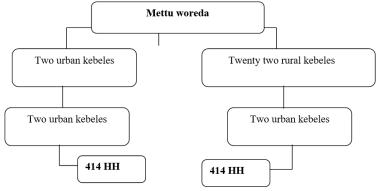
To select the study subjects, a multi-stage approach was implemented. Initially, a household census register, which had been documented by the Woreda Health Office for mass polio campaigns and routine EPI vaccinations, was obtained for every single kebele. From this sampling frame, a simple lottery technique was used to select a total of seven kebeles, specifically consisting of two urban and five rural localities. The designated sampling frame for the final selection comprised a comprehensive directory of households that contained at least one pregnant woman, a child under the age of five, or both, irrespective of their baseline ITN ownership status. The total required sample size was then allocated across the chosen urban and rural kebeles using a probability proportional to size method based on household volume. Ultimately, the actual study households within each kebele were chosen via systematic random sampling to ensure an objective distribution.
Figure 1. Multi-stage sampling flow chart demonstrating the selection process of study households from urban and rural kebeles in Mettu Woreda.
2.7. Data Collection
Quantitative Study
A standardized and structured questionnaire was developed based on previously published studies and adapted to the local context with minor modifications (10). The questionnaire was initially prepared in English, translated into Afaan Oromo, and then back-translated into English to ensure consistency. Interviews were conducted in Afaan Oromo.
Field data were collected by ten trained health workers, including a Sanitarian, several nurses, and two supervisors. The principal investigator conducted a two-day training session for data collectors, which covered the study objectives and included a practical rehearsal of the early morning insecticide-treated nets (ITNs) observation survey.
The questionnaire captured information on socio-demographic characteristics, knowledge and attitudes about malaria, mosquito net possession, utilization, re-impregnation practices, and included an early morning observation checklist. A pre-test was conducted in Mettu city administration, one of the with similar characteristics. Necessary adjustments were made based on pre-test findings, and the final questionnaire was adopted accordingly.
Data collection involved two stages. First, households were visited early in the morning (between 5: 00–6: 00 AM) to observe actual ITN use. Later the same day, the same households were revisited to complete the remaining parts of the questionnaire.
Qualitative Study
A qualitative assessment was conducted to gain deeper insights into perceptions, beliefs, and behaviors related to malaria and ITN use. Topics explored included the etiology and perceived severity of malaria, prevention methods, general beliefs regarding ITNs, and factors influencing their possession, consistent use, or non-use, as well as net re-treatment practices.
Focus Group Discussions (FGDs) were organized into four groups—two male and two female groups—each comprising 8 to 10 participants to ensure inclusivity and active participation. The principal investigator facilitated the discussions, supported by two supervisors who served as note-takers and participant recruiters. This arrangement minimized dominance by a few participants and reduced side conversations.
FGDs continued until information saturation was achieved, meaning no new themes or ideas emerged from subsequent discussions.
2.8. Data Quality Assurance
Data quality was ensured through daily checks by immediate supervisors, who reviewed completed questionnaires for completeness and consistency before submission to the principal investigator. Any incomplete or incorrectly filled questionnaires were returned to data collectors for correction.
The principal investigator conducted secondary reviews and supervised 5% of the surveyed households to confirm that all were visited twice and that morning visits occurred within the designated time.
2.9. Operational Definitions
1) Insecticide-Treated Net (ITN)
2) Untreated Net
3) Re-impregnation
4) Long-Lasting Insecticidal Net (LLIN)
5) Possession
6) Use
7) District (Woreda)
8) Sub-District or Kebele (Tabia)
9) Ketena (Kushet)
10) High-Risk Groups
2.10. Data Analysis
Quantitative data were entered, cleaned, and analyzed using EPI INFO version 6.02, and subsequently exported to SPSS version 11.0 for Windows for advanced statistical analysis. Ten percent of the data were re-entered to verify accuracy and consistency. Multiple logistic regression analyses were performed to identify associations and predictors of ITN use and related variables.
Qualitative data from FGDs were transcribed manually from audio recordings and analyzed through thematic content analysis by summarizing key ideas and recurring themes identified across discussions.
2.11. Ethical Declaration
Ethical clearance was obtained from the Department of Mettu University, faculty of public health and medical sciences. and official letter of co-operation was given and permissions were also secured from Mettu woreda Administration, and Mettu woreda Health Office. This research was conducted according to norm of Belmont Report ethics declaration.
Before each interview or observation, informed consent was obtained from respondents after explaining the purpose of the study. Participants were assured of confidentiality; no names or identifiable information were recorded, and all responses were kept anonymous. Data were reported only in aggregate form to maintain privacy.
Interviews and observations were conducted in a respectful and private manner by trained health professionals to foster trust and encourage honest participation. Participation was voluntary, and respondents were informed of their right to decline participation at any point without consequence.
When incorrect ITN use was observed, participants were provided with brief health education on proper use and maintenance. Any individuals found to be clinically ill during the survey were advised to seek care at the nearest health facility.
3. Results
3.1. Descriptive Findings
3.1.1. General Information
The survey on the assessment of ITN coverage for malaria control in Mettu woreda was conducted from 9 to 30 November 2024, during the peak malaria transmission season. Data collection methods included an early morning observational survey, structured household questionnaires, and focus group discussions.
Following administrative restructuring, Mettu woreda comprised two urban and eighteen rural kebeles. Based on census information from the woreda Health Office, 828 households were included in the study — 414 urban and 414 rural. All targeted households participated, resulting in a 100% response rate. Early morning observations preceded household interviews to assess actual ITN usage.
3.1.2. Socio-Demographic Characteristics
Among respondents, females accounted for 63.8% in rural and 69.3% in urban areas (
Table 1). Most households were male-headed (81.6% rural, 85.5% urban). The median age of household heads was 31 years in rural and 30 years in urban areas.
Illiteracy was higher in rural areas (56.1%) compared to urban (34.0%). The majority of respondents were married (81.6% overall). Farming was the dominant occupation in rural areas (74.6%), while urban respondents were more frequently merchants (24.6%) or government employees (18.6%).
The mean monthly income was ETB 427.77 ± 331.21 for rural and ETB 557.62 ± 515.03 for urban households. The average family size was 5.0 ± 1.97 persons, and the mean number of children under five was 1.3 ± 0.58 per household. The ratio of high-risk groups (children <5 years and pregnant women) to nets was 0.67: 1 in rural and 0.62: 1 in urban areas. Radio ownership was higher in urban (75.1%) than rural (52.4%) settings.
Table 1. Socio-Demographic Characteristics of Heads of Households, Mettu woreda south west Ethiopia 2024.
Variable | Rural n (%) | Urban n (%) | Total n (%) |
Sex of respondent | | | |
Male | 150 (36.2) | 127 (30.7) | 277 (33.5) |
Female | 264 (63.8) | 287 (69.3) | 551 (66.5) |
Sex of household head | | | |
Male | 338 (81.6) | 354 (85.5) | 692 (83.6) |
Female | 76 (18.4) | 60 (14.5) | 136 (16.4) |
Educational level | | | |
Illiterate | 232 (56.1) | 141 (34.0) | 373 (45.0) |
Literate | 182 (43.9) | 273 (66.0) | 455 (55.0) |
Occupation | | | |
Farmer | 309 (74.6) | 157 (37.9) | 466 (56.3) |
Merchant | 52 (12.6) | 102 (24.6) | 154 (18.6) |
Government employee | 19 (4.6) | 77 (18.6) | 96 (11.6) |
Others | 34 (8.2) | 78 (18.9) | 112 (13.5) |
Mean monthly income (ETB ± SD) | 427.77 ± 331.21 | 557.62 ± 515.03 | 492.5 ± 437.6 |
Family size (Mean ± SD) | 5.14 ± 1.9 | 4.87 ± 2.02 | 5.0 ± 1.97 |
Children under 5 (Mean ± SD) | 1.35 ± 0.62 | 1.23 ± 0.54 | 1.3 ± 0.58 |
Possession of radio | 217 (52.4) | 311 (75.1) | 528 (63.8) |
3.1.3. Knowledge and Practice About Malaria and Mosquitoes
Almost all respondents had heard of malaria (99.0% rural, 95.3% urban), and about 94% recognized mosquitoes as its vector (
Table 2). Fever was the most commonly cited symptom (91.8% rural, 87.4% urban). The majority of respondents reported using mosquito nets (82.1% rural, 93.5% urban) and participating in environmental sanitation activities.
Children under five years were recognized as the most affected group (86.7% rural, 76.6% urban). Most respondents (~89%) reported no malaria infection since sleeping under treated nets, and over 88% mentioned no disadvantages associated with ITN use.
Table 2. Knowledge and Practices Regarding Malaria and Mosquito Nets, Mettu woreda south west Ethiopia 2024.
Variable | Rural n (%) | Urban n (%) | Total n (%) |
Heard about malaria | 410 (99.0) | 407 (95.3) | 817 (98.7) |
Mosquito causes malaria | 390 (94.2) | 391 (94.4) | 781 (94.3) |
Identified fever as symptom | 380 (91.8) | 362 (87.4) | 742 (89.6) |
Use mosquito nets to prevent malaria | 340 (82.1) | 387 (93.5) | 727 (90.6) |
Heard malaria education messages | 359 (86.7) | 290 (70.1) | 649 (78.4) |
Children under five most affected | 359 (86.7) | 317 (76.6) | 676 (81.6) |
Pregnant women most affected | 177 (42.8) | 134 (32.4) | 311 (37.6) |
No disadvantage sleeping under net | 359 (86.7) | 377 (91.1) | 736 (88.9) |
3.1.4. Mosquito Net Possession
Overall, 90.3% of households owned at least one mosquito net (
Table 3). Ownership was higher in urban (96.1%) than rural (84.5%) areas. Similarly, ITN ownership was 91.1% in urban and 80.0% in rural settings.
Most households (70–79%) owned at least two nets. Conventional nets accounted for 76.3% of total nets, while 23.7% were LLINs. About 69% of nets were acquired within the last three years. Nearly half of rural nets (49.8%) were distributed free through public health programs, compared to only 7% in urban areas.
3.1.5. Mosquito Net Utilization
The proportion of children under five who slept under a net the previous night was 76.2%, while 57.3% of pregnant women did so. ITN use was slightly lower, 72.9% among children under five and 57.3% among pregnant women. Utilization was consistently higher in urban than rural settings.
Approximately 68.5% of nets were hung properly the previous night, and 71.7% of households reported tucking in their nets. The median bedtime for children under five and pregnant women was 8: 00 PM and 9: 00 PM, respectively.
3.1.6. Mosquito Net Treatment and Washing Patterns
Re-impregnation rates were very high (93.9% overall), with 94.1% in urban and 93.5% in rural areas. About 15.3% of households reported washing their nets at least once after treatment. The majority washed nets 1–4 times, primarily due to dirt (95.4% of respondents).
Table 3. Mosquito Net and ITN Possession, Utilization, and Re-impregnation Status, Mettu woreda south west Ethiopia 2024.
Variable | Rural n (%) | Urban n (%) | Total n (%) |
Households owning ≥1 net | 350 (84.5) | 398 (96.1) | 748 (90.3) |
Households owning ≥1 ITN | 331 (80.0) | 377 (91.1) | 708 (85.5) |
Nets re-treated | 514 (93.5) | 925 (94.1) | 1,439 (93.9) |
Children <5 using ITN | 375 (67.0) | 403 (79.5) | 778 (72.9) |
Pregnant women using ITN | 25 (52.1) | 22 (64.7) | 47 (57.3) |
LLINs owned | 419 (43.2) | 58 (5.6) | 477 (23.7) |
Free nets received | 483 (49.8) | 73 (7.0) | 556 (27.7) |
3.2. Focus Group Discussion
3.2.1. Perceptions of Malaria and Its Transmission
Most participants recognized malaria as a major public health concern in their community. They associated malaria transmission primarily with mosquito bites, particularly those occurring during nighttime. Some participants also mentioned environmental factors such as stagnant water and bushy surroundings as contributing to mosquito breeding and malaria spread. However, a few respondents still held misconceptions, attributing malaria to cold weather or consumption of unboiled water.
3.2.2. Knowledge and Use of Insecticide-Treated Nets
Awareness of ITNs as a preventive measure against malaria was high among both male and female participants. Many respondents reported that they had received mosquito nets during health campaigns or distributions organized by the local health office. However, actual utilization of the nets varied. Some participants admitted that they used the nets inconsistently, particularly during dry seasons when mosquito density was perceived to be low.
Women frequently emphasized the importance of using ITNs for protecting children and pregnant women, whom they recognized as being at higher risk. Nevertheless, certain barriers to consistent use were reported, including discomfort due to heat, improper hanging of nets, and perceptions that nets were only necessary during the rainy season.
3.2.3. Barriers to Consistent Use
Participants identified several practical and behavioral barriers to regular ITN use. These included:
1) Perceived heat and discomfort when sleeping under the net, especially during warm months.
2) Improper size or condition of nets, with some households reporting torn or old nets that were no longer effective.
3) Limited awareness of re-treatment procedures, as many participants did not know that nets needed to be re-impregnated periodically to maintain efficacy.
4) Household sleeping arrangements, particularly in large families, which made it difficult for all members to sleep under nets.
Some male participants expressed that ITN use was a responsibility mainly for women and children, indicating a gendered perception of malaria prevention practices.
3.2.4. Re-impregnation and Maintenance Practices
Most participants were aware that insecticide treatment could enhance the effectiveness of mosquito nets. However, only a few had ever re-treated their nets. Reasons cited for the low rate of re-impregnation included lack of access to insecticide, unavailability of community re-treatment campaigns, and limited understanding of how and when to perform the process.
3.2.5. Community Recommendations
Participants suggested that continuous community education, regular re-treatment campaigns, and replacement of worn-out nets would improve ITN utilization. They also emphasized the need for health workers to conduct household visits and provide demonstrations on correct net hanging and maintenance
3.3. Determinants of ITN Ownership and Utilization
3.3.1. Rural Areas
In rural areas, several factors were significantly associated with the utilization of ITNs. Heads of households aged 25 years or older, those who were merchants or government employees, and households with better income were more likely to utilize ITNs (
Table 4). Additionally, households with more sleeping places and larger family sizes demonstrated significant associations with net utilization.
1) Households headed by merchants were 0.90 times (95% CI: 0.03–0.38) less likely to allow children under five or pregnant women to sleep under a net.
2) Households headed by government employees were 0.87 times (95% CI: 0.03–0.65) less likely to follow this practice.
3) Households with better income were 11.44 times (95% CI: 2.97–44.12) more likely to let children under five or pregnant women sleep under a net.
4) Households with seven or more sleeping places were 47.23 times (95% CI: 12.32–181.05) more likely to do so.
5) Conversely, households with the largest family size were 0.95 times (95% CI: 0.02–0.19) less likely to follow similar practices.
Education level of the head of household did not significantly influence ITN utilization (p = 0.136).
Table 4. Predictors of Sleeping Under a Net for Households with High-Risk Groups in Rural Mettu woreda south west Ethiopia 2024.
Description | No. (%) | OR (Crude, 95% CI) | OR (Adjusted, 95% CI) |
Age of Head | | | |
16–24 | 78 (18.8) | 1.00 | 1.00 |
25–30 | 122 (29.5) | 1.88 (1.05–3.36)* | 2.46 (1.12–5.39)* |
31–39 | 101 (24.4) | 3.85 (1.99–7.45)* | 3.62 (1.48–8.85)* |
40 & above | 113 (27.3) | 3.34 (1.78–6.27)* | 2.55 (1.06–6.16)* |
Sex of Head | | | |
Male | 338 (81.6) | 1.00 | 1.00 |
Female | 76 (18.4) | 0.34 (0.21–0.57)* | 0.35 (0.04–2.78) |
Education of Head | | | |
Illiterate | 232 (56.1) | 1.00 | 1.00 |
Literate | 182 (43.9) | 1.24 (0.81–1.90) | 1.60 (0.86–2.98) |
Occupation of Head | | | |
Merchants | 52 (12.6) | 0.63 (0.26–1.50) | 0.10 (0.03–0.38)* |
Farmers | 309 (74.6) | 3.83 (1.85–7.92)* | 1.02 (0.31–3.32) |
Government employees | 19 (4.6) | 0.73 (0.23–2.26) | 0.13 (0.03–0.65)* |
Household Income | | | |
Better income | 44 (10.6) | 10.57 (4.09–27.34)* | 11.44 (2.97–44.12)* |
3.3.2. Urban Areas
The multivariable logistic regression model for urban domestic domains identified household economic status, the aggregate number of available sleeping spaces, and the possession of a functional radio as the primary predictors structurally linked to ITN utilization dynamics (
Table 5). Inferential testing indicated that affluent urban households categorized within elevated income strata demonstrated a 4.36-fold higher probability of deploying insecticide-treated nets for high-risk demographics—specifically pregnant women and pediatric cohorts under five years of age—during the night preceding the survey (AOR = 4.36, 95% CI: 1.69–11.27). In contrast, residential density within the domicile operated as a clear behavioral impediment; households maintaining five or more independent sleeping locations exhibited a 37% reduction in consistent net deployment for these vulnerable family members, yielding an adjusted odds ratio of 0.63 (AOR = 0.63, 95% CI: 0.16–0.86).
Table 5. Predictors of Sleeping Under a Net for High-Risk Groups in Urban Mettu woreda south west Ethiopia 2024.
Description | No. (%) | OR (Crude, 95% CI) | OR (Adjusted, 95% CI) |
Age of Head | | | |
16–24 | 113 (27.3) | 1.00 | 1.00 |
25–30 | 113 (27.3) | 0.89 (0.46–1.74) | 0.83 (0.39–1.74) |
31–39 | 82 (19.8) | 1.55 (0.68–3.51) | 1.61 (0.65–3.97) |
40 & above | 106 (25.6) | 1.21 (0.59–2.48) | 1.42 (0.61–3.32) |
Sex of Head | | | |
Male | 354 (85.5) | 1.00 | 1.00 |
Female | 60 (14.5) | 0.38 (0.21–0.72)* | 0.89 (0.42–1.91) |
Household Income | | | |
Better income | 120 (29.0) | 5.60 (2.42–12.98)* | 4.36 (1.69–11.27)* |
Sleeping place | | | |
Five and above | 114 (27.5) | 0.78 (0.39–1.56) | 0.37 (0.16–0.86)* |
3.3.3. ITN Possession
Rural areas: Determinants of net possession included being a merchant, government employee, better income, and radio ownership (
Table 6). Households with better income were 81.44 times (95% CI: 8.6–770.87) more likely to own a net. Possessing a radio increased likelihood by 2.78 times (95% CI: 1.14–6.82).
Table 6. Predictors of Insecticide-Treated Net (ITN) Ownership Among Households Hosting High-Risk Groups in Rural Catchments of Mettu Woreda, Southwest Ethiopia, 2024.
Description | No. (%) | OR (Crude, 95% CI) | OR (Adjusted, 95% CI) |
Occupation of Head – Merchants | 52 (12.6) | 0.39 (0.15–0.99)* | 0.07 (0.02–0.26)* |
Occupation of Head – Government employees | 19 (4.6) | 0.62 (0.19–2.06) | 0.06 (0.01–0.34)* |
Household Income – Better income | 44 (10.6) | 49.69 (6.48–381.26)* | 81.44 (8.6–770.87)* |
Radio possession – Possess | 217 (52.4) | 2.61 (1.48–4.58)* | 2.78 (1.14–6.82)* |
Urban areas: Only being a farmer was significantly associated with net possession. Farmer-headed households were 5.62 times (95% CI: 1.05–29.93) more likely to own a net.
3.3.4. Comparison BetweenRural and Urban Areas
Net possession was significantly higher in urban areas compared to rural areas, with urban households 3.33 times (95% CI: 1.39–7.98) more likely to own a net. Net utilization and treatment rates were similar across both settings (
Table 7).
Table 7. Comparative Analysis of Insecticide-Treated Net (ITN) Ownership and Real-Time Utilization Across Urban and Rural Household Strata in Mettu Woreda, Southwest Ethiopia, 2024.
Description | No. (%) | OR (Crude, 95% CI) | OR (Adjusted, 95% CI) |
Net Owned – Yes | 748 (80.7) | 4.55 (2.58–8.01)* | 3.33 (1.39–7.98)* |
Sleep under Net – Yes | 636 (53.6) | 2.18 (1.56–3.04)* | 1.37 (0.92–2.06) |
Net Treated – Yes | 707 (70.8) | 2.59 (1.71–3.92)* | 1.05 (0.56–1.97) |
4. Discussion
This study assessed the coverage and utilization of insecticide-treated nets (ITNs) for malaria control in Mettuworeda south west Ethiopia focusing on ownership versus use among high-risk groups. The findings revealed a substantial gap between ITN possession and actual utilization, consistent with evidence from similar studies conducted in other malaria-endemic areas.
ITN Ownership and Use
Although ITN possession among households was relatively high, utilization by high-risk groups—particularly children under five years of age and pregnant womenwas notably lower. This disparity between ownership and use has been widely reported in sub-Saharan Africa and reflects a persistent challenge in malaria prevention programs.
In this study, households tended to possess at least one ITN, often obtained through health campaigns or distribution programs. However, not all household members were covered, and usage was inconsistent. Similar findings were reported in studies from Ethiopia, Nigeria, and Kenya, where coverage was high but effective utilization remained suboptimal.
Several reasons may explain this gap. First, the perception those mosquitoes are less prevalent during the dry season contributed to irregular use. Second, practical barriers such as heat, net condition, and sleeping arrangements were common, especially in large households. Third, limited awareness regarding the need for consistent ITN use and re-impregnation also affected compliance.
Factors Influencing ITN Use
Educational status of the household head, awareness of malaria transmission, and understanding of the benefits of ITNs were significant factors influencing utilization. Households led by educated individuals were more likely to use ITNs regularly, indicating that knowledge plays a crucial role in shaping preventive health behavior.
Socioeconomic factors, including income level and housing conditions, also affected ITN use. Families with better housing structuresallowing easier hanging and maintenance of netsto have higher usage rates. Conversely, those living in temporary shelters or crowded households often faced physical constraints that limited net use.
Cultural beliefs and gender roles further influenced behavior. Some male participants viewed malaria prevention as primarily a concern for women and children, reflecting gendered divisions in household health responsibilities. These findings underscore the importance of targeted health education that involves all household members, including men, to promote collective responsibility for malaria prevention.
Re-impregnation and Long-Lasting Nets
The study found limited awareness and practice of net re-impregnation. Although participants recognized that treated nets offer protection, few had ever re-treated their nets. Contributing factors included unavailability of insecticide, lack of community-level re-treatment campaigns, and inadequate information dissemination. The introduction of long-lasting insecticidal nets (LLINs) such as PermaNet™ and Olyset™ has addressed some of these challenges, as they eliminate the need for frequent re-treatment and provide sustained protection over several years. However, continued education on proper maintenance and replacement remains essential.
Implications for Malaria Control Programs
The findings highlight the need to strengthen behavior change communication strategies alongside ITN distribution. Health education campaigns should focus on reinforcing the importance of consistent ITN use throughout the year, even during perceived low-risk seasons. In addition, community-based demonstrations on correct net hanging and care could enhance compliance and durability. Integration of malaria prevention messages into maternal and child health programs may further improve ITN utilization among high-risk groups. Regular monitoring, supervision, and replacement of damaged nets are also crucial to maintaining effective coverage.
Strength of the study
Key strength of this investigation lies in its balanced inclusion of both rural and urban catchments, providing a comprehensive and realistic baseline of geographical net distribution across the entire district. Furthermore, the research specifically prioritized highly vulnerable demographicsnamely pregnant women and pediatric cohortswho bear the heaviest clinical burden of the disease. Rather than relying solely on self-reported data, the study deployed unannounced early morning household observations to objectively verify physical net hanging and real-time utilization behaviors. Methodologically, the fieldwork was strategically synchronized with the peak malaria transmission season to ensure clinical relevance. Additionally, data collection was executed immediately following a mass distribution campaign, offering a timely audit of localized vector control measures supported by the Roll Back Malaria (RBM) initiative through the Global Fund (GFATM). Finally, the study design successfully cross-examined and contrasted diverse socio-demographic variations across the study population to isolate precise statistical predictors of adherence.
Limitations of the Study
This study has some limitations. The cross-sectional design limits causal interpretation of observed associations. Self-reported ITN use may be subject to recall or social desirability bias. Additionally, seasonal variations in mosquito density may have influenced participants’ responses regarding net use. Despite these limitations, the study provides valuable insights into the behavioral and contextual factors affecting ITN utilization in a malaria-endemic district.
5. Conclusion and Recommendations
5.1. Conclusion
This study demonstrated that while ownership of insecticide-treated nets (ITNs) in Mettu woreda District was relatively high, consistent and appropriate utilizationparticularly among high-risk groups such as children under five years of age and pregnant womenremained low. The findings revealed a persistent gap between possession and use, influenced by factors such as limited awareness, seasonal perceptions of malaria risk, discomfort associated with net use, and inadequate re-impregnation practices.
Although distribution campaigns have significantly improved ITN coverage, behavioral and contextual barriers continue to hinder optimal utilization. Sustained malaria prevention, therefore, requires not only provision of ITNs but also strengthened community engagement and education aimed at promoting continuous and correct use.
The introduction of long-lasting insecticidal nets (LLINs) has the potential to enhance protection; however, this benefit can only be fully realized through regular follow-up, replacement of worn-out nets, and reinforcement of proper usage practices at the household level.
5.2. Recommendations
Based on the study findings, the following recommendations are proposed:
1) Strengthen Health Education and Behavioral Change Communication:
a) Conduct continuous community awareness programs emphasizing the importance of consistent ITN use throughout the year.
b) Incorporate malaria prevention education into antenatal, postnatal, and child health services to target high-risk groups effectively.
2) Enhance Community-Level Support and Supervision:
a) Train and mobilize health extension workers to provide household-level demonstrations on proper net hanging, care, and maintenance.
b) Implement regular household follow-up visits to monitor ITN utilization and condition.
3) Improve Access to and Replacement of ITNs:
a) Ensure timely replacement of worn-out or damaged nets through routine distribution channels.
b) Prioritize high-risk households during redistribution campaigns to maintain adequate coverage.
4) Promote Use of Long-Lasting Insecticidal Nets (LLINs):
a) Expand access to factory-treated nets to minimize the need for re-impregnation and maintain sustained protection.
b) Conduct public education on proper care of LLINs to maximize their lifespan and efficacy.
5) Encourage Male Involvement in Malaria Prevention:
Promote inclusive health messages targeting both men and women to foster shared responsibility for ITN use and malaria prevention at the household level.
6) Further Research:
Undertake longitudinal and qualitative studies to better understand behavioral determinants of ITN use and to assess the long-term impact of LLIN distribution programs.
Abbreviations
ACT | Artemisinin-based Combination Therapy |
am | Ante Meridiem |
CI | Confidence Interval |
CSA | Central Statistics Authority |
DHS | Demographic and Health Survey |
EPI | Expanded Program of Immunization |
ETB | Ethiopian Birr |
FGD | Focus Group Discussion |
FMOH | Federal Ministry of Health |
GFATM | Global fund to fight AIDS, Tuberculosis and Malaria |
HH | Household |
IEC | Information, Education and Communication |
IRS | Indoor Residual Spraying |
ITN | Insecticide Treated Net |
LLIN | Long Lasting Insecticidal Net |
MDG | Millennium Development Goals |
MR | Multiple Response |
MSF-H | Medicine San Frontiers of Holland |
OR | Odds Ratio |
pm | Post meridiem |
PW | Pregnant Women |
RBM | Roll Back Malaria |
SD | Standard deviation |
SP | Sulphadoxine Pyrimethamine |
SRS | Systematic Random Sampling |
U5 | Children Under Five Years of Age |
UN | United Nations |
UNICEF | United Nations Children’s Fund |
USAID | United States Agency for International Development |
USD | United States Dollar |
VAT | Value Added Tax |
WHO | World Health Organization |
WHO-AFRO | World Health Organization Regional Office for Africa |
Acknowledgments
The author expresses sincere gratitude to Mettu University for facilitating the requisite academic environment, and extends appreciation to the Mettu Woreda Administration Office and the Woreda Health Office for their structural administrative permissions and cooperation. Recognition is also due to the field data collectors for their diligent data harvesting, and profound appreciation is reserved for the community respondents whose voluntary participation and invaluable insights made this study possible.
Author Contributions
Dagim Dagne: Conceptualization, Data curation, Formal Analysis,Investigation, Methodology, Project administration, Resources, Software, Validation, Visualization, Writing – original draft, Writing – review & editing
Data Availability Statement
Data are available upon reasonable request from the corresponding author.
Conflicts ofInterest
The author explicitly declares that no commercial, financial, personal, or professional competing interests exist that could potentially compromise the objectivity or integrity of this research.The authors declare no competing interests.
References
| [1] |
Alnwick D. Roll Back Malaria-what are the prospects? Bulletin of the World Health Organization. 2000; 78(12): 1476-1477.
https://doi.org/10.1590/S0042-96862000001200013
|
| [2] |
United Nations Country Team. Focus on Ethiopia: Situation Report August 2004. UN-OCHA; 2004.
https://www.humanitarianresponse.info/sites/www.humanitarianresponse.info/files/documents/files/FocusonEthiopiaAugust2004final.pdf
|
| [3] |
Roll Back Malaria. Malaria in Pregnancy. Geneva: World Health Organization; 2000. RBM Infosheet No. 4.
https://applications.who.int/iris/handle/10665/66735
|
| [4] |
UNICEF, WHO, Roll Back Malaria, MEASURE Evaluation. Guidelines for Core Population Coverage Indicators for Roll Back Malaria. Calverton, Maryland: MEASURE Evaluation; 2004.
https://doi.org/10.15171/ijhpm.2014.10
|
| [5] |
USAID. Preventing and Treating Malaria during Pregnancy. PlanetWire Technical Report; 2002.
https://pdf.usaid.gov/pdf_docs/Pnacp345.pdf
|
| [6] |
Gebremariam N. Malaria. In: Zein ZA, Kloos H, editors. The Ecology of Health and Disease in Ethiopia. Addis Ababa: Ministry of Health; 1988. p. 136-150.
|
| [7] |
Tulu AN. Malaria. In: Kloos H, Zein ZA, editors. The Ecology of Health and Disease in Ethiopia. Boulder, CO: Westview Press; 1993. p. 341-352.
|
| [8] |
World Health Organization. The Community-Based Malaria Control Program in Tigray, Northern Ethiopia: A Review of Program Setup, Activities, Outcomes and Impact. Geneva: WHO; 1999. WHO/CDS/RBM/99.13.
https://apps.who.int/iris/handle/10665/66185
|
| [9] |
Federal Ministry of Health (FMOH), UNICEF. Guide for Program Managers on the Use of Insecticide-Treated Nets in Ethiopia. Addis Ababa: FMOH/UNICEF; 2002.
|
| [10] |
NetMark. Baseline Survey on Insecticide-Treated Materials (ITMs) in Uganda. Washington, DC: Academy for Educational Development (AED); 2001.
https://pdf.usaid.gov/pdf_docs/PNACN471.pdf
|
| [11] |
Roll Back Malaria. Monitoring and Evaluation: Country Profile, Ethiopia. Geneva: World Health Organization; 2005.
https://www.who.int/malaria/publications/country-profiles/en/
|
| [12] |
Babaniyi OA. The Commemoration of 2005 Africa Malaria Day. Speech by the WHO Representative to Ethiopia; 25 April 2005. Addis Ababa: WHO Ethiopia.
https://www.afro.who.int/countries/ethiopia/news/
|
| [13] |
Adongo PB, Kirkwood B, Kendall C. How local community knowledge about malaria affects insecticide-treated net use in northern Ghana. Tropical Medicine & International Health. 2005; 10(4): 366-378.
https://doi.org/10.1111/j.1365-3156.2005.01396.x
|
| [14] |
Roll Back Malaria. Insecticide-Treated Mosquito Nets: A Position Statement. Geneva: World Health Organization; 2002.
https://apps.who.int/iris/handle/10665/67394
|
| [15] |
Mugisha F, Arinaitwe J. Sleeping arrangements and mosquito net use among under-fives: results from the Uganda Demographic and Health Survey. Malaria Journal. 2003; 2(1): 40.
https://doi.org/10.1186/1475-2875-2-40
|
| [16] |
IlluAbabor Zone Administration Office. Socio-economic profile of MettuWoreda. Scribd Document; 2021.
https://www.scribd.com/document/604121462/Illu-Ababor-Matuu
|
| [17] |
Abdulla S, Armstrong Schellenberg JRM, Mukasa O, Lengeler C. Usefulness of a dispensary-based case-control study for assessing morbidity impact of a treated net program. International Journal of Epidemiology. 2002; 31(1): 175-180.
https://doi.org/10.1093/ije/31.1.175
|
| [18] |
Korenromp EL, Miller J, Erickson RE, Cattani JA, Lines J, Steketee RW. Monitoring mosquito net coverage for malaria control in Africa: possession vs. use by children under 5 years. Tropical Medicine & International Health. 2003; 8(8): 693-703.
https://doi.org/10.1046/j.1365-3156.2003.01085.x
|
| [19] |
Manga L, et al. Mass mosquito net Impregnation Campaign: An effective way to increase net re-impregnation rates. Communicable Diseases Bulletin for the Africa Region. 2004; 2(1): 120-125.
https://doi.org/10.4314/ecam.v2i1.12
|
Cite This Article
-
APA Style
Dagne, D. (2026). Assessment of Insecticide-Treated Nets Coverage and Utilization for Malaria Control Among High-Risk Groups in Mettu Woreda,South West Ethiopia. Journal of Family Medicine and Health Care, 12(1), 14-26. https://doi.org/10.11648/j.jfmhc.20261201.12
 Copy
|
Copy
|
 Download
ACS Style
Dagne, D. Assessment of Insecticide-Treated Nets Coverage and Utilization for Malaria Control Among High-Risk Groups in Mettu Woreda,South West Ethiopia. J. Fam. Med. Health Care 2026, 12(1), 14-26. doi: 10.11648/j.jfmhc.20261201.12
Copy
|
Download
AMA Style
Dagne D. Assessment of Insecticide-Treated Nets Coverage and Utilization for Malaria Control Among High-Risk Groups in Mettu Woreda,South West Ethiopia. J Fam Med Health Care. 2026;12(1):14-26. doi: 10.11648/j.jfmhc.20261201.12
Copy
|
Download
-
@article{10.11648/j.jfmhc.20261201.12,
  author = {Dagim Dagne},
  title = {Assessment of Insecticide-Treated Nets Coverage and Utilization for Malaria Control Among High-Risk Groups in Mettu Woreda,South West Ethiopia},
  journal = {Journal of Family Medicine and Health Care},
  volume = {12},
  number = {1},
  pages = {14-26},
  doi = {10.11648/j.jfmhc.20261201.12},
  url = {https://doi.org/10.11648/j.jfmhc.20261201.12},
  eprint = {https://article.sciencepublishinggroup.com/pdf/10.11648.j.jfmhc.20261201.12},
  abstract = {Malaria remains a major public health challenge in southwestern Ethiopia, disproportionately affecting vulnerable populations. This community-based cross-sectional study assessed the coverage and utilization of insecticide-treated nets (ITNs) among high-risk groups, specifically pregnant women and children under five years of age, in Mettu Woreda, South West Ethiopia. A multi-stage sampling technique was employed to select 422 households with high-risk individuals. Data were collected using a pre-tested structured questionnaire and observational checklists, and analyzed using descriptive and logistic regression methods. The findings revealed that while household ITN ownership (coverage) was relatively high at 82.4%, the actual utilization rate among the high-risk individuals during the night preceding the survey was significantly lower at 58.7%. Predictors significantly associated with ITN utilization included health education exposure (AOR = 2.4, 95% CI: 1.5–3.8), primary education level of the household head (AOR = 1.9, 95% CI: 1.1–3.3), and family size of less than five members (AOR = 2.1, 95% CI: 1.3–3.5). The study concludes that a substantial gap exists between ITN ownership and actual utilization among high-risk groups in the study area. To maximize the impact of malaria control programs, local health sectors should shift focus from mere distribution to intensive behavioral change communication (BCC) strategies targeting consistent net usage.},
 year = {2026}
}
Copy
|
Download
-
TY  - JOUR
T1  - Assessment of Insecticide-Treated Nets Coverage and Utilization for Malaria Control Among High-Risk Groups in Mettu Woreda,South West Ethiopia
AU  - Dagim Dagne
Y1  - 2026/07/28
PY  - 2026
N1  - https://doi.org/10.11648/j.jfmhc.20261201.12
DO  - 10.11648/j.jfmhc.20261201.12
T2  - Journal of Family Medicine and Health Care
JF  - Journal of Family Medicine and Health Care
JO  - Journal of Family Medicine and Health Care
SP  - 14
EP  - 26
PB  - Science Publishing Group
SN  - 2469-8342
UR  - https://doi.org/10.11648/j.jfmhc.20261201.12
AB  - Malaria remains a major public health challenge in southwestern Ethiopia, disproportionately affecting vulnerable populations. This community-based cross-sectional study assessed the coverage and utilization of insecticide-treated nets (ITNs) among high-risk groups, specifically pregnant women and children under five years of age, in Mettu Woreda, South West Ethiopia. A multi-stage sampling technique was employed to select 422 households with high-risk individuals. Data were collected using a pre-tested structured questionnaire and observational checklists, and analyzed using descriptive and logistic regression methods. The findings revealed that while household ITN ownership (coverage) was relatively high at 82.4%, the actual utilization rate among the high-risk individuals during the night preceding the survey was significantly lower at 58.7%. Predictors significantly associated with ITN utilization included health education exposure (AOR = 2.4, 95% CI: 1.5–3.8), primary education level of the household head (AOR = 1.9, 95% CI: 1.1–3.3), and family size of less than five members (AOR = 2.1, 95% CI: 1.3–3.5). The study concludes that a substantial gap exists between ITN ownership and actual utilization among high-risk groups in the study area. To maximize the impact of malaria control programs, local health sectors should shift focus from mere distribution to intensive behavioral change communication (BCC) strategies targeting consistent net usage.
VL  - 12
IS  - 1
ER  -
Copy
|
Download





 Share This Article
 Twitter
 Linked In
 Facebook