1. Introduction
Decentralization policies are among the strongest initiatives to support rural development
| [1] | Bekolo-Ebe B. H. et Mama T. (2003), Regional integration in Central Africa. Assessment and prospects, Karthala, Paris, 43-58. |
[1]
. Understood as the transfer of part of the power of the national State to regional or local authorities, the process of decentralization accelerates local development according to
| [2] | DUPUIS, G. et alii, 2007, Droit administratif, Paris, Sirey, 10e éd. |
[2]
. This author emphasizes that local authorities have the vocation, like the State, to express the general interest, and are a key player in development. In this, they have an important role to play, for example, in achieving the MDGs in local areas. However, notwithstanding the enthusiasm they have generated, the latest MDG monitoring reports reveal that most of the targets have not been achieved by the
| [3] | Deberre, J. C. (2007). Décentralisation et développement local. Afrique contemporaine, 221(1), 45-54. |
[3]
. The particularities of the decentralized Region-Territorial Collectivity lie in its organization and its missions. The new General Code of Local Authorities gives regions, as well as municipalities, numerous powers and theoretically strengthens the responsibility of local executives. This implies, even if only from a formal point of view, a strong empowerment of the said local authorities
| [4] | Aberg, J. et al. (1999). Examen de la littérature pour la décentralisation et la mobilisation des ressources au Sahel. Avani-projet, Research Triangle Park, N. C., Research Triangle Institute. |
| [5] | Agrawal, A. (1999). Accountability in decentralization: A framework with South Asian and West African cases. The journal of developing areas, 33(4), 473-502. |
| [6] | Assogba, Yao D. (1996), «Problématique de la gouvernance en Afrique au Sud du Sahara. Tendance generate en Afrique francophone», revue canadienne de développement, 17. 2 1996, 58-73. |
| [7] | Ayee, Joseph R. A. (1992). Decentralization under Ghana's Fourth Republican Constitution. Verfassung und Recht in Ubersee, 25(4), 394-406. |
| [8] | Ayee, Joseph R. A. (1999). The Adjustment of Central Bodies to Decentralization. The Case of the Ghanaian Bureaucracy. African Studies Review, 40, 2, 37-57. |
| [9] | Ayee, Joseph, R. A. (1997). Good Governance and Decentralization in Ghana. Retrospect and Prospect. Démocraties Africaines, 9, 43-50. |
| [10] | Bah, A. O. (1997). La décentralisation en Guinée, Génève, Institut universitaire du développernent. Seminaire Etat, Territoire, Décentralisation. |
| [11] | Bako-Arifari, Nassirou et Pierre-Joseph Laurent (1998). Les dimensions sociales et économiques de développement local et la décentralisation en Afrique au sud de Sahara. Bulletin Associations Euro-Africaine pour l’anthropologie du changement social et du développement, 15. |
[4-11]
. One could also note a significant reduction in the control of the administration and therefore, in the weight of supervision which is now more a priori than a posteriori; especially since the administrative judge has become one of the essential arbiters of the regulation of relations between the administrative supervisory authority and the decentralized local authorities.
The history of decentralization in Cameroon predates the country's independence. It can be recalled that it was in 1941 that the Communes of Yaoundé and Douala were created. Since then, the practice of decentralization has continued to evolve in Cameroon through the advent of the establishment of other communes
| [12] | Nembot, M. (2000). Le glas de la fonction publique: Essai sur la signification d’une institution en quête de légitimité. Paris, L’Harmattan. |
[12]
. However, it was above all Law No. 96/06 of January 18, 1996, revising the Constitution of June 2, 1972, which gave new impetus and an increased and decisive role to decentralization to improve and boost the political, social and economic development of Cameroon. Decentralization in Cameroon is a reform process carried out at the highest level of the State
| [13] | Zotian, E. (2020). Cameroonian decentralisation at the crossroads: the dynamic between restructurating and maturity. Call for papers, Calenda. |
[13]
. The creation of the Ministry of Decentralization and Local Development in 2018 is a perfect illustration.
Cameroonian decentralization is based on several technical structures and the action of these different structures falls within the domain of decentralized cooperation. The constitutional law of January 18, 1996 confers a decentralized character to the unitary State of Cameroon
| [14] | Dongmo, V. B-R. G. (1998). Les bases constitutionnelles de la décentralisation au Cameroun (contribution à l’étude de l’émergence d’un droit constitutionnel des collectivités territoriales décentralisées). in RGD, n°1, 79-100. |
| [15] | Clark, J. F., & Gardinier, D. (2018). Political reform in francophone Africa. Routledge. |
[14, 15]
. Thus, the regions and municipalities are recognized as decentralized territorial communities, enjoying administrative and financial autonomy for the management of their interests
| [16] | Clauzel, J. (1995). Décentralisation en Afrique subsaharienne. Réflexion sur les appuis en matière de décentralisation. Paris, Groupe de réflexion sur la décentralisation, Ministère de la Coopération. |
| [17] | Conyers, Diane, (2000). Decentralization: a Conceptual Analysis in Local Government Perspectives: News and Views on Local Government in Sub- Saharan Africa, 7(3), 7-9, 13. |
| [18] | Crook, R. C., & Manor, J. (1995). Democratic decentralisation and institutional performance: four Asian and African experiences compared. Journal of Commonwealth & Comparative Politics, 33(3), 309-334. |
| [19] | Crook, R. C., & Manor, J. (1998). Democracy and decentralisation in South Asia and West Africa: Participation, accountability and performance. Cambridge University Press. |
| [20] | Atangana, E. D. (2012). La libre administration des collectivités territoriales décentralisées en droit public camerounais. Mémoire de master, Université de Yaoundé 2 Soa, 165 p. |
[16-20]
. The new General Code of Local Authorities, promulgated in December 2019, following the laws of July 22, 2004 (law on the orientation of decentralization, law on rules applicable to municipalities and law on rules applicable to regions) therefore traces the broad outlines of this decentralization
| [21] | Mohamadou, D. (1993). La décentralisation administrative au Niger: une perspective historique. Montréal, Groupe interuniversitaire de Montreal. |
| [22] | Kemkeng, C. V. N. (2018). Le cadre juridique de la décentralisation au Cameroun. In Alawadi Zelao (dir.), Décentraliser au Cameroun. Dynamiques institutionnelles et logiques des acteurs, Harmattan Paris, Collection Études Africaines, pp. 129-149. |
[21, 22]
. It thus redefines its actors, its issues, its tools, its strategies and even its objectives
| [23] | Danda, M. (1997). Une décentralisation importée ? Genèse des reformes décentralisatrices au Niger. Mémoire, CERVL-IEP, Bordeaux, 1997. |
| [24] | Davis, D. (1994). Decentralization by Default: Local Governance and the View from the Village in the Gambia. Public Administration and Development, 14, 3, 253-269. |
| [25] | Sebahara, A. P. (2000). Acteurs et enjeux de la décentralisation et du développement local expériences d’une commune du Burkina Faso. in Document de réflexion ECDPM, n°21, 34P. |
[23-25]
. Through this law, we move from a more or less authoritarian conception to a more democratic and dynamic conception of territorial decentralization.
Moreover, the project of effective decentralization and especially regionalization is a demand for democratization, political decongestion, in other words, liberalization of the national political space
| [26] | Manor, J. (1999). The political economy of democratic decentralization (pp. x+-133). |
| [27] | Olinga, A. D. (2003). La régionalisation camerounaise en chantier: acquis constitutionnels et perspectives législatives. Juridis périodique, n°55, p. 91. |
[26, 27]
. It is also the desire for better management of public finances in view of the enormous expectations in terms of local public service delivery. The desire to decongest the central government and bring the rulers closer to the ruled led the State of Cameroon to create the Ministry of Decentralization and Local Development (MINDDEVEL) in March 2018. In view of the enthusiasm generated by decentralization, we attempt in this article to analyze its effects on local development.
Following this introduction, we organize the remainder of the article into three sections. The section 2 presents a brief literature review. Section 3 outlines the methodological strategy, and Section 4 presents and analyzes the results. We conclude with some policy suggestions in section 5.
2. Literature Review
2.1. Theoretical Anchoring of the Link Between Decentralization and the Development of Local Authorities
The theory of financial federalism provides the theoretical framework for analyzing the relationship between decentralization and local development. This relationship is described through Musgravian's three functions of the State: resource allocation, income redistribution, and macroeconomic stabilization.
From the point of view of resource allocation, the literature agrees that decentralization increases the efficiency of the government in the allocation of resources and therefore in the provision of public services
| [28] | Tiebout, C. M. (1956). A Pure Theory of Local Expenditures. Journal of Political Economy, 64(5), 416-424. |
| [29] | Musgrave, R. (1959). The theory of Public Finance: A study in Public Economy. New York: McGraw Hill. |
| [30] | Oates, W. (1972). Fiscal federalism. New York, Harcourt Brace. |
[28-30]
. This point of view is based on the argument of proximity between governors and governed and that of inter-jurisdictional competition. The proximity argument is at the very origin of the demand for decentralization. Indeed, since
| [31] | Hayek, F. A. v. (1948). Individualism and economic order. Chicago: Chicago University Press. |
[31]
, it is accepted that decentralization, by reducing the distance between the center and the peripheries, also allows for the reduction of information asymmetry since local decision-makers have a better knowledge of local preferences which are by nature heterogeneous
| [30] | Oates, W. (1972). Fiscal federalism. New York, Harcourt Brace. |
[30]
. It follows therefore that decentralization should improve the level and quality of public services. On the competition side, decentralization strengthens the accountability of policymakers since it allows for the attraction of mobile tax bases
| [28] | Tiebout, C. M. (1956). A Pure Theory of Local Expenditures. Journal of Political Economy, 64(5), 416-424. |
[28]
and limits the "leviathan" behavior of the revenue - maximizing government
| [32] | Brennan, G., & Buchanan, J. M. (1980). The power to tax: Analytic foundations of a fiscal constitution. Cambridge University Press. |
[32]
. All this contributes to a better provision of public goods and a better fit between public policies and local needs.
Tax competition combined with inter-jurisdictional mobility may, however, lead to low taxation of capital, resulting in a sub-optimal allocation of resources
| [33] | Breuss, F., & Eller, M. (2003). On the optimal assignment of competences in a multi-level governed European Union. European Integration online Papers (EIoP), 7(8). |
[33]
. This argument supports macroeconomic stability, which generally assumes that the expected benefits of decentralization are conditioned by the presence of a stable, equitable and efficient system of intergovernmental transfers
| [3] | Deberre, J. C. (2007). Décentralisation et développement local. Afrique contemporaine, 221(1), 45-54. |
| [34] | Buchanan, J. (1950). Federalism and fiscal equity. The American Economic Review, 40(4), 583-599. |
| [35] | Gramlich, E. M. (1977). Intergovernmental grants: A review of the empirical literature. The political Economy of Fiscal Federalism, ed. W. E. Oates, Lexington MA: Health Publishers. |
[3, 34, 35]
. According to
| [36] | De Mello Jr, L. R. (2000). Fiscal decentralization and intergovernmental fiscal relations: a cross-country analysis. World development, 28(2), 365-380. |
[36]
, decentralization, when associated with a dependence of local authorities on transfers, leads to the deterioration of national public finances and
| [37] | Rodden, J. (2002). The dilemma of fiscal federalism: Grants and fiscal performance around the world. Am. J. Pol. Sci., 46, 670. |
[37]
adds that persistent deficits appear when local governments are simultaneously dependent on transfers and allowed to borrow.
On the redistribution side,
| [38] | Ezcurra, R., & Pascual, P. (2008). Fiscal decentralization and regional disparities: evidence from several European Union countries. Environment and Planning A, 40(5), 1185-1201. |
[38]
believe that decentralization increases the government's ability to reduce inequalities between individuals. But according to
| [39] | Prud’homme, R. (1995). The dangers of decentralization. World Bank Research Observer, 10(2), 201-20. |
| [40] | Tanzi, V. (1996). Fiscal_Federalism_Decentralization. In Annual World Bank Conference (pp. 1-22). |
[39, 40]
, decentralization most often leads to economic instability and especially to the risk of secession
| [41] | Tanzi, V. (2002). Pitfalls on the road to fiscal decentralization. In Managing fiscal decentralization (pp. 33-46). Routledge. |
[41]
in developing countries.
2.2. Empirical Review of the Link Between Decentralization and Local Development
As with the theoretical literature, the results of econometric studies remain divided on the link between decentralization and development
| [42] | Huther, J., and A. Shah (1998). Applying a simple measure of good governance to the debate on fiscal decentralization », Policy Research Working Paper Series 1894, The World Bank. |
| [43] | De Mello, L., & Barenstein, M. (2002). Governance: A Cross-Country Analysis. Governance, corruption, and economic performance, 333. |
| [44] | Fisman, R., and Gatti, R. (2002). Decentralization and corruption: Evidence across countries. Journal of Public Economics, 83(3), 325-345. |
[42-44]
conclude that decentralization reduces corruption and improves the quality of governance. On the contrary,
| [45] | Treisman, D. (2000). The causes of corruption: A cross-national study. Journal of Public Economics, 76(3), 399-457. |
| [46] | Fan, C. S., C. Lin, and D. Treisman (2009). Political decentralization and corruption: Evidence from around the world. Journal of Public Economics, 93(1-2), 14-34. |
[45, 46]
show that decentralized states experience higher levels of corruption. Empirical validation of the proximity principle has generally consisted of assessing the effect of decentralization on the provision of public goods. Most studies highlight a positive impact: for
| [47] | Faguet, J.-P. (2004). Does decentralization increase government responsiveness to local needs? Evidence from Bolivia. Journal of Public Economics, 88(3-4), 867-893. |
[47]
, the composition of public goods provided has changed with decentralization in Bolivia, better meeting the needs of local populations;
| [48] | Bird, R. M., and Rodriguez, E. (1999). Decentralization and poverty alleviation. International experience and the case of the Philippines. Public Administration and Development, 19, 299-319. |
| [49] | Galiani, S., Gertler, P. and Schargrodsky, E. (2008). School decentralization: Helping the good get better, but leaving the poor behind. Journal of Public Economics, 92(1011), 2106-2120. |
[48, 49]
conclude that decentralization has a favorable effect on access to health, primary education, housing, and infrastructure in the Philippines, and on student evaluations in Argentina, respectively. At the macroeconomic level,
| [50] | Robalino, D. A., Picazo, O. F. and Voetberg, A. (2001). Does fiscal decentralization improve health outcomes? Evidence from a cross-country analysis. Policy Research Working Paper Series 2565, The World Bank. |
[50]
highlight a negative correlation between the degree of decentralization and mortality rates, and
| [51] | Enikolopov, R. and Zhuravskaya, E. (2007). Decentralization and political institutions. Evidence from Argentina Economics and Politics, 13(3), 237-256. |
[51]
highlight the positive impact of decentralization on health and education indicators (DTP vaccination, infant mortality, literacy rates, and child-teacher ratios).
| [47] | Faguet, J.-P. (2004). Does decentralization increase government responsiveness to local needs? Evidence from Bolivia. Journal of Public Economics, 88(3-4), 867-893. |
[47]
hows that decentralization in Bolivia has improved the responsiveness of public investment to local needs.
| [52] | Alderman, H. (2002). Do local officials know something we don’t? Decentralization of targeted transfers in Albania. Journal of Public Economics, 83(3), 375-404. |
[52]
establishes that Albanian local authorities manage poverty reduction programs more accurately and cost-effectively than a central government agency because they are better informed.
| [53] | Bardhan, P., & Mookherjee, D. (2005). Decentralizing antipoverty program delivery in developing countries. Journal of public economics, 89(4), 675-704. |
| [54] | Galasso, E., & Ravallion, M. (2005). Decentralized targeting of an antipoverty program. Journal of Public economics, 89(4), 705-727. |
[53, 54]
also emphasized that decentralization improves poverty reduction policies, notably through better intra-regional targeting. These analyses suggest that decentralization can lead to poverty reduction through a bottom-up process. The results of econometric studies are mixed. Some studies provide more detailed analyses. Notably, the results of
| [36] | De Mello Jr, L. R. (2000). Fiscal decentralization and intergovernmental fiscal relations: a cross-country analysis. World development, 28(2), 365-380. |
[36]
show that decentralization, when associated with a dependence of local authorities on transfers, leads to the deterioration of national public finances and those of
| [37] | Rodden, J. (2002). The dilemma of fiscal federalism: Grants and fiscal performance around the world. Am. J. Pol. Sci., 46, 670. |
[37]
reveal that persistent deficits appear when local governments are simultaneously dependent on transfers and allowed to borrow.
Other analyses, however, temper these positive results. For
| [55] | Azfar, O., and Livingston J. A. (2010). Federalist disciplines or local capture? An empirical analysis of decentralization in Uganda. Working Papers 12, I. R. I. S., University of Maryand. |
[55]
, decentralization has no significant effect on the local provision of public services in Uganda, while
| [56] | Winkler, D. R., & Rounds, T. (1996). Municipal and private sector response to decentralization and school choice. Economics of Education Review, 15(4), 365-376. |
[56]
conclude that the result is negative, as the decentralization of education in Chile has considerably reduced the number of teaching posts and the level of education achieved by students, as assessed by knowledge tests.
| [57] | Faguet, J.-P., and F. Sanchez (2008). Decentralization’s effects on educational outcomes in Bolivia and Colombia. World Development, 36(7), 1294-1316. |
[57]
also show that decentralization in Colombia has led to the development of essential public services in small jurisdictions, previously neglected by the central government. This result tends to confirm that the expectations of local populations mainly concern basic services.
Finally, other authors believe that the central government can offer differentiated public goods and services according to preferences within its territory, thus making the expected advantage of decentralization in terms of responding to local preferences superfluous
| [58] | Treisman, D. (2007) The Architecture of Government: Rethinking Political Decentralization. Cambridge: Cambridge University Press. |
[58]
Several authors have established such a link:
| [48] | Bird, R. M., and Rodriguez, E. (1999). Decentralization and poverty alleviation. International experience and the case of the Philippines. Public Administration and Development, 19, 299-319. |
[48]
in the Philippines (health, primary education, housing and infrastructure),
| [47] | Faguet, J.-P. (2004). Does decentralization increase government responsiveness to local needs? Evidence from Bolivia. Journal of Public Economics, 88(3-4), 867-893. |
[47]
in Bolivia (education and social services),
| [49] | Galiani, S., Gertler, P. and Schargrodsky, E. (2008). School decentralization: Helping the good get better, but leaving the poor behind. Journal of Public Economics, 92(1011), 2106-2120. |
[49]
in Argentina (education),
| [49] | Galiani, S., Gertler, P. and Schargrodsky, E. (2008). School decentralization: Helping the good get better, but leaving the poor behind. Journal of Public Economics, 92(1011), 2106-2120. |
[49]
on a panel of low- and high-income countries from 1970 to 1995
| [51] | Enikolopov, R. and Zhuravskaya, E. (2007). Decentralization and political institutions. Evidence from Argentina Economics and Politics, 13(3), 237-256. |
[51]
on 75 developing and transition countries over 25 years (DPT vaccination, infant mortality, illiteracy rates and pupil/teacher ratio). Other studies have mitigated the impact of decentralization
| [55] | Azfar, O., and Livingston J. A. (2010). Federalist disciplines or local capture? An empirical analysis of decentralization in Uganda. Working Papers 12, I. R. I. S., University of Maryand. |
[55]
and little evidence of improved delivery of government services by local governments in Uganda. For
| [56] | Winkler, D. R., & Rounds, T. (1996). Municipal and private sector response to decentralization and school choice. Economics of Education Review, 15(4), 365-376. |
[56]
, the transfer of educational responsibilities in Chile reduced cognitive test scores.
3. Methodological Strategy
3.1. Data Source and Sampling
The data used in this work are from primary sources. They come from the exploitation of two series of surveys conducted among CTD executives by the Technical Advisors of the French Assistance during the training seminars for CTD executives, at the request of the Cameroonian government according to the following schedule:
1) July 2010 and June 2018: Completion of questionnaires during regional training seminars. The four regional training seminars on the management of first-generation skills transferred to municipalities took place over a period of time from July 5 to 30.
2) August 2010 and September 2018: data encoding and security.
Table 1 below summarizes the data collection timeline. The fact that the survey was conducted as part of the national training seminar made it possible to reach all institutional stakeholders involved in the decentralization process, i.e., approximately 1,400 people.
Table 1. Chronology of data collection and questionnaires received.
| Number of participants expected | Present | Number of questionnaires received |
Garoua, July 5 to 9 | 342 | 333 | 327 |
Yaoundé, July 12 to 16 | 479 | 448 | 431 |
Buea, July 19 to 23 | 257 | 257 | 257 |
Bafoussam, July 26 to 30 | 277 | 287 | 271 |
Total | 1,345 | 1325 | 1,286 |
Source: authors
3.2. Data Processing
The collected data were then secured (1286 questionnaires) with the DCTD Technical Advisor and encoded under her responsibility by a group of eight Cameroonian students recruited for this purpose, with the exception of those from the North (327 questionnaires) which were encoded in France, under the supervision of Eric. Kerrouche, in order to have a reference sample. The number of questionnaires to be encoded by students in Cameroon therefore amounted to 959. A roadmap was developed and distributed to all students, defining their recruitment procedures, their working conditions, the schedule and timetables to be respected, the emoluments due to them, and finally the instructions to be respected by each. The data obtained by exploitation and analysis of the questionnaire were transmitted to the researcher on August 23, 2010, August 2018. A first working meeting between Elodie Guérin and Eric Kerrouche during a trip to Paris on September 1, 2010, and again in 2018, which allowed for an initial smoothing of the data and a discussion on the methods of their use. Finally, the raw data from the questionnaire was returned and received.
3.2.1. Preliminary Analysis of the Survey Results
This context represented an exceptional opportunity for this type of survey, since the analysis was not conducted on a representative sample of the population, but rather on all stakeholders involved. Of the 1,286 completed questionnaires, 1,171 were usable, representing a response rate of 94.5%, far exceeding that of all surveys conducted on the same subject in Europe.
Such a rate firstly reflects a willingness of respondents to speak out on the subject of decentralisation; it is an indicator of the interest and involvement that stakeholders have in the decentralization process. Secondly, this high response rate also makes it possible to obtain sufficient numbers so that the results and analyses are robust and statistically significant . It is thus possible to identify trends that reflect the positions of the people who took part in the survey. Finally, the possible expansion of the questionnaire to civil society actors, trainers, as well as other African countries engaged in decentralisation reform, could initiate the establishment of comparative indicators, with a view to establishing a decentralisation observatory.
3.2.2. Distribution of Respondents According to Their Function and Geography
The distribution of the 1171 respondents who completed the questionnaire is as follows:
Table 2. Distribution of survey respondents by function.
| Survey sample | % in the survey |
Prefect | 50 | 4.3 |
Government Delegate | 14 | 1.3 |
Mayor | 323 | 27.6 |
Secretary General | 330 | 28.2 |
Receivers and collectors | 307 | 20.2 |
Head of the former provincial municipal services | 13 | 1.11 |
Regional representative of a TCR/MINFI ministry | 61 | 5.2 |
Regional representative of a partner • | 38 | 3.2 1 |
Other and unanswered | 134 | 3 |
Total | 1171 | 100 |
Source: authors
Table 2 above shows a strong representation of municipal actors with 27.6% of Mayors, 28.2% of general secretaries and 20.2% of heads of former provincial municipal services for a total representation of 76%.
If we now look at the representativeness of the survey, we notice that it is impressive for the main categories of actors.
Table 3. Representativeness of the survey by function.
| Total effective population | Survey sample/total population |
Prefect | 58 | 86.2% |
Government Delegate | 14 | 100% |
Mayor | 360 | 89.7% |
Secretary General | 374 | 88.2% |
Source: authors
Finally, regarding the geographical dimension, the responses obtained regarding the department where the function is exercised were recoded in order to have a picture of the distribution of the population by region.
Table 4 below clearly shows that the entire national territory is represented. From a gender perspective, 87.1% of respondents are men and 12.9% are women. The under-representation of women is more chronic among prefects and government delegates (who are all men). Women are better represented among municipal receivers (19.8%), among general secretaries (14.9%) and among mayors (8.4%), this percentage being quite comparable to what is found in European countries .
Table 4. Geographic distribution of survey respondents.
Region | Staff | Valid percentage |
Adamaoua | 74 | 6.5% |
Center | 178 | 15.8% |
East | 62 | 5.5% |
Far North | 144 | 12.7% |
Coastline | 120 | 10.6% |
North | 83 | 7.3% |
Northwest | 117. | 1 0.4% |
West | 167 | 14.8% |
South | 61 | 5.4% |
Southwest | 124 | 11.0% |
Total valid | 1130 | 100.0% |
NSP/SR | 41 | / |
Total | 1171 | / |
Source: authors
Here we also find a characteristic identical to that of the survey conducted in Europe, namely an overrepresentation of the educated population among local officials. If we systematize the level of education by using only three categories, we obtain
Table 4 above.
Of course, significant differences appear depending on the position held. Unelected local officials are generally the least qualified, while prefects in regional ministry positions, government delegates, and mayors are distinguished by their high level of education. This distribution already indicates that some categories of respondents are more likely to receive training than others, especially considering that qualification level is now a recruitment criterion at the municipal level.
3.2.3. Distribution of Respondents by Function and Diploma
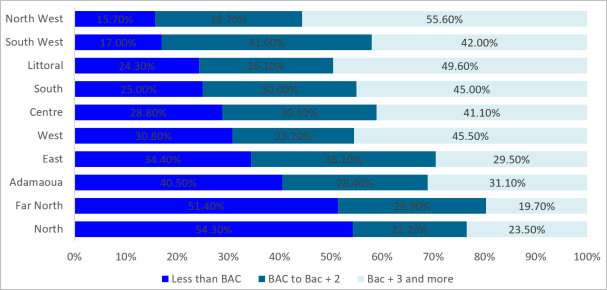
To refine the analysis, it is also important to provide an overview of the qualifications of the population studied by region. This is shown successively in
Table 5 and
Figure 1 below.
Table 5. Distribution of respondents by function and simplified categories of diplomas.
| Simplified diploma category |
Less than the Bac | Baccalaureate to Baccalaureate +2 | Bac+3 and above |
Prefect | 2.3% | 8.0% | 92.0% |
Government Delegate | 13.3% | 26.7% | 60.0% |
Mayor | 35.3% | 22.3% | 42.4% |
Secretary General | 43.8% | 32.1% | 24.1% |
Municipal receiver | 23.9% | 47.3% | 28.9% |
Collector/Receiver | 40.0% | 25.6% | 34.4% |
Rep. RegI Minre | 3.4% | 5.2% | 91.4% |
Total | 32.1% | 28.8% | 39.1% |
Source: authors
Figure 1. Qualification of respondents by simplified category of diplomas and by region.
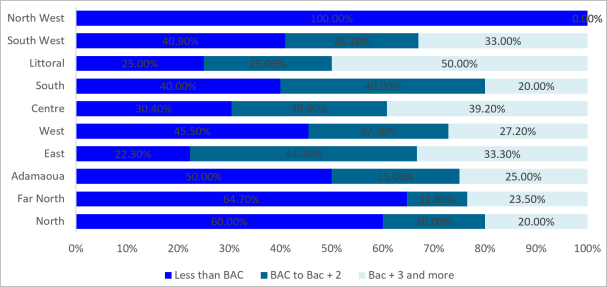
Here again, the disparities are more than substantial depending on the geographical area. Respondents from the Adamaoua, Far North and North regions are generally less qualified, unlike those from the Southwest, Centre, West, South, and especially the Littoral and Northwest. This implies that training objectives must be calibrated both by function and by region. It should be noted, however, that handicaps can be cumulative. Thus, for example, if we take into account the region of practice for the category of tax collectors/collectors, which is on average less qualified than the others,
Figure 2 clearly highlights this cumulative problem.
Figure 2. Qualification of tax collectors/receivers by simplified diploma categories and by region.
Overall, tax collectors are proportionally less qualified in regions where respondents are on average the least qualified, such as Adamaoua, the North and the Far North.
3.2.4. Distribution of Respondents by Age and Function
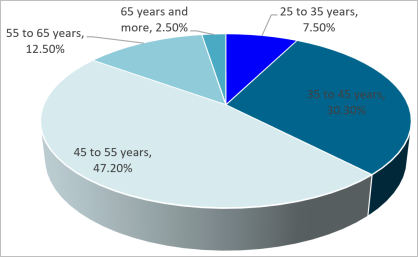
Another important feature of these data is the distribution of respondents by age as shown in the following
Figure 3.
Figure 3. Age distribution of survey respondents.
The distribution by age and function, however, gives a much more contrasting picture.
Table 6. Distribution of respondents by age group and by function.
Function exercised | Age category |
25/35 | 35/45 | 45/55 | 55/65 | 65 and over |
Prefect | 4.0% | 6.0% | 90.0% | / | / |
Government Delegate | / | 6.7% | 60.0% | 33.3% | / |
Mayor | 4.5% | 21.3% | 38.2% | 28.0% | 7.9% |
Secretary General | 6.8% | 44.0% | 42.5% | 6.8% | / |
Municipal receiver | 9.7% | 36.2% | 48.3% | 5.8% | / |
Collector/Receiver | 23.1% | 17.6% | 56.0% | 3.3% | / |
Total | 7.5% | 30.3% | 47.2% | 12.5% | 2.4% |
Source: Author
The distribution by function shows that local officials are, all other things being equal, the youngest - except for prefects, since this position implies a certain experience and a certain life - and that mayors are the oldest. This distribution structure of elected officials by age is quite similar to that found in Europe. 35.9% of mayors are over 55 years old. The fact that Cameroonian mayors are relatively older can be explained by two factors: on the one hand, election is a social recognition that generally occurs when the individual is at the height of his professional career, on the other hand this function can also be exercised after the professional period and constitute the continuation of it.
4. Results of the Analysis
4.1. Overall Assessment of the Reform
Here we analyze the overall assessment of the reform relating to the decentralization policy from the point of view of its usefulness, its effects and its legal modalities.
The decentralization reform is supported in most of its aspects by the respondents. For 96.5% of individuals who responded to the questionnaire, decentralization is a useful (20.5%) or very useful (76%) reform. Mayors are, unsurprisingly, those who most claim this usefulness (81.4% of them believe it is very useful), followed by prefects (78%). The intensity of this support, while still strong, is slightly lower among tax collectors/collectors.
From the perspective of its effects, we find the same unanimity. For 94.6% of the sample, decentralization had positive or very positive effects. With such rates, it is clear that all populations represented in the questionnaire are concerned by this approval. However, we find the same distribution as for the previous variable, with a slightly lower position among tax collectors/receivers.
In its legal terms, 76.1% of respondents to the questionnaire believe that the first decrees on the transfer of powers, as defined, increase local autonomy (compared to 20.6% who think the opposite and 3.3% who do not express an opinion). This opinion differs little depending on the type of respondent. This positive reading of decentralization is reflected in other specific judgments made in the questionnaire. Thus, 70.5% of those questioned completely agree or agree with the fact that we must move towards greater decentralization.
4.2. Effect of Decentralization on Local Development Through the Realistic Transfer of Skills
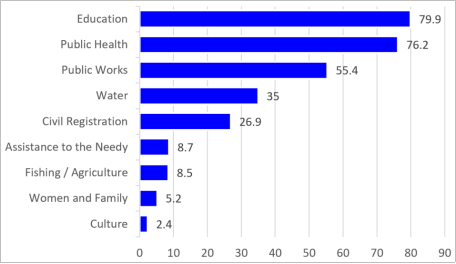
While 85.80% of respondents consider that the reform is adapted or very adapted (this choice being more often made by prefects and mayors) to their expectations, the satisfaction rate drops slightly when the question is restricted to that of the transfer of skills. 73.7% of individuals consider that the transferred skills are very adapted or adapted to the needs of the municipalities. An analysis of the responses given also makes it possible to determine the transferred sectors that are considered a priority by the respondents.
Figure 4 below summarizes the main areas of these sectors.
Figure 4. Priority transferred action areas.
Three sectors stand out clearly from all the others: education, public health, and finally, roads. There is therefore a marked interest among stakeholders in areas that are geared towards improving the well-being of populations, thereby responding to the major principles of decentralization aimed at improving the living conditions of populations. Regarding what skills transfers bring, the results are also quite explicit. 76.8% of respondents completely agree or agree that they bring more local autonomy, 64.4% also completely agree or agree that they allow more financial autonomy, and finally 59.1% agree that they provide additional human resources. These results should, however, be qualified and confirm the problems identified during the national training seminar on the management of the first skills transferred.
4.3. Effect of Decentralization on Local Development Through Local Democracy
A fairly large set of questions dealt with local democracy in all its dimensions, and the results are quite eloquent. First, two questions concerned the social dimension of local democracy, which corroborates the results found in the European survey. Thus, respondents believe that elected women and men do not have the same way of doing politics (38.7% agree with this answer and 25.2% completely agree), in the same way, and by a fairly overwhelming majority (80% favorable opinions), defending the interests of minorities appears essential.
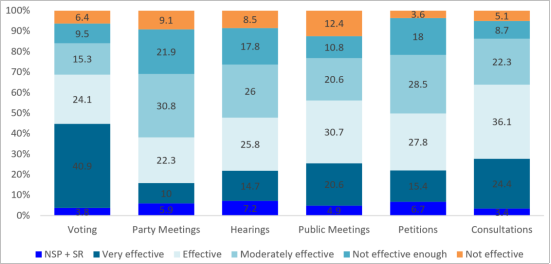
Secondly, another set of questions concerned conceptions of local democracy. Most of the time, the debate on local democracy oscillates between two poles. The first tends towards forms of direct democracy and management, the second which favors above all representative democracy. The results seem at first glance to show a divergence of assessment between Cameroonian actors and their European counterparts. The results of the questionnaire, even though they come from individuals with local responsibilities, do not clearly distinguish between these two dimensions. If the election remains the predominant factor, the respondents are nevertheless not attached to a strict vision of representative democracy, as is the case in France. The elective principle remains undeniable: 76.8% of respondents believe that the result of local elections is the main source of legitimacy for a local elected official and 70.5% even believe that government delegates should be elected by the population and from all categories of actors (even if this tendency is however less pronounced among prefects and government delegates) and regardless of their party affiliation. Furthermore, for 65% of respondents, voting is the most effective instrument of local democracy.
All democratic and direct consultation procedures are popular, whether it be voting, public meetings or even consultations with civil society, as illustrated in
Figure 5 below.
Furthermore, when respondents are asked to give their opinion on procedures that already exist in other countries, we again obtain confirmation of the trends that have just been identified.
All procedures promoting citizen participation appear desirable. However, there is a gradation between, on the one hand, what relates to the increase in possibilities for intervention (information procedure allowing citizens to intervene in decision-making, right to review the operation of municipal services) which are widely put forward and, on the other hand, measures which are also viewed positively but which lead to institutional transformations (delegation of responsibility to neighborhoods or villages, referendum, direct election of the mayor). These latter aspects are more particularly emphasized by mayors, general secretaries, receivers and tax collectors (while the former are rather put forward by prefects and government delegates).
Figure 5. Effectiveness of local democracy instruments.
The questionnaire shows that respondents primarily equate local democracy with grassroots democracy: 76.8% of them indicate that more decentralization to neighborhoods or villages is necessary to involve citizens. It should be noted that municipal stakeholders (mayors, general secretaries, municipal receivers) are the most favorable to this type of decentralization, which is in line with programs such as the PNDP, aimed at managing local affairs in a participatory manner.
The search for consensus and the ability to reflect citizens' opinions in decision-making thus appear to be real concerns for local stakeholders. This is true both when it comes to political leaders promoting consensus - 81.3% agree or strongly agree with this statement - and when it comes to the fact that municipal council decisions must reflect the majority opinion of citizens (81% in agreement). The questionnaire results thus allow us to account for the sometimes contradictory position of stakeholders, particularly mayors, regarding the effective role of citizens in decision-making. Thus, opinions are divided on the possibility for citizens to make their views known before important decisions are made by elected officials (47.2% are against this, compared to 45.1% who are in favor). We find the same hesitation on whether elected officials must make good decisions independently of the opinions of the population (46% against and 45.1% for).
4.4. Local Development Priorities in Cameroon
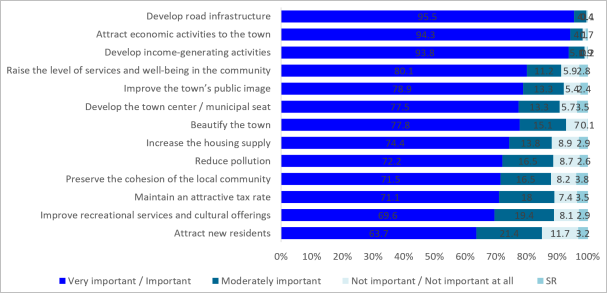
Figure 6 below highlights the priorities in terms of municipal development.
Figure 6. Hierarchy of objectives for municipal development.
Figure 6 provides a fairly clear picture of the priorities of Cameroonian local government stakeholders. The approval rates are such that it is difficult to distinguish very significant differences between stakeholders. However, while all the elements appear essential, four stand out in particular and are divided into two themes.
1) The affirmation of the principle of the importance of economic development;
2) The absolute necessity of developing infrastructure and services.
These two elements are essential for all the actors questioned even if, once again, the rates obtained by the other items on the list are far from negligible. To conclude on this point and to the extent that the list contained 14 indicators, it was possible to carry out a factor analysis in order to try to reduce this set to a more limited number of explanatory variables. In fact, the analysis reveals two dimensions which, combined, explain half of the variance . The first dimension, synthesizes the essential expectations of the respondents in terms of local development (this dimension concerns 11 variables out of 14). It is therefore, as in the graph, a highlighting of the need for an increase in services provided to the population in all areas. The second dimension is above all focused on the economic and financial aspect (three variables are concerned here: that of economic attractiveness, the development of income-generating activities and the establishment of an attractive tax rate). In other words, respondents to the questionnaire value on the one hand a dimension centered on the purpose (in terms of services and achievements) and, on the other hand, another based on the means.
4.5. The Obstacles Identified
The framework of the survey not only allows for an opinion on the decentralization process as such, but also allows for a perspective on the difficulties that remain in this area.
4.5.1. A Mixed Vision of How the Administration Works
While the reform is generally highly appreciated, there are still some mixed opinions in some responses. Thus, only 38.1% of respondents believe that local government is currently operating in a very satisfactory or satisfactory manner, with 22.1% opting for a middle ground, while 36.7% express their dissatisfaction (mayors, general secretaries, and collectors/tax collectors generally being more forthcoming in their opinions).
The distribution is roughly identical for the judgment made on the decentralized administration (34.3% satisfied, 31.6% in the middle, 29.7% dissatisfied, the rest distributed between no opinion and no response, the regional heads of ministries being a little more severe). For the same question asked this time regarding the functioning of the central administration, we find roughly the same trend, with however a slightly higher satisfaction rate (40.2% satisfied, 21.9% in the middle, 33.2% dissatisfied, the rest distributed between no opinion and no response).
4.5.2. Lack of Resources and Skills Deficit as a Structural Obstacle
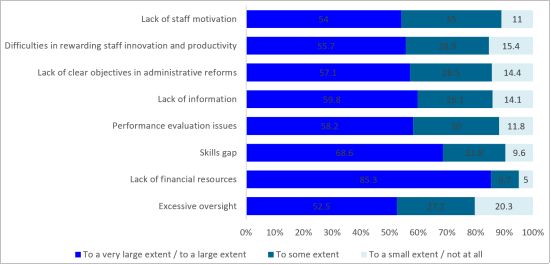
First, a battery of items listed these potential obstacles to the proper functioning of decentralization. The results are on
Figure 7 bellow:
Figure 7. Main obstacles to the proper functioning of decentralization.
Figure 7 above provides several pieces of information. First, each of the items received an approval rate above 50%. This means, first and foremost, that all of the difficulties listed are relevant to the respondents. Second, two themes stand out from all the others. These are, on the one hand, the lack of financial resources and, on the other, the skills deficit. While it is reasonably possible to be optimistic on the second point given the respondents' training efforts (see below), things are slightly different for the first point insofar as this lack of resources appears relatively structural. This positioning explains why the central state is perceived both as a recourse and as a necessity, which may seem paradoxical in a logic of decentralization (even if this deficiency in terms of financial autonomy is also shared by other local governments in the world).
This lack of financial resources is expressed elsewhere in the questionnaire. Thus, 87.6% of stakeholders believe that the State should be involved in local development policies. Similarly, 88.9% believe that municipalities should receive more money from the central State. It should not be forgotten that, as with other results, these Figures, which are averages, hide variations depending on the functions performed. As for the lack of resources, while it appears to be a constant for all individuals, mayors and general secretaries are more sensitive to this difficulty. Reluctance to change is primarily denounced by mayors, while the lack of motivation appears more detrimental in the eyes of municipal administrative officials (collectors, tax collectors, general secretaries), who are also quicker to consider the lack of information as a problem. They have the same judgment on the difficulties in rewarding innovation, which seems more problematic to them than to other local government stakeholders.
4.5.3. An Ambiguous Relationship with Guardianship
The vision of guardianship highlighted in the previous graph actually hides a predictable divide among our respondents.
Table 7. Opinion on the burden of guardianship by function.
| Not at all/small extent | To some extent | Large/very large measure |
Prefect | 73.5% | 22.4% | 4.1% |
Government Delegate | 20.0% | 20.0% | | 60.0% |
Mayor | 13.5% | 26.4% | 60.1% |
Secretary General | 17.1% | 29.9% | 53.0% |
Municipal receiver | 18.6% | 29.9% | 51.5% |
Receiver/Collector | 24.1% | 23.0% | 52.9% |
Rep. Regl Minre | 14.3% | 28.6% | 57.1% |
Total | 19.5% | 27.7% | 52.8% |
Source: Author
Table 7 shows an asymmetrical view of supervision. Its burdensome nature is denounced by all municipal stakeholders, especially by executives. It constitutes an obstacle for 60.1% of mayors and 60% of government delegates, while conversely, it is not problematic for 73.5% of prefects. It should also be noted that the larger the municipality, the less tolerant the mayors are of supervision. To the extent that urban municipalities have more capacity and resources, the "intrusion" of the State is more negatively experienced than in smaller entities, which probably have more need of state services.
4.5.4. Corruption: A Problem Without a Solution
To conclude on this theme of obstacles to decentralization, four questions addressed the issue of corruption. For 17.2% of respondents, this is a daily problem, for 39% it is a recurring problem, for 26.3% corruption is a marginal problem and finally for 8.8% it does not constitute a difficulty (3.7% did not express an opinion). Three generic solutions, included in many programs, were proposed for the fight against corruption. The results are shown in
Table 8 below.
Table 8. Means of combating corruption in percentage.
| All right | Neither agree nor disagree | Disagree | SR + NSP |
Better governance | 95.7 | 3.2 | 1.5 | 1.8 |
Increased control over the use of resources | 90.5 | 3.5 | 2.8 | 3.3 |
A clear distribution of roles and functions of each person | 89.7 | 3.6 | 2.9 | 3.8 |
Source: Author
The plebiscite rates are such that it's difficult to draw any conclusions. All the solutions are good, but none seems more relevant than the other. The responses seem more like wishful thinking. This situation also reflects the difficulty of addressing this issue in a quantitative survey and calls into question the effectiveness of anti-corruption policies implemented by central administrations and often encouraged by international donors.




 Share This Article
 Twitter
 Linked In
 Facebook
 Copy
Copy Download