Abstract
Foot and Mouth Disease (FMD) is a highly contagious viral disease, which affects the livelhood and productivity of livestock farmer in endemic region. It can infect various domestic and wild animals with cloven-hooves. FMD has a detrimental effect on the agricultural economies of most countries worldwide. A retrospective study was applied to analyze FMD outbreaks in animals, place and time in Mareko, Centeral Ethiopia from 2021 to 2025 G.C. The data of the FMD outbreaks was collected from special wereda veterinary clinic and Keble veterinary post office from the case book record and DOVAR report. The data was analyzed by line, chart or graphs by using pivot table. Over the past five years a total of 134 FMD outbreaks have been reported in the district. The highest number reported in 2023 followed by 2024. Especially in 2024 during the month of October FMD outbreaks were reported. Seasonally, the highest outbreaks were in winter (68) followed by autumn (42). The spatial distribution of FMD, the higher numbers of outbreaks were in Meka-jardemeka, Koshe 01 and Alemena. The highest number of suspected FMD cases was in 2024 (450) followed by 2025 (500). So supplying adequate doses of vaccine, control risk factors and strong animal disease surveillance system is important to control and prevention of FMD.
Keywords
Mareko, Retrospective Study, Central Ethiopia, Spatioal and Temporal Disturbution, Morbidity and Mortality
1. Introduction
Ethiopia has a large and diverse livestock population, contributes significantly to the national economy and the livelihoods of rural communities
| [1] | CSA Agricultural sample survey 2020/21 [2013 E. c]. Report on livestock and livestock characteristics. Statistical Bulletin 589. Vol. II. Addis Ababa, Ethiopia [Online]. Available: http://www.StatsEthiopia.gov.et |
[1]
. However, the livestock sector faces major challenges from transboundary animal diseases such as foot-and-mouth disease (FMD), a highly contagious viral disease that affects domestic and wild cloven-hoofed animals
| [2] | Dabasa G, Abunna F. Review on Epidemiology of Foot and Mouth Disease (FMD) in Ethiopia. J Trope Dis. 2021; 9: 269. |
[2]
. FMD is one of the most economically important viral diseases and is listed as a notifiable transboundary animal disease by the World Organization for Animal Health
| [3] | OIE (2017) World organization for Animal Health. |
[3]
. The disease is clinically characterized by fever and lesions in the mouth, teats and feet of cloven-hoofed animals
| [4] | Samuel, Knowles (2001) Foot-and-mouth disease type O viruses exhibit genetically and geographically distinct evolutionary lineages (top types). Journal of General Virology 82(3): 609–621. |
[4]
. FMD is caused by an aphthovirus (family Picornaviridae) which exists as seven serologically distinct types. Serotypes O and A were initially discovered by Vallee and Carre
| [5] | Vallée H, Carré H: Sur la pluralité du virus aphteux. C R Hebd Acad Sci Paris 1922, 174: 1498–1500 (in French). |
[5]
.
The seventh serotype, Asia-1, was first detected in a sample collected from a water buffalo in Okara, Punjab, Pakistan in 1954
| [6] | Brooksby JB, Rogers J: Methods used in typing the virus of Foot-and mouth disease at Pirbright, 1950–55. In Methods of typing and cultivation of foot-and-mouth disease virus: Project No. 208. Paris: European Productivity Agency of the Organization of European Cooperation (OEEC); 1957. |
[6]
. The disease spreads rapidly through direct or indirect contact with infected animals or materials or through the air
. It is common in Africa, the Middle East Asia, and some parts of South America. FMD prevention and control are costly and mostly borne by low- and lower middle-income countries
. In Ethiopia, FMD is a notifiable disease that has been reported since 1957
| [9] | Desissa F, Tura D, Mamo B, Rufael T. Epidemiological study on foot and mouth disease in cattle: seroprevalence and risk factor assessment in Kellem Wollega Zone, West Ethiopia. Afr J Agric Res. 2014; 9(18): 1391–5. |
[9]
. The disease affects cattle of all ages and breeds, as well as small ruminants and wildlife. The seroprevalence of FMD in Ethiopia ranges from 5.6 to 72.1% in cattle
| [10] | Awel SM, Dilba GM, Abraha B, Zewde D, Wakjira BS, Aliy A. Seropreva lence and molecular detection of foot and mouth disease virus in dairy cattle around Addis Ababa, Central Ethiopia. Vet Med (Auckl). 2021; 12: 187–97.
https://doi.org/10.2147/vmrr.S3171.03 |
[10]
and from 4 to 11% in small ruminants
). Four serotypes (O, A, SAT 1, and SAT 2) are endemic in Ethiopia, with serotype O being the most dominant and widespread
. FMD outbreaks occur frequently across the country, with higher frequency and intensity during the dry season
| [13] | Dubie T, Negash W. Seroprevalence of bovine foot and mouth dis ease (FMD) and its associated risk factors in selected districts of Afar region, Ethiopia. Vet Med Sci. 2021; 7(5): 1678–87. |
[13]
. New FMDV topotypes in Ethiopia challenge the livestock industry and require a better understanding of the disease and its serotypes. This will help designing effective control and prevention measures such as vaccination, rapid diagnostic tests (RDTs), and early warning systems
| [14] | Wubshet AK, Dai J, Li Q, Zhang J. Review on outbreak dynamics, the endemic serotypes, and diversified topotypic profiles of foot and mouth disease virus isolates in Ethiopia from 2008 to 2018. Viruses. 2019; 11(11): 1076. |
[14]
.
FMD outbreaks are increasing in many parts if the country and is similar in in Central Ethiopia, Mareko. However, information on the spatial and temporal distribution and vaccination activities of FMD outbreaks in the district is not properly monitored. Hence, gathering of information on the disease spatial and temporal distribution and vaccination activities is an essential tool for future intervention and in designing most reliable strategies for prevention and control of the disease in the study area.
1.1. General Objective
To obtain update information on the spatial and temporal distribution of foot and mouth disease outbreak in Mareko district.
1.2. Specific Objectives
1) To determine morbidity and mortality within study area.
2) To assess economic impact of the disease.
3) To determine the trend of the disease in the district.
2. Material and Methods
2.1. Study Area
The study was conducted from September 2025 to November 2025 G. C. in Mareko Special Woreda, which is located 160 km south of Addis Ababa, the capital of Ethiopia. Koshe is the capital city of the Special Woreda. The Special Woreda is bordered by Silte Zone to Southwest, Misrak Meskan Wereda to Northwest, and Oromia Region to the east. The specific geographical coordinates are 8.015128899 latitude and 38.5325105 longitude, and it is situated at ab altitude between 1850 and 2000 meters above sea level. This altitude range places it within the weina-dega category, characteristic of the highland areas of the country. The average temperature ranges from 16°C to 18°C, although the area has a tropical rainy climate. Mareko Special Woreda has 586,684 heads of cattle, 153,816 head of sheep, 201,900 head of goats, 11,900 head of horses, 1200 head of mules, 102,555 head of donkeys and 501,000 poultry. The area includes diverse livestock production system and is known for epidemic occurrence of FMD.
2.2. Operational Definition
Foot and Mouth Disease
Highly contagious viral disease affecting cloven hoofed animals, identified in this study through clinical sign such as, mouth lesion, lameness, and reduced productivity, as recorded by district surveillance report.
Outbreak
An occurrence of one or more suspected or confirmed FMD cases within specific kebelle or area during defined reporting period as documented in the dataset.
Suspected Case
Any animal showing clinical signs consistent with FMD uch as fever, mouth ulcers, drooling, and foot lesions eported by farmers, animal health workers, or surveillance teams, but not necessarily laboratory-confirmed.
Mortality Rate
The proportion of suspected FMD infected animals that died during a given year, calculated as: (Number of deaths / Total suspected cases) × 100, presented in annual mortality graphs.
Kebelle
The smallest administrative unit in the study area used for organizing and reporting disease data in this study, kebelle seve as geographic location for evaluating FMD case distribution.
Trend Analysis
An examination of changes in outbreak frequency and suspected cases over the five year period (2021-2025), used to determine whether disease occurrence increasing, decreasing, or fluctuating.
2.3. Source and Study Population
Retrospective studies rely on secondary data that have already been collected so source of data is typically existing record such as case book, DOVAR report from veterinary clinic, veterinary post office and qutionary from veterinarians and farmers information regarding their animal’s health history, vaccination states, and FMD clinical signs in their herds over a past period. Study population are cattle, sheep and goat are highly susceptible to FMD. All age groups of animals were included in this study.
2.4. Study Design and Period
A retrospective study was conducted to obtain updated information on geographical and temporal distribution as well as to determine mortality, morbidity in Special wereda of Mareko over the past five years from 2021 to 2025 G.C.
2.5. Sampling Procedure and Sample Size
Secondary data for the study were gathered from various sources: veterinary clinics, vet post offices, DOVAR reports, case books, and questionnaires. While a traditional sample size formula was not applied, the inclusion of all available reported data spanning the 5-year period provided a naturally comprehensive and representative dataset.
2.6. Data Collection Methods
A retrospective study was conducted by reviewing secondary on FMD documented in special Woreda of Mareko over the past 5 years was reviewed from 2021-2025 G. sC. Case book and DOVAR record secondary data. The variables, which were considered in relation to the outbreaks, were factors that contributed to the current progress of the disease outbreak.
2.7. Data Management and Analysis
The data that extracted from the district case book record and DOVAR was processed (examined) to obtain updated information on spatial and temporal distribution, additionally to determine morbidity and mortality of foot and mouth disease. Lastly the data was entered into the spread sheets of a Microsoft Ex-cell and analyzed. Analysis of the data was performed by using pivot table on Microsoft Ex-cell sheet.
3. Result
3.1. FMD Outbreaks in the District
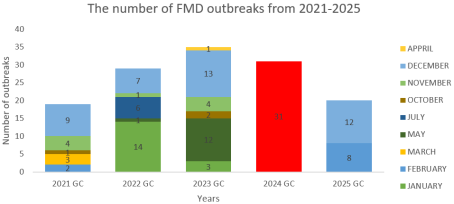
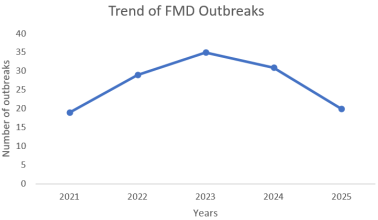
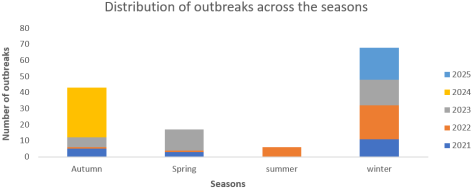
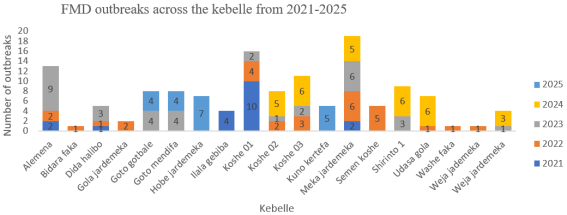
Over the past five years a total of 134 FMD outbreaks have been reported in the district. The highest number reported in 2023 followed by 2024. Especially in 2024 during the month of October 31 FMD outbreaks were reported. Seasonally, the highest outbreaks were in winter followed by Autumn (
Figures 1-3). The higher number of outbreaks were in kebelle Meka jardemeka followed by Koshe 1 and Alemena (
Figure 4).
Figure 1. Shows that FMD outbreak from 2021-2925.
Figure 2. FMD trend from 2021-2025.
Figure 3. Distribution of FMD outbreak across the season.
Figure 4. The number of FMD outbreaks across the kebele from 2021-2025.
3.2. FMD Suspected Cattle Cases from 2021-2025 Across the Kebele
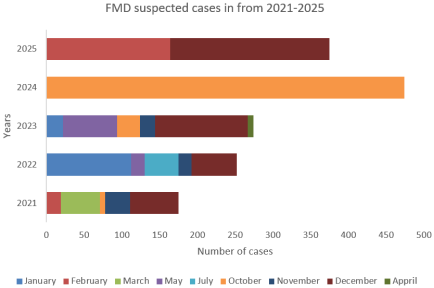
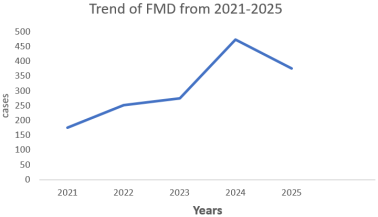
The number of FMD suspected cases from the in the past years from the outbreaks described above in in Mareko was 1550. Year wise, the highest number of suspected FMD cases was in 2024 followed by 2025. The number of season-wise and monthly cases is like the number of outbreaks presented (
Figure 5). The number of suspected cases showed increasing trend (
Figure 6).
Figure 5. Number of FMD suspected cattle from 2021-2025.
Figure 6. Trend of FMD from 2021-2025.
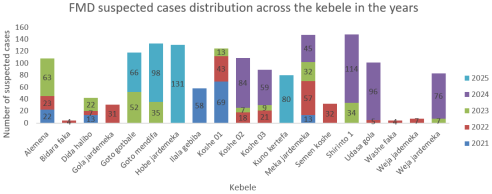
Figure 7. Distribution of FMD suspected cases across kebele.
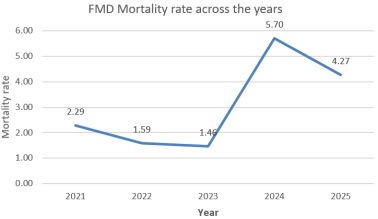
Figure 8. FMD mortality rate across the year.
4. Discussion
This study indicated that Foot-and Mouth Disease (FMD) continues to be major livestock health concern in Mareko district, with outbreaks occurring consistently from 2021-2025. The fluctuating nature of outbreak frequently across the years indicates that FMD transmission is influenced by multiple dynamic factors, including seasonal patterns, animal movement, management practice, and possibly the presence of different circulating serotype
. The observed peak in outbreak during 2023 and 2024 aligns with similar patterns reported in SNNPR where FMD outbreak commonly rise during periods of increased animals movement and market interaction
| [16] | Hag ere H. A Retrospective Study of Foot and Mouth Disease outbreaks from 2010-2018 in SNNPR. Global Veterinaria 24 (3): 101-108, 2022. |
[16]
. Seasonal analysis revealed that autumn and spring had the highest outbreak frequencies. The season often corresponds to period when communal grazing, water point congregation, and migration between grazing areas occur. Such increased animal to animal contact likely enhance transmission rate. Lower outbreak number in winter and summer may be to feed and water that reduce herd mixing. These seasonal variations underscore the importance of timing vaccination campaigns before the high risk season to maximize immunity level these disagree with
| [17] | Eskeziaw B, Mesfin M. Retrospective Study of Foot and Mouth Disease Outbreak in West Omo Zone, Southwest Region, Ethiopia, 2017-2022. Dairy and vet sci J. 2024; 17(1): 555952. https://doi.org/10.19080/JDVS.2024.17.555952 |
[17]
where the highest outbreak number occur in winter and summer and lowest outbreak number in autumn and spring. The rising trend of suspected FMD cases from 2021-2025, with peak values approaching 450-500 cases in the later years, suggests either increasing virus circulation or an improvement in disease detection or reporting system. In some kebeles, recurrent high case numbers particularly in Semen Koshe, Shirinto 1, Meka Jardemeka, and Gola Jardemeka indicate persistent hotspot areas. These kebelles likely share characteristics such as high livestock density, shared grazing lands, or communal watering sites, all of which facilitate rapid disease spreads. These spatial clustering highlights the need for location based surveillance strengthening and targeted control strategies, such as focused vaccination and community engagement in these hotspot kebelles.
Mortality rate fluctuated throughout the study period, with the highest value recorded in 2023 (4.27%) and 2025 (5.7%). The disease is rarely fatal in adult cattle but high in young or immune compromised calves or delayed treatment response these agree with the disease rarely fatal in adult animal (1-5%) but high in young calves
| [18] | Zewdie G, Akalu M and Tolossa W, Virology Journal Review of foot and mouth disease in Ethiopia; epidemiological aspect, economic implication, and control strategies. virology journal, 2023, v. 20, n. 1, p. 1
https://doi.org/10.1186/s12985-023-02263-0 |
[18]
.
Economic loss includes direct (death) and indirect loss decrease in milk production, drought power, control cost and highest economic loss ocure in 2025 with mortality rate 5.7% these result agree with
.
Overall, the results emphasize the endemic nature of FMD in the study area and complexity of factors driving its persistence. While seasonal patterns and hotspot kebelles provide clear guidance for targeted interventions, the increasing trends of suspected cases’ suggests that current control strategies may be insufficient. Strengthening vaccination program, improving surveillance, and enhancing rapid response mechanisms are essential for reducing disease burden.
5. Limitation
1) Lack of laboratory confirmation for suspected case
Many suspected cases were reported based on clinical signs only, without laboratory confirmation. This increase risk of, misclassification, overestimation or underestimation of true FMD case and confusion with disease that have similar symptoms (vesicular stomatitis).
2) Reliance on Secondary Data
The study depended entire on retrospective recorded from 2021-2025 such record may contain: Missing the data, error in reporting, underreporting during busy outbreak period.
3) Limeted Geographic Coverage
Only kebelles with available recorded or unknown outbreak history where included. Thise may exclude Remote areas, kebelles with weak surveillance, areas with poor reporting system, a result the study may not reflect the entire districts FMD situation.
4) No Data on Risk Factors
5) This study did not collect data on key epidemiological risk factors such as animal movement pattern, vaccination status, herd management practice and environmental condition.
6. Conclusion and Recommendation
The data collection and reporting methods of the district veterinarians require more training.
Strengthening vaccination campaign prior to high risk season (autumn and spring).
Enhance early warning surveillance at kebelles with repeated high caseloads.
Improve animal movement control, particularly around communal grazing and market.
Conduct community awareness campaigns on early reporting and bio security.
Abbreviations
FMD | Foot and Mouth Disease |
OIE | Office International des Epizooties |
RDT | Rapid Diagnostic Treatment |
DOVAR | Disease Outbreak and Vaccination Report |
G.C | Gregorian Calendar |
CE | Central Ethiopian |
ISAVET | In Service Applied Veterinary Epidemiology Training |
FAO | Food and Agricultural Organization |
Acknowledgments
First, I would like to thank Allah for everything, next, the Ministry of Agriculture and Food and agricultural organization (FAO) for providing me this golden opportunity to develop this field project and would like to present my heartfelt thanks to my mentor Dr. Teshale Teklue for his intensive guidance, being available and sparing his valuable time to help me. Finally I would like to extend my appreciation and thanks to front line veterinary epidemiology training coordinators, beloved teachers and six cohort ISAVET students who support and share different knowledge for me.
Author Contributions
Mudesir Daweto Sirmollo: Data curation, Investigation, Resources, Validation, Writing – original draft, Writing – review & editing
Conflicts of Interest
The author declares no conflicts of interest.
References
| [1] |
CSA Agricultural sample survey 2020/21 [2013 E. c]. Report on livestock and livestock characteristics. Statistical Bulletin 589. Vol. II. Addis Ababa, Ethiopia [Online]. Available:
http://www.StatsEthiopia.gov.et
|
| [2] |
Dabasa G, Abunna F. Review on Epidemiology of Foot and Mouth Disease (FMD) in Ethiopia. J Trope Dis. 2021; 9: 269.
|
| [3] |
OIE (2017) World organization for Animal Health.
|
| [4] |
Samuel, Knowles (2001) Foot-and-mouth disease type O viruses exhibit genetically and geographically distinct evolutionary lineages (top types). Journal of General Virology 82(3): 609–621.
|
| [5] |
Vallée H, Carré H: Sur la pluralité du virus aphteux. C R Hebd Acad Sci Paris 1922, 174: 1498–1500 (in French).
|
| [6] |
Brooksby JB, Rogers J: Methods used in typing the virus of Foot-and mouth disease at Pirbright, 1950–55. In Methods of typing and cultivation of foot-and-mouth disease virus: Project No. 208. Paris: European Productivity Agency of the Organization of European Cooperation (OEEC); 1957.
|
| [7] |
Zhang Z, Waters R, Li Y. Pathogenesis of non-epithelial foot-and mouth disease in neonatal animals. Vet Microbiol. 2021; 254: 108961.
https://doi.org/10.1016/j.vetmic.2020.108961
|
| [8] |
WOAH. Foot and mouth disease (FMD). World Organisation for Animal Health.
https://www.woah.org/en/disease/foot-and-mouth-disease/
(accessed 21 March 2023).
|
| [9] |
Desissa F, Tura D, Mamo B, Rufael T. Epidemiological study on foot and mouth disease in cattle: seroprevalence and risk factor assessment in Kellem Wollega Zone, West Ethiopia. Afr J Agric Res. 2014; 9(18): 1391–5.
|
| [10] |
Awel SM, Dilba GM, Abraha B, Zewde D, Wakjira BS, Aliy A. Seropreva lence and molecular detection of foot and mouth disease virus in dairy cattle around Addis Ababa, Central Ethiopia. Vet Med (Auckl). 2021; 12: 187–97.
https://doi.org/10.2147/vmrr.S3171.03
|
| [11] |
Abdela N. Sero-prevalence, risk factors and distribution of foot and mouth disease in Ethiopia. Acta Trop. 2017; 169: 125–32.
https://doi.org/10.1016/j.actatropica.2017.02.017
|
| [12] |
Ayelet G, Gelaye E, Negussie H, Asmare K. Study on the epidemiology of foot and mouth disease in Ethiopia. Rev Sci Tech. 2012; 31(3): 789 98.
https://doi.org/10.20506/rst.31.3.2153
|
| [13] |
Dubie T, Negash W. Seroprevalence of bovine foot and mouth dis ease (FMD) and its associated risk factors in selected districts of Afar region, Ethiopia. Vet Med Sci. 2021; 7(5): 1678–87.
|
| [14] |
Wubshet AK, Dai J, Li Q, Zhang J. Review on outbreak dynamics, the endemic serotypes, and diversified topotypic profiles of foot and mouth disease virus isolates in Ethiopia from 2008 to 2018. Viruses. 2019; 11(11): 1076.
|
| [15] |
Endeshaw D, Belege T. Spatio-temporal distribution of foot and mouth disease outbreak in Western Amhara region from January 2018-June 2023. February 11, 2025.
https://doi.org/10.1371/journal.phone.0313305
|
| [16] |
Hag ere H. A Retrospective Study of Foot and Mouth Disease outbreaks from 2010-2018 in SNNPR. Global Veterinaria 24 (3): 101-108, 2022.
|
| [17] |
Eskeziaw B, Mesfin M. Retrospective Study of Foot and Mouth Disease Outbreak in West Omo Zone, Southwest Region, Ethiopia, 2017-2022. Dairy and vet sci J. 2024; 17(1): 555952.
https://doi.org/10.19080/JDVS.2024.17.555952
|
| [18] |
Zewdie G, Akalu M and Tolossa W, Virology Journal Review of foot and mouth disease in Ethiopia; epidemiological aspect, economic implication, and control strategies. virology journal, 2023, v. 20, n. 1, p. 1
https://doi.org/10.1186/s12985-023-02263-0
|
| [19] |
Philip R, Alexandra S, Wudu T, Theodor j. Economic losses due to Foot and Mouth Disease in Ethiopia. August 2023
https://doi.org/10.213/ssrn.4547171
|
Cite This Article
-
-
@article{10.11648/j.sdan.20260103.12,
  author = {Mudesir Daweto Sirmollo},
  title = {Retrospective Study of Foot and Mouth Disease in Mareko, Central Ethiopia, 2021-2025GC},
  journal = {Science Discovery Animals},
  volume = {1},
  number = {3},
  pages = {86-92},
  doi = {10.11648/j.sdan.20260103.12},
  url = {https://doi.org/10.11648/j.sdan.20260103.12},
  eprint = {https://article.sciencepublishinggroup.com/pdf/10.11648.j.sdan.20260103.12},
  abstract = {Foot and Mouth Disease (FMD) is a highly contagious viral disease, which affects the livelhood and productivity of livestock farmer in endemic region. It can infect various domestic and wild animals with cloven-hooves. FMD has a detrimental effect on the agricultural economies of most countries worldwide. A retrospective study was applied to analyze FMD outbreaks in animals, place and time in Mareko, Centeral Ethiopia from 2021 to 2025 G.C. The data of the FMD outbreaks was collected from special wereda veterinary clinic and Keble veterinary post office from the case book record and DOVAR report. The data was analyzed by line, chart or graphs by using pivot table. Over the past five years a total of 134 FMD outbreaks have been reported in the district. The highest number reported in 2023 followed by 2024. Especially in 2024 during the month of October FMD outbreaks were reported. Seasonally, the highest outbreaks were in winter (68) followed by autumn (42). The spatial distribution of FMD, the higher numbers of outbreaks were in Meka-jardemeka, Koshe 01 and Alemena. The highest number of suspected FMD cases was in 2024 (450) followed by 2025 (500). So supplying adequate doses of vaccine, control risk factors and strong animal disease surveillance system is important to control and prevention of FMD.},
 year = {2026}
}
 Copy
|
Copy
|
 Download
-
TY  - JOUR
T1  - Retrospective Study of Foot and Mouth Disease in Mareko, Central Ethiopia, 2021-2025GC
AU  - Mudesir Daweto Sirmollo
Y1  - 2026/09/30
PY  - 2026
N1  - https://doi.org/10.11648/j.sdan.20260103.12
DO  - 10.11648/j.sdan.20260103.12
T2  - Science Discovery Animals
JF  - Science Discovery Animals
JO  - Science Discovery Animals
SP  - 86
EP  - 92
PB  - Science Publishing Group
SN  - 3142-8983
UR  - https://doi.org/10.11648/j.sdan.20260103.12
AB  - Foot and Mouth Disease (FMD) is a highly contagious viral disease, which affects the livelhood and productivity of livestock farmer in endemic region. It can infect various domestic and wild animals with cloven-hooves. FMD has a detrimental effect on the agricultural economies of most countries worldwide. A retrospective study was applied to analyze FMD outbreaks in animals, place and time in Mareko, Centeral Ethiopia from 2021 to 2025 G.C. The data of the FMD outbreaks was collected from special wereda veterinary clinic and Keble veterinary post office from the case book record and DOVAR report. The data was analyzed by line, chart or graphs by using pivot table. Over the past five years a total of 134 FMD outbreaks have been reported in the district. The highest number reported in 2023 followed by 2024. Especially in 2024 during the month of October FMD outbreaks were reported. Seasonally, the highest outbreaks were in winter (68) followed by autumn (42). The spatial distribution of FMD, the higher numbers of outbreaks were in Meka-jardemeka, Koshe 01 and Alemena. The highest number of suspected FMD cases was in 2024 (450) followed by 2025 (500). So supplying adequate doses of vaccine, control risk factors and strong animal disease surveillance system is important to control and prevention of FMD.
VL  - 1
IS  - 3
ER  -
Copy
|
Download





 Share This Article
 Twitter
 Linked In
 Facebook