Review Article | | Peer-Reviewed

The Role of Carbon Nanomaterials in Sample Preparation: Review

Received: 7 March 2026     Accepted: 20 March 2026     Published: 10 April 2026
Views:       Downloads:
Abstract

Sample preparation plays a vital role in analytical chemistry, particularly for the isolation and enrichment of trace analytes from complex matrices. Conventional techniques such as solid-phase extraction (SPE) and solid-phase microextraction (SPME) are widely employed; however, their efficiency is often limited by the performance of traditional sorbents. These conventional materials may suffer from low selectivity, limited adsorption capacity, and reduced stability under varying analytical conditions. As a result, there has been growing interest in developing advanced materials that can overcome these limitations and enhance analytical performance. Recent advances in nanotechnology have introduced carbon-based nanomaterials as promising alternatives for improving extraction efficiency and selectivity. Materials such as graphene, graphene oxide, and carbon nanotubes (CNTs) exhibit unique physicochemical properties, including exceptionally large surface area, tunable surface functionality, high mechanical strength, and strong π–π interactions with a wide range of analytes. These features enable more efficient adsorption and improved sensitivity in analytical procedures. This review summarizes recent developments in the application of graphene and CNT-based nanomaterials for SPE, magnetic SPE (MSPE), and SPME. Their synthesis methods, surface modification strategies, and characterization techniques are discussed in detail. Furthermore, their analytical performance in environmental, food, and biological sample analysis is critically evaluated. The advantages, current limitations, and future prospects of carbon nanomaterials in enhancing analytical sample preparation are also highlighted, emphasizing their potential role in advancing modern analytical methodologies.

Published in Science Discovery Chemistry (Volume 1, Issue 1)
DOI 10.11648/j.sdc.20260101.14
Page(s) 28-40
Creative Commons

This is an Open Access article, distributed under the terms of the Creative Commons Attribution 4.0 International License (http://creativecommons.org/licenses/by/4.0/), which permits unrestricted use, distribution and reproduction in any medium or format, provided the original work is properly cited.

Copyright

Copyright © The Author(s), 2026. Published by Science Publishing Group

Keywords

Carbon Based Nanomaterials, Solid Phase Extraction, Solid Phase Microextraction, Sample Matrices, Sample Preparation

1. Introduction
Sample preparation is a crucial step in analytical processes that includes separation, pre-concentration, analytical derivatization, and making the sample compatible with analytical instruments. The main goals of sample preparation are to obtain representative and adequate quantities of the analytes from matrices for accurate analysis . Over the past two decades, substantial research efforts have been devoted to the development and optimization of sample preparation methods. This persistent focus is predominantly driven by factors such as trace-level analyte concentrations, the presence of interfering species, and the incompatibility between complex sample matrices and analytical instrumentation . A variety of sample-preparation methods such as liquid-liquid extraction (LLE) , liquid-phase microextraction (LPME) , solid-phase extraction (SPE) and solid-phase microextraction (SPME) have been developed to extract and enrich trace-level analytes from complex matrices. The selection of extraction method depends on the nature of the target analytes and sample matrices . SPE including its miniaturized form SPME has become widely applied due to its short extraction times, reduced consumption of organic solvents, low cost, high recovery and enrichment factors, and the compatibility with advanced analytical techniques. Optimal recovery and high enrichment factor are achieved when the sorbent material is appropriately selected for the analytes of interest . The development of new extraction methods as well as the enhancement of existing methods through improved separation and pre-concentration approaches, represents a major focus in separation science . Among emerging approaches, nanomaterials are recognized as a key focus area for enhancing sample preparation methods to improve the sensitivity, selectivity, and efficiency of analytical methods .
In recent years, extensive research has highlighted the application of nanomaterials in areas such as chromatography and sample preparation primarily due to their unique and appealing thermal, mechanical, electronic, and biological properties . Their high surface-to-volume ratio, surface functionality potential, and physical and chemical stability make the nanomaterials an excellent candidate for surface adsorption applications such as SPE methods . Nanomaterials used in sample preparation can be categorized according to their functional roles. Certain nanomaterials act as sorbents that interact directly with the analytes while others function as inert supports, such as silica nanoparticles modified with complexing agents. Furthermore, magnetic nanoparticles have gained attention because they facilitate quick separation of analyte through the use of external magnetic. Their performance depend on direct analyte adsorption or functionalization with specific organic groups .
This review provides an overview of the various carbonaceous nanomaterials used in sample preparation techniques. It evaluates their advantages and disadvantages as well as their application in SPE and SPME methods. The challenges and future research route are also addressed. Overall, this review aims to highlight their importance in enhancing the efficiency and sensitivity of sample preparation methods.
2. Overview on Nanomaterials
Nanomaterials (NMs), including particles and materials, are substances with at least one external dimension (length, width, or thickness) in the nanometer range (1–100 nm) . Compared to bulk materials, they often exhibit changes in physical and chemical properties including unique optical, electrical, magnetic, thermal, and catalytic characteristics. Nanotechnology is the product or design of functional materials and systems through the controlled handling of matter at the nanoscale . NMs can be either amorphous or crystalline, with surfaces capable of carrying droplets or liquid gases. Their high surface-to-volume ratio, tunable surface chemistry, and favorable thermal characteristics make them suitable for various analytical applications, especially in sample preparation . The physico-chemical properties of nanomaterials are often controlled through structural design, incorporation of appropriate components, or modification of their surfaces . In particular, hybrid nanoparticles have exceptional properties that can enhance analytical methods. Various strategies are employed in the preparation of these multifunctional nanomaterials to achieve a combination of specific target properties, including magnetic, electrical, optical, mechanical, and catalytic properties, which surpass those of their bulk counterparts . Superficial modification of nanomaterials with functional molecules, particles, or polymers can improve separation and pre-concentration efficiency, analytical selectivity, and method reliability. One of the key applications of nanomaterials is in sample preparation for analytical procedures. As nanotechnology continues to advance in materials science, a variety of nanomaterials have been developed for specific purposes in sample preparation processes .
2.1. Classification of Nanomaterials
Nanomaterials are commonly classified using several criteria including origin, chemical composition, dimensional scale, and structural uniformity . In term of origin, nanomaterials may be classified as natural, anthropogenic, or designed through physical top-down or chemical bottom-up approaches. Based on chemical composition, nanomaterials are broadly categorized as organic materials such as carbon nanotubes, graphene, molecularly imprinted polymers, inorganic materials including metal nanoparticles, metal oxide nanoparticles, or hybrid. In terms of structural uniformity may consist of single or hybrid compositions. Classification based on dimensions distinguishes zero-dimensional nanostructures (such as quantum dots, carbon dots, and metallic nanoparticles), one-dimensional nanostructures (including nanofibers, nanowires, nanorods, and carbon nanotubes), two-dimensional nanomaterials (like thin films, nanosheets, quantum wells, nanocoatings, and nanoplates), and three-dimensional nanomaterials (such as nanocomposites and nanostructured materials) .
2.2. Techniques for Synthesizing Nanomaterials
Nanomaterial fabrication strategies are commonly classified into two main categories: bottom-up and top-down. The bottom-up approach involves making nanostructures from atomic or molecular building blocks, usually through chemical or biological processes. In contrast, the top-down approach involves reducing bulk materials into nanoscale structures using physical or mechanical techniques, resulting in smaller and more uniform nanostructured materials . In addition to the significant energy input required to maintain high temperatures and pressures, top-down synthesis techniques face challenges in creating nanoparticles with consistent structural uniformity. On the other hand, bottom-up synthesis produces nanoparticles with improved structural characteristics, shape, particle size, and compositional uniformity, offering potential benefits in cost-effective large-scale manufacturing. However, the use of harmful solvents and the generation of unwanted chemical waste are significant limitations .
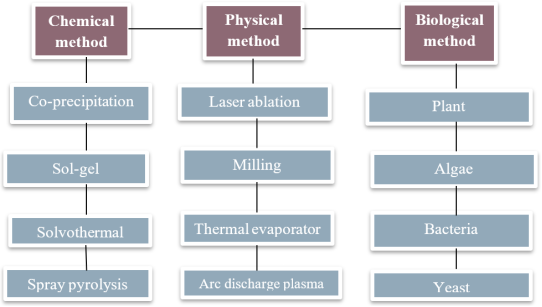
Nanomaterials (NMs) can be prepared through chemical, physical, and biological approaches, each employing different synthesis strategies. Chemical methods are generally rapid and economical, allowing for the production of a large quantity of NMs. However, they frequently involve harmful chemicals for stabilization and capping, raising environmental concerns. Biological methods offer a more sustainable and environmentally benign alternative, characterized by straightforward procedures and relatively low cost. In contrast, physical routes typically require high, prolonged processing time, and advanced instrumentation, making them more expensive in comparison . Green synthesis of nanomaterials (NMs), also referred to as biosynthesis, represents a bottom-up approach in which microorganisms, enzymes, or plant-derived phytochemicals act as reducing and stabilizing agents to convert metal precursors into nanoscale materials . This eco-friendly approach minimizes the reliance on toxic chemicals, reduces energy consumption, and promotes the formation of safer end products and by-products . Various techniques for the synthesis of nanomaterials are demonstrated in Figure 1.
Figure 1. Various routes for the synthesis of nanomaterials .
2.3. Characterization of Nanomaterials
Nanomaterials are characterized by determining not only particle dimension and morphology but also crystallinity, elemental composition, and other physicochemical characteristics. Certain techniques are primarily used to investigate the sizes, shape, and surface feature of nanostructures, while others provide detail information on internal structure and atomic arrangement. Commonly applied techniques include electron microscopy, X-ray scattering, and optical or electronic spectroscopic analyses . In transmission electron microscopy (TEM), the incident electron beam is allowed to penetrate through a thin sample at a high acceleration voltage. The interaction between the sample and the electron beam produces images. On the other hand, scanning electron microscopy (SEM) creates images by focusing a high-energy electron beam onto a sample's surface and then detecting signals from the incident electrons' interaction with the sample's surface. Electronic absorption spectroscopy is used to measure the attenuation of a beam of light after it passes through or is reflected off a sample surface. Electron microscopy is more advantageous in analyzing nanomaterials directly because information on their shape and atomic structures can be simultaneously obtained. In contrast, X-ray diffraction provides only diffraction patterns related to the averaged structure of atomic arrangements of a sample, particularly crystal structures . It is based on monochromatic X-rays and a crystalline sample interacting constructively. When conditions satisfy Bragg's law (nλ= 2dsinθ), the interaction of incident rays with the sample creates constructive interference, where n is an integer, λ is the wavelength of the X-rays, d is the inter-planar spacing creating the diffraction, and θ is the diffraction angle . XRD could aid in mineral phase identification by utilizing d-spacing values and references from the database .
3. Carbon-based Nanomaterials
Carbon nanomaterials (CNMs) have long been of interest due to their vast properties and applicability in a variety of sectors. They have also been used for pre-analytical separation in many analytical systems and procedures, including chromatography and capillary columns . In recent years, a significant number of carbon-based nanomaterials, such as carbon nanotubes, graphene, nanodiamonds, fullerenes, carbon nanofibers, carbon nanodisks, and nanohorns, along with their functionalized forms, have been investigated in sample pretreatment and extraction procedures . Carbon-based nanomaterials have been widely used as adsorbents in the past decade and are well-known for their high adsorption capacity for various chemical compounds. Non-covalent forces such as hydrogen bonding, π–π stacking, electrostatic forces, van der Waals forces, and hydrophobic interactions enable these materials to interact with organic molecules due to their unique structures and electrical properties. Their attractive features make them ideal candidates for use as adsorbents, given their interactions and hollow or layered nanostructures . Carbon nanotubes (CNTs), graphene (G), graphene oxide (GO), and fullerenes are the most well-known carbon-based nanomaterials . In addition, similar to carbon nanotubes (CNTs), graphene (G), graphene oxide (GO), and reduced graphene oxide (RGO) are well-known sorbents used for separation and pre-concentration due to their excellent physical stability and ability to be functionalized . Fullerenes, CNTs, and, more recently, carbon nanocones and nanodiamonds have been utilized in the field of SPE to create innovative analytical procedures that offer added value compared to existing alternatives .
3.1. Graphene
Graphene (G) is a single-layer sheet of sp2 hybridized carbon atoms with a two-dimensional structure. It features a large specific surface area, high hydrophobicity, chemical adaptability, tunability, quick charge carrier mobility, and excellent chemical stability, among other properties. Furthermore, due to graphene’s massive delocalized π-electron system, it may generate strong hydrophobic and π-stacking contacts with various molecules. Therefore, G and G-based materials are attractive candidates for use as an adsorbent in sample preparation procedures . One major advantage of graphene over fullerenes and CNTs is that it can be synthesized from graphite, a very common and inexpensive material, without the need for metal catalysts . Various methods have been reported for the fabrication of G , with the most commonly adopted route involving the chemical oxidation of graphite to form graphene oxide (GO). This reduction step is typically performed using appropriate reducing agents such as hydrazine or hydroxylamine. The oxidation-reduction approach is regarded as an effective and inexpensive technique, especially for large-scale production of G Graphene oxide, unlike graphene, is highly soluble in water and possesses several reactive groups, while still maintaining the basic structure of graphene. This feature is particularly useful in the preparation of functional graphene materials or graphene composites .
Recent findings have shown that isolated graphene layers tend to collapse into stacked or aggregated assemblies due to π–π interactions, hydrophobic forces, and van der Waals attractions. This structural collapse highly reduces the material surface area, thereby limiting its performance for practical applications. To address this limitation, extensive research efforts have focused on transforming two-dimensional graphene sheets into three-dimensional structure such as foams, aerogels, and sponge-like networks. These structures efficiently inhibit restacking while maintaining accessible surface sites . Compared with 2D-G the 3D graphene structures show markedly improved performance characteristics including higher specific surface area, lower density, higher mechanical strength, and more efficient mass and electron transport kinetics. These advantages arise from the combined interaction between interconnected 3D-G sheet and the material’s superior intrinsic properties . Currently, 3D-G structures have primarily been used in super capacitors , sensors , batteries , and catalysis . The ultra-high surface area, 3D-G porous and hollow structure, and fast mass transport kinetics make it a good candidate for an effective adsorbent .
3.2. Carbon Nanotubes
Carbon nanotubes (CNTs) are considered the most important carbon-based nanomaterials. They consist of a one-dimensional structure formed by rolling up a graphene sheet. They were discovered by the Japanese scientist Iijima in 1991 . CNTs are carbon allotropes made of graphite, constructed in cylindrical tubes with diameters on the nanometer scale and lengths of several millimeters. Their structures have been produced using a variety of approaches, with the majority involving gas-phase procedures. Methods such as chemical vapor deposition (CVD) , laser-ablation , and carbon arc-discharge are used for the synthesis of CNTs. CNTs were initially synthesized using high-temperature preparation techniques like laser ablation or arc discharge. However, these methods have since been replaced by low-temperature chemical vapor deposition (CVD) techniques (800°C). This shift occurred because low-temperature CVD allows for precise control over the length, diameter, alignment, purity, density, and orientation of CNTs .
CNTs are highly effective for SPE because of their extensive adsorption surface and strong affinity for organic compounds. They are further classified into single-walled (SWCNTs) and multi-walled (MWCNTs) types, and have attracted significant interest due to their high capacity and interaction abilities. MWCNTs are preferred over SWCNTs due to the presence of concentric sheets that enhance interaction with analytes. Longer MWCNTs (5–15 µm) exhibit higher sorption capacities compared to shorter ones (1–2 µm). CNTs strongly interact with organic molecules through non-covalent forces such as hydrophobic interactions, hydrogen bonding, π-π stacking, electrostatic, and van der Waals forces. These interactions, along with their hollow and layered nanosized structures, make CNTs attractive sorbents. The presence of aromatic rings and functional groups within organic molecules that can form hydrogen bonds (e.g., –OH, NH2) further enhances the adsorption of these compounds .
4. Application of Nanomaterials for SPE and SPME
In the mid-1970s, sample preparation using SPE was introduced. SPE involves several steps such as conditioning, sample loading, rinsing, and eluting. Both online and offline modes of SPE are still being used and developed as conventional extraction methods. Some new modes, such as dispersive solid-phase extraction (d-SPE) and magnetic solid-phase extraction (MSPE), have also been developed in recent years based on the SPE principle. Commonly used sorbents include C18, C8, Florisil, mixed-mode/cationic exchange (MCX), mixed-mode/anion exchange (MAX), weak cation exchange (WCX), and weak anion exchange (WAX). However, these sorbents have major disadvantages such as poor selectivity and limited applicability for certain analytes of interest. New nanoscale sorbents, like carbon nanomaterials (CNTs, nanocones, nanodisks, nanofibers, G and GO), and metallic nanoparticles are increasingly being used in combination with existing analytical methods (SPE and SPME) for the extraction and preconcentration of target analytes . Although CNTs have an adsorption capacity to a certain extent, graphene has an advantage over CNTs for the following reasons, such as providing a higher adsorption capacity due to its large specific surface area and both sides of the layers are available for adsorption, are readily obtained in the laboratory by graphite ablation, have multiple sites of functional change, and can be used in most sample preparation techniques .
4.1. Graphene for SPE
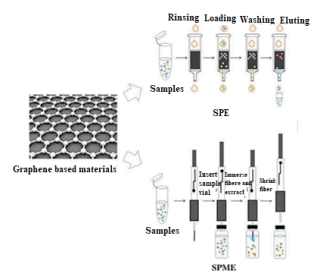
SPE is a popular sample preparation method because of its simplicity, speed, low cost, minimal reagent consumption, and compatibility with a variety of analytical techniques, both online and offline. The SPE procedures are illustrated in Figure 3 . The selectivity and efficiency of SPE are determined by the sorbent material utilized. Graphene is utilized in SPE as a sorbent due to its properties of a π-electron-rich structure, large surface area, and good thermal and chemical stability. In SPE, a sample solution is passed through a cartridge containing graphene to selectively retain analytes . Examples of its application include the adsorption of chlorophenols and various heavy metals, such as Pb and Cr, from water matrices through the use of diverse chelating reagents , glutathione in human plasma, and neurotransmitters from rat brain .
The adsorption performance of graphene-based nanoparticles has been critically compared with established materials such as C18 silica, graphitic carbon, and CNTs under carefully control experimental conditions . In the earlier investigation, Yan et al. (2014) demonstrated that hybrid nanocomposite composed of magnetite particles had a remarkable adsorption capacity of 220 mg/g. Based on these materials, the SPE method successfully detected isocarbophos residues in various matrices such as apple, cabbage, lake water, cowpeas, and rice. Method validation confirmed good linearity across the concentration range of 0.05 to 50 ng/mL, with an R² value of 0.9995. The method showed excellent sensitivity achieving detection limit (LOD) and quantification limit (LOQ) 0.0044 ng mL-1 and 0.0147 ng mL-1, respectively. The materials maintained their efficiency after being reused for at least 10 cycles with minimal reduction in adsorption capacity. When compared to carbon nanotubes (CNTs) graphene’s adsorption performance exceeds, which can be attributed to its two-dimensional structure and the presence surface functional groups. Their structural stability notably allowed them to be reused for up to 50 cycles of absorption and elution, while also providing effective preconcentration recoveries for chlorophenols and heavy metals .
Figure 2. Graphene-based materials in SPE cartridges and SPME fibers .
4.2. Graphene for Magnetic Solid-phase Extraction
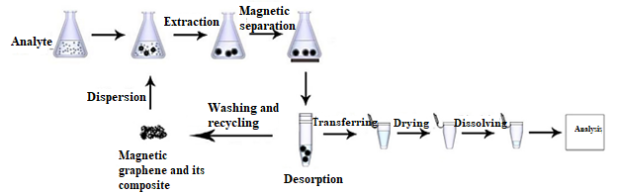
Magnetic solid-phase extraction (MSPE) offers several advantages over traditional SPE methods. The magnetic sorbent can be immersed in the sample solution, enhancing the interfacial interactions of the sorbents with the sample. MSPE has been introduced as a rapid and convenient sample preparation procedure . In MSPE, a magnetic adsorbent is immediately added to a sample solution containing the analytes of interest. The analytes are adsorbed onto the magnetic adsorbent, which is subsequently separated from the sample solution by applying an external magnetic field, making the separation easier and faster. Figure 3 illustrates the operating principles of MSPE. In contrast to conventional SPE, this method eliminates column packing and the time-consuming procedure of loading large volumes of samples. Due to efficient mass transfer, adsorption equilibrium is rapidly achieved. After that, the magnetic sorbent, along with the adsorbed analytes, can be easily separated using external magnetic .
In a previous study, magnetic graphene oxide modified with nano-zeolitic imidazolate framework structures demonstrated high efficiency in detection of trace fungicide residues in complex matrices, including water, honey, and fruit juice samples. The method's analytical performance demonstrated good repeatability and a wide concertation range between 1 and 1000 µg L-1, with correlation coefficients of R² = 0.9914. Detection limits for four triazole fungicides ranging from 0.014 to 0.109 µg L-1, while the corresponding quantification limits were between 0.047 and 0.365 µg L-1. Furthermore, the sorbent showed favorable regeneration behavior, enabling efficient removal of analytes with commonly used organic solvents like acetone, acetonitrile, and methanol. This supports its repeated use .
In the presence of graphene, Wang and co-workers synthesized magnetic graphene nanoparticles through in situ co-precipitation process involving Fe2+ and Fe3+ ion under an alkaline solution. The resulting material was used for the extraction of various organic pollutants from various liquid samples such as phthalate esters , triazine herbicides , and carbamate pesticides . The method achieved enrichment factors ranging from 247 to 582.4. The sorbent material maintained its extraction performance for up to ten successive reuse cycles, highlighting its reproducibility and applicability for routine analysis. The Fe3O4 nanoparticles were evenly dispersed on the graphene sheets, and this material, which has a saturation magnetization intensity of 72.8 emu g-1 and a specific surface area of 225 m2 g-1, may be reused more than ten times without losing its extraction capability .
Figure 3. Schematic diagram of magnetic solid-phase extraction (MSPE) .
4.3. Graphene for SPME
SPME method is a solvent-free and miniaturized microextraction method that integrates sampling, extraction, preconcentration, and sample introduction into a single step . It depends on the equilibrium distribution of analytes between the sample matrix and a stationary phase-coated fiber. Therefore, the coating material plays essential role in extraction efficiency . Graphene has been extensively applied as a coating material, where graphene-coated fibers are directly immersed in liquid samples to separate the target analytes. Several covalent and non-covalent approaches have been developed to immobilize graphene onto the surface of the fiber. These coatings materials generally show higher extraction efficiency, enhanced mechanical and thermal stability, and longer service life compared with conventional SPME fibers .
Chen and his colleagues fabricated a graphene-coated fiber by repeatedly dipping a stainless steel wire into a graphene suspension, then air drying it, resulting in a 6-8 µm thick coating. The fiber exhibited approximately 1.5 times higher extraction efficiency compared to commercially available 100 µm polydimethylsiloxane (PDMS) and 65 µm PDMS/divinylbenzene (PDMS/DVB) coatings . Similar approaches were adopted by Wang and colleagues to prepare graphene-coated SPME fiber for the analysis of carbamate pesticide and triazine herbicide in water samples .
4.4. Analytical Application of Graphene for SPE, MSPE and SPME Methods
Chlorophenols in tap and river water were separated using graphene (G) as a sorbent through SPE and determined by HPLC–DAD, obtaining recoveries of 77.2–116.6% with limits of detection (LODs) of 0.1–0.4 ng mL-1; the method employed a cartridge-packed format . Cr (III) in tap, sea, and river water was preconcentrated using graphene (G) via SPE and analyzed by FAAS, providing recoveries of 95.7–101.2% and an LOD of 0.5 ng mL-1, using a column-packed configuration . Lead (Pb) in various water samples and vegetables was extracted with graphene (G) using SPE and measured by FAAS, yielding recoveries of 95.3–100.4% and an LOD of 0.61 ng mL-1 with a column-packed system . Glutathione in human plasma was extracted using graphene (G) as an SPE sorbent and detected by fluorescence spectroscopy, achieving recoveries of 92–108% and an LOD of 0.01 nM in a column-packed setup . Neurotransmitters in rat brain tissue were isolated using graphene (G)-based SPE and determined by HPLC–FL, with recoveries ranging from 94.2–112.1% and LODs of 23.4–67.5 ng g-1 using a column-packed format . Phthalate esters in bottled and river water as well as beverages were extracted using magnetic graphene via magnetic solid-phase extraction (MSPE) and analyzed by HPLC–UV, giving recoveries of 80.0–106.0% and LODs of 0.01–0.04 ng mL-1 through magnetic dispersion . Triazine herbicides in reservoir, river, and lake water were preconcentrated using magnetic graphene with MSPE and detected by HPLC–DAD, achieving recoveries of 89.0–96.2% and LODs of 0.025–0.040 ng mL-1 using magnetic dispersion . Carbamate pesticides in reservoir, river, and pool water were extracted by magnetic graphene-based MSPE and determined by HPLC–DAD, with recoveries of 87.0–97.3% and LODs of 0.02–0.04 ng mL-1 via magnetic dispersion . Pyrethroid pesticides in pond water were extracted using graphene (G)-coated SPME fibers (stainless steel wire) and analyzed by GC–ECD, resulting in recoveries of 83–110% and LODs of 0.00369–0.0694 ng mL-1 . Carbamate pesticides in tap, sea, and lake water were extracted using graphene (G)-based SPME fibers (stainless steel wire) and determined by HPLC–DAD, providing recoveries of 83.8–95.4% and LODs of 0.1–0.8 ng mL-1 . Triazine herbicides in tap, sea, and lake water were preconcentrated using graphene (G)-coated SPME fibers (stainless steel wire) and analyzed by HPLC–DAD, achieving recoveries of 86.0–94.6% and LODs of 0.05–0.2 ng mL-1 .
5. CNTs for SPE
CNTs are widely applied in SPE and SPME because of their unique physical and chemical properties. The large surface area of these materials promotes effective adsorption and enrichment of target analytes. Additionally, their strong interactions with nonpolar and moderately polar compounds enhance extraction performance. Recently, there has been a significant increase in the use of CNTs based sorbents in SPE for the determination of inorganic and organic compounds. CNTs can be distinguished into three types based on their application in SPE: as-prepared, oxidized, and functionalized CNTs. As-prepared CNTs are directly produced from synthetic processes. Their ability to absorb metal ions is typically low due to their hydrophobicity and lack of functional binding groups on the surface. The second type of CNTs is created by oxidizing as-grown CNTs (which contain hydroxyl, carboxyl, and carbonyl groups), and they can retain a variety of metals when the pH is above the oxidized CNTs' isoelectric point. The third type is primarily obtained by modifying oxidized CNTs with different functional groups. It is recommended to increase the selectivity for various target compounds using oxidized and functionalized CNTs .
Due to their accessible surface sites, inner cavities, and inter-nanotube space, as-prepared carbon nanotubes (CNTs) have been applied as sorbents in SPE to extract metal ions either in the presence or absence of chelating agents . In the previous study, Wu and co-worker employed single-walled CNTs (SWCNTs) as sorbent materials in online SPE micro-columns to the extraction and preconcentration of inorganic arsenic (As(III)) and antimony (Sb(III)) from water samples. In their procedure, ammonium pyrrolidine dithiocarbamate (APDC) was used as a chelating agent to form stable complex with in the target analyte .
In a related investigation, Soylak and Unsal presented the applications of multi-walled CNTs (MWCNTs) as SPE sorbents in combination with 8-hydroxyquinoline as a chelating agent. Their method enabled the determination of cadmium (Cd(II)), cobalt (Co(II)), nickel (Ni(II)), lead (Pb(II)), iron (Fe(III)), copper (Cu(II)), and zinc (Zn(II)) in variety of samples matrices including lichen, bovine liver, river sediment, pharmaceuticals, and water .
In a subsequent study, the same research group prepared a column based SPE method using multi-walled CNTs (MWNTs) for the preconcentration of Fe(III), Cu(II), Mn(II), and Pb(II) . The developed approach was applied to analyze metal ions in environmental samples; however, the reported enrichment factor was limited to 20 showing moderate preconcentration efficiency.
The extraction efficiency of oxidized CNTs was found to be higher than that of pristine CNTs. Based on this improvement; a new method was developed for the preconcentration of trace amounts of Cu, Co, and Pb in biological and water samples. This method involves using a micro-column packed with oxidized SWCNTs as a sorbent material . SWCNTs were oxidatively modified using concentrated HNO3, leading to the combination oxygen carrying functional groups including carboxyl, hydroxyl, and carbonyl moieties, onto their surfaces. This surface functionalization significantly enhanced the remarkable adsorption capabilities of oxidized SWCNTs for analytes, resulting in an enrichment factor of 50. Oxidized MWCNTs has been reported as easily synthesized and chemically stable SPE material for the enrichment of trace rhodium ions in aqueous solutions . In this procedure, rhodium ions were first complexed with 1-(2-pyridylazo)-2-naphthol (PAN) within a pH range of 3.2–4.7 to forming stable Rh-PAN complex. The resulting complex was successively retained on the surface of oxidized MWCNTs. The proposed method offers a relatively higher enrichment factor (EF=120) and a lower detection limit indicating improved sensitivity compared to several previously reported sorbent systems. .
5.1. CNT for SPME
CNTs has been integrated into wide range of SPME configurations, including fiber SPME, thin-film SPME, in-tube SPME, stir-bar microextraction, in-needle SPME, and in-tip SPME. In particular, the application of CNTs used as SPME fiber has received considerable attention. Such coatings demonstrate improved affinity towards both organic and inorganic analytes, showing promising performance in terms of adsorption efficiency, selectivity, and enrichment factor before instrumental analysis . Various established approaches have been reported to anchor CNTs onto supporting fibers for SPME applications. These approaches include dip coating in a CNT suspension , sol-gel method and electrophoretic deposition . Using HS-SPME, Sarafraz-Yazdi and co-worker introduced SPME method for detection of methyl tert-butyl ether (MTBE) in water samples. In their work MWCNTs grafted with poly (ethylene glycol) (PEG) were included as the extraction phase via a sol–gel technique providing a stable and efficient coating .
CNT based SPME fibers prepared through different coating approaches have been applied to analysis of pesticides in tea samples , methyl tertbutyl ether, ethyl tert-butyl ether, and methyl tert-amyl ether in human urine , bisphenol A and bisphenol F in canned food , and other non-polar and polar compounds in water samples . In many cases unmodified CNTs are used directly as sorbent material. However surface modified CNTs are expected to offer enhanced extraction efficiency and selectivity. For example Sun and co-worker developed a carboxylated SWCNT fiber for the determination chlorophenols and organochlorine pesticides in aqueous samples . The modified fiber demonstrated superior extraction performance compared to commercially available SPME fibers. In another investigation, an amine-functionalized MWCNT based SPME fiber was fabricated for the extraction of six phenols from aqueous samples . This material achieved lower detection limits for the target analytes compared to both commercial fibers and previously reported. Moreover, it demonstrated excellent chemical and thermal stability, maintaining performance under acids, alkalis, organic solvents, and elevated temperatures .
5.2. Analytical Application of CNTs for SPE and SPME
Cd(II), Cu(II), and Pb(II) in environmental samples were extracted using multi-walled carbon nanotubes (MWCNTs) as sorbents through solid-phase extraction (SPE) and determined by ICP-AES, achieving recoveries of 98–102% with limits of detection (LODs) of 0.18–0.22 ng/mL; the sorbent was packed in a column . Arsenic (As) and antimony (Sb) in water samples were preconcentrated using MWCNTs via SPE and analyzed by ICP-MS, providing LODs of 0.02–0.05 µg/L with a column-packed configuration . Metal ions (Co, Cu, Pb, Fe, Mn, and Ni) in environmental samples were extracted using MWCNT-based SPE and measured by FAAS, yielding recoveries of 90–96% and LODs of 0.5–6.9 µg/L, with the sorbent packed in a column . Metal ions (Cd, Co, Ni, Pb, Fe, Cu, and Zn) in environmental samples were preconcentrated using MWCNTs through SPE and determined by FAAS, achieving recoveries of 95–101% and LODs of 1.0–5.2 µg/L using a column-packed format . Pesticides in tea samples were extracted using single-walled carbon nanotubes (SWCNTs) as SPME fiber coatings on stainless steel wire and analyzed by GC-MS, resulting in recoveries of 75.1–118.4% and LODs of 0.027–0.23 ng/mL . Methyl tert-butyl ether and ethyl tert-butyl ether in human urine were extracted using SWCNT-coated SPME fibers (stainless steel wire) and determined by GC-MS, providing recoveries of 90–95% and an LOD of 10 ng L-1 . Bisphenol A (BPA) and bisphenol F (BPF) in canned food samples were preconcentrated using SWCNT-coated SPME fibers (stainless steel wire) and analyzed by GC-MS, achieving recoveries of 80–120% and an LOD of 0.10 µg/kg . Phenols in aqueous samples were extracted using MWCNT-coated SPME fibers (stainless steel wire) and determined by HPLC, with LODs ranging from 0.25–3.67 ng/mL .
6. Conclusion and Future Perspectives
The present review focuses on the recent application of nanomaterials for sample extraction and preconcentration of various analytes, such as metal ions, polar, and nonpolar organic compounds. The high surface-to-volume ratio, surface functionality potential, and physical and chemical stability of nanomaterials make them excellent candidates for adsorption purposes, particularly for SPE. The application of carbon-based nanomaterials like graphene, carbon nanotubes, and carbon nanofibers in SPE and SPME is discussed and summarized in detail. These materials can act as sorbent agents in SPE or online SPE through direct interaction between the analyte and the nanoparticles. They can also be immobilized or coated on fibers for SPME, or possess special magnetic properties that simplify the analytical procedure when a magnetic field is used. Much work is needed in the development of SPE, particularly for magnetic-based nanomaterials, due to their numerous advantages in sample preparation. New nanomaterial preparation methods to produce or adapt to new approaches, especially in separation and preconcentration techniques, may be another area of focus.
However, despite their benefits, nanomaterials have drawbacks such as particle instability, impurities, biologically hazardous properties, and difficulties in synthesis, isolation, and application. Additionally, there is a lack of fast and safe disposal procedures for these materials. As a result, advancements will need to be made in the future to address these shortcomings.
Abbreviations

CNT

Carbon Nanotube

FAAS

Flame Atomic Absorption Spectroscopy

G

Graphene

GO

Graphene Oxide

HPLC

High-Performance Liquid Chromatography

ICP-MS

Inductively Coupled Plasma Mass Spectrometry

LLE

Liquid-Liquid Extraction

LOD

Limit of Detection

LOQ

Limit of Quantification

LPME

Liquid-Phase Microextraction

MSPE

Magnetic Solid-Phase Extraction

MWCNT

Multi-Walled Carbon Nanotube

NMs

Nanomaterials

SPE

Solid-Phase Extraction

SPME

Solid-Phase Microextraction

SWCNT

Single-Walled Carbon Nanotube

Acknowledgments
The authors are grateful to Dire Dawa University Institute of Technology, Department of Food Process Engineering, Ethiopia, for providing all kinds of support and inspiration to carry out this work.
Author Contributions
Bereket Tesfaye: Conceptualization, Methodology, Resources, Writing – original draft
Fekadu Melak: Data curation, Formal Analysis, Supervision, Writing – review & editing
Conflicts of Interest
The authors declare that there are no competing interests regarding the publication of this paper.
References
[1] Abulhassani, J., Manzoori, J. L., Amjadi, M., Hollow fiber based-liquid phase microextraction using ionic liquid solvent for preconcentration of lead and nickel from environmental and biological samples prior to determination by electrothermal atomic absorption spectrometry. J. Hazard. Mater. 2010, 176, 481–486.
[2] Sajid, M., Nazal, M. K., Adio, S. O., Applications of Nanomaterials in Miniaturized Extraction Techniques. Nanomater. Chromatogr. 2018, 0, 157–200.
[3] Pedersen-Bjergaard, S., Rasmussen, K. E., Electrical potential can drive liquid-liquid extraction for sample preparation in chromatography. TrAC - Trends Anal. Chem. 2008, 27, 934–941.
[4] Dadfarnia, S., Haji Shabani, A. M., Recent development in liquid phase microextraction for determination of trace level concentration of metals-A review. Anal. Chim. Acta 2010, 658, 107–119.
[5] Mogensen, O., Jensen, O. N., Serum protein profiling by solid phase extraction and mass spectrometry : A future diagnostics tool ? Proteomics 2009, 9, 1428–1441.
[6] Wei, F., Feng, Y. Q., Methods of sample preparation for determination of veterinary residues in food matrices by porous monolith microextraction-based techniques. Anal. Methods 2011, 3, 1246–1256.
[7] Li, X. S., Zhu, G. T., Luo, Y. B., Yuan, B. F., Feng, Y. Q., Synthesis and applications of functionalized magnetic materials in sample preparation. TrAC - Trends Anal. Chem. 2013, 45, 233–247.
[8] Jiang, X., Huang, K., Deng, D., Xia, H., Hou, X., Nanomaterials in analytical atomic spectrometry. Trends Anal. Chem. 2012, 39, 38–59.
[9] Lasarte-, G., Lucena, R., Nanoparticle-based microextraction techniques in bioana ­ lysis. Bioanalysis 2011, 3, 2533–2548.
[10] Mekuye, B., Abera, B., Nanomaterials: An overview of synthesis, classification, characterization, and applications. Nano Sel. 2023, 4, 486–501.
[11] Ahmadi, M., Elmongy, H., Madrakian, T., Abdel-Rehim, M., Nanomaterials as sorbents for sample preparation in bioanalysis: A review. Anal. Chim. Acta 2017, 958, 1–21.
[12] Gopidas, K. R., Whitesell, J. K., Fox, M. A., Nanoparticle-Cored Dendrimers : Synthesis and Characterization increase in interest in these aesthetically appealing macro-. Joural Am. Chem. Soc. 2003, 125, 6491–6502.
[13] Lucena, R., Simonet, B. M., Cárdenas, S., Valcárcel, M., Potential of nanoparticles in sample preparation. J. Chromatogr. A 2011, 1218, 620–637.
[14] Kailasa, S. K., Wu, H., Recent developments in nanoparticle-based MALDI mass spectrometric analysis of phosphoproteomes. Microchim. Acta 2014, 181, 853–864.
[15] Kailasa, S. K., Wu, H., Nanomaterial-based miniaturized extraction and preconcentration techniques coupled to matrix-assisted laser desorption / ionization mass spectrometry for assaying biomolecules. Trends Anal. Chem. 2014, 0, 2–36.
[16] Ruiz-palomero, C., Soriano, M. L., Valcárcel, M., Nanocellulose as analyte and analytical tool: opportunities and challenges. Trends Anal. Chem. 2016, 0, 1–55.
[17] Westerhoff, P., Overcoming implementation barriers for nanotechnology in drinking water treatment. Environ. Sci. Nano 2016, 3, 1241–1253.
[18] Zhang, B., Yan, B., Analytical strategies for characterizing the surface chemistry of nanoparticles. Anal. Bioanal. Chem. 2010, 396, 973–982.
[19] Valcárcel, M., Cárdenas, S., Simonet, B. M., Role of carbon nanotubes in analytical science. Anal. Chem. 2007, 79, 4788–4797.
[20] Lin Hao, Chenhuan Wang, Xiaoxing Ma, Qiuhua Wu, Chun Wang, Z. W., Magnetic three-dimensional graphene solid-phase extraction coupled with high performance liquid chromatography for the determination of phthalate esters in fruit juice. Anal. Methods 2014, 6, 5659–5665.
[21] Wierucka, M., Biziuk, M., Trends in Analytical Chemistry Application of magnetic nanoparticles for magnetic solid-phase extraction in preparing biological, environmental and food samples. Trends Anal. Chem. 2014, 59, 50–58.
[22] Yilmaz, E., Soylak, M., Functionalized Nanomaterials for Sample Preparation Methods. Elsevier Inc. 2019.
[23] Quintana, J. B., Ramil, M., Rodil, R., Rodriguez, I., Cela, R., New Sample Preparation Strategies for Analytical Determinations. 2014.
[24] Su, S. S., Chang, I., Review of Production Routes of Nanomaterials. 2017.
[25] Anwar, S. H., A Brief Review on Nanoparticles : Types of Platforms, Biological Synthesis and Applications. J. Mater. Sci. 2018, 6, 109–116.
[26] Singh, H., Desimone, M. F., Pandya, S., Jasani, S., George, N., Adnan, M., Aldarhami, A., Bazaid, A. S., Alderhami, S. A., Revisiting the Green Synthesis of Nanoparticles : Uncovering Influences of Plant Extracts as Reducing Agents for Enhanced Synthesis Efficiency and Its Biomedical Applications. Int. J. Nanomedcine 2023, 18, 4727–4750.
[27] Singh, P., Kim, Y., Zhang, D., Yang, D., Biological Synthesis of Nanoparticles from Plants and Microorganisms. Trends Biotechnol. 2016, 34, 588–599.
[28] Iravani, S., Zolfaghari, B., Green Synthesis of Silver Nanoparticles Using Pinus eldarica Bark Extract. Biomed Res. Int. 2013, 1–6.
[29] Mahgoub, H. A., Nanoparticles used for extraction of polycyclic aromatic hydrocarbons. J. Chem. 2019, 1–21.
[30] Mourdikoudis, S., Pallares, R. M., Characterization techniques for nanoparticles : comparison and complementarity upon studying. Nanoscale 2018, 10, 12871–12934.
[31] Veron-Parry, center for electronic M., Microscopy : an introduction. Analysis 2000, 13, 40–44.
[32] Rao, C. N. R., Biswas, K., Characterization of nanomaterials by physical methods. Annu. Rev. Anal. Chem. 2009, 2, 435–462.
[33] Hamed, H., Hale, W., Stern, B., X-ray diffraction to determine the mineralogy in soil samples in the UK. Int. J. Eng. Appl. Sci. Technol. 2021, 5, 91–98.
[34] Zhang, B. T., Zheng, X., Li, H. F., Lin, J. M., Application of carbon-based nanomaterials in sample preparation: A review. Anal. Chim. Acta 2013, 784, 1–17.
[35] Scida, K., Stege, P. W., Haby, G., Messina, G. A., García, C. D., Recent applications of carbon-based nanomaterials in analytical chemistry: Critical review. Anal. Chim. Acta 2011, 691, 6–17.
[36] Tian, J., Xu, J., Zhu, F., Lu, T., Su, C., Ouyang, G., Application of nanomaterials in sample preparation. J. Chromatogr. A 2013, 1300, 2–16.
[37] Nasir, S., Carbon-Based Nanomaterials / Allotropes : A Glimpse of Their Synthesis , Properties and Some Applications. MDPI 2018, 11, 1–24.
[38] Ruess, T., Stuart, T., A new structure. 1988, 26, 357–361.
[39] Chen, J., Zou, J., Zeng, J., Song, X., Ji, J., Wang, Y., Ha, J., Chen, X., Preparation and evaluation of graphene-coated solid-phase microextraction fiber. Anal. Chim. Acta 2010, 678, 44–49.
[40] Wang, L., Ambrosi, A., Pumera, M., “ Metal-Free ” Catalytic Oxygen Reduction Reaction on Heteroatom- Doped Graphene is Caused by Trace Metal Impurities Angewandte. Angew. chemie 2013, 125, 14063–14066.
[41] Zhu, B. Y., Murali, S., Cai, W., Li, X., Suk, J. W., Potts, J. R., Ruoff, R. S., Graphene and Graphene Oxide : Synthesis, Properties, and Applications. Adv. Mater. 2010, 22, 3906–3924.
[42] Marcano, D. C., Kosynkin, D. V, Berlin, J. M., Sinitskii, A., Sun, Z., Slesarev, A., Alemany, L. B., Lu, W., Tour, J. M., Improved Synthesis of Graphene Oxide. ACS Nano 2010, 4, 4806–4814.
[43] Stoller, M. D., Park, S., Zhu, Y., An, J., Ruoff, R. S., Graphene-Based Ultracapacitors. Nano Lett. 2008, 8, 3498–3502.
[44] Potts, J. R., Dreyer, D. R., Bielawski, C. W., Ruoff, R. S., Graphene-based polymer nanocomposites. Polymer (Guildf). 2011, 52, 5–25.
[45] Chen, W., Li, S., Chen, C., Yan, L., Self-Assembly and Embedding of Nanoparticles by In Situ Reduced Graphene for Preparation of a 3D Graphene / Nanoparticle Aerogel. Adv. Mater. 2011, 23, 5679–5683.
[46] Fang, Q., Shen, Y., Chen, B., Synthesis, Decoration and Properties of Three-Dimensional Graphene-Based Macrostructures : A Review. Chem. Eng. J. 2014, 264, 753–771.
[47] Li, J., Xie, J., Gao, L., Li, C. M., Au Nanoparticles − 3D Graphene Hydrogel Nanocomposite To Boost Synergistically in Situ Detection Sensitivity toward Cell-Released Nitric Oxide. Appl. Mater. Interfaces 2015, 7, 2726–2734.
[48] From, C., Samples, H., Liu, X., Zhou, X., Wang, C., Wu, Q., Wang, Z., Magnetic Three-dimensional Graphene Solid-phase Extraction Of Food Additives & Contaminants : Part A Magnetic three-dimensional graphene solid-phase extraction of chlorophenols from honey samples. Food Addit. Contam. - Part A Chem. Anal. Control. Expo. Risk Assess. 2015, 32, 40–47.
[49] Bello, A., Barzegar, F., Momodu, D., Dangbegnon, J., Taghizadeh, F., Manyala, N., Electrochimica Acta Symmetric supercapacitors based on porous 3D interconnected carbon framework. Electrochim. Acta 2015, 151, 386–392.
[50] Liu, A., Zhong, G., Chen, J., Weng, S., Huang, H., Chen, W., Lin, L., Lei, Y., Fu, F., Analytica Chimica Acta A sandwich-type DNA biosensor based on electrochemical co-reduction synthesis of graphene-three dimensional nanostructure gold nanocomposite films. Anal. Chim. Acta 2013, 767, 50–58.
[51] Choi, S. H., Lee, J., Kang, Y. C., Three-Dimensional Porous Graphene-Metal Oxide Composite Microspheres : Preparation and Application in Li-ion Batteries. Nano Res. 2014, 8, 1584–1594.
[52] Wu, Z., Yang, S., Sun, Y., Parvez, K., Feng, X., 3D Nitrogen-Doped Graphene Aerogel-Supported Fe3O4 Nanoparticles as E ffi cient Electrocatalysts for the Oxygen Reduction Reaction. Joural Am. Chem. Soc. 2012, 134, 9062–905.
[53] Lei, Y., Chen, F., Luo, Y., Three-dimensional magnetic graphene oxide foam / Fe3O4 nanocomposite as an efficient absorbent for Cr (VI) removal. J. Mater. Sci. 2014, 49, 4236–4245.
[54] Liu, L., Feng, T., Wang, C., Wu, Q., Wang, Z., Magnetic three-dimensional graphene nanoparticles for the preconcentration of endocrine-disrupting phenols. Microchim. Acta 2014, 181, 1249–1255.
[55] Iijima, S., Helical microtubules of graphitic carbon. Nature 1991, 354, 56–58.
[56] Abbasi, E., Aval, S. F., Akbarzadeh, A., Milani, M., Nasrabadi, H. T., Dendrimers : synthesis, applications, and properties. 2014, 9, 1–10.
[57] Large-scale boron nanowire nanojunctions and their highly-oriented arrays. 2004, 47, 621–633.
[58] Sokolov, P., Sokolov, P., Crystalline Ropes of Metallic Carbon Nanotubes. Science (80-.). 1996, 273, 483–487.
[59] Ganesh, E. N., Single Walled and Multi Walled Carbon Nanotube Structure, Synthesis and Applications. 2013, 2, 311–320.
[60] Pyrzynska, K., Separation & Purification Reviews Carbon Nanotubes as a New Solid - Phase Extraction Material for Removal and Enrichment of Organic Pollutants in Water. Sep. Purif. Rev. 2013, 37, 37–41.
[61] Ye, N., Shi, P., Applications of graphene-based materials in solid-phase extraction and solid-phase microextraction. Sep. Purif. Rev. 2015, 44, 183–198.
[62] Qu, J., Chen, H., Lu, C., Lin, J., On-line solid phase extraction of humic acid from environmental water and monitoring with flow-through chemiluminescence. Analyst 2012, 137, 1824–1830.
[63] Lin, X., Li, H., He, X., Hashi, Y., Lin, J., Wang, Z., Automated online pretreatment and cleanup recycle coupled with high-performance liquid chromatography-mass spectrometry for determination of deca-bromodiphenyl ether in human serum. J. Sep. Sci. 2012, 35, 2553–2558.
[64] Feng, Z., Yang, R., Du, B., Fast SPE and HPLC – DAD Determination of Brucine in Human Urine Using Multi-Walled Carbon Nanotubes Modified. Joural Anal. Chem. 2017, 72, 862–869.
[65] Sitko, R., Turek, E., Zawisza, B., Malicka, E., Talik, E., Heimann, J., Gagor, A., Feist, B., Wrzalik, R., Adsorption of divalent metal ions from aqueous solutions using graphene oxide. Dalt. Trans. 2013, 42, 5682–5689.
[66] Pérez-lópez, B., Merkoçi, A., Carbon nanotubes and graphene in analytical sciences. Microchim. Acta 2012, 179, 1–16.
[67] Online, V. A., residual organophosphorus pesticides in water †. J. Mater. Chem. 2013, 1, 1875–1884.
[68] Huang, K. J., Yu, S., Li, J., Wu, Z. W., Wei, C. Y., Extraction of neurotransmitters from rat brain using graphene as a solid-phase sorbent, and their fluorescent detection by HPLC. Microchim. Acta 2012, 176, 327–335.
[69] Liu, Q., Shi, J., Zeng, L., Wang, T., Cai, Y., Jiang, G., Evaluation of graphene as an advantageous adsorbent for solid-phase extraction with chlorophenols as model analytes. J. Chromatogr. A 2011, 1218, 197–204.
[70] Yuqi Yang, a Haiyang Tu, a Aidong Zhang, a D. D. and Y. L., Preparation and characterization of Au–ZrO2–SiO2 nanocomposite spheres and their application in enrichment and detection of organophosphorus agents. J. Mater. Chem. 2012, 22, 4977–4981.
[71] Chen, L., Wang, T., Tong, J., Application of derivatized magnetic materials to the separation and the preconcentration of pollutants in water samples. Trends Anal. Chem. 2011, 30, 1095–1108.
[72] Geng, Y., Ding, M., Chen, H., Li, H., Lin, J., Talanta Preparation of hydrophilic carbon-functionalized magnetic microspheres coated with chitosan and application in solid-phase extraction of bisphenol A in aqueous samples. Talanta 2012, 89, 189–194.
[73] Abdelhai, I., Guo, H., Ouyang, M., Lu, Z., Magnetic solid-phase extraction based on nano-zeolite imidazolate framework-8-functionalized magnetic graphene oxide for the quanti fi cation of residual fungicides in water, honey and fruit juices. Food Chem. 2020, 325, 126944.
[74] Lu, W., Xiao-Huan, Z., Chun, W., Zhi, W., Research developments for applications of graphene in sample preparation. Fenxi Huaxue/ Chinese J. Anal. Chem. 2014, 42, 136–144.
[75] Zhao, G., Song, S., Wang, C., Wu, Q., Wang, Z., Determination of triazine herbicides in environmental water samples by high-performance liquid chromatography using graphene-coated magnetic nanoparticles as adsorbent. Anal. Chim. Acta 2011, 708, 155–159.
[76] Wu, Q., Zhao, G., Feng, C., Wang, C., Wang, Z., Preparation of a graphene-based magnetic nanocomposite for the extraction of carbamate pesticides from environmental water samples. J. Chromatogr. A 2011, 1218, 7936–7942.
[77] Shi, C., Meng, J., Deng, C., ChemComm Enrichment and detection of small molecules using magnetic graphene as an adsorbent and a novel matrix of MALDI-TOF-MS w. Chem. commun. 2012, 48, 2418–2420.
[78] Catherine L. Arthur, J. P., Solid Phase Microextraction with Thermal Desorption Using Fused Silica Optical Fibers. Anal. Chem. 1990, 62, 2145–2148.
[79] Huang, G., Li, H., Zhang, B., Ma, Y., Lin, J., Talanta Vortex solvent bar microextraction for phthalate esters from aqueous matrices. Talanta 2012, 100, 64–70.
[80] Duan, C., Shen, Z., Wu, D., Guan, Y., Recent developments in solid-phase microextraction for on-site sampling and sample preparation. TrAC - Trends Anal. Chem. 2011, 30, 1568–1574.
[81] Links, D. A., Solid-phase microextraction with a novel graphene-coated fiber coupled with high-performance liquid chromatography for the determination of some carbamates in water samples. Anal. Methods 2011, 3, 2929–2935.
[82] Wang, C., Graphene-coated fiber for solid-phase microextraction of triazine herbicides in water samples. J. Sep. Sci. 2012, 35, 193–199.
[83] López-García, I., Rivas, R. E., Hernández-Córdoba, M., Use of carbon nanotubes and electrothermal atomic absorption spectrometry for the speciation of very low amounts of arsenic and antimony in waters. Talanta 2011, 86, 52–57.
[84] Nabid, M. R., Sedghi, R., Hajimirza, R., Oskooie, H. A., Heravi, M. M., A nanocomposite made from conducting organic polymers and multi-walled carbon nanotubes for the adsorption and separation of gold (III) ions. Microchim. Acta 2011, 175, 315–322.
[85] Martín, S. G., Méndez, J. Á., García, J. B., Pe, R. M., Latorre, C. H., Talanta A new flow injection preconcentration method based on multiwalled carbon nanotubes for the ETA-AAS determination of Cd in urine. Talanta 2011, 85, 2361–2367.
[86] Herrera-herrera, A. V, Ravelo-pérez, L. M., Hernández-borges, J., Afonso, M. M., Palenzuela, J. A., Rodríguez-delgado, M. Á., Oxidized multi-walled carbon nanotubes for the dispersive solid-phase extraction of quinolone antibiotics from water samples using capillary electrophoresis and large volume sample stacking with polarity switching. J. Chromatogr. A 2011, 1218, 5352–5361.
[87] Viñas, P., López-garcía, I., Multi-walled carbon nanotubes as solid-phase extraction adsorbents for the speciation of cobalamins in seafoods by liquid chromatography. Anal. Bioanal. Chem. 2011, 401, 1393–1399.
[88] Wu, H., Wang, X., Liu, B., Lu, J., Du, B., Zhang, L., Ji, J., Yue, Q., Han, B., Flow injection solid-phase extraction using multi-walled carbon nanotubes packed micro-column for the determination of polycyclic aromatic hydrocarbons in water by gas chromatography – mass spectrometry. J. Chromatogr. A 2010, 1217, 2911–2917.
[89] Soylak, M., Unsal, Y. E., Use of multiwalled carbon nanotube disks for the SPE of some heavy metals as 8-hydroxquinoline complexes. J. AOAC Int. 2011, 94, 1297–1303.
[90] Wu, H., Wang, X., Liu, B., Liu, Y., Li, S., Lu, J., Tian, J., Zhao, W., Yang, Z., Simultaneous speciation of inorganic arsenic and antimony in water samples by hydride generation-double channel atomic fl uorescence spectrometry with on-line solid-phase extraction using single-walled carbon nanotubes micro-col. Spectrochim. Acta Part B At. Spectrosc. 2011, 66, 74–80.
[91] Soylak, M., Unsal, Y. E., Simultaneous enrichment-separation of metal ions from environmental samples by solid-phase extraction using double-walled carbon nanotubes. J. AOAC Int. 2009, 92, 1219–1224.
[92] Gollu, S., Satiroglu, N., Soylak, M., Column solid phase extraction of iron (III), copper (II), manganese (II) and lead (II) ions food and water samples on multi-walled carbon nanotubes. Food Chem. Toxicol. 2010, 48, 2401–2406.
[93] Chen, S., Liu, C., Yang, M., Lu, D., Zhu, L., Wang, Z., Solid-phase extraction of Cu, Co and Pb on oxidized single-walled carbon nanotubes and their determination by inductively coupled plasma mass spectrometry. 2009, 170, 247–251.
[94] Ghaseminezhad, S., Afzali, D., Taher, M. A., Talanta Flame atomic absorption spectrometry for the determination of trace amount of rhodium after separation and preconcentration onto modified multiwalled carbon nanotubes as a new solid sorbent. 2009, 80, 168–172.
[95] Hussain, C. M., Mitra, S., Micropreconcentration units based on carbon nanotubes (CNT). Anal. Bioanal. Chem. 2011, 399, 75–89.
[96] Duchamp, M., Lee, K., Dwir, B., Seo, J. W., Kapon, E., Controlled Positioning of Carbon Nanotubes by Dielectrophoresis : Insights into the Solvent and Substrate Role. ACS Nano 2010, 4, 279–284.
[97] Augusto, F., Carasek, E., Gomes, R., Silva, C., Regina, S., Domingues, A., Martendal, E., New sorbents for extraction and microextraction techniques. J. Chromatogr. A 2010, 1217, 2533–2542.
[98] Abbasi, V., Sarafraz-yazdi, A., Amiri, A., Vatani, H., Determination of Aromatic Amines Using Solid-Phase Microextraction Based on an Ionic Liquid-Mediated Sol – Gel Technique. J. Chromatogr. Sci. 2016, 0, 1–5.
[99] Li, Q., Ding, Y., Yuan, D., Talanta Electrosorption-enhanced solid-phase microextraction of trace anions using a platinum plate coated with single-walled carbon nanotubes. Talanta 2011, 85, 1148–1153.
[100] Liu, X., Wang, X., Tan, F., Zhao, H., Quan, X., Chen, J., Li, L., Analytica Chimica Acta An electrochemically enhanced solid-phase microextraction approach based on molecularly imprinted polypyrrole / multi-walled carbon nanotubes composite coating for selective extraction of fluoroquinolones in aqueous samples. Anal. Chim. Acta 2012, 727, 26–33.
[101] Wu, F., Lu, W., Chen, J., Liu, W., Zhang, L., Single-walled carbon nanotubes coated fibers for solid-phase microextraction and gas chromatography – mass spectrometric determination of pesticides in Tea samples. Talanta 2010, 82, 1038–1043.
[102] Rastkari, N., Ahmadkhaniha, R., Yunesian, M., Single-walled carbon nanotubes as an effective adsorbent in solid-phase microextraction of low level methyl tert -butyl ether, ethyl tert -butyl ether and methyl tert -amyl ether from human urine. Joural Chromatogr. B 2009, 877, 1568–1574.
[103] Rastkari, N., Ahmadkhaniha, R., Yunesiana, M., Baleh, L. J., Mesdaghiniaa, A., Sensitive determination of bisphenol a and bisphenol f in canned food using a solid-phase microextraction fibre coated with single-walled carbon nanotubes before gc/ms. Food Addit. Contam. - Part A Chem. Anal. Control. Expo. Risk Assess. 2010, 27, 1460–1468.
[104] Minet, I., Hevesi, L., Azenha, M., Delhalle, J., Mekhalif, Z., Preparation of a polyacrylonitrile/multi-walled carbon nanotubes composite by surface-initiated atom transfer radical polymerization on a stainless steel wire for solid-phase microextraction. J. Chromatogr. A 2010, 1217, 2758–2767.
[105] Jiang, R., Zhu, F., Luan, T., Tong, Y., Liu, H., Ouyang, G., Pawliszyn, J., Carbon nanotube-coated solid-phase microextraction metal fiber based on sol-gel technique. J. Chromatogr. A 2009, 1216, 4641–4647.
Cite This Article
  • APA Style

    Tesfaye, B., Melak, F. (2026). The Role of Carbon Nanomaterials in Sample Preparation: Review. Science Discovery Chemistry, 1(1), 28-40. https://doi.org/10.11648/j.sdc.20260101.14

    Copy | Download

    ACS Style

    Tesfaye, B.; Melak, F. The Role of Carbon Nanomaterials in Sample Preparation: Review. Sci. Discov. Chem. 2026, 1(1), 28-40. doi: 10.11648/j.sdc.20260101.14

    Copy | Download

    AMA Style

    Tesfaye B, Melak F. The Role of Carbon Nanomaterials in Sample Preparation: Review. Sci Discov Chem. 2026;1(1):28-40. doi: 10.11648/j.sdc.20260101.14

    Copy | Download

  • @article{10.11648/j.sdc.20260101.14,
      author = {Bereket Tesfaye and Fekadu Melak},
      title = {The Role of Carbon Nanomaterials in Sample Preparation: Review},
      journal = {Science Discovery Chemistry},
      volume = {1},
      number = {1},
      pages = {28-40},
      doi = {10.11648/j.sdc.20260101.14},
      url = {https://doi.org/10.11648/j.sdc.20260101.14},
      eprint = {https://article.sciencepublishinggroup.com/pdf/10.11648.j.sdc.20260101.14},
      abstract = {Sample preparation plays a vital role in analytical chemistry, particularly for the isolation and enrichment of trace analytes from complex matrices. Conventional techniques such as solid-phase extraction (SPE) and solid-phase microextraction (SPME) are widely employed; however, their efficiency is often limited by the performance of traditional sorbents. These conventional materials may suffer from low selectivity, limited adsorption capacity, and reduced stability under varying analytical conditions. As a result, there has been growing interest in developing advanced materials that can overcome these limitations and enhance analytical performance. Recent advances in nanotechnology have introduced carbon-based nanomaterials as promising alternatives for improving extraction efficiency and selectivity. Materials such as graphene, graphene oxide, and carbon nanotubes (CNTs) exhibit unique physicochemical properties, including exceptionally large surface area, tunable surface functionality, high mechanical strength, and strong π–π interactions with a wide range of analytes. These features enable more efficient adsorption and improved sensitivity in analytical procedures. This review summarizes recent developments in the application of graphene and CNT-based nanomaterials for SPE, magnetic SPE (MSPE), and SPME. Their synthesis methods, surface modification strategies, and characterization techniques are discussed in detail. Furthermore, their analytical performance in environmental, food, and biological sample analysis is critically evaluated. The advantages, current limitations, and future prospects of carbon nanomaterials in enhancing analytical sample preparation are also highlighted, emphasizing their potential role in advancing modern analytical methodologies.},
     year = {2026}
    }
    

    Copy | Download

  • TY  - JOUR
    T1  - The Role of Carbon Nanomaterials in Sample Preparation: Review
    AU  - Bereket Tesfaye
    AU  - Fekadu Melak
    Y1  - 2026/04/10
    PY  - 2026
    N1  - https://doi.org/10.11648/j.sdc.20260101.14
    DO  - 10.11648/j.sdc.20260101.14
    T2  - Science Discovery Chemistry
    JF  - Science Discovery Chemistry
    JO  - Science Discovery Chemistry
    SP  - 28
    EP  - 40
    PB  - Science Publishing Group
    UR  - https://doi.org/10.11648/j.sdc.20260101.14
    AB  - Sample preparation plays a vital role in analytical chemistry, particularly for the isolation and enrichment of trace analytes from complex matrices. Conventional techniques such as solid-phase extraction (SPE) and solid-phase microextraction (SPME) are widely employed; however, their efficiency is often limited by the performance of traditional sorbents. These conventional materials may suffer from low selectivity, limited adsorption capacity, and reduced stability under varying analytical conditions. As a result, there has been growing interest in developing advanced materials that can overcome these limitations and enhance analytical performance. Recent advances in nanotechnology have introduced carbon-based nanomaterials as promising alternatives for improving extraction efficiency and selectivity. Materials such as graphene, graphene oxide, and carbon nanotubes (CNTs) exhibit unique physicochemical properties, including exceptionally large surface area, tunable surface functionality, high mechanical strength, and strong π–π interactions with a wide range of analytes. These features enable more efficient adsorption and improved sensitivity in analytical procedures. This review summarizes recent developments in the application of graphene and CNT-based nanomaterials for SPE, magnetic SPE (MSPE), and SPME. Their synthesis methods, surface modification strategies, and characterization techniques are discussed in detail. Furthermore, their analytical performance in environmental, food, and biological sample analysis is critically evaluated. The advantages, current limitations, and future prospects of carbon nanomaterials in enhancing analytical sample preparation are also highlighted, emphasizing their potential role in advancing modern analytical methodologies.
    VL  - 1
    IS  - 1
    ER  - 

    Copy | Download

Author Information
  • Abstract
  • Keywords
  • Document Sections

    1. 1. Introduction
    2. 2. Overview on Nanomaterials
    3. 3. Carbon-based Nanomaterials
    4. 4. Application of Nanomaterials for SPE and SPME
    5. 5. CNTs for SPE
    6. 6. Conclusion and Future Perspectives
    Show Full Outline
  • Abbreviations
  • Acknowledgments
  • Author Contributions
  • Conflicts of Interest
  • References
  • Cite This Article
  • Author Information