Research Article | | Peer-Reviewed

Pre-basic Seed Multiplication and Evaluation of Improved Soybean Varieties on Seed Quality and Seed Yield at Gobu Sayo District of Western Oromia, Ethiopia

Received: 15 September 2026     Accepted: 28 September 2026     Published: 21 October 2026
Views:       Downloads:
Abstract

One of the most significant sources of vegetable oil in the global economy has been soybeans. An essential component of increasing crop yield and output is seed. Improving seed quality is one of the most cost-effective and efficient inputs for agricultural development because it can significantly boost the crop's potential output. The Bako Agricultural Research Center carried out the seed multiplication during the cropping seasons of 2024, 2025, and 2026. Five Soya bean varieties, Bilo, Gute, Korme, Dhidhesa and kata were multiplied. Seed rate was used 60 kg ha-1 and spacing was used 40 cm between rows. The maximum yield (1766.7kg/ ha), were recorded for Bilo varieties and the minimum yield (1126.6 kg/ ha) was recorded from kata variety. Bilo variety is maximum thousand seed weight because of large seed size when compere to other varieties. The average yield of soybean in the study area was 1401.44 kilo gram per hectare which showed very satisfactory in respect to average yield. Over all, on an average the cost of cultivation per hectare of soybean was found to be a 98700 per hectare. The overall gross return and net return was found to be 208114.94ETBirr and 109414.94ETBirr respectively and the overall Benefit cost ratio was observed 1.108.

Published in Science Discovery Plants (Volume 1, Issue 3)
DOI 10.11648/j.sdplants.20260103.12
Page(s) 123-130
Creative Commons

This is an Open Access article, distributed under the terms of the Creative Commons Attribution 4.0 International License (http://creativecommons.org/licenses/by/4.0/), which permits unrestricted use, distribution and reproduction in any medium or format, provided the original work is properly cited.

Copyright

Copyright © The Author(s), 2026. Published by Science Publishing Group

Keywords

Seed, Clean, Yield, Variety, Demand

1. Introduction
One of the most significant vegetable oil crops in the global economy is soybeans (Glycine max L.). For small-holder farmers, the crop is also the primary source of nutritional protein (40%), vitamins, and vital minerals, especially for the most vulnerable members of low-income households like women and children. Additionally, it fixes biological nitrogen, which is crucial for improving soil fertility. When compared to investments in other cereal crops in Ethiopia, the productivity of soybeans receives only a small portion of official investments or is essentially ignored.
Since agriculture is the nation's largest economic sector, using new agricultural technologies is essential to increasing agricultural productivity and output, ensuring food security, and lowering poverty. In order to do this, Ethiopia's soybean breeding research program has produced 26 cultivars for the nation's various agro-ecologies . Despite the introduction of multiple better varieties, small-scale farmers have not used much of the enhanced seed. The Agricultural Sample Survey report states that soybeans were grown on 83797.17 hectares of land annually and produced 2086763.89 quintals, which is extremely low when compared to the global average. Poor extension services and a dearth of significantly better quality seed are two major causes .
Seed is a crucial element in raising crop output and yield. Improving seed quality can greatly increase the crop's potential output, making it one of the most economical and effective inputs for agricultural development . Better technological development and dissemination are crucial prerequisites for agricultural growth, especially in agriculturally oriented nations like Ethiopia. Aside from the development and dissemination of improved technologies, one of the primary reasons for the limited adoption of improved seeds, which further contributes to low agricultural output, is the lack of high-quality seeds at the right time and place along with a poor promotion system .
Variety creation, early generation seed multiplication, and seed system supply are activities carried out by federal and regional research institutions and universities . One of the most important inputs for significantly boosting soybean yield and production, ultimately guaranteeing food security and enhancing national livelihoods, is improved seed. It is necessary to have a thorough understanding of seed systems in order to facilitate and provide smallholder farmers with high-quality seed. The ability of the seed producer industry to generate the amount of seed required to satisfy the country's seed demand is constrained. The certified seed, which is sold to farmers for production, is created by multiplying the basic seed once more.
The certified seed, which is sold to farmers for production, is created by multiplying the basic seed once more. Inadequate availability of high-quality seeds, a lack of appropriate market channels, and a lack of market knowledge limit soybean production and productivity, especially in western Ethiopia. Due to the increasing demand for soy bean seed, we provide clean, large quantities of seeds to end users on schedule and at a fair price. Similarly, the goal of this soy bean basic seed multiplication is to address the issue of seed production and distribution in the FSRP areas of western Oromia.
2. Materials and Methods
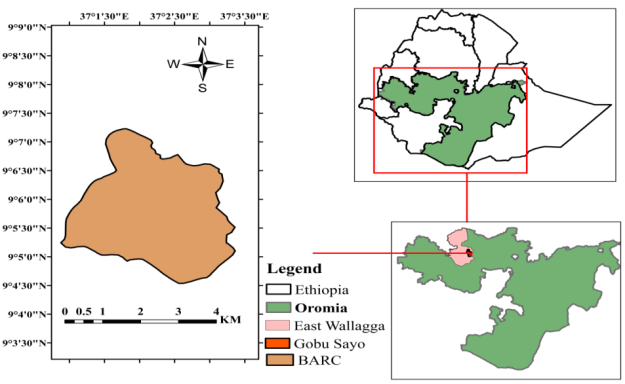
The Bako Agricultural Research Center, which is situated in a subhumid region of Western Ethiopia at latitude 9E6N, longitude 37E9E, and elevation 1650 m a.s.l., was the site of the seed multiplication during the three-year 2024–2026 cropping season (Figure 1). The average yearly minimum and maximum air temperatures are 13.5°C and 29.7°C, respectively. In 2024–2026, the region saw 1431 mm of annual rainfall, with June–August seeing the most precipitation. The Bako region's soil is nitosol and reddish-brown. The soil's pH ranges from 4.5 to 5.6, making it acidic.
Figure 1. The experimental site's geographic location.
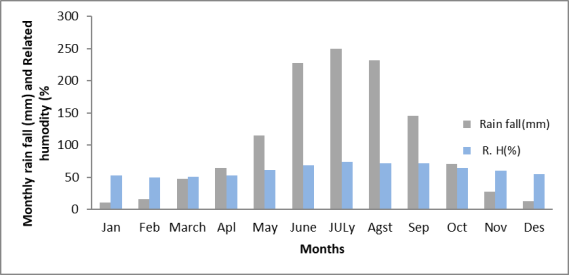
Figure 2. shows the average monthly rainfall (mm) and associated humidity (%) at Bako throughout the cropping seasons of 2024, 2025, and 2026.
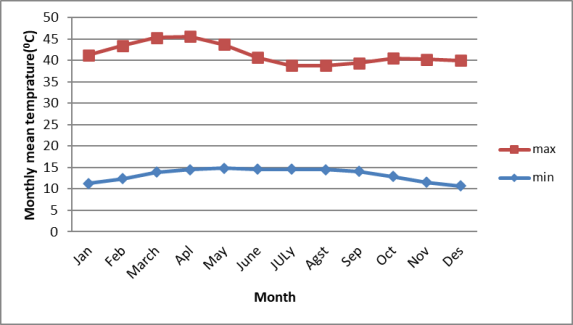
Source: Weather data from the Bako Agricultural Research Center in Bako, West Shewa, Ethiopia.

Download: Download full-size image

Figure 3. Average monthly high and low temperatures (°C) at Bako during the cropping season of 2024–2026.
Five Soya bean varieties, Bilo, Gute, Korme, Dhidhesa and kata were multiplied on six ha of land. Seed rate was used 60 kg ha-1 and spacing was used 40 cm between rows. All recommended agronomic practices were conducted. Soybean varieties were harvested and tested seed quality in BARC laboratory. When the crop reached harvesting maturity, it was hand harvested and sun-dried. Next, according to , a Complete Randomized Design (CRD) with four replications was used to test seed quality analysis in a lab. Using a spatula and a purity work board, the working sample was divided into pure and broken seeds . Purity seed was determined in percentage by using following formula:-
Purity (%)=Wheight of pure cseed gTotal wheight of working sample (g)x100
The air oven method was used to determine the moisture content of the seeds. After reaching the necessary temperature, the samples were dried for 17 hours at 103°C. Sand samples were then stored in the oven for drying. The container was moved into the desiccators at the conclusion of the drying period, the desiccators were sealed, and the sample was left to cool. The moisture content was then determined using the following formula after it was weighed once again.
MC=(M3-M2)(M2-M1) x100%
Where M =seed moisture content
M1= weight of the empty container with its lid.
M2= weight of the container with its cover and seed before drying
M3= Weight of the container with its cover and seeds after drying
Every variety of soybean seed was tested for germination using a complete randomized design. Four hundred (400) seeds were randomly selected from the purity test's mixed pure seed component and split into four repetitions, each containing 100 seeds. The seeds were sowed at a same temperature (0C) in a seed germinator. Seven days after planting, the seedlings were counted and classified as normal, aberrant, hard, or dead. The standard germination was computed as a percentage .
Germination test %=total number of nornal seedlingntotal number of seed plantedx100
3. Result and Discussion
Rainfall totals during the soybean growing season varied across the study's years. June, July, and August saw the most total rainfall (Figure 2). Since seed is more valuable than grain, a higher quality of management should be used. Agronomic approaches for seed crops, however, are fundamentally the same as those for regular crops in that field techniques that increase production must be properly considered. Using the right seed parents of the right seed class, growing the seed apart from contaminated crops, and eliminating off-types are ways to ensure genetic purity. Based on seed demand, high-quality soybean seeds were produced in the 2024–2026 production year. Thus, on six hectares of land, five Varieties of soy beans-Bilo, Gute, Korme, Dhidhesa, and Kata were multiplied. From the preparation of the ground to the seed harvest, constant attention was given.
3.1. Seed Yields of Soybean Varieties
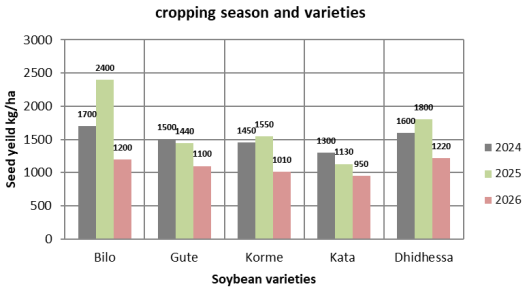
Genetic changes in pod count, branch number, plant height, and seed weight result in significant variability in seed output amongst soybean cultivars. The varieties Bilo, Dhidhesa, Korme, and Gute had the highest yield results (1766.7 kg/ha), (1540 kg/ha), (1336.6 kg/ha), and (1316.6 kg/ha) based on the mean of three-year yield data, while the Kata variety had the lowest yield result (1126.6 kg/ha) (Figure 4). Bilo has the highest yield (2400 kg/ha in the 2025 cropping season) and the highest yield (1766.7 kg/ha in the three-year mean of data) among the five types of soy beans. In the three-year cropping season, the Dhidheesa variety will be produced after Bilo (Figure 4). The results of the current study are comparable to those of , who noted that soybean cultivars differed significantly in terms of their potential for yield. In a similar vein, examined one assessment of soybean varieties and found that, depending on performance, there was a considerable difference in grain production.
Figure 4. seed yield of soybean varieties in 2024, 2025 and 2026 cropping season.
3.2. Thousand Seed Weight and Purity Seed
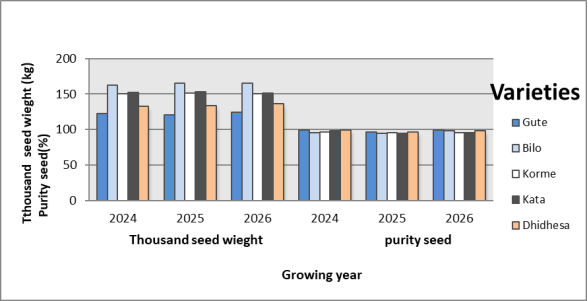
Seed quality analysis: Soybean seed obtained from farm land were harvested and seed quality was determined. The Seed quality is done, when after seed has been harvested, threshed, cleaned and stored. The experiment was conducted in a Complete Randomized Design (CRD) with four replications as per procedure. The thousand seed weight of soybean typically ranges from 120 to 190 grams, though extreme small or large specialty varieties can span from 50 to 270 grams. This variation depends heavily on the specific cultivar, growing environment, and management practices . The maximum weight of thousand seed yield (162.8 g) was recorded for the variety bilo and the minimum thousand weight of seed yield (122.3 g) was recorded for the gute variety. Among these five varieties bilo variety has large seed size so it has maximum thousand seed weight. Accordingly gute variety has small seed size than bilo variety therefore lower thousand seed wieght than bilo variety. This finding is similar to the finding of which observed a significant difference among soybean varieties based on their thousand seed weights.
The purity and other purity components were determined in percent. According to the three-year data, Gute and dhidhesan Varieties were highest purity seed (99%) from other varieties (Figure 5). Among these varieties Kata and korme varieties were lowst purity seed but in terms of seed quality standards all five varieties ((Gute (98.6%), Dhidhesa (98), Bilo (97), Korme (96.6) and Kata (96.5) were above seed purity standard. The purity present of all varieties was above 95%. (Figure 4). All varieties were accepted for seed purity. The result similar to Indicated that seed quality was determined by pure seed and damaged seeds.
Figure 5. Thousand seed weight (gm) and Purity seed (%) of Soybean varieties in 2024, 2025 and 2026 cropping season.
3.3. Germination Test and Moisture Content (%)
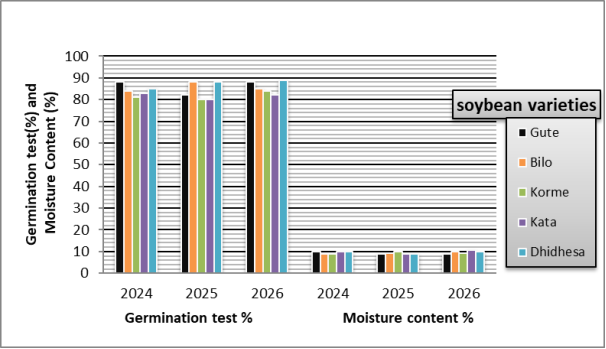
From the mean of three year yield data, the maximum germination test results (87.6%), (85.6), (84.6%), (82%) and (81%) were recorded for varieties, Dhidhesa, Bilo, Gute, Kata and Korme respectively and the minimum germination percent (81%) was recorded from Korme variety (Figure 6). This finding similar to reported that germination seed significantly difference in varieties. The results of this research of moisture content from three year mean data were (10%), (9.8%), (9.6%), (9.2%) and (9%) korme, gute, dhidhesa, bilo and kat respectively (Figure 6).
Figure 6. Germination test and Moisture content of Soybean varieties in 2024- 2026.
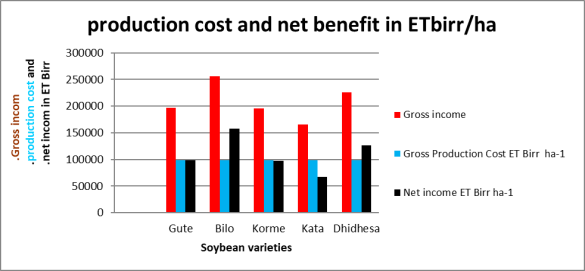
Production cost is the total money a business spends to make a product or service. Profit is the money left over after you subtract those total costs from your total sales revenue. Soybean production costs and net income vary widely by region, farm size, and management intensity. The research area's average soybean production was 1401.44 kilograms per hectare, which was extremely good. Over all, on an average the cost of cultivation per hectare of soybean was found to be a 98700 per hectare. The overall gross return and net return was found to be 208114.94ETBirr and 109414.94ETBirr respectively and the overall Benefit cost ratio was observed 1.108 (Table 1 and Figure 7). Bilo and dhidhesa varieties were maximum net income (profit) 157,191.50ETbirr and 126,910.00ETbirr respectively when compeer to other varieties. The minimum net income obtained 67328.4ETbirr, 97067.0ETBirr and 98576.90 ET Birr from kata, Korme and Gute varieties respectively (Table 1 and Figure 7).
Figure 7. Soybean production cost and Net income per hector in mean of 2024-2026 cropping season.

Table 1. Estimation of Production cost and Net income of Soybean pre basic seed multiplication (ET Birr ha-1).

Varieties

Seed yield mean of three years

Gross income ET Birr ha-1

Gross Production Cost ET Birr ha-1

Net income ET Birr ha-1

Benefit Cost Ratio

Gute

1328.46

197,276.9

98,700

98,576.90

1.00

Bilo

1723.18

255,891.5

98,700

157,191.50

1.59

Korme

1318.30

195,767.9

98,700

97,067.90

0.98

Kata

1118.04

166,028.4

98,700

67,328.40

0.68

Dhidhesa

1519.26

225,610

98,700

126,910.00

1.29

Mean

1401.44

208114.94

98700

109414.94

1.108

4. Conclusion
In order to assess high-yielding varieties from enhanced varieties provided from the Bako Agricultural Research Center, five soybean varieties were assessed in 2024, 2025, and 2026 for three consecutive major cropping years. According to the research findings, the varieties Bilo, Dhidhesa, Korme, and Gute had the highest yield results (1766.7 kg/ha), 1540 kg/ha, 1336.6 kg/ha, and 1316.6 kg/ha, respectively), while the Kata variety had the lowest production result (1126.6 kg/ha).
Abbreviations

BARC

Bako AgriCultural Research Center

CBD

Compeletide Randamize Design

ET

Ethiopia Birr

KG

Kilo Gram

RH

Related Humidity

Acknowledgments
The authors would like to thank the Oromia Agricultural Research Institute (OARI) and Food System Resilience Program (FSRP) for financial support as well as Bako Agricultural Research Center (BARC) for facilitation during the fieldwork and write up activities.
Author Contributions
Megersa Debel: Conceptualization, Data curation, Formal Analysis, Investigation, Methodology, Software, Supervision, Writing – original draft
Belay Teressa: Methodology, Supervision, Validation, Visualization, Writing – review & editing
Data Availability Statement
The data supporting of this research finding are available within the research article and its supplementary materials.
Conflicts of Interest
The authors declare no conflicts of interest.
References
[1] MoANR. 2016. Plant variety release, protection and seed quality control directorate: Crop variety register issue No. 18. Addis Ababa, Ethiopia June, 2016 (Proceeding).
[2] CSA. 2021. Annual Agricultural Sample Survey 2020/21 (2013E.C.) Area and production of major crops.
[3] Kumlachew Alemu, 2015. Seed production and dissemination systems analyses: The case of Ethiopia. Seed, 35.
[4] Abebe, G. and Alemu, A., 2017. Role of improved seeds towards improving livelihood and food security at Ethiopia. International Journal of Research-Granthaalayah, 5(2), pp. 338-356.
[5] Abebe Atilew. 2010. A baseline survey on the Ethiopian seed sector. Submitted to the African seed trade association. Addis Ababa, Ethiopia.
[6] Pray, C. and Ramaswami, B., 1991. A framework for seed policy analysis in developing countries. Intl Food Policy Res Inst.
[7] ISTA (International Seed Testing Association). 1996. International Rules for Seed Testing. Seed Science and Technology, 1B288, Zurich, Switzerland.
[8] Milivojević, M., Ripka, Z. and Petrović, T., 2018. ISTA rules changes in seed germination testing at the beginning of the 21st century. Journal on processing and energy in agriculture, 22(1), pp. 40-45.
[9] MacMillan, K. P. and Gulden, R. H., 2020. Effect of seeding date, environment and cultivar on soybean seed yield, yield components, and seed quality in the Northern Great Plains. Agronomy journal, 112(3), pp. 1666-1678.
[10] Paulsen, M. R., Nave, W. R. and Gray, L. E., 1981. Soybean seed quality as affected by impact damage. Transactions of the ASAE, 24(6), pp. 1577-1582.
[11] Awoke, T., 2022. Performance Evaluation of Soybean (Glycine max L.) Varieties for Growth, Yield, and Yield Components under Irrigation at Lowland Area of South Omo Zone, Southern Ethiopia. Journal of Agriculture and Aquaculture, 4(2), pp. 5-10.
[12] Hunde, D. and Tefera, G., 2018. Participatory varietal selection and evaluation of twelve soybeans Glycine max (L.) Merrill] varieties for lowland areas of North Western Ethiopia. International Journal of Plant Breeding and Crop Science, 5(2), p. 403.
[13] Pylypenko, S. and Kovalyshyna, H., 2026. Development of soybean yield and seed productivity elements depending on the variety. Scientific Reports of the National University of Life and Environmental Sciences of Ukraine, 1(22), pp. 9-21.
[14] Odoba, A., Odiaka, N. I., Gbanguba, A. U. and Bashiru, M., 2016. Germination characteristics of twenty varieties of soybean (Glycine max (L.) Merr) stored for seven months. Scientia Agriculturae, 13(3), pp. 151-155.
Cite This Article
  • APA Style

    Debele, M., Teressa, B. (2026). Pre-basic Seed Multiplication and Evaluation of Improved Soybean Varieties on Seed Quality and Seed Yield at Gobu Sayo District of Western Oromia, Ethiopia. Science Discovery Plants, 1(3), 123-130. https://doi.org/10.11648/j.sdplants.20260103.12

    Copy | Download

    ACS Style

    Debele, M.; Teressa, B. Pre-basic Seed Multiplication and Evaluation of Improved Soybean Varieties on Seed Quality and Seed Yield at Gobu Sayo District of Western Oromia, Ethiopia. Sci. Discov. Plants 2026, 1(3), 123-130. doi: 10.11648/j.sdplants.20260103.12

    Copy | Download

    AMA Style

    Debele M, Teressa B. Pre-basic Seed Multiplication and Evaluation of Improved Soybean Varieties on Seed Quality and Seed Yield at Gobu Sayo District of Western Oromia, Ethiopia. Sci Discov Plants. 2026;1(3):123-130. doi: 10.11648/j.sdplants.20260103.12

    Copy | Download

  • @article{10.11648/j.sdplants.20260103.12,
      author = {Megersa Debele and Belay Teressa},
      title = {Pre-basic Seed Multiplication and Evaluation of Improved Soybean Varieties on Seed Quality and Seed Yield at Gobu Sayo District of Western Oromia, Ethiopia},
      journal = {Science Discovery Plants},
      volume = {1},
      number = {3},
      pages = {123-130},
      doi = {10.11648/j.sdplants.20260103.12},
      url = {https://doi.org/10.11648/j.sdplants.20260103.12},
      eprint = {https://article.sciencepublishinggroup.com/pdf/10.11648.j.sdplants.20260103.12},
      abstract = {One of the most significant sources of vegetable oil in the global economy has been soybeans. An essential component of increasing crop yield and output is seed. Improving seed quality is one of the most cost-effective and efficient inputs for agricultural development because it can significantly boost the crop's potential output. The Bako Agricultural Research Center carried out the seed multiplication during the cropping seasons of 2024, 2025, and 2026. Five Soya bean varieties, Bilo, Gute, Korme, Dhidhesa and kata were multiplied. Seed rate was used 60 kg ha-1 and spacing was used 40 cm between rows. The maximum yield (1766.7kg/ ha), were recorded for Bilo varieties and the minimum yield (1126.6 kg/ ha) was recorded from kata variety. Bilo variety is maximum thousand seed weight because of large seed size when compere to other varieties. The average yield of soybean in the study area was 1401.44 kilo gram per hectare which showed very satisfactory in respect to average yield. Over all, on an average the cost of cultivation per hectare of soybean was found to be a 98700 per hectare. The overall gross return and net return was found to be 208114.94ETBirr and 109414.94ETBirr respectively and the overall Benefit cost ratio was observed 1.108.},
     year = {2026}
    }
    

    Copy | Download

  • TY  - JOUR
    T1  - Pre-basic Seed Multiplication and Evaluation of Improved Soybean Varieties on Seed Quality and Seed Yield at Gobu Sayo District of Western Oromia, Ethiopia
    AU  - Megersa Debele
    AU  - Belay Teressa
    Y1  - 2026/10/21
    PY  - 2026
    N1  - https://doi.org/10.11648/j.sdplants.20260103.12
    DO  - 10.11648/j.sdplants.20260103.12
    T2  - Science Discovery Plants
    JF  - Science Discovery Plants
    JO  - Science Discovery Plants
    SP  - 123
    EP  - 130
    PB  - Science Publishing Group
    SN  - 3142-7421
    UR  - https://doi.org/10.11648/j.sdplants.20260103.12
    AB  - One of the most significant sources of vegetable oil in the global economy has been soybeans. An essential component of increasing crop yield and output is seed. Improving seed quality is one of the most cost-effective and efficient inputs for agricultural development because it can significantly boost the crop's potential output. The Bako Agricultural Research Center carried out the seed multiplication during the cropping seasons of 2024, 2025, and 2026. Five Soya bean varieties, Bilo, Gute, Korme, Dhidhesa and kata were multiplied. Seed rate was used 60 kg ha-1 and spacing was used 40 cm between rows. The maximum yield (1766.7kg/ ha), were recorded for Bilo varieties and the minimum yield (1126.6 kg/ ha) was recorded from kata variety. Bilo variety is maximum thousand seed weight because of large seed size when compere to other varieties. The average yield of soybean in the study area was 1401.44 kilo gram per hectare which showed very satisfactory in respect to average yield. Over all, on an average the cost of cultivation per hectare of soybean was found to be a 98700 per hectare. The overall gross return and net return was found to be 208114.94ETBirr and 109414.94ETBirr respectively and the overall Benefit cost ratio was observed 1.108.
    VL  - 1
    IS  - 3
    ER  - 

    Copy | Download

Author Information