Review Article | | Peer-Reviewed

Production of Potash from Green and Ripe Plantain Peels

Received: 8 May 2025     Accepted: 21 July 2025     Published: 29 December 2025
Views:       Downloads:
Abstract

Plantain peels are bulky rubbish in Man. However, Man households use chemical potasses to attenuate their sauces. The general aim of this study is to use plantain peels as a natural potash to attenuate the taste of certain Manx dishes. To achieve this objective, a preliminary survey was carried out on how potash is used in Man. Natural potash was manufactured after drying and incinerating plantain peels (green and ripe). The physico-chemical parameters of the potasses produced were determined. The survey revealed that 40% of the population uses chemical potasses. Determination of the physico-chemical parameters of the natural potasses produced enabled us to observe their alkaline nature and their richness in mineral salts. The potasses produced have potassium contents (24.53±0.45%-74.44±0.3%), calcium (0.07±0.2%-12.67±0.56%), iron (2.80±0.35- 3.01±0.45) and pH values (10.43 ± 0.68-10.45 ± 0.76). Potash based on green peel is the richest and most recommended. Processing plantain peels in the same way as natural potash would help to reduce waste.

Published in Science Journal of Analytical Chemistry (Volume 13, Issue 4)
DOI 10.11648/j.sjac.20251304.13
Page(s) 96-103
Creative Commons

This is an Open Access article, distributed under the terms of the Creative Commons Attribution 4.0 International License (http://creativecommons.org/licenses/by/4.0/), which permits unrestricted use, distribution and reproduction in any medium or format, provided the original work is properly cited.

Copyright

Copyright © The Author(s), 2025. Published by Science Publishing Group

Keywords

Plantain Banana, Peel, Green, Ripe, Potash, Man

1. Introduction
The plantain banana is grown mainly for its fruit . Plantains are used to make dishes in some African and European countries .
In terms of global production, they are the fourth most important agricultural product after wheat, rice and maize, ranking first in fruit production and a crop that plays a major role in the food security of developing countries In Côte d'Ivoire, plantain is the third most important food crop after yam and cassava . Its fruits are very useful for human and livestock nutrition, as they are a source of proteins, lipids and vitamins . Consumption by humans varies according to circumstances, and they can be used as a dessert or as a main course in developing countries . Plantain peel can also be used as a therapeutic remedy, as well as being useful in making beer in Central Africa . However, in Côte d'Ivoire, plantain peels are discarded and constitute bulky refuse . Plantain peel, on the other hand, has a high potassium content (59.5%) according to and also has flavours that are beneficial to humans . Some Ivorian households use chemicals such as sodium bicarbonate, sodium hydrocarbonate, sodium chloride and potassium hydroxide to preserve or modify the appearance or taste of food during cooking . The use of these chemicals without respecting the dose standards in cooking food can lead to illness . Potassium hydroxide, commonly known as potash and used in cooking certain Ivorian dishes, is a solid that is very rich in potassium but deteriorates easily and is no longer necessary once exposed to the air .
Scientific studies are being carried out into the manufacture of natural and inexpensive additives capable of preserving the colour of food during cooking . The main objective of this study is to use plantain peel as a food additive in the cooking of certain local dishes in the town of Man. Specifically, the aim is to:
1) conduct a survey of households in the town of Man to determine how potash is used,
2) manufacture potash from the green, ripe peel of plantain bananas,
3) compare the physico-chemical parameters of potash made from plantain peel with those of potash made from cocoa shells produced by the local population of Man,
4) and finally, test these potasses on a local maize-based meal.
2. Materials and Methods
2.1. Plant Material
The plant material used was plantain (Musa x AAB). Green and ripe plantain peels were used, along with cocoa pods (Theobroma cacao).
2.2. Geographical Location of the Town of Man
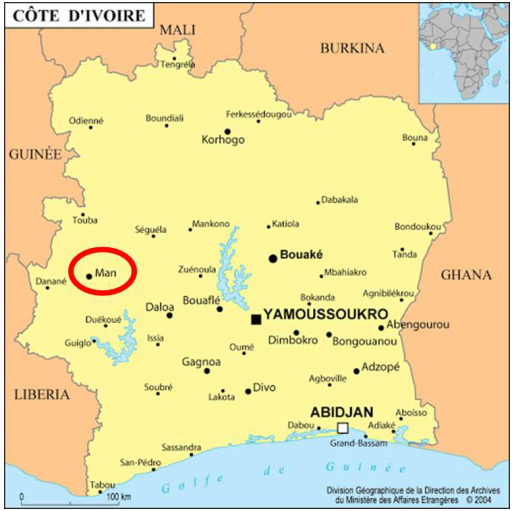
This study was carried out in the town of Man. The town of Man is located in the west of Côte d'Ivoire, at latitude 7° 24‘ North and longitude 7° 33’ West. It is bordered to the north and west by Biankouman and Danané, and to the south by Bangolo (Figure 1). It is a mountainous, forested area with a mountain climate, a long rainy season and a short dry season that favours the formation of dense forest. The commune of Man is one of the major plantain-producing regions in Côte d'Ivoire .
Figure 1. Geographical location of the town of Man.
2.3. Method
2.3.1. Survey
A survey was conducted in the town of Man to determine the frequency of use of potash in cooking. For this study, 04 districts were chosen because of the high use of plantain in these areas. The survey was carried out among several households in these neighbourhoods.
2.3.2. Sampling
The ethnobotanical investigations were carried out from January to March 2021 in the neighbourhoods of the city of Man (CAFOP, Libreville, Thérèse, and Koko neighbourhoods). The survey was carried out in 100 households, with 25 households in each neighbourhood. The methodology adopted was that of a semi-structured interview based on a pre-developed questionnaire used by many authors (). The questionnaires focused on the frequency and mode of use of potash in these different districts of the city of Man. The target population consisted of housewives, restaurant owners and porridge sellers who were selected at random. The interviews were generally conducted with the help of an interpreter in the local language Yacouba, in Dioula or in French, depending on the interviewees.
2.3.3. Analytical Methods
(i). Nutritional Analysis of Plantain Peels and Cocoa Pods Collected for Potash Production
The water and ash content of plantain peels (green and ripe) and cocoa pods were determined using the method.
(ii). Manufacture of Potash from Plantain Peels and Cocoa Bean Shells
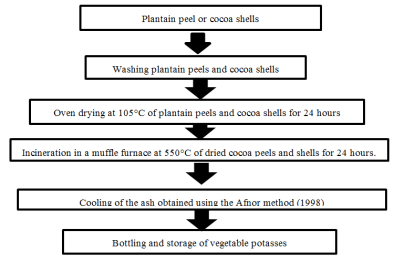
Potash was manufactured using the method described in . Plantain peelings (green and ripe) and cocoa shells were oven-dried at 105°C for 24 hours. After drying, the fragments were incinerated in a muffle furnace at 550°C for 5 h. The ash obtained was cooled on the bench using method . The cooled ash was placed in flasks and stored at room temperature. The ash from each plant sample was then spread out in a sieve and washed with distilled water. The mixture was filtered for 24 h and the filtrate obtained was filtered through filter paper. The ash filtrate thus obtained represents the potassium stock solution. This potash stock solution was boiled on an electric stove at 350°C for 4 hours to obtain a paste, which was oven-dried at 200°C for 6 days to obtain the solidified form found on the various markets (Figure 2).
Figure 2. Plant potash production diagram (Source: ).
(iii). Physico-chemical Analysis of the Potasses Obtained
The pH of the various potasses obtained was determined using a pH meter. The mineral salts contained in the various potasses obtained were determined using an X-ray spectrometer.
(iv). Organoleptic Testing of the Potasses Obtained
The potasses obtained were tested on maize grains immersed in water for 24 hours.
2.3.4. Statistical Analysis
The physical and chemical parameters were analysed using XLSTAT 7.5.3 software. Means were compared using Duncan's test with a threshold of 5%.
3. Results and Discussion
3.1. Surveys
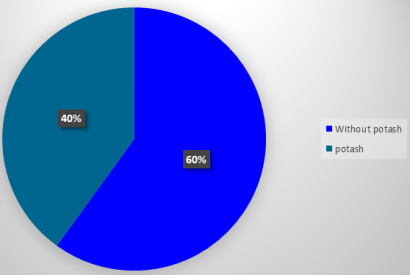
Our survey revealed that 40% of the population use potash while 60% do not. The population uses both homemade and chemical potash (Figure 3). Homemade potash is based on cocoa shells and chemical potash is based on potassium hydroxide. Those who use potash revealed that they use it to soften beef (68%), to reduce the acidity of certain sauces such as tomato and leaf sauces (24%) and also to preserve sauces (8%) (Figure 4).
The arguments given by potash users in the town of Man are in line with those of , who states that African potash is used a lot in African cooking to reduce or completely eliminate the acidity of certain dishes such as tomato sauce or sorrel sauce. It makes certain leaves easier to cook and prevents bloating when introduced into the preparation of beans.
The low level of potash use in some areas of Man is thought to be due to the fear of stomach ulcers. Potash is also used more by porridge sellers and some restaurant owners in Man.
Figure 3. Breakdown of respondents on the use of potash.
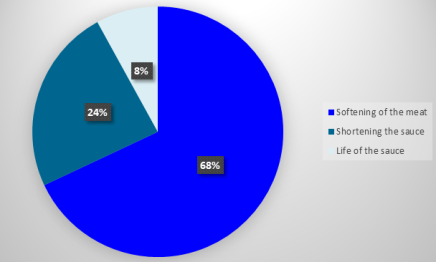
Figure 4. Distribution of potash use in the town of Man.
3.2. Analytical Methods for Plantain Peels and Cocoa Shells
3.2.1. Determination of Water Content
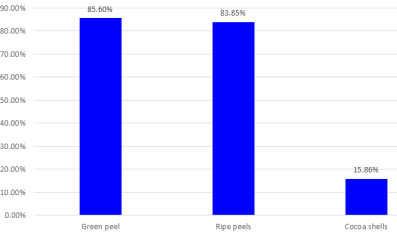
The results of the moisture content of the three (3) samples used are shown in Figure 5. These results show that Theobroma cocoa hulls have the lowest moisture content (15.86 ± 0.36%), while green Musa paradisica peels have the highest moisture content (85.60 ± 0.56%) and that of ripe peels is 83.85 ± 0.76%. Green and ripe plantain peels have different water contents at the 5% threshold.
The water contents of the plantain peels used and of the cocoa shells are lower than those obtained by . The authors obtained water contents for plantain peels of between 72.38 ± 0,23% and 81.96 ± 0,45%, compared with 10.35 ± 0,76% for cocoa shells. This difference was due to the variety of plantains and cocoa pods used. The water content of green plantain peels is similar to that of peels of the Orishele variety obtained by , which is 85.3%.
Figure 5. Moisture content of plantain peels (green and ripe) and cocoa shells.
3.2.2. Determination of Ash Content
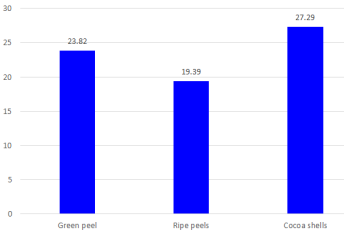
The ash contents of the three plant materials, Theobroma cacao shells and ripe and green Musa paradisica peels, are shown in Figure 6. The analyses show that cocoa shells have the highest ash content (27.19 ± 0.45%). Green peels had an ash content of 23.82 ± 0.76%, while ripe peels had an ash content of 19.28 ± 0.13%. The samples used have different ash contents at the 5% threshold.
The ash content of the plantain peels and cocoa shells used is lower than that obtained by when cassava leaf chlorophylls were preserved by potash filtrates. This difference in results can be explained by the difference in homogeneity of the ashes obtained. In fact, the ash from peels (green and ripe) presents an aggregation of ash, whereas the ash from cocoa shells is a homogeneous powder.
Figure 6. Ash content of plantain peels (green and unripe) and cocoa shells.
3.3. Physico-chemical Analysis of the Potash Obtained
3.3.1. Determination of Ash Minerals
The mineral profile of the potasses manufactured is shown in Table 1. The potasses produced contain the same types of mineral salts but at different levels at the 5% threshold. The chemical or mineralogical composition of the ash from plant matter showed the presence of potassium, calcium, iron and zinc. The green skins and cocoa shells have a potassium content of 74.44 ± 0.34% and 80.01 ± 0.91% respectively, compared with 24.53 ± 0.45% for the ripe skins. The richness of the mineral elements potassium, calcium and magnesium in plantain peel potash was also reported by . This difference in potassium content in plantain peel potash could be explained by the different physiological state of the bananas.
The peel of green plantains contains large quantities of chlorophyll, which has not yet been broken down by the enzyme responsible for changing the colour of the peel from green to yellow, and for breaking down the chlorophyll into cellulose, thus reducing the mineral content of the banana as it ripens. As far as cocoa shell ash is concerned, the high level of potassium in the shells can be explained by the large amount of fertiliser containing a high potassium content used during cocoa cultivation to enable the plant to grow and produce cocoa pods of very high quality.
Table 1. Mineral profile of potash manufactured.

Sample

Potassium (%)

Calcium (%)

Iron (%)

Zinc (%)

Green skins

74,44±0,34a

12,67±0,56d

3,01±0,45g

0,09±0,78e

Mature skins

24,53±0,45b

0,07±0,2e

2,80±0,35g

0,02±0,0e

Cocoa shells

80,01±0,91c

17,17±0,12f

0,39±0,12h

0,3±0,18h

Values in the same column followed by different letters show significant differences (p< 0.05). Each value is the average of the results obtained over 3 determinations ± standard deviation of this average.
3.3.2. Determination of pH
The different pH values of the potasses manufactured are shown in Table 2. The potasses manufactured are all basic. Potasses based on green and ripe plantain peels have sensitive pH values equal to the 5% threshold (pH of potasses based on green peels 10.43 ± 0.68 and 10.45 ± 0.76). However, their pH is lower than that of cocoa shell-based potash (10.66 ± 0.58).
The pH values of the potasses obtained are close to those found by and which are 10.13 and 10.9 respectively. The differences could be attributed to the production area of the plantains and cocoa and the conditions under which the solutions were prepared. Similarly, according to , this high pH value could be due to the presence of alkaline oxides: calcium oxide (CaO), potassium oxide (K2O), sodium oxide (Na2O) and magnesium oxide (MgO). The alkaline nature of potasses is in line with the findings of , who state that potasses are alkalising products with a variety of culinary uses.
Table 2. pH of filtrates of manufactured.

Sample

pH value

Green skins

10,43 ± 0,68 a

Mature skins

10,45 ± 0,76 a

Cocoa shells

10,66 ± 0, 58 b

Values in the same column followed by different letters show significant differences (p< 0.05). Each value is the average of the results obtained over 3 determinations ± standard deviation of this average.
3.3.3. Organoleptic Testing of These Potasses Obtained on a Local Dish from the Town of Man
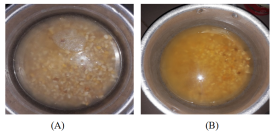
The purpose of the organoleptic tests was to test the intensity of colouring on maize grains after addition of the potasses produced. The results obtained are shown in Figures 7 and 8. The colour intensity of the maize is due to the presence or absence of potassium in the potash. In fact, on contact with the potash, the maize, which is initially whitish in colour, turns light yellow or darker, or does not change colour after 24 hours of contact, depending on the amount of potassium involved. The high potassium content of the potasses from the green peel and cocoa shells would explain the high colour intensity of these in the maize experiment.
The conservation of the colour of maize grains after addition of the potasses obtained was also observed by on green vegetables after addition of the potash extracted from the shank of the Corn 1 plantain diet (Musa esculenta). These authors observed that the potash extracted from the stem of the plantain diet, once added to the cooking, preserved the chlorophyll 4 days later and maintained the green colour of the vegetables.
Figure 7. Colour intensities of maize kernels after the addition of potash based on green (A) and ripe (B) plantain peels.
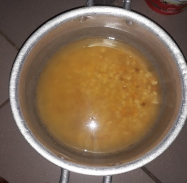
Figure 8. Colour intensity of maize kernels after the addition of cocoa shell-based potash.

4. Conclusion
The aim of the study was to use plantain peels (green and ripe) to make potash, which is used to cook certain local dishes in Man. The study showed that, despite its presence on the Man market, potash is used less by the Manx population. From a physico-chemical point of view, the potash made from plantain peels was rich in mineral elements such as potassium and calcium, with a basic pH. The mineral content of potash produced in this way coincided with that of potash made from cocoa pods. It could also be used for cooking dishes that require the addition of potash.
Looking ahead, it would be wiser to:
1) prove that potash has curative effects on certain skin diseases,
2) find the precise quantity of potash for a remedy against gastric ulcers.
Abbreviations

CAFOP

Teacher Training Centres (CAFOP)

Afnor

French Association for Standardisation

AOAC International

Association of Officical Analytical Chemists

pH

Hydrogen Potential

h

Hour

Conflicts of Interest
The authors declare no conflicts of interest.
References
[1] Anonymous. (2017). La potasse africaine: d'incroyables rôles dans la cuisine. Recette et cuisine africaine.
[2] Afnor (1998). Détermination de la teneur en huile (méthode de référence). 10 p.
[3] AOAC (Association of Official Analytical Chemists) (1985). Official method of analysis (8e éd.) the Association Washington, DC, États-Unis. 2.
[4] Awah-Lekaka N. N. J1., Mpika J., Moyen R., Okiémy-Akéli M. G., Atibayéba.. (2020), Effect of five ash filtrates used as condiments in Congolese cuisine on the preservation of chlorophyll in leafy vegetables after cooking, Journal of Animal & Plant Science (J. Anim. Plant Sci. ISSN 2071-7024), 43(2), 7441-7451
[5] Béné C., Arthur R., Norbury H., Allison H. E., Beveridge M., Bush S. (2016). Contribution of fisheries and aquaculture to food security and poverty reduction: An assessment of current evidence. World Development 79, 177-196.
[6] Bello Pérez L. A., Agama-Acevedo E., Gibert O., Dufour D. (2012). In: Siddiq Muhammad (ed.). Tropical and subtropical fruits: postharvest physiology, processing and packaging. Chichester: Wiley-Blackwell [United Kingdom], p. 137-157.
[7] Collin M. N. and Dalnic R. (1991). Evolution of some physico-chemical criteria of plantains (cultivar Orishele) during ripening. Fruits, 46(1), 13-17.
[8] Dhed’a B., Adheka J., Onautshu D., Swennen R. (2019). The cultivation of bananas and plantains in the agroecological zones of the Democratic Republic of Congo, University Press, UNIKIS.
[9] Gnagné A. S, Camara D., Fofie N. B. Y, Bene K., Zirihi G. N. (2017). Ethnobotanical study of medicinal plants used in the treatment of diabetes in the department of Zouenoula (Côte d'Ivoire). Journal of Animal and Plant Sciences, 27, 4230-4250.
[10] Jacquot M., Fagot P., Voilley A.. (2005). The colour of food: From theory to practice. Agro-food Science and Technology Collection. 5-15 pp.
[11] Jones D. R. (2000). Diseases of Bananas, Abaca and Enset, CABI Publishing International, Wallingford, United Kingdom, 544 p.
[12] Koffi Y. D. (2014). Effect of planting density on the growth and development of three cultivars (Pita 3, Fhia 21 and Orishele) of plantain banana (Musa sp.) in Azaguie (Ivory Coast). Master's thesis in biology and plant protection, specialising in agrophysiology. Nangui Abrogoua University. 76 p.
[13] Kouassi K. S. (2005). Role of genetic resources in the growth of the plantain banana sector in Côte d'Ivoire. Genetic Resources Multiplication and Utilisation. 179-192.
[14] Koulibaly A., Monian M., Acka J. J. A. A. B., Koné M. W., Traoré K. (2016). Etude etchnobotanique des plantes medicinales: cas des affections les plus fréquentes d’une région agricole Daloa (Centre Ouest, CI). Journal of Animal and Plants Science, 31(2), 5021-5032.
[15] Koriko M., Sanonka T., Fouad A., Koffi A. D., Gado T. (2021). Extraction et Caractérisation physico-chimiaquend’un sel. plant-based from the ashes of oil palms in northern Togo. ESJ/Natural/Life/Medical Sciences.
[16] Mosso K; Kouadio N and Nemlin G. J. (1996). Traditional processing of plantains, cassava, taro and yams in central and southern Côte d'Ivoire. IAA No. 3, 113rd year. pp. 91–96.
[17] Niebi N. J., Mpika J., Okiemy-Akeli M., G., Attibayeba. (2016). Effects of potassium from the stalk of the Corn 1 plantain (Musa esculenta) on the preservation of chlorophyll in green vegetables after cooking: the case of cassava leaves. Journal of Applied Biosciences 102; 9777–9783.
[18] Thiémélé D. E. F., Traoré S., Aby N., Gnonhouri P., Yao N., Kobenan K., Konan E., Adiko A., Zakra N. (2017). Diversity and participatory selection of productive local plantain varieties in Côte d'Ivoire. Journal of Applied Biosciences, 114, 11324-11335.
[19] Tra Bi F., Irié G. M, N’Gaman K. C. C., Mohou C. H. B. (2008). Study of some therapeutic plants used in the treatment of high blood pressure and diabetes: Two emerging diseases in Côte d'Ivoire. Science et Nature, 5(1) 13-20.
[20] Udoetok I. A., Akwa I., Ikot A., Mkpat E., Akwa I. (2012). Characterization of ash made from oil palm empty fruit bunches (oefb). p. 518-524.
[21] Ratsiaharovala V. (2011). Contribution to the valorisation of babanes skins, Final dissertation for the degree of Engineer in Chemical Engineering, University of Antananarivo.
[22] Zhong X. O. H. I., Azhar A. B. (2013). Characterisation of oil palm ash (OPA) and thermal properties of OPA-filled natural rubber compounds. 15 p.
Cite This Article
  • APA Style

    Kouadio, K. K. A., Soro, L. C., Kossonou, Y. K., Anin, A. L. (2025). Production of Potash from Green and Ripe Plantain Peels. Science Journal of Analytical Chemistry, 13(4), 96-103. https://doi.org/10.11648/j.sjac.20251304.13

    Copy | Download

    ACS Style

    Kouadio, K. K. A.; Soro, L. C.; Kossonou, Y. K.; Anin, A. L. Production of Potash from Green and Ripe Plantain Peels. Sci. J. Anal. Chem. 2025, 13(4), 96-103. doi: 10.11648/j.sjac.20251304.13

    Copy | Download

    AMA Style

    Kouadio KKA, Soro LC, Kossonou YK, Anin AL. Production of Potash from Green and Ripe Plantain Peels. Sci J Anal Chem. 2025;13(4):96-103. doi: 10.11648/j.sjac.20251304.13

    Copy | Download

  • @article{10.11648/j.sjac.20251304.13,
      author = {Kouakou Kouassi Armand Kouadio and Lenifere Chantal Soro and Yao Kamele Kossonou and Atchibri Louise Anin},
      title = {Production of Potash from Green and Ripe Plantain Peels},
      journal = {Science Journal of Analytical Chemistry},
      volume = {13},
      number = {4},
      pages = {96-103},
      doi = {10.11648/j.sjac.20251304.13},
      url = {https://doi.org/10.11648/j.sjac.20251304.13},
      eprint = {https://article.sciencepublishinggroup.com/pdf/10.11648.j.sjac.20251304.13},
      abstract = {Plantain peels are bulky rubbish in Man. However, Man households use chemical potasses to attenuate their sauces. The general aim of this study is to use plantain peels as a natural potash to attenuate the taste of certain Manx dishes. To achieve this objective, a preliminary survey was carried out on how potash is used in Man. Natural potash was manufactured after drying and incinerating plantain peels (green and ripe). The physico-chemical parameters of the potasses produced were determined. The survey revealed that 40% of the population uses chemical potasses. Determination of the physico-chemical parameters of the natural potasses produced enabled us to observe their alkaline nature and their richness in mineral salts. The potasses produced have potassium contents (24.53±0.45%-74.44±0.3%), calcium (0.07±0.2%-12.67±0.56%), iron (2.80±0.35- 3.01±0.45) and pH values (10.43 ± 0.68-10.45 ± 0.76). Potash based on green peel is the richest and most recommended. Processing plantain peels in the same way as natural potash would help to reduce waste.},
     year = {2025}
    }
    

    Copy | Download

  • TY  - JOUR
    T1  - Production of Potash from Green and Ripe Plantain Peels
    AU  - Kouakou Kouassi Armand Kouadio
    AU  - Lenifere Chantal Soro
    AU  - Yao Kamele Kossonou
    AU  - Atchibri Louise Anin
    Y1  - 2025/12/29
    PY  - 2025
    N1  - https://doi.org/10.11648/j.sjac.20251304.13
    DO  - 10.11648/j.sjac.20251304.13
    T2  - Science Journal of Analytical Chemistry
    JF  - Science Journal of Analytical Chemistry
    JO  - Science Journal of Analytical Chemistry
    SP  - 96
    EP  - 103
    PB  - Science Publishing Group
    SN  - 2376-8053
    UR  - https://doi.org/10.11648/j.sjac.20251304.13
    AB  - Plantain peels are bulky rubbish in Man. However, Man households use chemical potasses to attenuate their sauces. The general aim of this study is to use plantain peels as a natural potash to attenuate the taste of certain Manx dishes. To achieve this objective, a preliminary survey was carried out on how potash is used in Man. Natural potash was manufactured after drying and incinerating plantain peels (green and ripe). The physico-chemical parameters of the potasses produced were determined. The survey revealed that 40% of the population uses chemical potasses. Determination of the physico-chemical parameters of the natural potasses produced enabled us to observe their alkaline nature and their richness in mineral salts. The potasses produced have potassium contents (24.53±0.45%-74.44±0.3%), calcium (0.07±0.2%-12.67±0.56%), iron (2.80±0.35- 3.01±0.45) and pH values (10.43 ± 0.68-10.45 ± 0.76). Potash based on green peel is the richest and most recommended. Processing plantain peels in the same way as natural potash would help to reduce waste.
    VL  - 13
    IS  - 4
    ER  - 

    Copy | Download

Author Information
  • Abstract
  • Keywords
  • Document Sections

    1. 1. Introduction
    2. 2. Materials and Methods
    3. 3. Results and Discussion
    4. 4. Conclusion
    Show Full Outline
  • Abbreviations
  • Conflicts of Interest
  • References
  • Cite This Article
  • Author Information