Abstract
The purpose of this study is to determine the level of acceptability of the "Beep Card," a cashless transaction system utilized by public utility buses in Koronadal City, among its passengers. The study's goal is to evaluate the card's acceptability based on ease of use, adaptability, awareness, and security concerns among different demographic profiles, such as age, gender, and occupation. A cross-sectional survey approach was used to collect opinions, attitudes, and behaviors on the use of the "Beep Card" from a varied set of bus riders. The data demonstrates that occupation has a significant impact on sentiments regarding the "Beep Card," highlighting the necessity for targeted marketing and outreach methods geared toward certain occupational groupings. Female passengers had somewhat higher average acceptability scores than male passengers, and students had higher mean acceptance scores than employed passengers. Frequent transportation passengers had higher mean acceptance scores than infrequent ones. These findings suggest that transit authorities and service providers may need to provide additional training or support to people in specific occupations who may have lower levels of tolerance or awareness as a result of their job. As the "Beep Card" becomes more popular, monitoring demographic and acceptance trends will assist refine strategies for promoting and extending the use of this cashless transaction system in public transportation.
|
Published in
|
World Journal of Electronic Commerce (Volume 1, Issue 1)
|
|
DOI
|
10.11648/j.wjec.20260101.14
|
|
Page(s)
|
32-42 |
|
Creative Commons
|

This is an Open Access article, distributed under the terms of the Creative Commons Attribution 4.0 International License (http://creativecommons.org/licenses/by/4.0/), which permits unrestricted use, distribution and reproduction in any medium or format, provided the original work is properly cited.
|
|
Copyright
|
Copyright © The Author(s), 2026. Published by Science Publishing Group
|
Keywords
Beep Card, Public Utility Buses, Cashless Transaction System and Acceptability
1. Introduction
The integration of cashless transaction systems has emerged as an integral innovation, transcending geographical boundaries, in the dynamic environment of modern urban transportation. This paradigm change is most visible in the widespread usage of Beep Cards on public transportation vehicles, ushering a new era of efficiency, ease, and financial transparency. This introduction attempts to investigate the global acceptance and ramifications of Beep Cards, collecting insights from various locations and citing major studies and industry reports.
To understand the global perspective on the acceptability of Beep Cards in public utility buses, it is necessary to look into the unique variables driving their adoption. Studies
| [1] | Raj, L. V., et al. (2023). Factors influencing the adoption of cashless transactions during COVID-19: An extension of enhanced UTAUT with pandemic precautionary measures. Journal of Financial Services Marketing.
https://doi.org/10.1057/s41264-023-00218-8 |
[1]
have highlighted the importance of convenience and speed in driving the acceptability of cashless systems. This is consistent with the inherent nature of Beep Cards, which provide passengers with a quick and easy way to pay, saving boarding time and improving overall operational efficiency.
Furthermore, in the discussion of cashless transactions, the question of financial inclusion takes center stage. The World Bank's Global Findex Database
emphasizes digital financial services' revolutionary potential in giving access to formal financial systems, particularly in emerging nations. Beep Cards, which serve as a gateway to digital transactions, play a critical role in closing the financial inclusion gap between banked and unbanked communities.
To properly navigate the international landscape, the researcher must look at case studies from various regions that have effectively adopted Beep Card systems. Singapore, London, and Bogotá's experiences provide significant insights into the varied benefits and challenges connected with the integration of cashless transactions in public transit
.
The Philippines' archipelagic nature, along with the issues of urban congestion and different commuter preferences, has prompted fresh ideas for the public transportation industry. Beep Cards, with their contactless payment feature, have emerged as a promising method for addressing these difficulties and improving the entire commute experience.
The local adoption of Beep Cards is heavily entrenched in the goal of convenience, which is a critical concern for the Filipino commuter population. Studies like the one done by the Philippine Institute for Development Studies
highlight the importance of expedited payment processes in reducing the time and effort associated with everyday trips. Beep Cards, by providing a quick and effective way to pay for fares, are in line with the desires of Filipino commuters who enjoy a hassle-free travel experience.
Local case studies provide vital insights as the Philippines navigates the hurdles and opportunities posed by the deployment of Beep Cards. Examining the experiences of metropolitan areas where the Beep Card system has been deployed in multiple forms of transportation, such as Metro Manila, gives light on the intricate dynamics of acceptability, user behavior, and system efficiency
| [5] | AF Payments Inc. Beep Reloadable Contactless Smart Card. Available from: https://www.beeptopay.com (accessed 17 July 2026). |
[5]
.
The introduction of cashless payment systems, such as the "Beep Card," in public utility buses in the City of Koronadal has been met with a mixed level of acceptability among commuters. While some individuals have embraced the convenience and efficiency of using the "Beep Card," others remain hesitant to fully embrace this cashless transaction scheme. The limited utilization of noncash payment cards in specific transactions, primarily transportation ticket purchases for public transit systems, has been a significant factor in the slow adoption of the "Beep Card" in the City of Koronadal. However, there is potential for its extended use in various businesses beyond transportation.
To encourage the further acceptance and utilization of the "Beep Card" in the City of Koronadal, the government can introduce additional incentives and national payment systems. Implementing compulsory salary cards for budget workers and national loyalty programs can create a higher impact of network effects at the retail payments market. These measures will result in higher merchant acceptance rates and increased card holding and card-using shares, ultimately leading to a more successful transition towards a cashless economy in the city.
The growing adoption of digital payment technologies has been supported by several theoretical and empirical studies. According to Davis
| [6] | Davis, F. D. (1989). Perceived usefulness, perceived ease of use, and user acceptance of information technology. MIS Quarterly, 13(3), 319–340. https://doi.org/10.2307/249008 |
[6]
, perceived usefulness and perceived ease of use significantly influence an individual's willingness to adopt new technologies. Likewise, Venkatesh et al.
| [7] | Venkatesh, V., Morris, M. G., Davis, G. B., & Davis, F. D. (2003). User acceptance of information technology: Toward a unified view. MIS Quarterly, 27(3), 425–478.
https://doi.org/10.2307/30036540 |
[7]
emphasized that performance expectancy, effort expectancy, social influence, and facilitating conditions are major determinants of technology acceptance. In the Philippine context, the Bangko Sentral ng Pilipinas has actively promoted digital payment systems through its Digital Payments Transformation Roadmap and Consumer Payments Survey, highlighting the country's increasing reliance on electronic transactions
| [8] | Venkatesh, V., Thong, J. Y. L., & Xu, X. (2012). Consumer acceptance and use of information technology: Extending the Unified Theory of Acceptance and Use of Technology. MIS Quarterly, 36(1), 157–178. https://doi.org/10.2307/41410412 |
| [9] | Bangko Sentral ng Pilipinas. (2023). Consumer Payments Survey 2023. Available from: https://www.bsp.gov.ph (accessed 17 July 2026). |
[8-9]
. Moreover, the Department of Transportation continues to expand contactless fare collection systems, including the Beep Card, to improve commuting efficiency and support the country's digitalization efforts
| [10] | Department of Transportation. Automated Fare Collection System. Available from: https://dotr.gov.ph (accessed 17 July 2026). |
[10]
. Similar initiatives have also been encouraged by international organizations such as the Asian Development Bank, UNESCAP, OECD, and the World Economic Forum, all of which recognize digital payments as essential components of sustainable, inclusive, and efficient transportation systems
| [11] | Asian Development Bank. (2022). Accelerating Digital Transformation in Asia and the Pacific. Available from:
https://www.adb.org/publications/accelerating-digital-transformation-asia-pacific (accessed 17 July 2026). |
| [12] | United Nations Economic and Social Commission for Asia and the Pacific (UNESCAP). (2022). Digital Payment Systems for Sustainable Development. Available from: https://www.unescap.org (accessed 17 July 2026). |
| [13] | Organization for Economic Co-operation and Development (OECD). (2020). Digital Transformation in Transport: Trends, Challenges and Opportunities. Available from:
https://www.oecd.org (accessed 17 July 2026). |
| [14] | World Economic Forum. (2023). The Future of Digital Payments. Available from: https://www.weforum.org (accessed 17 July 2026). |
[11-14]
. Recent market analyses further indicate that the Philippine digital payments market continues to experience significant growth, reflecting increasing consumer acceptance of cashless payment technologies
| [15] | Statista. (2024). Digital Payments Market Insights: Philippines. Available from: https://www.statista.com (accessed 17 July 2026). |
[15]
.
Over the years, the Beep Card has become increasingly popular as a convenient mode of payment for various forms of public transportation in the Philippines. However, there is a significant research gap when it comes to understanding the acceptability of Beep Card across different demographics and geographical areas. To address this gap, a comprehensive study needs to be conducted to investigate the factors that contribute to the acceptability of the Beep Card among commuters. This study should encompass a wide range of variables such as age, income and occupation.
2. Research Method
2.1. Research Design
A cross-sectional survey research design is a quantitative research strategy that entails gathering information from a large and diverse group of people at a single point in time. This research design would involve administering a questionnaire to a representative sample of bus passengers to gather their opinions, attitudes, and behaviors toward the use of the "Beep Card" in the context of determining the level of acceptability of the "Beep Card" as a cashless transaction scheme among public utility bus passengers in the City of Koronadal. The survey would touch on many aspects of the Beep Card's acceptance, such as ease of use, adaptability, and security concerns. It also addresses issues of awareness, such as marketing and information campaigns, as well as technology literacy. The survey findings will be examined statistically in order to draw conclusions and give recommendations for enhancing the acceptance and use of the Beep Card among Koronadal bus passengers.
2.2. Research Locale
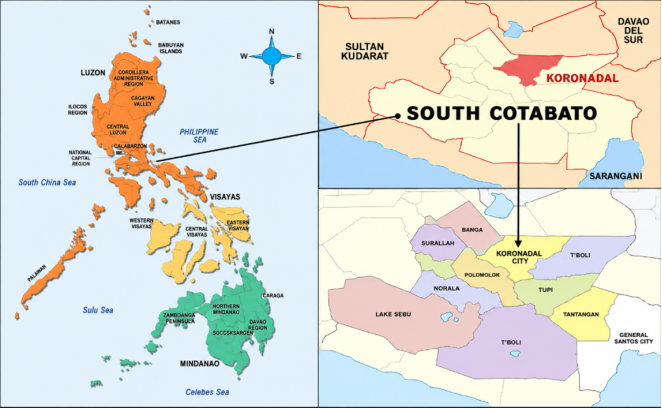
The research location is in the City of Koronadal, often referred to as Marbel, situated in the province of South Cotabato, Philippines. As the provincial capital, the City of Koronadal have an important role in the socio-economic situation of the region. The city is a blend of modernism and history, with a mix of metropolitan institutions and rich natural environments. Its diverse population and vibrant public transportation system make it an ideal locale to study the acceptance of innovations like the "Beep Card". The city's roadways, bustling with public utility buses, tricycles, and other modes of transport, provide a realistic setting for evaluating the card's feasibility and its potential impact on daily commutes. With its unique mix of urban development and local culture, the City of Koronadal provides an interesting backdrop for insights into the interplay of technology, convenience, and user adaptability in the public transportation sector.
Figure 1. Map of the City of Koronadal.
2.3. Respondents of the Study
The respondents of this study will be the commuters of the City of Koronadal. These individuals, whether they're daily bus users commuting for work or school, or occasional riders, are the end-users of the "Beep Card". Their first-hand experiences offer rich insights into the card's functionality, convenience, and potential challenges. This group encompasses both current adapters of the "Beep Card" and those who haven't yet integrated it into their daily travel, allowing for a diverse range of feedback on the system's acceptability. Commuters are important for this study, reflecting the diverse tapestry of the City of Koronadal's daily travelers. As the primary respondents, these individuals bring as wide range of commuting reports—be it the office worker rushing to clock in, the students traveling to educational institutions, or the occasional passengers exploring the city for business or leisure. Their encounters with the "Beep Card", whether as daily users or potential adapters contemplating its adoption, provide an important insight. Their collective comments provide insights on the card's ease of use, potential glitches, or benefits—mapping the card's integration into their commuting habits.
2.4. Sampling Design and Sampling Technique
Quota sampling method for will be used in the study on the level of acceptability of the "Beep Card" among public utility bus passengers in the City of Koronadal.
Quota sampling allows researchers to ensure that different demographic groups within the population are adequately represented in the study. In the context of the acceptability of beep cards, demographics such as age, income, and education levels might influence people's perceptions and usage patterns. Quota sampling helps to capture diverse perspectives by setting quotas for these demographic categories.
Quota sampling is an effective method for selecting 100 individuals for the research. To define quota categories, researchers should define demographic variables and identify sources for recruitment. Participants will be recruited from various sources, such as bus terminals, stops, or specific routes. Data collection will be done through surveys or questionnaires, and the study will continue until the quota for each category is reached. The data analysis will be conducted to address research questions and calculate mean scores for ease of use, adaptability, and security concerns.
2.5. Research Instrument
The research instrument for data collection in this study is a survey questionnaire. This carefully designed questionnaire aims to collect comprehensive insights from respondents, primarily commuters in the City of Koronadal, regarding their level of acceptance of the "Beep Card" as a cashless transaction option for public utility buses. The questionnaire consists of several sections, including demographics, ease of use, adaptability, awareness and usage of the beep card, and multi-dimensional rating scales using Likert scales to assess factors such as ease of use, adaptability, and security concerns.
Table 1. Likert Scale.
Numeric Scale | Mean Range | Descriptive Rating |
5 | 4.50-5.00 | Strongly Agree |
4 | 3.50-4.49 | Agree |
3 | 3.45-2.50 | Neutral |
2 | 1.50-2.49 | Disagree |
1 | 1.00-1.49 | Strongly Disagree |
Additionally, survey checklist questions have been strategically integrated to capture the necessary data from the field. This instrument will serve as a vital tool for systematically gathering data, enabling quantitative analysis and ultimately providing information on the card's feasibility and acceptance within the commuting community of the City of Koronadal.
2.6. Data Gathering Procedures
Here is a simplified step by step summary of data gathering:
1) Validation of Questionnaire: The researchers validate the questionnaire with the help of the adviser. This step is important to ensure that the questions are effective in collecting the desired data and are clear and understandable for the respondents.
2) Approval from LTFRB (Land Transportation Franchising and Regulatory Board):
After receiving authorization from the academic institution, the researcher may need to seek approval from the relevant regulatory authority, in this case, the LTFRB, to conduct research within their jurisdiction. This may involve submitting a formal research proposal, explaining the research objectives, methodology, and any potential impact on public transportation services.
3) Identifying and Approaching Target Respondents:
Identify the target group of respondents, in this case, the commuters in the City of Koronadal who use public utility buses. Access to this group may require coordination with transportation providers, bus stations, or other relevant parties. Inform them about the study's purpose and obtain their cooperation in facilitating access to potential respondents.
4) Survey Questionnaire Administration:
Once access to the target respondents is secured, the survey questionnaire is administered to collect data. This may involve conducting face-to-face interviews, distributing paper-based questionnaires and depending on the preferences and accessibility of the respondents.
5) Data Entry and Analysis:
After data collection, the collected information needs to be carefully entered into a data analysis tool or software. Statistical methods can then be applied to analyze the data. This might involve descriptive statistics, inferential statistics, or qualitative content analysis, depending on the research goals.
6) Interpretation of Findings:
The interpretation of findings involves analyzing the data to draw conclusions and insights regarding the acceptability of the "Beep Card" among commuters in the City of Koronadal. It may involve identifying patterns, correlations, and trends in the data. The interpretation should be aligned with the research objectives and framed in the context of the study's purpose.
7) Reporting and Presentation:
The research findings are typically summarized and presented in a research report or paper. This report should include an introduction, methodology, results, and discussion of the findings. Conclusions should be drawn, and recommendations may be provided based on the research results.
2.7. Statistical Techniques
In this study on the 'Level of Acceptability on the Use of 'Beep Card' among passengers of public utility buses in the City of Koronadal, Analysis of Variance (ANOVA) was used as statistical approach to investigate the variances in acceptability scores across different demographic groups. The analysis found that acceptability scores differed significantly by age, gender and employment status. Passengers between the ages of 19 and 30 had the highest mean acceptability score, followed by those between the ages of 31 and 45. Female passengers scored somewhat better on average acceptability than male passengers. Students received better mean acceptance scores than employed passengers. In addition, frequent users of public transit had better mean acceptance scores than infrequent users.
3. Result and Discussion
To identify the level of acceptability on the use of Beep Card: A cashless transaction scheme among Public Utility Bus, the responses of 100 commuters who were between the ages of 15 to 56 years and above to the questionnaire about their acceptability towards the use of Beep Cards were analyzed. A response of was achieved in this study. The Following section represents the analysis of the responses to the questionnaire administered in this study.
From the results of the questionnaire, most of the respondents were ages 19-30 years old and mostly Female which range to 64% and mostly students that reach to 43%. The table below shows the demographic profile of the commuters in the City of Koronadal, South Cotabato.
Table 2. Demographic Profile.
Demographic Profile | Categories | Frequency | Percent |
AGE | 15-18 years | 10 | 10% |
19-30 years | 42 | 42% |
31-45 years | 22 | 22% |
46-55 years | 14 | 14% |
56+ years | 12 | 12% |
GENDER | Male | 36 | 36% |
Female | 64 | 64% |
Employment Status | Student | 43 | 43% |
Employed | 30 | 30% |
Unemployed | 16 | 16% |
Retired | 11 | 11% |
The demographic profile of the study on the acceptability of the 'Beep Card' among Koronadal City public utility bus users showed some interesting observations. The sample comprised of 100 people, with 36% identifying as male and 64% identifying as female. The bulk of participants (42%), were between the ages of 19 and 30, with 14% between the ages of 46 and 55 and 12% between the ages of 56 and older. 43% of the sample were students, 30% were employed, and 16% were jobless. Only 11% of individuals identified as retired. These demographic categories will be examined further to see if there are any significant differences in acceptability scores among them.
Table 3. Level of Awareness About the Beep Card in Terms of Marketing Information Campaign. Level of Awareness About the Beep Card in Terms of Marketing Information Campaign. Level of Awareness About the Beep Card in Terms of Marketing Information Campaign.
Statement | Mean | SD | Interpretation |
1. I am fully aware of the “Beep Card” as one of the cashless transactions on the Public Utility Bus. | 3.48 | 1.14 | Moderate Level |
2. I see a lot of posters and tarpaulins about the use of Beep Card. | 2.95 | 1.10 | Moderate Level |
3. I can see the promotions of Beep Card on Social Media. | 3.16 | 1.20 | Moderate Level |
4. I can hear radio stations promoting the use of Beep Card. | 2.91 | 1.16 | Moderate Level |
5. I well informed regarding the use of Beep Card as a cashless transaction based from what I hear on the other people. | 3.24 | 1.16 | Moderate Level |
OVERALL | 3.15 | 0.97 | Moderate Level |
Table 3 shows that the respondents have a moderate level of awareness regarding the Beep Card as a cashless payment system, with an overall mean of 3.15 (SD = 0.97). The highest-rated statement was respondents' awareness of the Beep Card as a cashless transaction on public utility buses (M = 3.48), while the lowest-rated statement was hearing radio promotions about the Beep Card (M = 2.91). Overall, the findings suggest that respondents are generally aware of the Beep Card and its use, although there is still an opportunity to further increase public awareness through more effective promotional and information campaigns.
Table 4. Level of Awareness About the Beep Card in Terms of Technological Literacy.
Statement | Mean | SD | Interpretation |
6. I am confident in using “Beep Card” in terms of cashless transactions in public utility bus because it feels like an ATM Card. | 3.81 | 1.05 | High Level |
7. I find it easy to use “Beep Card” in paying my transportation anywhere I go. | 3.83 | 1.03 | High Level |
8. I can say that using the “Beep Card” is very convenient because of its hassle – free features. | 3.93 | 1.05 | High Level |
9. I can easily swipe the card to the Public Utility Bus device to pay for my fare. | 3.77 | 0.99 | High Level |
10. I am fully aware on how to check the balance of my “Beep Card” because it indicates how much I spend every time I pay for my fare. | 3.52 | 1.12 | High Level |
OVERALL | 3.77 | 10.48 | High Level |
Table 4 shows that the survey participants demonstrated a high level of technological literacy regarding the use of the Beep Card, with an overall mean of 3.77 (SD = 1.05), interpreted as High Level. Statement 8 obtained the highest mean score (M = 3.93), indicating that respondents found the Beep Card very convenient because of its hassle-free features. This was followed by Statement 7 (M = 3.83), which showed that respondents found the Beep Card easy to use for transportation payments, and Statement 6 (M = 3.81), indicating confidence in using the card because it is similar to an ATM card. Statement 9 (M = 3.77) also reflected respondents' ability to easily swipe the card to pay for their fare, while Statement 10 (M = 3.52) indicated that respondents were aware of how to check their Beep Card balance. Overall, the findings suggest that respondents possess a high level of technological literacy in using the Beep Card for cashless transactions on public utility buses.
Table 5. The Level of Acceptability in the use of Beep Card in terms of Ease of Use.
Statement | Mean | SD | Interpretation |
11. I search for public transportation that prioritizes having an intuitive interface that is simple for users of all ages and backgrounds to use. | 3.83 | 0.97 | High Level |
12. I prefer for public utility bus to have an easy registration when applying a travel card. | 3.96 | 0.86 | High Level |
13.. I look public utility bus to have a quick and straightforward one tap card system when paying for fare. | 3.91 | 0.93 | High Level |
14. I look for public utility bus that consider to be re-loadable and eliminate the single use travel card. | 3.82 | 0.93 | High Level |
15. I look for a public utility bus that promotes accessibility features and considers passengers with disability and senior citizen, ensuring to reach wide of users. | 4.02 | 0.97 | High Level |
OVERALL | 3.91 | 0.93 | High Level |
Table 5 shows that the study participants demonstrated a high level of acceptability regarding the ease of use of the Beep Card, with an overall mean of 3.91 (SD = 0.93), interpreted as High Level. Statements 11, 12, 13, 14, and 15 all obtained mean scores above 3.80, indicating a high level of acceptability. Respondents preferred public transportation that provides an intuitive interface that is easy to use (M = 3.83), offers a simple registration process for obtaining a travel card (M = 3.96), uses a quick and straightforward one-tap card system for fare payment (M = 3.91), and provides a reloadable travel card instead of a single-use travel card (M = 3.82). The highest-rated statement was the preference for public utility buses that promote accessibility features and accommodate persons with disabilities and senior citizens (M = 4.02), ensuring accessibility for a wider range of users. Overall, the findings indicate that respondents have a high level of acceptability regarding the ease of use of the Beep Card.
Table 6. The Level of Acceptability in the use of Beep Card in terms of Adaptability.
Statement | Mean | SD | Interpretation |
16. I will quickly adapt the use of Beep Card in the Public transportation. | 4.05 | 0.87 | High Level |
17. The Beep Card has made my daily commuting experience more efficient. | 3.96 | 0.92 | High Level |
18. The availability of Beep Card services at various locations (e.g., loading stations, convenience stores) facilitated its adoption. | 3.82 | 0.87 | High Level |
19. I feel confident in troubleshooting any issues that may arise while using the Beep Card. | 3.68 | 1.05 | High Level |
20. The Beep Card has become an integral part of my transportation routines. | 3.69 | 0.99 | High Level |
OVERALL | 3.84 | 0.94 | High Level |
Table 6 shows that the study participants demonstrated a high level of acceptability regarding the adaptability of the Beep Card, with an overall mean of 3.84 (SD = 0.94), interpreted as High Level. Statements 16, 17, 18, 19, and 20 all obtained high mean scores, indicating a high level of acceptability. Statement 16 received the highest mean score (M = 4.05), indicating that respondents are willing to quickly adapt to using the Beep Card in public transportation. This was followed by Statement 17 (M = 3.96), showing that respondents believe the Beep Card has made their daily commuting experience more efficient. Respondents also agreed that the availability of Beep Card services at various locations facilitated its adoption (M = 3.82), that they felt confident in troubleshooting issues while using the card (M = 3.68), and that the Beep Card had become an integral part of their transportation routines (M = 3.69). Overall, the findings indicate that respondents have a high level of acceptability regarding the adaptability of the Beep Card.
Table 7. The Level of Acceptability in the use of Beep Card in terms of Security Concerns.
Statement | Mean | SD | Interpretation |
21. I am confident that my personal information is secure when using the Beep Card. | 4.13 | 0.98 | High Level |
22. I believe the Beep Card system is resistant to unauthorized access or hacking. | 4.47 | 4.01 | High Level |
23. I believe the Beep Card infrastructure is resilient to technological vulnerabilities and threats. | 4.00 | 0.98 | High Level |
24. I feel that the Beep Card system adequately protects my privacy during transactions. | 3.90 | 1.00 | High Level |
25. I am confident that my Beep Card account information is stored securely by the service provider. | 3.98 | 0.96 | High Level |
OVERALL | 4.10 | 1.59 | High Level |
Table 7 shows that the study participants demonstrated a high level of acceptability regarding the security concerns of the Beep Card, with an overall mean of 4.10 (SD = 1.59), interpreted as High Level. Statements 21, 22, 23, 24, and 25 all obtained high mean scores, indicating a high level of acceptability. Statement 22 received the highest mean score (M = 4.47), indicating that respondents believe the Beep Card system is resistant to unauthorized access or hacking. This was followed by Statement 21 (M = 4.13), which reflects respondents' confidence that their personal information is secure when using the Beep Card, and Statement 23 (M = 4.00), indicating that respondents believe the Beep Card infrastructure is resilient to technological vulnerabilities and threats. Respondents also agreed that the Beep Card system adequately protects their privacy during transactions (M = 3.90) and that their account information is securely stored by the service provider (M = 3.98). Overall, the findings indicate that respondents have a high level of acceptability regarding the security concerns of the Beep Card.
Table 8. Level of Acceptability in the use of Beep card in terms of Ease of Use.
| F | df1 | df2 | P |
Age | 3.13 | 3 | 44.8 | 0.035 |
Sex | 3.5 | 1 | 94.5 | 0.064 |
Occupation | 19.7 | 3 | 51.8 | <.001 |
According to the data in
Table 8, presents the differences in the level of acceptability in the use of the Beep Card in terms of ease of use according to respondents' demographic profile. The results revealed a statistically significant difference in the level of acceptability according to age (F = 3.13, df = 3, 44.8, p = 0.035) and occupation (F = 19.70, df = 3, 51.8, p <.001), indicating that respondents' age and occupation significantly influence their level of acceptability in terms of ease of use. However, no statistically significant difference was found according to sex (F = 3.50, df = 1, 94.5, p = 0.064), since the p-value is greater than the 0.05 level of significance. Overall, the findings suggest that age and occupation are significant factors affecting respondents' level of acceptability in terms of the ease of use of the Beep Card, whereas sex is not.
Table 9. Level of Acceptability in the use of Beep Card in terms of Adaptability.
| F | df1 | df2 | P |
Age | 1.02 | 3 | 44.8 | 0.096 |
Sex | 0.561 | 1 | 81.5 | 0.456 |
Occupation | 15.2 | 3 | 52.5 | <.001 |
According to the data in
Table 9, presents the differences in the level of acceptability in the use of the Beep Card in terms of adaptability according to respondents' demographic profile. The results revealed that only occupation showed a statistically significant difference in the level of acceptability (F = 15.20, df = 3, 52.5, p < .001), indicating that respondents' occupation significantly influences their level of acceptability in terms of adaptability. On the other hand, no statistically significant differences were found according to age (F = 1.02, df = 3, 44.8, p = 0.096) and sex (F = 0.561, df = 1, 81.5, p = 0.456), since both p-values are greater than the 0.05 level of significance. Overall, the findings suggest that occupation is a significant factor affecting respondents' level of acceptability in terms of adaptability, whereas age and sex are not.
Table 10. Level of Acceptability in the use of Beep Card in terms of Security Concern.
| F | df1 | df2 | P |
Age | 5.51 | 3 | 43.9 | 0.003 |
Sex | 4.848 | 1 | 67.6 | 0.031 |
Occupation | 10.6 | 3 | 49.3 | <.001 |
According to the data in
Table 10 presents the differences in the level of acceptability in the use of the Beep Card in terms of security concerns according to respondents' demographic profile. The results revealed statistically significant differences according to age (F = 5.51, df = 3, 43.9, p = 0.003), sex (F = 4.848, df = 1, 67.6, p = 0.031), and occupation (F = 10.60, df = 3, 49.3, p < .001). These findings indicate that respondents' age, sex, and occupation significantly influence their level of acceptability regarding the security concerns of the Beep Card. Overall, the findings suggest that demographic characteristics play a significant role in shaping respondents' perceptions of the Beep Card's security.
Table 11. Reject or Accept the Hypothesis.
| | Results | Reject/Accept |
Ho1: There is no significant difference about the level of acceptability and awareness of beep card in terms of: | Ease of use | in terms of: Age = P<0.035 | Reject |
Sex = P>0.064 | Accept |
Occupation = P<0.001 | Reject |
Adaptability | in terms of: Age = P>0.096 | Accept |
Sex = P>0.456 | Accept |
Occupation = P <0.001 | Reject |
Security Concern | in terms of: Age = P<0.003 | Reject |
Sex = P<0.031 | Reject |
Occupation = P<0.001 | Reject |
Based on the statistical analysis, we can reject the null hypothesis (Ho1) for the variables "Ease of use" and "Security Concern" in terms of occupation because the p-values are less than 0.05. This suggests that there is a considerable difference in the level of acceptability and awareness of the beep card among individuals with different occupations for these factors. However, because the p-value for the variable "Adaptability" is greater than 0.05, we cannot dismiss Ho1 in terms of occupation. This implies that there is no considerable distinction in adaptability to beep card based on occupation.
We cannot reject Ho1 in terms of age and gender because the p-values are more than 0.05 for the variables "Ease of use" and "Security Concern." This means that there is no statistically significant difference in the level of acceptability and awareness of the beep card among people of different ages and genders for these characteristics.
In summary, based on the results we found, we can say that occupation has an important effect on the level of acceptability and awareness of beep cards for ease of use and security concerns, but not for adaptability. Age and gender do not appear to have any effect on these variables.
4. Conclusion
These data imply that occupation is an important aspect to consider when assessing the amount of acceptability and awareness of the "Beep Card." This data may be valuable for transit authorities and service providers as they devise strategies to promote the adoption of the 'Beep Card' among various demographic groups. To raise awareness and acceptance of the 'Beep Card,' they may need to customize their marketing and promotional efforts to various occupations. Furthermore, they may be required to provide additional training or support to individuals in specific occupations who may have lower levels of tolerance or awareness as a result of their occupation.
The survey reveals that the 'Beep Card' is generally well-received among Koronadal City commuters, with high levels of awareness, acceptability, and confidence in its technological and security characteristics. Occupation emerges as an important factor impacting attitudes, indicating the necessity for customized marketing and outreach tactics geared to certain occupational groups. As the 'Beep Card' grows in popularity, analyzing these demographic and acceptance tendencies can help refine tactics for promoting and expanding the usage of this cashless transaction system in public transit.
5. Recommendations
Based on the results of the study, some recommendations can be made to improve the level of acceptance of the Beep Card among commuters in the City of Koronadal:
1) To raise knowledge and acceptance of the 'Beep Card, 'Public transportation authorities could consider personalizing their marketing and promotional activities to various occupations. This could include developing targeted campaigns that highlight the benefits of the 'Beep Card' for individuals in specific occupations, as well as providing additional training or support to individuals in these occupations who may have lower levels of acceptability or awareness due to their occupation.
2) Commuters might consider adopting the 'Beep Card' due to its widespread acceptance and awareness among others in their occupation for convenience of use and security concerns. This could include giving additional training or help to people who are unfamiliar with the 'Beep Card,' as well as emphasizing the advantages of utilizing the 'Beep Card' for commuting.
3) Tourists and travelers should consider adopting the 'Beep Card' due to its high degree of acceptability and awareness among individuals in their occupation for ease of use and security concerns. This could include offering further information on the 'Beep Card' to tourists and travelers, as well as emphasizing the benefits of utilizing the 'Beep Card' for sightseeing or exploring.
4) Policymakers should evaluate the possible economic benefits of promoting the usage of the 'Beep Card' among individuals in specific occupations due to its high degree of acceptability and awareness for simplicity of use and security issues. This could involve offering incentives or subsidies for persons in certain occupations to use the 'Beep Card', as well as investigating potential collaborations with employers or other groups to encourage the usage of the 'Beep Card'.
5) Future researchers should continue to investigate the factors that influence the level of acceptability and awareness of the 'Beep Card' among different demographic groups, as well as explore potential solutions or interventions that could address any barriers or challenges that prevent individuals from using the 'Beep Card'. This could include conducting additional surveys, interviews, or experiments to better understand the opinions and experiences of people with varied demographic features when it comes to public transportation payment systems.
Abbreviations
ANOVA | Analysis of Variance |
ATM | Automated Teller Machine |
BSP | Bangko Sentral ng Pilipinas |
LTFRB | Land Transportation Franchising and Regulatory Board |
PIDS | Philippine Institute for Development Studies |
Author Contributions
Ritzchelyn Miana: Conceptualization, Data curation, Investigation, Methodology, Writing – original draft, Writing – review & editing
Chandrena Guerra: Conceptualization, Supervision, Validation, Writing – review & editing
Conflicts of Interest
The authors declare no conflict of interest.
References
| [1] |
Raj, L. V., et al. (2023). Factors influencing the adoption of cashless transactions during COVID-19: An extension of enhanced UTAUT with pandemic precautionary measures. Journal of Financial Services Marketing.
https://doi.org/10.1057/s41264-023-00218-8
|
| [2] |
World Bank. The Global Findex Database 2021: Financial Inclusion, Digital Payments, and Resilience in the Age of COVID-19. Available from:
https://www.worldbank.org/en/publication/globalfindex
(accessed 17 July 2026).
|
| [3] |
Transport for London. Contactless and Mobile Pay as You Go. Available from:
https://tfl.gov.uk/fares/how-to-pay-and-where-to-buy-tickets-and-oyster/pay-as-you-go/contactless-and-mobile-pay-as-you-go
(accessed 17 July 2026).
|
| [4] |
Bangko Sentral ng Pilipinas. Digital Payments Transformation Roadmap 2020–2023. Available from:
https://www.bsp.gov.ph/Media_And_Research/Primers%20Faqs/Digital%20Payments%20Transformation%20Roadmap
(accessed 17 July 2026).
|
| [5] |
AF Payments Inc. Beep Reloadable Contactless Smart Card. Available from:
https://www.beeptopay.com
(accessed 17 July 2026).
|
| [6] |
Davis, F. D. (1989). Perceived usefulness, perceived ease of use, and user acceptance of information technology. MIS Quarterly, 13(3), 319–340.
https://doi.org/10.2307/249008
|
| [7] |
Venkatesh, V., Morris, M. G., Davis, G. B., & Davis, F. D. (2003). User acceptance of information technology: Toward a unified view. MIS Quarterly, 27(3), 425–478.
https://doi.org/10.2307/30036540
|
| [8] |
Venkatesh, V., Thong, J. Y. L., & Xu, X. (2012). Consumer acceptance and use of information technology: Extending the Unified Theory of Acceptance and Use of Technology. MIS Quarterly, 36(1), 157–178.
https://doi.org/10.2307/41410412
|
| [9] |
Bangko Sentral ng Pilipinas. (2023). Consumer Payments Survey 2023. Available from:
https://www.bsp.gov.ph
(accessed 17 July 2026).
|
| [10] |
Department of Transportation. Automated Fare Collection System. Available from:
https://dotr.gov.ph
(accessed 17 July 2026).
|
| [11] |
Asian Development Bank. (2022). Accelerating Digital Transformation in Asia and the Pacific. Available from:
https://www.adb.org/publications/accelerating-digital-transformation-asia-pacific
(accessed 17 July 2026).
|
| [12] |
United Nations Economic and Social Commission for Asia and the Pacific (UNESCAP). (2022). Digital Payment Systems for Sustainable Development. Available from:
https://www.unescap.org
(accessed 17 July 2026).
|
| [13] |
Organization for Economic Co-operation and Development (OECD). (2020). Digital Transformation in Transport: Trends, Challenges and Opportunities. Available from:
https://www.oecd.org
(accessed 17 July 2026).
|
| [14] |
World Economic Forum. (2023). The Future of Digital Payments. Available from:
https://www.weforum.org
(accessed 17 July 2026).
|
| [15] |
Statista. (2024). Digital Payments Market Insights: Philippines. Available from:
https://www.statista.com
(accessed 17 July 2026).
|
Cite This Article
-
APA Style
Miana, R., Guerra, C. (2026). Level of Acceptability on the Use of Beep Card, a Cashless Transaction Scheme Among Public Utility Bus. World Journal of Electronic Commerce, 1(1), 32-42. https://doi.org/10.11648/j.wjec.20260101.14
 Copy
|
Copy
|
 Download
ACS Style
Miana, R.; Guerra, C. Level of Acceptability on the Use of Beep Card, a Cashless Transaction Scheme Among Public Utility Bus. World J. Electron. Commer. 2026, 1(1), 32-42. doi: 10.11648/j.wjec.20260101.14
Copy
|
Download
AMA Style
Miana R, Guerra C. Level of Acceptability on the Use of Beep Card, a Cashless Transaction Scheme Among Public Utility Bus. World J Electron Commer. 2026;1(1):32-42. doi: 10.11648/j.wjec.20260101.14
Copy
|
Download
-
@article{10.11648/j.wjec.20260101.14,
  author = {Ritzchelyn Miana and Chandrena Guerra},
  title = {Level of Acceptability on the Use of Beep Card, a Cashless Transaction Scheme Among Public Utility Bus},
  journal = {World Journal of Electronic Commerce},
  volume = {1},
  number = {1},
  pages = {32-42},
  doi = {10.11648/j.wjec.20260101.14},
  url = {https://doi.org/10.11648/j.wjec.20260101.14},
  eprint = {https://article.sciencepublishinggroup.com/pdf/10.11648.j.wjec.20260101.14},
  abstract = {The purpose of this study is to determine the level of acceptability of the "Beep Card," a cashless transaction system utilized by public utility buses in Koronadal City, among its passengers. The study's goal is to evaluate the card's acceptability based on ease of use, adaptability, awareness, and security concerns among different demographic profiles, such as age, gender, and occupation. A cross-sectional survey approach was used to collect opinions, attitudes, and behaviors on the use of the "Beep Card" from a varied set of bus riders. The data demonstrates that occupation has a significant impact on sentiments regarding the "Beep Card," highlighting the necessity for targeted marketing and outreach methods geared toward certain occupational groupings. Female passengers had somewhat higher average acceptability scores than male passengers, and students had higher mean acceptance scores than employed passengers. Frequent transportation passengers had higher mean acceptance scores than infrequent ones. These findings suggest that transit authorities and service providers may need to provide additional training or support to people in specific occupations who may have lower levels of tolerance or awareness as a result of their job. As the "Beep Card" becomes more popular, monitoring demographic and acceptance trends will assist refine strategies for promoting and extending the use of this cashless transaction system in public transportation.},
 year = {2026}
}
Copy
|
Download
-
TY  - JOUR
T1  - Level of Acceptability on the Use of Beep Card, a Cashless Transaction Scheme Among Public Utility Bus
AU  - Ritzchelyn Miana
AU  - Chandrena Guerra
Y1  - 2026/10/14
PY  - 2026
N1  - https://doi.org/10.11648/j.wjec.20260101.14
DO  - 10.11648/j.wjec.20260101.14
T2  - World Journal of Electronic Commerce
JF  - World Journal of Electronic Commerce
JO  - World Journal of Electronic Commerce
SP  - 32
EP  - 42
PB  - Science Publishing Group
UR  - https://doi.org/10.11648/j.wjec.20260101.14
AB  - The purpose of this study is to determine the level of acceptability of the "Beep Card," a cashless transaction system utilized by public utility buses in Koronadal City, among its passengers. The study's goal is to evaluate the card's acceptability based on ease of use, adaptability, awareness, and security concerns among different demographic profiles, such as age, gender, and occupation. A cross-sectional survey approach was used to collect opinions, attitudes, and behaviors on the use of the "Beep Card" from a varied set of bus riders. The data demonstrates that occupation has a significant impact on sentiments regarding the "Beep Card," highlighting the necessity for targeted marketing and outreach methods geared toward certain occupational groupings. Female passengers had somewhat higher average acceptability scores than male passengers, and students had higher mean acceptance scores than employed passengers. Frequent transportation passengers had higher mean acceptance scores than infrequent ones. These findings suggest that transit authorities and service providers may need to provide additional training or support to people in specific occupations who may have lower levels of tolerance or awareness as a result of their job. As the "Beep Card" becomes more popular, monitoring demographic and acceptance trends will assist refine strategies for promoting and extending the use of this cashless transaction system in public transportation.
VL  - 1
IS  - 1
ER  -
Copy
|
Download





 Share This Article
 Twitter
 Linked In
 Facebook