
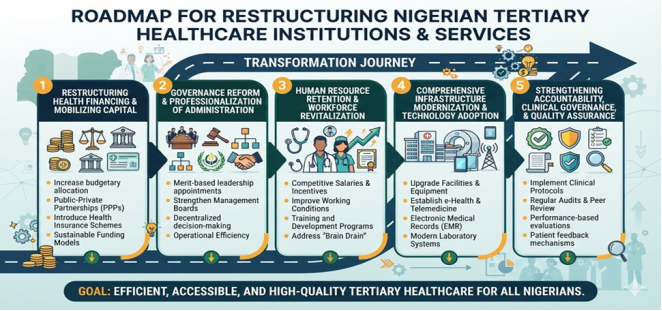
Nigerian tertiary healthcare centers are legally mandated to provide specialized clinical care, advance research, and deliver undergraduate and postgraduate medical education. Decades of systemic, structural, and institutional dwindling infrastructure and medical services, however, have profoundly compromised this national mandate. This narrative review analyzes current evidence from public health, health economics, public policy, and clinical practice reports to examine the multidimensional crises plaguing these apex tertiary healthcare centers. Five primary drivers of the declining infrastructure and services of Nigeria's tertiary healthcare centers emerge from the search data: chronic underfunding coupled with misaligned budgets, severe infrastructure and technological deficits, widespread procurement corruption, weak regulatory oversight, and an unprecedented human resource crisis fueled by medical emigration ("brain drain"). By tracing the historical evolution of these challenges, we outline their direct consequences (degradation of patient outcomes and escalating mortality rates, the erosion of medical education and research output, and economic devaluation and the outflow of medical tourism) for patient outcomes and medical education, and detail critical lessons from past policy failures, including the multi-million United States dollar Vamed Engineering Project to equip apex tertiary medical centers during the 2000s, the 2014 National Health Act, and the Public-Private Partnerships. To reverse this infrastructure and medical services decline and advance toward universal health coverage, we propose a targeted framework centered on alternative health financing, public-private partnerships, institutional autonomy, clinical technology integration, and robust and aggressive workforce retention strategies.
| Published in | World Journal of Health Services Research (Volume 1, Issue 1) |
| DOI | 10.11648/j.wjhsr.20260101.14 |
| Page(s) | 35-44 |
| Creative Commons |
This is an Open Access article, distributed under the terms of the Creative Commons Attribution 4.0 International License (http://creativecommons.org/licenses/by/4.0/), which permits unrestricted use, distribution and reproduction in any medium or format, provided the original work is properly cited. |
| Copyright |
Copyright © The Author(s), 2026. Published by Science Publishing Group |
Nigeria, Tertiary Healthcare, Health Services Administration, Institutional Failures, Quality of Healthcare, Health Policy
COMPONENT | STRATEGY DETAILS |
|---|---|
Databases/Engines | PubMed, MEDLINE, African Journals OnLine, Embase, Scopus, Cochrane Database of Systematic Reviews, Google Scholar |
Domain 1: Facility Type | "tertiary healthcare", "teaching hospitals", "federal medical centers" |
Domain 2: Location | "Nigeria", "Nigerian" |
Domain 3: Systemic Challenges | "institutional failure", "infrastructure decay", "brain drain", "medical negligence", "funding deficits", "governance" |
Search Logic | MeSH terms and free-text keywords combined within and across the three primary domains |
Publication Types | Peer-reviewed articles, gray literature, government reports |
Timeframe | January 1980 - December 2025 |
Manual Searching | Reference lists of included studies, national health policies, official reports from the Nigerian Federal Ministry of Health and the World Health Organization |
PARAMETER/ CATEGORY | INCLUSION CRITERIA | EXCLUSION CRITERIA |
|---|---|---|
Setting/Facility Level | Nigerian tertiary healthcare institutions (teaching hospitals and federal medical centers) | Primary or secondary healthcare tiers with no tertiary nexus. |
Scope/Focus | Systemic, structural, financial, or administrative frameworks. | Purely clinical case reports or drug efficacy trials without systemic analysis. |
Design/Publication Type | Peer-reviewed empirical research or systematic and narrative reviews. | Editorials, commentaries, or opinion pieces lacking empirical data. |
Gray Literature | Official white papers, national policies, and institutional reports. | Unofficial blogs, self-published reports, or gray literature from unaccredited or non-public health bodies. |
Language | Documents published exclusively in English. | Documents published in languages other than English. |
FMoH | Federal Ministry of Health |
MDCN | Medical and Dental Council of Nigeria |
PPPs | Public-Private Partnerships |
THCs | Tertiary Healthcare Centers |
UCH | University College Hospital |
WHO | World Health Organization |
| [1] | Abubakar I, Dalglish SL, Angell B, Sanuade O, Abimbola S, Adamu AL, et al. The Lancet Nigeria Commission: investing in health and the future of the nation. The Lancet. 2022; 399(10330): 1155-200. |
| [2] | Josiah BO, Enebeli EC, Duncan BA, Anukam LU, Akingbade O, Ncube F, et al. Correction: Perceptions of healthcare finance and system quality among Nigerian healthcare workers. PLOS Global Public Health. 2025; 5(8): e0005068. |
| [3] | Obi C, Arize I, Nwokolo C, Okechi B, Ebenso B, Onwujekwe O. Referral experiences of healthcare consumers: results from a cross-sectional study in urban slums in southeast Nigeria. Front Public Health. 2025; 13: 1561158. |
| [4] | Koce F, Randhawa G, Ochieng B. Understanding healthcare self-referral in Nigeria from the service users' perspective: a qualitative study of Niger state. BMC Health Serv Res. 2019; 19(1): 209. |
| [5] | Adewale OS. An internet-based telemedicine system in Nigeria. Int J Inf Manag. 2004; 24(3): 221-34. |
| [6] | Ukpe E. Transforming healthcare: Telemedicine's role and impact in Nigeria. IOSR J Hum Soc Sci. 2025; 30(2): 20-6. |
| [7] | Aregbeshola BS, Khan SM. Out-of-Pocket Payments, Catastrophic Health Expenditure and Poverty Among Households in Nigeria 2010. Int J Health Policy Manag. 2018 Sep 1; 7(9): 798-806. |
| [8] | Croke K, Ogbuoji O. Health reform in Nigeria: the politics of primary health care and universal health coverage. Health Policy Plan. 2024; 39(1): 22-31. |
| [9] | Ilesanmi OS, Afolabi AA, Adeoya CT. Driving the implementation of the National Health Act of Nigeria to improve the health of her population. Pan Afr Med J. 2023; 45: 157. |
| [10] | Adeniji T, Oyeyemi AY. A Review-Based Comparative Analysis of Health Care Delivery System in Nigeria and the United Kingdom. West Afr J Med. 2020; 37(6): 597-605. |
| [11] | Ityavyar DA. Background to the development of health services in Nigeria. Soc Sci Med. 1987; 24(6): 487-99. |
| [12] | Ibrahim M. Medical education in Nigeria. Med Teach. 2007; 29(9): 901-5. |
| [13] | Osoba M, Usman S, Oyadiran O, Odeyemi J, Abode M, Usman O, et al. O. Undergraduate medical education in Nigeria: current standard and the need for advancement. Pan Afr Med J. 2021; 40: 40. |
| [14] | Bolt J, Cilliers J. The expansion of colonial state healthcare in twentieth-century British Africa. Med Hist. 2025; 69(1): 119-165. |
| [15] | Ekanade OV. The dynamics of forced neoliberalism in Nigeria since the 1980s. J Ret Afr. 2014; 1(1): 1-24. |
| [16] | Ajoseh S, Langer A, Amoniyan O, Uyah UA. Navigating brain drain: understanding public discourse on legislation to retain medical professionals in Nigeria. Global Health. 2024; 20(1): 80. |
| [17] | Umar AA, Salihu HM, Azuine RE. Crisis of Brain Drain in Nigeria's Health Sector: Challenges, Opportunities, and the Path Forward. Int J MCH AIDS. 2025; 14: e011. |
| [18] | Chukwuma JN, Obi FA. A political economy analysis of health policymaking in Nigeria: the genesis of the 2014 National Health Act. Health Policy Plan. 2025; 40(4): 459-470. |
| [19] | Enabulele O, Enabulele JE. Nigeria's National Health Act: An assessment of health professionals' knowledge and perception. Niger Med J. 2016; 57(5): 260-265. |
| [20] | Yisa SS, Ogunniyi TJ, Dine RD. Strengthening primary health care in Nigeria: a means to achieve universal health coverage. BMJ Glob Health. 2025; 10(10): e018486. |
| [21] | Madu AC, Osborne K. Healthcare Financing in Nigeria: A Policy Review. Int J Soc Determinants Health Health Serv. 2023; 53(4): 434-443. |
| [22] | Edeh HC. Exploring dynamics in catastrophic health care expenditure in Nigeria. Health Econ Rev. 2022; 12(1): 22. |
| [23] | Ilegogie OC. Energizing Health: Electricity Access and the Right to Health in Nigeria. Health Hum Rights. 2025 Dec; 27(2): 409-418. |
| [24] | Zakir B. Nigeria's Medical Exodus: Urgent Reforms to Retain Doctors. Cureus. 2025; 17(11): e96421. |
| [25] | Uneke CJ, Ezeoha AE, Ndukwe CD, Oyibo PG, Onwe FD. Enhancing leadership and governance competencies to strengthen health systems in Nigeria: assessment of organizational human resources development. Healthc Policy. 2012; 7(3): 73-84. |
| [26] | Adeloye D, David RA, Olaogun AA, Auta A, Adesokan A, Gadanya M, Opele JK, Owagbemi O, Iseolorunkanmi A. Health workforce and governance: the crisis in Nigeria. Hum Resour Health. 2017; 15(1): 32. |
| [27] | Onwujekwe O, Orjiakor CT, Hutchinson E, McKee M, Agwu P, Mbachu C, et al. Where Do We Start? Building Consensus on Drivers of Health Sector Corruption in Nigeria and Ways to Address It. Int J Health Policy Manag. 2020; 9(7): 286-296. |
| [28] | Diaconu K, Chen YF, Cummins C, Jimenez Moyao G, Manaseki-Holland S, Lilford R. Methods for medical device and equipment procurement and prioritization within low- and middle-income countries: findings of a systematic literature review. Global Health. 2017; 13(1): 59. |
| [29] | Umeano-Enemuoh JC, Onwujekwe OE, Uzochukwu BS, Ezeoke OP. Patients’ satisfaction and quality of care in a tertiary institution in Southeast Nigeria. Int Res J Basic Clin Stud. 2014; 2(2): 14-9. |
| [30] | Afolalu OO, Jordan S, Kyriacos U. Medical error reporting among doctors and nurses in a Nigerian hospital: A cross-sectional survey. J Nurs Manag. 2021; 29(5): 1007-1015. |
| [31] | Mbachu II, Ezeama C, Osuagwu K, Umeononihu OS, Obiannika C, Ezeama N. A cross-sectional study of maternal near miss and mortality at a rural tertiary centre in southern Nigeria. BMC Pregnancy Childbirth. 2017; 17(1): 251. |
| [32] | Makanjuola OB, Fayemiwo SA, Okesola AO, Gbaja A, Ogunleye VA, Kehinde AO, et al. Pattern of multidrug-resistant bacteria associated with intensive care unit infections in Ibadan, Nigeria. Ann Ibadan Postgrad Med. 2018; 16(2): 162-169. |
| [33] | Tolani MA, Ahmed M, Ojewola RW, Abdulwahab-Ahmed A, Abdulkadir A, Mbaeri TU, et al. Assessment of Health-care Research and Its Challenges among Medical Doctors in Nigeria. Niger Med J. 2020; 61(4): 218-222. |
| [34] | Adeoye AO. Assessing the associated medical, legal, and social issues in medical tourism and its implications for Nigeria. Pan Afr Med J. 2023; 45: 145. |
| [35] | Makinde OA. Physicians as medical tourism facilitators in Nigeria: ethical issues of the practice. Croat Med J. 2016 Dec 31; 57(6): 601-604. |
| [36] | Kalu Q, Edentekhe TA, Eguma S. Anesthesia equipment and their chain of survival. Calabar J Health Sci. 2020; 4(1): 13-9. Doi. 10.25259/CJHS_16_2020 |
| [37] | Egwudo AE, Jegede AO, Oyeniyi TA, Ezekwelu NJ, Abdu-Aguye SN, Okwuraiwe AP, et al. Integrating digital health technologies into the healthcare system: Challenges and opportunities in Nigeria. PLOS Digit Health. 2025; 4(7): e0000928. |
| [38] | Uzochukwu B, Onwujekwe E, Mbachu C, Okeke C, Molyneux S, Gilson L. Accountability mechanisms for implementing a health financing option: the case of the basic health care provision fund (BHCPF) in Nigeria. Int J Equity Health. 2018; 17(1): 100. |
| [39] | Jinadu FO, Agunloye AM, Adeyomoye AA, Adekoya AO, Obajimi GO. Public-private partnerships in Nigerian teaching hospitals: Potential and challenges. West Afr J Rad. 2020 Jul 1; 27(2): 143-9. |
| [40] | Josiah BO, Enebeli EC, Duncan BA, Adejumo PO, Josiah CC, Anukam L. et al. Critical review of healthcare financing and a survey of system quality perception among healthcare users in Nigeria (2010-2023). PLOS Glob Public Health. 2025; 5(5): e0004615. |
| [41] | Ipinnimo TM, Durowade KA, Afolayan CA, Ajayi PO, Akande TM. The Nigeria national health insurance authority act and its implications towards achieving universal health coverage. Niger Postgrad Med J. 2022; 29(4): 281-287. |
| [42] | Mohammed ENA. Knowledge, causes, and experience of inter-professional conflict and rivalry among healthcare professionals in Nigeria. BMC Health Serv Res. 2022; 22(1): 320. |
| [43] | Adigwe OP, Mohammed ENA, Onavbavba G. Preventing and Mitigating Inter-Professional Conflict Among Healthcare Professionals in Nigeria. J Healthc Leadersh. 2023; 15: 1-9. |
| [44] |
Otolorin EO. Mitigating the healthcare exodus: pathways to retention and brain gain in Nigeria. J Global Med [Internet]. 2026 Mar. 30 [cited 2026 Aug. 11]; 6(1): e345. Available from:
https://globalmedicine.co.uk/index.php/jogm/article/view/345 |
| [45] | Alobo IG, Soyannwo T, Ukponwan G, Akogu S, Akpa AM, Ayankola K. Implementing electronic health system in Nigeria: perspective assessment in a specialist hospital. Afr Health Sci. 2020; 20(2): 948-954. |
| [46] | Onyeabor US, Onwuasoigwe O, Okenwa WO, Schaaf T, Pinkwart N, Balzer F. Exploring user experiences of clinicians engaged with the digital healthcare interventions across the referral and university teaching hospitals in Nigeria: a qualitative study. Front Digit Health. 2025; 7: 1488880. |
| [47] | Olufunlayo TF, Ojo OO, Ozoh OB, Agabi OP, Opara CR, Taiwo FT, et al. Telemedicine ready or not? A cross-sectional assessment of telemedicine maturity of federally funded tertiary health institutions in Nigeria. Digit Health. 2023; 9: 20552076221150072. |
| [48] | Alinnor EA, Ogaji DS. Physicians' knowledge, attitude and practice of clinical audit in a tertiary health facility in a developing country: a cross-sectional study. Pan Afr Med J. 2022; 43: 22. |
| [49] | Ogbuanya AU, Enemuo VC, Eni UE, Nwigwe CG, Otu O. Mortality audit in general surgery unit and lessons learned at a Nigerian tertiary hospital: a single centre observational study. Pan Afr Med J. 2022; 41: 228. |
APA Style
Amadi, C., Amadi, R. C., Amadi, S. C., Amadi, E. C., John, C. (2026). Downturns of Tertiary Healthcare Infrastructure and Services in Nigeria: Context, Dimensions, Consequences, Past Policy Interventions, and Roadmap for Reform. World Journal of Health Services Research, 1(1), 35-44. https://doi.org/10.11648/j.wjhsr.20260101.14
ACS Style
Amadi, C.; Amadi, R. C.; Amadi, S. C.; Amadi, E. C.; John, C. Downturns of Tertiary Healthcare Infrastructure and Services in Nigeria: Context, Dimensions, Consequences, Past Policy Interventions, and Roadmap for Reform. World J. Health Serv. Res. 2026, 1(1), 35-44. doi: 10.11648/j.wjhsr.20260101.14
AMA Style
Amadi C, Amadi RC, Amadi SC, Amadi EC, John C. Downturns of Tertiary Healthcare Infrastructure and Services in Nigeria: Context, Dimensions, Consequences, Past Policy Interventions, and Roadmap for Reform. World J Health Serv Res. 2026;1(1):35-44. doi: 10.11648/j.wjhsr.20260101.14
@article{10.11648/j.wjhsr.20260101.14,
  author = {Collins Amadi and Roy Chidi Amadi and Sasha Chidera Amadi and Elena Chile Amadi and Comfort John},
  title = {Downturns of Tertiary Healthcare Infrastructure and Services in Nigeria: Context, Dimensions, Consequences, Past Policy Interventions, and Roadmap for Reform},
  journal = {World Journal of Health Services Research},
  volume = {1},
  number = {1},
  pages = {35-44},
  doi = {10.11648/j.wjhsr.20260101.14},
  url = {https://doi.org/10.11648/j.wjhsr.20260101.14},
  eprint = {https://article.sciencepublishinggroup.com/pdf/10.11648.j.wjhsr.20260101.14},
  abstract = {Nigerian tertiary healthcare centers are legally mandated to provide specialized clinical care, advance research, and deliver undergraduate and postgraduate medical education. Decades of systemic, structural, and institutional dwindling infrastructure and medical services, however, have profoundly compromised this national mandate. This narrative review analyzes current evidence from public health, health economics, public policy, and clinical practice reports to examine the multidimensional crises plaguing these apex tertiary healthcare centers. Five primary drivers of the declining infrastructure and services of Nigeria's tertiary healthcare centers emerge from the search data: chronic underfunding coupled with misaligned budgets, severe infrastructure and technological deficits, widespread procurement corruption, weak regulatory oversight, and an unprecedented human resource crisis fueled by medical emigration ("brain drain"). By tracing the historical evolution of these challenges, we outline their direct consequences (degradation of patient outcomes and escalating mortality rates, the erosion of medical education and research output, and economic devaluation and the outflow of medical tourism) for patient outcomes and medical education, and detail critical lessons from past policy failures, including the multi-million United States dollar Vamed Engineering Project to equip apex tertiary medical centers during the 2000s, the 2014 National Health Act, and the Public-Private Partnerships. To reverse this infrastructure and medical services decline and advance toward universal health coverage, we propose a targeted framework centered on alternative health financing, public-private partnerships, institutional autonomy, clinical technology integration, and robust and aggressive workforce retention strategies.},
 year = {2026}
}
TY  - JOUR
T1  - Downturns of Tertiary Healthcare Infrastructure and Services in Nigeria: Context, Dimensions, Consequences, Past Policy Interventions, and Roadmap for Reform
AU  - Collins Amadi
AU  - Roy Chidi Amadi
AU  - Sasha Chidera Amadi
AU  - Elena Chile Amadi
AU  - Comfort John
Y1  - 2026/09/18
PY  - 2026
N1  - https://doi.org/10.11648/j.wjhsr.20260101.14
DO  - 10.11648/j.wjhsr.20260101.14
T2  - World Journal of Health Services Research
JF  - World Journal of Health Services Research
JO  - World Journal of Health Services Research
SP  - 35
EP  - 44
PB  - Science Publishing Group
UR  - https://doi.org/10.11648/j.wjhsr.20260101.14
AB  - Nigerian tertiary healthcare centers are legally mandated to provide specialized clinical care, advance research, and deliver undergraduate and postgraduate medical education. Decades of systemic, structural, and institutional dwindling infrastructure and medical services, however, have profoundly compromised this national mandate. This narrative review analyzes current evidence from public health, health economics, public policy, and clinical practice reports to examine the multidimensional crises plaguing these apex tertiary healthcare centers. Five primary drivers of the declining infrastructure and services of Nigeria's tertiary healthcare centers emerge from the search data: chronic underfunding coupled with misaligned budgets, severe infrastructure and technological deficits, widespread procurement corruption, weak regulatory oversight, and an unprecedented human resource crisis fueled by medical emigration ("brain drain"). By tracing the historical evolution of these challenges, we outline their direct consequences (degradation of patient outcomes and escalating mortality rates, the erosion of medical education and research output, and economic devaluation and the outflow of medical tourism) for patient outcomes and medical education, and detail critical lessons from past policy failures, including the multi-million United States dollar Vamed Engineering Project to equip apex tertiary medical centers during the 2000s, the 2014 National Health Act, and the Public-Private Partnerships. To reverse this infrastructure and medical services decline and advance toward universal health coverage, we propose a targeted framework centered on alternative health financing, public-private partnerships, institutional autonomy, clinical technology integration, and robust and aggressive workforce retention strategies.
VL  - 1
IS  - 1
ER  -
Department of Chemical Pathology, Rivers State University, Port Harcourt, Nigeria; Department of Chemical Pathology, PAMO University of Medical Sciences, Port Harcourt, Nigeria; Department of Chemical Pathology, University of Uyo, Uyo, Nigeria; Department of Laboratory Services, MEDCOL Nigeria Limited, Port Harcourt, Nigeria
Department of Laboratory Services, MEDCOL Nigeria Limited, Port Harcourt, Nigeria; Basic Health Studies, Captain Elechi Amadi, Port Harcourt, Nigeria; Basic Health Studies, Excellent Montessori College, Port Harcourt, Nigeria
Department of Laboratory Services, MEDCOL Nigeria Limited, Port Harcourt, Nigeria; Basic Health Studies, Captain Elechi Amadi, Port Harcourt, Nigeria; Basic Health Studies, Excellent Montessori College, Port Harcourt, Nigeria
Department of Laboratory Services, MEDCOL Nigeria Limited, Port Harcourt, Nigeria; Basic Health Studies, Captain Elechi Amadi, Port Harcourt, Nigeria; Basic Health Studies, Excellent Montessori College, Port Harcourt, Nigeria
Department of Laboratory Services, MEDCOL Nigeria Limited, Port Harcourt, Nigeria; Department of Management, Ignatius Ajuru University of Education, Port Harcourt, Nigeria

Information



 Share This Article
 Twitter
 Linked In
 Facebook
 Copy
Copy Download