Research Article | | Peer-Reviewed

Menstrual Cycle Manipulation in Female Athletes to Avoid Competition-Day Bleeding: Symptom Control, Performance Limits, and RED-S-Safe Prescribing—A Narrative Review

Received: 8 June 2026     Accepted: 14 July 2026     Published: 26 August 2026
Views:       Downloads:
Abstract

Background: In elite sport, an increasing number of female athletes use menstrual cycle manipulation (MCM), most commonly via hormonal contraceptives, to delay or suppress withdrawal bleeding during key competitions. Although MCM may address legitimate functional needs, it is often misconstrued as a logistical strategy rather than a pharmacological intervention requiring contraindication screening, adverse-effect monitoring, and vigilance for masked underlying conditions. Objectives: This narrative review synthesizes current evidence on motivations for MCM use, commonly employed pharmacological approaches, limits of performance-related benefits, screening considerations for low energy availability (LEA) and Relative Energy Deficiency in Sport (RED-S), long-term safety, and clinical implementation in female athletes. Main Findings: Hormonal contraceptives improve menstrual predictability and reduce dysmenorrhea, heavy menstrual bleeding, and selected premenstrual symptoms. However, systematic reviews and meta-analyses consistently show no direct ergogenic benefit and no meaningful improvement in VO2max, muscular strength, or explosive power. Perceived performance gains likely reflect symptom relief and reduced competition burden rather than intrinsic pharmacological enhancement. Athletes with oligomenorrhea, amenorrhea, rapid weight loss, chronic dietary restriction, or recurrent bone stress injuries should be evaluated for LEA and RED-S before initiating MCM to avoid delayed diagnosis and masking of energy deficiency. Conclusions: MCM can be integrated into individualized menstrual health management when guided by clear objectives, structured risk stratification, an assess-before-prescribing approach, and preseason pharmacological trials with longitudinal monitoring. Within such a framework, MCM may support athlete welfare without obscuring underlying pathology.

Published in World Journal of Public Health (Volume 11, Issue 3)
DOI 10.11648/j.wjph.20261103.20
Page(s) 310-321
Creative Commons

This is an Open Access article, distributed under the terms of the Creative Commons Attribution 4.0 International License (http://creativecommons.org/licenses/by/4.0/), which permits unrestricted use, distribution and reproduction in any medium or format, provided the original work is properly cited.

Copyright

Copyright © The Author(s), 2026. Published by Science Publishing Group

Keywords

Female Athletes, Menstrual Cycle Manipulation, Hormonal Contraceptives, Athletic Performance, Low Energy Availability, RED-S, Levonorgestrel-releasing Intrauterine System

1. Introduction
Menstrual cycle-related concerns have become an increasingly important, yet historically underrecognized, issue in elite female sport . For many athletes, menstrual symptoms and competition-specific logistical challenges may disrupt training consistency, psychological readiness, and perceived preparedness . Consequently, a growing number of athletes use menstrual cycle manipulation (MCM), most commonly through hormonal contraceptives, to avoid withdrawal bleeding during major competitions or congested competition schedules .
In high-performance environments, the menstrual cycle is often treated as a logistical variable rather than a complex physiological process, creating a gap between performance-oriented management and appropriate clinical oversight . Unlike external strategies such as sleep optimization or nutritional supplementation, MCM is a pharmacological intervention that alters endogenous hormonal regulation . It therefore requires a structured clinical framework incorporating contraindication screening, monitoring for adverse effects, and evaluation for potentially masked conditions—particularly low energy availability (LEA) and Relative Energy Deficiency in Sport (RED-S) .
A central clinical tension underlies MCM use: although demand is largely driven by practical considerations , the interventions are medical in nature and carry established indications, contraindications, and safety implications . Framing MCM solely as a strategy to “avoid menstruation during competition” risks trivializing its clinical significance and reducing it to a performance-management tool . Failure to recognize its pharmacological nature may lead to inadequate monitoring and underrecognition of adverse effects . Importantly, hormonally induced withdrawal bleeding can create a false impression of endocrine normality, potentially masking functional hypothalamic amenorrhea (FHA) associated with RED-S .
MCM is also frequently misconstrued as an ergogenic intervention. The assumption that menstrual suppression inherently enhances performance is not supported by meta-analytic evidence, which demonstrates no direct improvements in VO2max, strength, or power with hormonal contraceptive use . At most, MCM may mitigate symptom-related disruptions—such as dysmenorrhea or logistical burden—thereby improving perceived competitive readiness . Clear communication that MCM is a symptom-management strategy rather than a performance-enhancing intervention is essential for informed counseling and to prevent unrealistic expectations .
Accordingly, discussion of MCM for competition-day bleeding should move beyond the question of how to delay menstruation and instead address three issues: when is MCM clinically justified; does it enhance physiological capacity or primarily the athlete’s subjective experience; and under what circumstances might it obscure more consequential health conditions? This narrative review synthesizes evidence on motivations for MCM use, commonly employed modalities, limits of benefit, risk identification, and implementation strategies, with the aim of providing an evidence-informed framework for sports medicine physicians, gynecologists, and multidisciplinary support teams.
2. Materials and Methods
To inform this narrative review, literature published between January 2000 and March 2026 was identified through searches of PubMed, Scopus, and Web of Science. Key terms included “menstrual cycle manipulation,” “hormonal contraceptives,” “female athletes,” “athletic performance,” “low energy availability,” and “RED-S.” Emphasis was placed on systematic reviews, meta-analyses, and international consensus statements (e.g., International Olympic Committee and Endocrine Society reports) to establish the physiological and clinical context. Additional relevant publications were identified through reference screening.
3. Clinical and Practical Drivers of Menstrual Cycle Manipulation in Sport
3.1. Symptom Burden and Logistical Competition
Although meta-analytic evidence does not consistently demonstrate objective performance impairment during menstruation, menstrual-related factors may influence athletes through symptomatic and practical pathways . Dysmenorrhea, fatigue, and gastrointestinal disturbances are commonly reported and may reduce training continuity and perceived competition readiness . In addition, logistical challenges—such as managing menstrual products during prolonged events or competing in tight-fitting or light-coloured uniforms—may increase distraction and cognitive load .
For most athletes, menstrual cycle manipulation (MCM) is therefore pursued not for ergogenic enhancement, but to reduce symptom burden and improve bleeding predictability during key competitions. Its effectiveness should be evaluated primarily by functional outcomes—symptom control, scheduling reliability, and uninterrupted participation—rather than maximal physiological performance, as current meta-analyses do not support a direct ergogenic effect of hormonal contraceptives .
3.2. Sport-Specific Competitive Demands
The perceived need for MCM varies across sporting contexts. In endurance sports, athletes frequently report that fatigue and gastrointestinal symptoms disrupt training quality and competitive consistency . In aesthetic or uniform-dependent sports, concerns regarding visible bleeding and limited opportunities for product management may heighten the desire for cycle control . These contextual differences underscore that decisions surrounding MCM are shaped as much by sport culture and competitive structure as by physiology alone.
3.3. Weight-Category Sport and RED-S-Sensitive Contexts
Particular caution is warranted in weight-category and leanness-focused sports, where intentional energy restriction is more prevalent. In these settings, hormonal manipulation may mask menstrual disturbances secondary to low energy availability or Relative Energy Deficiency in Sport (RED-S) . Accordingly, MCM should not be adopted as a routine solution but individualized following appropriate clinical risk stratification and screening for underlying energy deficiency .
4. Hormonal Strategies for Menstrual Cycle Manipulation: Options and Practical Fit
4.1. Combined Oral Contraceptives (COCs)
Combined oral contraceptives (COCs) remain the most commonly used method of menstrual cycle manipulation (MCM) in athletes . By suppressing ovulation and stabilizing hormonal fluctuations, COCs provide relatively predictable bleeding patterns and allow short-term cycle control . In athletes already established on monophasic formulations, continuous use (omitting the hormone-free interval) is a practical strategy to delay or avoid withdrawal bleeding around key competitions . Although unscheduled bleeding may occur—particularly after regimen changes—extended COC regimens are well supported in the broader clinical literature and represent a pragmatic option for competition planning .
4.2. Progestin-Only Pills (POPs)
Progestin-only pills (POPs) are appropriate when estrogen is contraindicated; however, bleeding predictability is generally lower than with COCs, and unscheduled spotting is common . Even newer formulations demonstrate substantial rates of breakthrough bleeding in clinical trials . Accordingly, in settings where high bleeding reliability is essential (e.g., major championships), POPs may be less suitable than estrogen-containing regimens for athletes without contraindications to estrogen .
4.3. Non-Oral Combined Hormonal Contraception (CHC)
Transdermal patches and vaginal rings offer non-oral combined hormonal options that can be used in extended or continuous regimens to reduce or suppress withdrawal bleeding . Their dosing schedules may improve convenience; however, evidence for sustained menstrual suppression is less robust than for COCs, and unscheduled bleeding remains possible . In practice, their role in MCM is individualized and guided by athlete preference and prior tolerance rather than clear superiority in bleeding control.
4.4. Long-Acting Reversible Contraception (LARC)
Long-acting reversible contraceptives, including the levonorgestrel-releasing intrauterine system (LNG-IUS) and the etonogestrel implant, offer low-maintenance options with increasing rates of amenorrhea over time . However, bleeding irregularities are common in the early months after initiation . When the primary objective is to avoid bleeding during a specific competition, initiation should therefore occur well in advance—preferably during the off-season—to allow stabilization of bleeding patterns.
4.5. LNG-IUS for Heavy Menstrual Bleeding
For athletes seeking durable management of heavy menstrual bleeding (HMB) or dysmenorrhea rather than short-term cycle delay, the LNG-IUS provides strong evidence of reduced menstrual blood loss and symptom improvement . Concerns regarding device stability during high-intensity sport are not supported by robust athlete-specific data; available population-based evidence suggests that expulsion risk is primarily related to established clinical factors rather than physical activity itself . Counseling should therefore focus on recognized risk factors and early post-insertion bleeding changes. A side-by-side comparison of the hormonal strategies is provided in Table 1.
Table 1. Comparison of hormonal strategies for menstrual cycle manipulation (MCM) in female athletes.

Hormonal Strategy

Best Fit Goal

Bleeding Predictability

Early Unscheduled Bleeding Risk

Stabilization Time

Athlete-Specific Considerations

Key Contraindications / Cautions

Extended/Continuous Monophasic COC

Single-event bleeding avoidance; season-long symptom control

Moderate (improves over time)

Higher initially

Often months

Daily adherence required; portable; not affected by water exposure; possible breakthrough bleeding (BTB) may disrupt training; minimal kit concerns

Contraindicated with U.S. MEC estrogen restrictions; may mask RED-S/LEA; athlete-specific stability data limited

POP (Progestin-Only Pill)

Season-long symptom control; alternative if estrogen contraindicated

Low

Higher

May require several months

Stringent adherence (same time daily); unaffected by travel/water; possible BTB impacts training; minimal leakage concerns

Suitable if estrogen contraindicated; may mask RED-S/LEA; athlete-specific stability data limited

CHC Patch (Extended/Continuous)

Single-event bleeding avoidance; season-long control

Moderate

Moderate

Several months

Weekly application; concerns with sweating/water exposure (patch adhesion); visible on skin; possible BTB

U.S. MEC estrogen contraindications apply; may mask RED-S/LEA; athlete-specific stability data limited

CHC Vaginal Ring (Extended/Continuous)

Single-event bleeding avoidance; season-long control

Moderate

Moderate

Several months

Monthly/extended replacement; less impacted by water/sweating; possible discomfort; possible BTB

U.S. MEC estrogen contraindications apply; may mask RED-S/LEA; athlete-specific stability data limited

LNG-IUS (Levonorgestrel Intrauterine System)

Heavy menstrual bleeding (HMB)/dysmenorrhea reduction; season-long control

High after stabilization

Higher initial spotting, then improves

Often months (3–6)

No daily action; no effect from water/sweat; potential kit/leakage concerns early; possible BTB may affect training; athlete-specific expulsion rates not known

Counsel on early spotting; may mask RED-S/LEA; athlete-specific stability data limited

Etonogestrel Implant

Season-long symptom control; HMB/dysmenorrhea

Low to moderate (unpredictable bleeding patterns possible)

Higher

Often months

No daily adherence; not impacted by water/sweat; possible local discomfort; possible BTB; minimal kit issues

Counsel on unpredictable bleeding; may mask RED-S/LEA; athlete-specific stability data limited

Table Notes: Use cautious, non-promotional language throughout. Do not claim athlete-specific expulsion rates. Athlete-specific stability data are limited.
5. Performance Implications and Physiological Considerations
5.1. MCM Is Not an Ergogenic Strategy
Current high-quality evidence does not support menstrual cycle manipulation (MCM) as an ergogenic strategy. Systematic reviews and meta-analyses consistently indicate that hormonal contraceptive use does not meaningfully improve objective physiological performance and may, at most, be associated with trivial or small changes in selected outcomes . More focused evidence syntheses similarly report no clear effect on maximal aerobic capacity (VO2max) or on resistance training-induced adaptations in muscular strength and power .
Perceived improvements in training or competition “stability” after MCM are therefore more plausibly explained by reduced symptom burden and fewer practical disruptions rather than by direct pharmacological enhancement. Dysmenorrhea, fatigue, gastrointestinal symptoms, concerns about bleeding management, and distraction may all interfere with perceived readiness and competitive focus . In this context, MCM may help athletes maintain training availability and functional baseline performance during key periods. However, this should not be interpreted as evidence that MCM increases physiological capacity. Menstrual cycle-related performance differences, when observed, are generally small, inconsistent, and highly individualized .
5.2. Formulation-Specific Effects: Limited and Inconsistent Evidence
The physiological effects of hormonal contraceptives may vary according to formulation characteristics, including estrogen dose, progestin type, and regimen design; however, the available evidence remains heterogeneous and difficult to translate into athlete-specific recommendations . From a mechanistic and clinical pharmacology perspective, progestins differ in molecular structure, receptor activity profiles, and downstream effects, supporting the plausibility of individual variability in tolerability across formulations even when overall performance effects are small . In addition, progestins used in contraception differ in pharmacokinetics, metabolism, and serum concentration profiles, which may contribute to inter-individual differences in bleeding patterns and side-effect experiences during training and competition periods . Progestins also show differential transcriptional activity via non-target receptors (including the mineralocorticoid receptor), highlighting that “progestin type” is not pharmacologically uniform; the clinical significance of these mechanistic differences in elite athlete settings remains uncertain and under-studied .
Some studies have reported formulation-related differences in hypertrophy, strength, or other training outcomes, but these findings are generally small in magnitude and have not been consistently replicated . Importantly, the most recent quantitative synthesis of resistance-training studies found no statistically significant overall effect of oral contraceptive use on hypertrophy, strength, or power adaptations .
Accordingly, broad claims that combined oral contraceptives either enhance or impair athletic performance are not justified. Potential formulation-specific effects should be discussed cautiously, particularly because most studies are limited by small samples, variable training protocols, inconsistent contraceptive classification, and limited longitudinal follow-up in elite athletes . At present, formulation choice should be guided primarily by clinical indications, contraindications, bleeding control, side-effect profile, and athlete preference rather than expectations of performance enhancement.
5.3. Avoiding the “Ergogenic Aid” Misconception
A key counseling priority is to prevent MCM from being framed as a legitimate ergogenic aid. Athlete surveys suggest that perceived performance effects often influence contraceptive decision-making, sometimes leading to trial-and-error use driven by expectations rather than clear medical indications . Clinicians and support staff should emphasize that MCM may reduce symptoms and logistical burdens, but it does not provide intrinsic physiological advantages or reliably improve athletic capacity . This distinction is clinically important because inappropriate use may also delay recognition of underlying conditions, particularly low energy availability and Relative Energy Deficiency in Sport (RED-S), by masking menstrual dysfunction .
6. Menstrual Dysfunction, LEA, and RED-S
6.1. Menstrual Dysfunction as a Clinical Signal
In female athletes, oligomenorrhea, amenorrhea, and other menstrual irregularities should not be regarded as benign consequences of intensive training . Current consensus statements and clinical guidelines emphasize that such presentations warrant evaluation for low energy availability (LEA) and Relative Energy Deficiency in Sport (RED-S), including FHA within the RED-S spectrum . If unrecognized, LEA/RED-S may impair bone health—raising the risk of bone stress injury—and contribute to broader endocrine and metabolic dysfunction that compromises recovery, increases fatigue, and elevates overall injury risk . Accordingly, menstrual dysfunction should be interpreted as a potential clinical signal of systemic energy deficiency rather than as a training adaptation.
6.2. Risks of Masking LEA/RED-S Through Hormonal Manipulation
When combined oral contraceptives (COCs) are used, scheduled withdrawal bleeding may occur during the hormone-free interval; however, this pharmacologically induced bleeding does not indicate restoration of spontaneous ovulation or recovery of hypothalamic-pituitary-ovarian axis function . In athletes at risk of LEA/RED-S, hormonal contraception used for menstrual cycle manipulation (MCM) should therefore not be considered a treatment for underlying menstrual dysfunction. Instead, it may obscure persistent energy-deficiency-related disturbances and delay appropriate diagnosis .
For this reason, an “assess-before-prescribing” approach is essential. Athletes presenting with red flags suggestive of LEA/RED-S should undergo appropriate clinical evaluation before initiating MCM. Key indicators include oligomenorrhea or amenorrhea, rapid or unexplained weight loss, chronic dietary restriction or rigid eating behaviors, recurrent bone stress injuries, and persistent fatigue or impaired recovery . In such cases, identification and management of LEA/RED-S should take priority, and any consideration of MCM should follow comprehensive assessment and a structured longitudinal monitoring plan. Table 2 summarizes practical screening indicators to support clinical decision-making.
Table 2. “Assess-before-prescribing” checklist: RED-S/LEA screening triggers prior to menstrual cycle manipulation (MCM) in female athletes.

Domain

Screening Triggers ("Red Flags")

Recommended Evaluation Components Prior to MCM

Menstrual Function

Amenorrhea, oligomenorrhea

Assess medical history and perform physical examination. Review training load.

Weight Change/Energy Intake

Rapid weight loss, chronic dietary restriction, rigid eating patterns

Assess dietary intake. Use LEAF-Qscreening. Consider referral to dietitian.

Bone Health

Recurrent bone stress injuries, stress fractures

Consider bone health assessment (e.g., DXA) as indicated. Assess fracture history.

Fatigue/Recovery

Persistent fatigue, declining exercise tolerance

Assess recovery patterns and training logs.

Consider targeted laboratory testing.

Psychosocial/Eating Behaviors

Body image distress, disordered eating

Assess for disordered eating. Consider psychosocial evaluation. Refer as indicated.

7. Safety Considerations and Clinical Limitations
7.1. Hormonal-Contraception-Related Symptoms
Hormonal contraceptives should not be framed as a risk-free scheduling tool. Common adverse effects include nausea, breast tenderness, headache, mood changes, bloating, perceived fluid retention, and unscheduled bleeding or spotting . Although often considered mild in the general population, even low-grade symptoms may have disproportionate consequences in elite sport, where sleep quality, training execution, and competition-day focus are highly sensitive to physiological disruption . Individualized counseling and follow-up are therefore essential when menstrual cycle manipulation (MCM) is implemented.
7.2. Breakthrough Bleeding (BTB) and Bleeding Predictability
Unscheduled or breakthrough bleeding (BTB) remains one of the most practically disruptive limitations of MCM, particularly when bleeding occurs during targeted competition windows . BTB during extended or continuous combined oral contraceptive (COC) use is generally attributed to endometrial instability under sustained progestin exposure and local endometrial changes . Regardless of mechanism, unpredictability may undermine the primary objective of cycle control and increase pre-competition anxiety and distraction .
To improve bleeding reliability, extended or continuous regimens should be initiated well in advance of major competitions, allowing time to establish individual bleeding patterns and tolerability . Where BTB occurs, management should follow established menstrual-suppression counseling and contraceptive practice recommendations rather than ad hoc, pericompetitive adjustments .
7.3. Venous Thromboembolism (VTE) Risk and Contraindications
Although the absolute risk of venous thromboembolism (VTE) in healthy young women using combined hormonal contraception (CHC) is low, it is higher than in nonusers and varies by formulation and route of administration . In athletes, risk assessment should be individualized, particularly in the context of prolonged travel , injury-related immobilization, or perioperative periods—transient exposures that may increase thrombotic risk and are explicitly addressed within contraceptive eligibility guidance .
Estrogen-containing CHCs are contraindicated in athletes with a personal history of VTE, known thrombophilia, migraine with aura, severe hypertension, or perioperative immobilization, in accordance with the 2024 United States Medical Eligibility Criteria (U.S. MEC) . Careful screening for contraindications remains a core component of safe prescribing.
7.4. Long-Term Use, and Monitoring
Continuous or extended hormonal regimens are acceptable options for many healthy athletes, as monthly withdrawal bleeding is not physiologically required . However, long-term use should not be framed as a simple season-long suppression strategy. Ongoing follow-up is required to assess tolerability, bleeding patterns, and potential masking of underlying menstrual dysfunction in athletes at risk of low energy availability (LEA) or Relative Energy Deficiency in Sport (RED-S) .
7.5. Post-Cessation Recovery
Athletes frequently inquire about the timeline for return of natural menstrual function after discontinuing hormonal contraception. For most individuals, fertility returns promptly following cessation of combined hormonal contraception, and persistent infertility is not expected . However, the timing of spontaneous cycle resumption is variable.
If menstruation does not resume within approximately three months—or if cycles remain persistently prolonged—clinical evaluation is warranted, particularly in athletes with prior irregularity or established LEA/RED-S risk . In such cases, delayed return of menses may reflect previously unrecognized menstrual dysfunction rather than a direct medication effect and should prompt assessment of energy availability, training load, and related health factors.
8. Practical Clinical Framework for Athlete-Centered MCM
8.1. Why MCM Should Not Be Initiated Immediately Before Competition
Menstrual cycle manipulation (MCM) should not be initiated immediately before a major competition. In the initial months following initiation or transition to extended or continuous hormonal regimens, unscheduled bleeding and tolerability concerns are common and may take time to stabilize . Introducing a new regimen in the pericompetitive period therefore risks creating greater uncertainty rather than reducing it.
A structured trial period—ideally at least three months prior to high-priority competition—allows clinicians and athletes to establish an individual bleeding pattern, assess tolerability, and make adjustments if necessary . In practice, perceived “failure” of MCM often reflects insufficient time for stabilization rather than lack of pharmacological effect. Early planning is therefore a core principle of athlete-centered implementation.
8.2. Trial Periods, Monitoring, and Competition Preparation
Method selection should be aligned explicitly with the athlete’s primary objective—whether short-term bleeding delay for a specific event or longer-term reduction in heavy menstrual bleeding or symptom burden—while adhering to established contraceptive guidance (e.g., U.S. MEC, ACOG, CDC practice recommendations) .
For athletes already stabilized on combined hormonal contraception, shortening or omitting the hormone-free interval is often the most practical approach for event-specific bleeding control . For season-long symptom reduction, longer-acting options such as the levonorgestrel-releasing intrauterine system may be appropriate, recognizing the potential for early irregular spotting . When estrogen is contraindicated or thrombotic risk is elevated, regimen choice must reflect formal eligibility criteria, with progestin-only or non-hormonal methods considered as indicated .
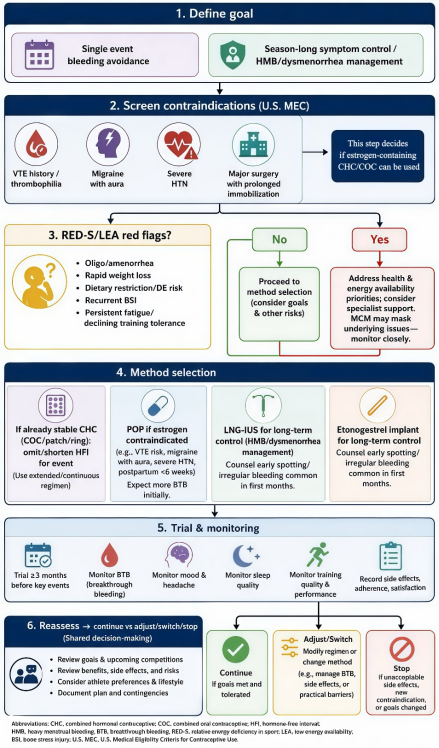
Across scenarios, implementation should include prospective monitoring of bleeding patterns, tolerability, mood symptoms, and training quality (Table 3). In athletes with suspected low energy availability (LEA) or Relative Energy Deficiency in Sport (RED-S), evaluation and management of underlying dysfunction should take precedence over contraceptive-based cycle manipulation . A stepwise clinical pathway is illustrated in Figure 1. A fillable monitoring template incorporating these domains is shown in Table 3.
Table 3. MCM trial-phase monitoring template (≥3 months) for female athletes.
Instructions: Complete wekly during the MCM trial period (recommended 3 months). Use 0-10 numerical rating scales unless othervise indicated.
Context notes hep interpret fluctuations (eg. travel, competition, mised doses, llness, high training load). Cinician action should be recorded at each review.

Week

BTB days(0-7)

BTB severity

Headache

Mood/anxiety

Sleep quality

Key-session RPE

Fatigue/readiness

Context notes

Clinician action

Week1

Week2

Week3

Week4

Week5

Week6

Week7

Week8

Week9

Week 10

Week 11

Week 12

Record the RPE of your most important training or competition session of the week.
Scoring guidance: 0 = no symptoms / very poor; 10 = worst imaginable / excellent / very ready (as applicable to each domain).
Note: >3 consecutive weeks of moderate-heavy BTB, or any severe adverse effect (e.g., severe headache, mood worsening, unacceptable fatigue) should prompt clinician review.
8.3. Goal-Stratified Method Selection
Effective implementation of MCM requires shared decision-making grounded in realistic expectations. Athletes should understand that the primary benefits of MCM relate to symptom reduction, bleeding predictability, and logistical convenience—not enhancement of physiological performance capacity .
Acute bleeding avoidance for a single major competition: For an athlete already stabilised on a combined hormonal contraceptive (CHC) regimen, the most practical approach is typically to omit or shorten the hormone-free interval (i.e., continuing active hormone administration) to delay scheduled withdrawal bleeding .
Equally, clinicians should communicate that cycle control may introduce new uncertainties, including unscheduled bleeding or tolerability concerns. Framing MCM as a collaborative, revisable strategy—rather than a definitive performance intervention—supports informed consent and promotes athlete welfare within a structured follow-up plan . The stepwise clinical algorithm is illustrated in Figure 1.
Figure 1. Clinical algorithm for goal-directed menstrual cycle manipulation (MCM) in female athletes.
9. Evidence Gaps and Future Directions
Despite increasing clinical use of menstrual cycle manipulation (MCM) in elite sport, most prescribing decisions remain extrapolated from general-population data. Athlete-specific evidence is limited, particularly regarding competition-relevant outcomes such as time to bleeding stabilization, likelihood of disruptive unscheduled bleeding during priority events, and discontinuation due to performance-facing side effects. Prospective athlete cohorts incorporating standardized bleeding outcomes alongside sport-specific measures of training continuity and competition readiness are needed to inform counseling and method selection .
Second, heterogeneity in contraceptive formulation and regimen limits actionable guidance. Many studies compare “oral contraceptive users versus non-users,” pooling diverse estrogen doses, progestin types, and cyclic versus continuous regimens. Although mechanistic and pharmacological data highlight differences in progestin receptor activity and pharmacokinetics , performance-relevant effects appear small and inconsistent. Future research should therefore prioritize formulation-stratified, longitudinal designs powered to detect clinically meaningful differences in bleeding control, tolerability, and training response .
Finally, stronger integration between MCM prescribing and RED-S risk management is required. While consensus guidance emphasizes that hormonally induced bleeding does not confirm endocrine recovery, few studies evaluate whether structured prescribing pathways improve early detection of low energy availability or reduce downstream complications such as bone stress injury . Advancing the field will require athlete-centered, longitudinal research that links cycle control and symptom management to performance readiness while preserving diagnostic vigilance for underlying energy deficiency.
10. Conclusion
Menstrual cycle manipulation (MCM) can be a clinically useful strategy for female athletes when the objective is to reduce symptom burden and improve bleeding predictability during training and competition . Established indications include management of dysmenorrhea, heavy menstrual bleeding, and selected premenstrual symptoms when appropriate therapies are chosen . Implementation should be individualized and grounded in standard contraceptive safety principles, including contraindication screening and venous thromboembolism risk assessment when estrogen-containing regimens are considered . Advance planning—rather than pericompetitive initiation—remains central to minimizing unscheduled bleeding and tolerability concerns .
Current evidence does not support MCM as a performance-enhancing intervention; perceived benefits are more plausibly related to improved symptom control and logistical stability than to direct physiological augmentation . Importantly, in athletes with menstrual irregularity or other indicators of low energy availability or Relative Energy Deficiency in Sport (RED-S), evaluation and management of underlying energy deficiency should take precedence over hormonal cycle manipulation, given the risk of obscuring clinically significant dysfunction . Within an individualized, safety-focused clinical framework, MCM may support athlete well-being without compromising diagnostic vigilance.
Abbreviations

BTB

Breakthrough Bleeding

CHC

Combined Hormonal Contraception

COC

Combined Oral Contraceptive

FHA

Functional Hypothalamic Amenorrhea

HMB

Heavy Menstrual Bleeding

LARC

Long acting Reversible Contraception

LEA

Low Energy Availability

LNG IUS

Levonorgestrel releasing Intrauterine System

MCM

Menstrual Cycle Manipulation

POP

Progestin only Pill

RED S

Relative Energy Deficiency in Sport

U.S. MEC

United States Medical Eligibility Criteria

VO2max

Maximal Oxygen Consumption

VTE

Venous thromboembolism

UV

Ultraviolet

Author Contributions
Qiquan Guo: Conceptualization, Formal Analysis, Investigation, Methodology, Project administration, Resources, Visualization, Writing – original draft, Writing – review & editing
Conflicts of Interest
The authors declare no conflicts of interest.
References
[1] Mountjoy M, Ackerman KE, Bailey DM, Burke LM, Constantini N, Hackney AC, et al. 2023 International Olympic Committee's (IOC) consensus statement on Relative Energy Deficiency in Sport (REDs). Br J Sports Med. 2023; 57(17): 1073-97.
[2] Findlay RJ, Macrae EHR, Whyte IY, Easton C, Forrest Née Whyte LJ. How the menstrual cycle and menstruation affect sporting performance: experiences and perceptions of elite female rugby players. Br J Sports Med. 2020; 54(18): 1108-13.
[3] Schaumberg MA, Emmerton LM, Jenkins DG, Burton NW, Janse de Jonge XAK, Skinner TL. Use of Oral Contraceptives to Manipulate Menstruation in Young, Physically Active Women. Int J Sports Physiol Perform. 2018; 13(1): 82-7.
[4] Armour M, Parry K, Manohar N, Holmes K, Ferfolja T, Curry C, et al. The Prevalence and Academic Impact of Dysmenorrhea in 21,573 Young Women: A Systematic Review and Meta-Analysis. J Womens Health (Larchmt). 2019; 28(8): 1161-71.
[5] Martin D, Sale C, Cooper SB, Elliott-Sale KJ. Period Prevalence and Perceived Side Effects of Hormonal Contraceptive Use and the Menstrual Cycle in Elite Athletes. Int J Sports Physiol Perform. 2018; 13(7): 926-32.
[6] von Rosen P, Ekenros L, Solli GS, Sandbakk Ø, Holmberg HC, Hirschberg AL, et al. Offered Support and Knowledge about the Menstrual Cycle in the Athletic Community: A Cross-Sectional Study of 1086 Female Athletes. Int J Environ Res Public Health. 2022; 19(19).
[7] McNulty KL, Elliott-Sale KJ, Dolan E, Swinton PA, Ansdell P, Goodall S, et al. The Effects of Menstrual Cycle Phase on Exercise Performance in Eumenorrheic Women: A Systematic Review and Meta-Analysis. Sports Med. 2020; 50(10): 1813-27.
[8] Gordon CM, Ackerman KE, Berga SL, Kaplan JR, Mastorakos G, Misra M, et al. Functional Hypothalamic Amenorrhea: An Endocrine Society Clinical Practice Guideline. J Clin Endocrinol Metab. 2017; 102(5): 1413-39.
[9] Castanier C, Bougault V, Teulier C, Jaffré C, Schiano-Lomoriello S, Vibarel-Rebot N, et al. The Specificities of Elite Female Athletes: A Multidisciplinary Approach. Life (Basel). 2021; 11(7).
[10] Elliott-Sale KJ, McNulty KL, Ansdell P, Goodall S, Hicks KM, Thomas K, et al. The Effects of Oral Contraceptives on Exercise Performance in Women: A Systematic Review and Meta-analysis. Sports Med. 2020; 50(10): 1785-812.
[11] Ekenros L, von Rosen P, Solli GS, Sandbakk Ø, Holmberg HC, Hirschberg AL, et al. Perceived impact of the menstrual cycle and hormonal contraceptives on physical exercise and performance in 1,086 athletes from 57 sports. Front Physiol. 2022; 13: 954760.
[12] Brown N, Knight CJ, Forrest Née Whyte LJ. Elite female athletes' experiences and perceptions of the menstrual cycle on training and sport performance. Scand J Med Sci Sports. 2021; 31(1): 52-69.
[13] Bruinvels G, Goldsmith E, Blagrove R, Simpkin A, Lewis N, Morton K, et al. Prevalence and frequency of menstrual cycle symptoms are associated with availability to train and compete: a study of 6812 exercising women recruited using the Strava exercise app. Br J Sports Med. 2021; 55(8): 438-43.
[14] Solli GS, Sandbakk SB, Noordhof DA, Ihalainen JK, Sandbakk Ø. Changes in Self-Reported Physical Fitness, Performance, and Side Effects Across the Phases of the Menstrual Cycle Among Competitive Endurance Athletes. Int J Sports Physiol Perform. 2020; 15(9): 1324-33.
[15] Jørgensen H, Davenport MH, Holt NL, McHugh TF. National team biathletes' experiences of the menstrual cycle: "it's something that needs to be heard". BMJ Open Sport Exerc Med. 2025; 11(2): e002407.
[16] Jacobson JC, Likis FE, Murphy PA. Extended and Continuous Combined Contraceptive Regimens for Menstrual Suppression. J Midwifery Womens Health. 2012; 57(6): 585-92.
[17] Edelman A, Micks E, Gallo MF, Jensen JT, Grimes DA. Continuous or extended cycle vs. cyclic use of combined hormonal contraceptives for contraception. Cochrane Database Syst Rev. 2014; 2014(7): Cd004695.
[18] Mendoza N, Lobo P, Lertxundi R, Correa M, Gonzalez E, Salamanca A, et al. Extended regimens of combined hormonal contraception to reduce symptoms related to withdrawal bleeding and the hormone-free interval: a systematic review of randomised and observational studies. Eur J Contracept Reprod Health Care. 2014; 19(5): 321-39.
[19] General Approaches to Medical Management of Menstrual Suppression: ACOG Clinical Consensus No. 3. Obstet Gynecol. 2022; 140(3): 528-41.
[20] Zigler RE, McNicholas C. Unscheduled Vaginal Bleeding with Progestin-only Contraceptive Use. Am J Obstet Gynecol. 2017; 216(5): 443-50.
[21] Palacios S, Colli E, Regidor PA. Bleeding profile of women using a drospirenone-only pill 4 mg over nine cycles in comparison with desogestrel 0.075 mg. PLoS One. 2020; 15(6): e0231856.
[22] Teal S, Edelman A. Contraception Selection, Effectiveness, and Adverse Effects: A Review. Jama. 2021; 326(24): 2507-18.
[23] Curtis KM, Nguyen AT, Tepper NK, Zapata LB, Snyder EM, Hatfield-Timajchy K, et al. U.S. Selected Practice Recommendations for Contraceptive Use, 2024. MMWR Recomm Rep. 2024; 73(3): 1-77.
[24] Costescu D, Chawla R, Hughes R, Teal S, Merz M. Discontinuation rates of intrauterine contraception due to unfavourable bleeding: a systematic review. BMC Womens Health. 2022; 22(1): 82.
[25] Moray KV, Chaurasia H, Sachin O, Joshi B. A systematic review on clinical effectiveness, side-effect profile and meta-analysis on continuation rate of etonogestrel contraceptive implant. Reprod Health. 2021; 18(1): 4.
[26] Bofill Rodriguez M, Lethaby A, Jordan V. Progestogen-releasing intrauterine systems for heavy menstrual bleeding. Cochrane Database Syst Rev. 2020; 6(6): Cd002126.
[27] Wang J, Deng K, Li L, Dai Y, Sun X. Levonorgestrel-releasing intrauterine system vs. systemic medication or blank control for women with dysmenorrhea: Systematic review and meta-analysis of randomized controlled trials. Front Glob Womens Health. 2022; 3: 1013921.
[28] Anthony MS, Zhou X, Schoendorf J, Reed SD, Getahun D, Armstrong MA, et al. Demographic, Reproductive, and Medical Risk Factors for Intrauterine Device Expulsion. Obstet Gynecol. 2022; 140(6): 1017-30.
[29] Furlani RM, Garcia E, Castro S, Machado HC, Bahamondes L, Monteiro I. Expulsion rates of the levonorgestrel 52 mg intrauterine system are similar among women with heavy menstrual bleeding and users for contraception. Contraception. 2022; 105: 75-9.
[30] Schumpf LF, Braun C, Peric A, Schmid MJ, Lehnick D, Christmann-Schmid C, et al. The influence of the menstrual cycle and hormonal contraceptives on cardiorespiratory fitness in physically active women: A systematic review and meta-analysis. Heliyon. 2023; 9(6): e17049.
[31] Nolan D, McNulty KL, Manninen M, Egan B. The Effect of Hormonal Contraceptive Use on Skeletal Muscle Hypertrophy, Power and Strength Adaptations to Resistance Exercise Training: A Systematic Review and Multilevel Meta-analysis. Sports Med. 2024; 54(1): 105-25.
[32] Ryall S, Ohrling H, Stellingwerff T, Black S, Reilly K, Thornton JS. Contraception Choice for Female Endurance Athletes: What's Sport Got to Do With It? A Cross-Sectional Survey. Sports Med. 2024; 54(12): 3181-97.
[33] Thompson B, Almarjawi A, Sculley D, Janse de Jonge X. The Effect of the Menstrual Cycle and Oral Contraceptives on Acute Responses and Chronic Adaptations to Resistance Training: A Systematic Review of the Literature. Sports Med. 2020; 50(1): 171-85.
[34] Dalgaard LB, Dalgas U, Andersen JL, Rossen NB, Møller AB, Stødkilde-Jørgensen H, et al. Influence of Oral Contraceptive Use on Adaptations to Resistance Training. Front Physiol. 2019; 10: 824.
[35] Alexander SE, Pollock AC, Lamon S. The effect of sex hormones on skeletal muscle adaptation in females. Eur J Sport Sci. 2022; 22(7): 1035-45.
[36] Holm MR, Holtvedt H, Hansen M, Paulsen G, Seynnes O. Second-Generation Oral Contraceptive Use Is Associated With Greater Muscle Hypertrophy Following Resistance Training. Scand J Med Sci Sports. 2025; 35(12): e70189.
[37] Dalgaard LB, Jørgensen EB, Oxfeldt M, Dalgaard EB, Johansen FT, Karlsson M, et al. Influence of Second Generation Oral Contraceptive Use on Adaptations to Resistance Training in Young Untrained Women. J Strength Cond Res. 2022; 36(7): 1801-9.
[38] García-Sáenz M, Ibarra-Salce R, Pozos-Varela FJ, Mena-Ureta TS, Flores-Villagómez S, Santana-Mata M, et al. Understanding Progestins: From Basics to Clinical Applicability. J Clin Med. 2023; 12(10).
[39] Bick AJ, Louw-du Toit R, Skosana SB, Africander D, Hapgood JP. Pharmacokinetics, metabolism and serum concentrations of progestins used in contraception. Pharmacol Ther. 2021; 222: 107789.
[40] Louw-du Toit R, Hapgood JP, Africander D. A direct comparison of the transcriptional activities of progestins used in contraception and menopausal hormone therapy via the mineralocorticoid receptor. Biochem Biophys Res Commun. 2020; 526(2): 466-71.
[41] Mountjoy M, Sundgot-Borgen JK, Burke LM, Ackerman KE, Blauwet C, Constantini N, et al. IOC consensus statement on relative energy deficiency in sport (RED-S): 2018 update. Br J Sports Med. 2018; 52(11): 687-97.
[42] Williams NI, De Souza MJ, Misra M, Nattiv A, Joy E, Barrack M, et al. 2025 Update to the Female Athlete Triad Coalition Consensus Statement Part 2: Clinical Guidelines for Screening, Diagnosis, Treatment, and Return to Play for Adolescents and Adults. Sports Med. 2026; 56(2): 375-427.
[43] Logue DM, Madigan SM, Melin A, Delahunt E, Heinen M, Donnell SM, et al. Low Energy Availability in Athletes 2020: An Updated Narrative Review of Prevalence, Risk, Within-Day Energy Balance, Knowledge, and Impact on Sports Performance. Nutrients. 2020; 12(3).
[44] Heikura IA, Uusitalo ALT, Stellingwerff T, Bergland D, Mero AA, Burke LM. Low Energy Availability Is Difficult to Assess but Outcomes Have Large Impact on Bone Injury Rates in Elite Distance Athletes. Int J Sport Nutr Exerc Metab. 2018; 28(4): 403-11.
[45] Heikura IA, Stellingwerff T, Areta JL. Low energy availability in female athletes: From the lab to the field. Eur J Sport Sci. 2022; 22(5): 709-19.
[46] Critchley HOD, Maybin JA, Armstrong GM, Williams ARW. Physiology of the Endometrium and Regulation of Menstruation. Physiol Rev. 2020; 100(3): 1149-79.
[47] Jain V, Chodankar RR, Maybin JA, Critchley HOD. Uterine bleeding: how understanding endometrial physiology underpins menstrual health. Nat Rev Endocrinol. 2022; 18(5): 290-308.
[48] Hickey M, Crewe J, Mahoney LA, Doherty DA, Fraser IS, Salamonsen LA. Mechanisms of irregular bleeding with hormone therapy: the role of matrix metalloproteinases and their tissue inhibitors. J Clin Endocrinol Metab. 2006; 91(8): 3189-98.
[49] McKerrow Johnson I, Shatzel J, Olson S, Kohl T, Hamilton A, DeLoughery TG. Travel-Associated Venous Thromboembolism. Wilderness Environ Med. 2022; 33(2): 169-78.
[50] Nguyen AT, Curtis KM, Tepper NK, Kortsmit K, Brittain AW, Snyder EM, et al. U.S. Medical Eligibility Criteria for Contraceptive Use, 2024. MMWR Recomm Rep. 2024; 73(4): 1-126.
[51] Girum T, Wasie A. Return of fertility after discontinuation of contraception: a systematic review and meta-analysis. Contracept Reprod Med. 2018; 3: 9.
Cite This Article
  • APA Style

    Guo, Q. (2026). Menstrual Cycle Manipulation in Female Athletes to Avoid Competition-Day Bleeding: Symptom Control, Performance Limits, and RED-S-Safe Prescribing—A Narrative Review. World Journal of Public Health, 11(3), 310-321. https://doi.org/10.11648/j.wjph.20261103.20

    Copy | Download

    ACS Style

    Guo, Q. Menstrual Cycle Manipulation in Female Athletes to Avoid Competition-Day Bleeding: Symptom Control, Performance Limits, and RED-S-Safe Prescribing—A Narrative Review. World J. Public Health 2026, 11(3), 310-321. doi: 10.11648/j.wjph.20261103.20

    Copy | Download

    AMA Style

    Guo Q. Menstrual Cycle Manipulation in Female Athletes to Avoid Competition-Day Bleeding: Symptom Control, Performance Limits, and RED-S-Safe Prescribing—A Narrative Review. World J Public Health. 2026;11(3):310-321. doi: 10.11648/j.wjph.20261103.20

    Copy | Download

  • @article{10.11648/j.wjph.20261103.20,
      author = {Qiquan Guo},
      title = {Menstrual Cycle Manipulation in Female Athletes to Avoid Competition-Day Bleeding: Symptom Control, Performance Limits, and RED-S-Safe Prescribing—A Narrative Review},
      journal = {World Journal of Public Health},
      volume = {11},
      number = {3},
      pages = {310-321},
      doi = {10.11648/j.wjph.20261103.20},
      url = {https://doi.org/10.11648/j.wjph.20261103.20},
      eprint = {https://article.sciencepublishinggroup.com/pdf/10.11648.j.wjph.20261103.20},
      abstract = {Background: In elite sport, an increasing number of female athletes use menstrual cycle manipulation (MCM), most commonly via hormonal contraceptives, to delay or suppress withdrawal bleeding during key competitions. Although MCM may address legitimate functional needs, it is often misconstrued as a logistical strategy rather than a pharmacological intervention requiring contraindication screening, adverse-effect monitoring, and vigilance for masked underlying conditions. Objectives: This narrative review synthesizes current evidence on motivations for MCM use, commonly employed pharmacological approaches, limits of performance-related benefits, screening considerations for low energy availability (LEA) and Relative Energy Deficiency in Sport (RED-S), long-term safety, and clinical implementation in female athletes. Main Findings: Hormonal contraceptives improve menstrual predictability and reduce dysmenorrhea, heavy menstrual bleeding, and selected premenstrual symptoms. However, systematic reviews and meta-analyses consistently show no direct ergogenic benefit and no meaningful improvement in VO2max, muscular strength, or explosive power. Perceived performance gains likely reflect symptom relief and reduced competition burden rather than intrinsic pharmacological enhancement. Athletes with oligomenorrhea, amenorrhea, rapid weight loss, chronic dietary restriction, or recurrent bone stress injuries should be evaluated for LEA and RED-S before initiating MCM to avoid delayed diagnosis and masking of energy deficiency. Conclusions: MCM can be integrated into individualized menstrual health management when guided by clear objectives, structured risk stratification, an assess-before-prescribing approach, and preseason pharmacological trials with longitudinal monitoring. Within such a framework, MCM may support athlete welfare without obscuring underlying pathology.},
     year = {2026}
    }
    

    Copy | Download

  • TY  - JOUR
    T1  - Menstrual Cycle Manipulation in Female Athletes to Avoid Competition-Day Bleeding: Symptom Control, Performance Limits, and RED-S-Safe Prescribing—A Narrative Review
    AU  - Qiquan Guo
    Y1  - 2026/08/26
    PY  - 2026
    N1  - https://doi.org/10.11648/j.wjph.20261103.20
    DO  - 10.11648/j.wjph.20261103.20
    T2  - World Journal of Public Health
    JF  - World Journal of Public Health
    JO  - World Journal of Public Health
    SP  - 310
    EP  - 321
    PB  - Science Publishing Group
    SN  - 2637-6059
    UR  - https://doi.org/10.11648/j.wjph.20261103.20
    AB  - Background: In elite sport, an increasing number of female athletes use menstrual cycle manipulation (MCM), most commonly via hormonal contraceptives, to delay or suppress withdrawal bleeding during key competitions. Although MCM may address legitimate functional needs, it is often misconstrued as a logistical strategy rather than a pharmacological intervention requiring contraindication screening, adverse-effect monitoring, and vigilance for masked underlying conditions. Objectives: This narrative review synthesizes current evidence on motivations for MCM use, commonly employed pharmacological approaches, limits of performance-related benefits, screening considerations for low energy availability (LEA) and Relative Energy Deficiency in Sport (RED-S), long-term safety, and clinical implementation in female athletes. Main Findings: Hormonal contraceptives improve menstrual predictability and reduce dysmenorrhea, heavy menstrual bleeding, and selected premenstrual symptoms. However, systematic reviews and meta-analyses consistently show no direct ergogenic benefit and no meaningful improvement in VO2max, muscular strength, or explosive power. Perceived performance gains likely reflect symptom relief and reduced competition burden rather than intrinsic pharmacological enhancement. Athletes with oligomenorrhea, amenorrhea, rapid weight loss, chronic dietary restriction, or recurrent bone stress injuries should be evaluated for LEA and RED-S before initiating MCM to avoid delayed diagnosis and masking of energy deficiency. Conclusions: MCM can be integrated into individualized menstrual health management when guided by clear objectives, structured risk stratification, an assess-before-prescribing approach, and preseason pharmacological trials with longitudinal monitoring. Within such a framework, MCM may support athlete welfare without obscuring underlying pathology.
    VL  - 11
    IS  - 3
    ER  - 

    Copy | Download

Author Information
  • School of Physical Education, Shanxi Normal University, Taiyuan, China

  • Abstract
  • Keywords
  • Document Sections

    1. 1. Introduction
    2. 2. Materials and Methods
    3. 3. Clinical and Practical Drivers of Menstrual Cycle Manipulation in Sport
    4. 4. Hormonal Strategies for Menstrual Cycle Manipulation: Options and Practical Fit
    5. 5. Performance Implications and Physiological Considerations
    6. 6. Menstrual Dysfunction, LEA, and RED-S
    7. 7. Safety Considerations and Clinical Limitations
    8. 8. Practical Clinical Framework for Athlete-Centered MCM
    9. 9. Evidence Gaps and Future Directions
    10. 10. Conclusion
    Show Full Outline
  • Abbreviations
  • Author Contributions
  • Conflicts of Interest
  • References
  • Cite This Article
  • Author Information