
 ,
Peter Uduak Augustine,
Queen Desmond Atuzie,
Priscillia Nyekpunwo Ogbonda,
Anthony Ike Wegbom
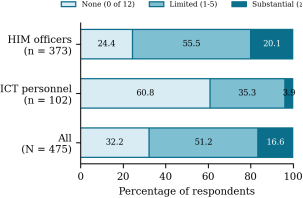
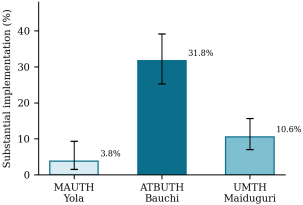
Background: The 11th revision of the International Classification of Diseases (ICD-11) took effect in January 2022, yet there is no published evidence on how far Nigerian hospitals have put it into use. We measured the extent of ICD-11 implementation reported by health information management (HIM) professionals and information and communication technology (ICT) personnel in three teaching hospitals in North-East Nigeria, and examined which respondent and hospital characteristics were associated with substantial implementation. Methods: This was the second objective of a cross-sectional survey of staff in teaching hospitals in Yola, Bauchi and Maiduguri, whose design is described in a companion paper. Twelve Yes/No indicators covering system availability, technical integration, functional readiness and interoperability were summed (range 0-12); a score of 6 or more was defined as substantial implementation. Associations were examined with chi-square tests and binary logistic regression. Results: Data from 475 respondents were analysed (373 HIM, 102 ICT; response 97.7%). A third (32.2%) reported none of the indicators, half (51.2%) reported one to five, and 16.6% (95% confidence interval [CI] 13.6-20.2) reported six or more. Substantial implementation was reported by 20.1% of HIM officers and 3.9% of ICT personnel (p < 0.001), and by 3.8% of respondents in Yola, 31.8% in Bauchi and 10.6% in Maiduguri (p < 0.001). After adjustment, ICT personnel (adjusted odds ratio [AOR] 0.14; 95% CI 0.05-0.42) and staff with 16 or more years of experience (AOR 0.17; 0.06-0.50) were less likely, and staff in Bauchi (AOR 13.57; 4.58-40.19) and Maiduguri (AOR 3.88; 1.25-12.03) more likely than staff in Yola, to report substantial implementation. Conclusion: ICD-11 implementation is at an early stage in these hospitals, with wide differences between professions and hospitals. Joint HIM-ICT planning, integration of the ICD-11 code set into existing systems, training and hospital-specific support are needed. The estimates rest on self-report and a pragmatic cut-off and should be confirmed by audits of actual coding.
| Published in | World Journal of Public Health (Volume 11, Issue 4) |
| DOI | 10.11648/j.wjph.20261104.13 |
| Page(s) | 427-438 |
| Creative Commons |
This is an Open Access article, distributed under the terms of the Creative Commons Attribution 4.0 International License (http://creativecommons.org/licenses/by/4.0/), which permits unrestricted use, distribution and reproduction in any medium or format, provided the original work is properly cited. |
| Copyright |
Copyright © The Author(s), 2026. Published by Science Publishing Group |
ICD-11, Disease Classification, Clinical Coding, Health Information Systems, Implementation, Nigeria
Indicator | HIM officers (n = 373) Yes, n (%) |
|---|---|
System availability and deployment | |
1. EHR systems required for ICD-11 coding are available | 105 (28.2) |
2. Computer systems are accessible for routine ICD-11 coding | 95 (25.5) |
3. System downtime rarely disrupts ICD-11 coding work | 99 (26.5) |
Technical integration of ICD-11 | |
4. ICD-11 codes are integrated into the EHR system | 130 (34.9) |
5. EHR supports ICD-11 coding without reliance on manual processes | 120 (32.2) |
6. ICD-11 updates are implemented promptly | 126 (33.8) |
Functional readiness of ICT systems | |
7. The facility has functional ICT systems | 37 (9.9) |
8. ICT infrastructure is adequate for electronic record management | 42 (11.3) |
9. System features support correct documentation for ICD-11 coding | 75 (20.1) |
Interoperability and data exchange | |
10. ICD-11 coded data can be shared electronically across departments | 103 (27.6) |
11. EHR system supports standardised health data exchange | 65 (17.4) |
12. ICD-11 data generated are suitable for reporting and analysis | 87 (23.3) |
Indicator | ICT personnel (n = 102) Yes, n (%) |
|---|---|
System availability and deployment | |
1. EHR systems required for ICD-11 implementation are fully deployed | 7 (6.9) |
2. Server, network and hardware infrastructure adequately support ICD-11 operations | 5 (4.9) |
3. System uptime is sufficient to sustain ICD-11 activities | 8 (7.8) |
Technical integration of ICD-11 | |
4. ICD-11 code libraries are technically integrated into the EHR system | 13 (12.7) |
5. System configurations support ICD-11 coding requirements | 10 (9.8) |
6. ICD-11 system updates and patches are routinely implemented | 9 (8.8) |
Functional readiness of ICT systems | |
7. EHR system is technically capable of supporting ICD-11 workflows | 5 (4.9) |
8. System functionality minimises errors during ICD-11 coding | 8 (7.8) |
9. ICT systems support structured clinical documentation for ICD-11 use | 7 (6.9) |
Interoperability and data exchange | |
10. EHR system supports interoperable exchange of ICD-11 data | 9 (8.8) |
11. ICD-11 data can be transmitted across internal and external systems | 9 (8.8) |
12. Standard data exchange protocols are used for ICD-11 information | 10 (9.8) |
Implementation status | HIM officers n (%) | ICT personnel n (%) | Total n (%) |
|---|---|---|---|
None (0 of 12) | 91 (24.4) | 62 (60.8) | 153 (32.2) |
Limited (1-5 of 12) | 207 (55.5) | 36 (35.3) | 243 (51.2) |
Substantial (6-12 of 12) | 75 (20.1) | 4 (3.9) | 79 (16.6) |
Mean number of indicators reported* | 2.91 | 0.98 | 2.49 |
Characteristic | n | Substantial n (%) | Not substantial n (%) | χ² | p-value |
|---|---|---|---|---|---|
Gender | 0.10 | 0.759 | |||
Male | 227 | 39 (17.2) | 188 (82.8) | ||
Female | 248 | 40 (16.1) | 208 (83.9) | ||
Age (years) | 8.00 | 0.046 | |||
≤30 | 157 | 19 (12.1) | 138 (87.9) | ||
31-40 | 209 | 34 (16.3) | 175 (83.7) | ||
41-50 | 84 | 18 (21.4) | 66 (78.6) | ||
≥51 | 25 | 8 (32.0) | 17 (68.0) | ||
Educational qualification | 0.340† | ||||
Secondary | 19 | 1 (5.3) | 18 (94.7) | ||
Higher | 456 | 78 (17.1) | 378 (82.9) | ||
Socio-economic status | 3.15 | 0.207 | |||
Low | 37 | 10 (27.0) | 27 (73.0) | ||
Middle | 377 | 59 (15.6) | 318 (84.4) | ||
High | 61 | 10 (16.4) | 51 (83.6) | ||
Years of experience | 11.36 | 0.010 | |||
1-5 | 114 | 17 (14.9) | 97 (85.1) | ||
6-10 | 98 | 19 (19.4) | 79 (80.6) | ||
11-15 | 155 | 35 (22.6) | 120 (77.4) | ||
≥16 | 108 | 8 (7.4) | 100 (92.6) | ||
Facility | 46.02 | <0.001 | |||
MAUTH, Yola | 106 | 4 (3.8) | 102 (96.2) | ||
ATBUTH, Bauchi | 170 | 54 (31.8) | 116 (68.2) | ||
UMTH, Maiduguri | 199 | 21 (10.6) | 178 (89.4) | ||
Professional group | 15.13 | <0.001 | |||
HIM officers | 373 | 75 (20.1) | 298 (79.9) | ||
ICT personnel | 102 | 4 (3.9) | 98 (96.1) | ||
Total | 475 | 79 (16.6) | 396 (83.4) |
Characteristic | Crude OR (95% CI) | p-value | Adjusted OR (95% CI) | p-value |
|---|---|---|---|---|
Age (per year) | 1.04 (1.01-1.07) | 0.010 | 1.06 (1.02-1.10) | 0.007 |
Gender (ref: Male) | ||||
Female | 0.93 (0.57-1.50) | 0.759 | 0.80 (0.46-1.42) | 0.449 |
Educational qualification (ref: Secondary) | ||||
Higher | 3.71 (0.49-28.24) | 0.205 | 3.82 (0.48-30.71) | 0.207 |
Socio-economic status (ref: Low) | ||||
Middle | 0.50 (0.23-1.09) | 0.081 | 0.56 (0.22-1.41) | 0.220 |
High | 0.53 (0.20-1.43) | 0.209 | 0.70 (0.22-2.22) | 0.547 |
Years of experience (ref: 1-5) | ||||
6-10 | 1.37 (0.67-2.82) | 0.388 | 1.14 (0.49-2.64) | 0.767 |
11-15 | 1.66 (0.88-3.15) | 0.118 | 0.78 (0.34-1.76) | 0.543 |
≥16 | 0.46 (0.19-1.11) | 0.083 | 0.17 (0.06-0.50) | 0.001 |
Facility (ref: MAUTH, Yola) | ||||
ATBUTH, Bauchi | 11.87 (4.15-33.92) | <0.001 | 13.57 (4.58-40.19) | <0.001 |
UMTH, Maiduguri | 3.01 (1.00-9.01) | 0.049 | 3.88 (1.25-12.03) | 0.019 |
Professional group (ref: HIM officers) | ||||
ICT personnel | 0.16 (0.06-0.45) | <0.001 | 0.14 (0.05-0.42) | <0.001 |
AOR | Adjusted Odds Ratio |
ATBUTH | Abubakar Tafawa Balewa University Teaching Hospital |
CI | Confidence Interval |
EHR | Electronic Health Record |
HIM | Health Information Management |
ICD-10 / ICD-11 | International Classification of Diseases, 10th / 11th Revision |
ICT | Information and Communication Technology |
MAUTH | Modibbo Adama University Teaching Hospital |
OR | Odds Ratio |
SD | Standard Deviation |
STROBE | Strengthening the Reporting of Observational Studies in Epidemiology |
UMTH | University of Maiduguri Teaching Hospital |
WHO | World Health Organization |
| [1] | World Health Organization (WHO). International Classification of Diseases 11th Revision (ICD-11) [Internet]. Geneva: World Health Organization; 2019. Available from: |
| [2] | Harrison, J. E., Weber, S., Jakob, R., Chute, C. G. ICD-11: an international classification of diseases for the twenty-first century. BMC Medical Informatics and Decision Making. 2021; 21(Suppl 6): 206. |
| [3] | Chute, C. G., Çelik, C. Overview of ICD-11 architecture and structure. BMC Medical Informatics and Decision Making. 2021; 21(Suppl 6): 378. |
| [4] | Fung, K. W., Xu, J., Bodenreider, O. The new International Classification of Diseases 11th edition: a comparative analysis with ICD-10 and ICD-10-CM. Journal of the American Medical Informatics Association. 2020; 27(5): 738-746. |
| [5] | Reed, G. M., First, M. B., Kogan, C. S., Hyman, S. E., Gureje, O., Gaebel, W., et al. Innovations and changes in the ICD-11 classification of mental, behavioural and neurodevelopmental disorders. World Psychiatry. 2019; 18(1): 3-19. |
| [6] |
World Health Organization (WHO). ICD-11 implementation or transition guide, version 1.05. Geneva: World Health Organization; 2019. Available from:
https://icd.who.int/en/docs/ICD-11%20Implementation%20or%20Transition%20Guide_v105.pdf |
| [7] | Azadmanjir, Z., Sheikhtaheri, A., Zarei, J., Golpira, R., Bakhshandeh, H., Vahedi, A., Hashemi, N. A study on initial productivity trend in the transition of the ICD-10 to ICD-11 morbidity coding in Iran. Informatics in Medicine Unlocked. 2024; 44: 101440. |
| [8] | Zarei, J., Golpira, R., Hashemi, N., Azadmanjir, Z., Meidani, Z., Vahedi, A., et al. Comparison of the accuracy of inpatient morbidity coding with ICD-11 and ICD-10. Health Information Management Journal. 2025; 54(1): 14-24. |
| [9] | Lee, H., Kim, S. Impact of the ICD-11 on the accuracy of clinical coding in Korea. Health Information Management Journal. 2023; 52(3): 221-228. |
| [10] | Lee, H., Lee, Y. A Korean field trial of ICD-11 classification under practical clinical coding rules to clarify the reasons for inconsistencies. Health Information Management Journal. 2025; 54(3): 303-310. |
| [11] | Zhang, M., Wang, Y., Jakob, R., Su, S., Bai, X., Jing, X., et al. Methodologies and key considerations for implementing the International Classification of Diseases-11th revision morbidity coding: insights from a national pilot study in China. Journal of the American Medical Informatics Association. 2024; 31(5): 1084-1092. |
| [12] | Ming, X., Wei, H., Zhou, D., Tao, J., Qian, B., Li, H., Hu, J. ICD-11 pilot in West China: feasibility evaluation and implications for future implementation. Scientific Reports. 2026; 16: 25328. |
| [13] | Eastwood, C. A., Southern, D. A., Doktorchik, C., Khair, S., Cullen, D., Boxill, A., et al. Training and experience of coding with the World Health Organization's International Classification of Diseases, Eleventh Revision. Health Information Management Journal. 2023; 52(2): 92-100. |
| [14] | Ooi, E. C. W., Isa, Z. M., Manaf, M. R. A., Ahmad Fuad, A. S., Sidek, H. F., Mustapa, M. N., et al. From data collection to downstream data use: Malaysia's experience with ICD-11. Health Information Management Journal. 2025; 54(3): 325-332. |
| [15] | Ampah, B. A., Opoku, D. A., Sackeya, E., Ayisi-Boateng, N. K., Konadu, E., Addae, M., et al. Profiling disease patterns using ICD-11 at a university hospital in Ghana: a retrospective analysis of cross-sectional data from 2018 to 2021. Health Science Reports. 2026; 9(4): e72366. |
| [16] | AbouZahr, C., de Savigny, D., Mikkelsen, L., Setel, P. W., Lozano, R., Nichols, E., Notzon, F., Lopez, A. D. Civil registration and vital statistics: progress in the data revolution for counting and accountability. The Lancet. 2015; 386(10001): 1373-1385. |
| [17] | Mikkelsen, L., Phillips, D. E., AbouZahr, C., Setel, P. W., de Savigny, D., Lozano, R., Lopez, A. D. A global assessment of civil registration and vital statistics systems: monitoring data quality and progress. The Lancet. 2015; 386(10001): 1395-1406. |
| [18] | Maduekwe, N. I., Banjo, O. O., Sangodapo, M. O. The Nigerian civil registration and vital statistics system: contexts, institutions, operation. Social Indicators Research. 2017; 134: 651-674. |
| [19] | Gamage, U. S. H., Adair, T., Mikkelsen, L., Mahesh, P. K. B., Hart, J., Chowdhury, H., et al. The impact of errors in medical certification on the accuracy of the underlying cause of death. PLOS ONE. 2021; 16(11): e0259667. |
| [20] | Suthar, A. B., Khalifa, A., Yin, S., Wenz, K., Ma Fat, D., Mills, S. L., et al. Evaluation of approaches to strengthen civil registration and vital statistics systems: a systematic review and synthesis of policies in 25 countries. PLOS Medicine. 2019; 16(9): e1002929. |
| [21] | Adeleke, I. T., Ajayi, O. O., Jimoh, A. B., Adebisi, A. A., Omokanye, S. A., Jegede, M. K. Current clinical coding practices and implementation of ICD-10 in Africa: a survey of Nigerian hospitals. American Journal of Health Research. 2015; 3(1-1): 38-46. |
| [22] | Adeleke, I. T., Lawal, A. H., Adio, R. A., Adebisi, A. A. Information technology skills and training needs of health information management professionals in Nigeria: a nationwide study. Health Information Management Journal. 2015; 44(1): 30-38. |
| [23] | Makinde, O. A., Mami, M. I., Oweghoro, B. M., Oyediran, K. A., Mullen, S. Investing in health information management: the right people, in the right place, at the right time. Health Information Management Journal. 2016; 45(2): 90-96. |
| [24] | Ojo, A. I. Repositioning health information management practice in Nigeria: suggestions for Africa. Health Information Management Journal. 2018; 47(3): 140-144. |
| [25] | Adeleke, I. T., Suleiman-Abdul, Q. B., Aliyu, A., Ishaq, I. A., Adio, R. A. Deploying unqualified personnel in health records practice: role substitution or quackery? Implications for health services delivery in Nigeria. Health Information Management Journal. 2019; 48(3): 152-156. |
| [26] | Ravi, N., Thomas, C., Odogwu, J. How to reload and upgrade digital health to serve the healthcare needs of Nigerians. Frontiers in Digital Health. 2023; 5: 1225092. |
| [27] | Babatope, A. E., Adewumi, I. P., Ajisafe, D. O., Adepoju, K. O., Babatope, A. R. Assessing the factors militating against the effective implementation of electronic health records (EHR) in Nigeria. Scientific Reports. 2024; 14: 31398. |
| [28] | Weiner, B. J. A theory of organizational readiness for change. Implementation Science. 2009; 4: 67. |
| [29] | Greenhalgh, T., Wherton, J., Papoutsi, C., Lynch, J., Hughes, G., A'Court, C., Hinder, S., Fahy, N., Procter, R., Shaw, S. Beyond adoption: a new framework for theorizing and evaluating nonadoption, abandonment, and challenges to the scale-up, spread, and sustainability of health and care technologies. Journal of Medical Internet Research. 2017; 19(11): e367. |
| [30] | Zarei, J., Hadianfard, A., Sheikhtaheri, A. Preparation for the implementation of the International Classification of Diseases 11th revision: a survey on clinical coders' knowledge of ICD-11, educational needs, and readiness to accept new roles: a cross-sectional study. Health Science Reports. 2025; 8(3): e70453. |
| [31] | Ooi, E. C. W., Isa, Z. M., Manaf, M. R. A., Ahmad Fuad, A. S., Ahmad, A., Mustapa, M. N., et al. Development and validation of the intention to use the ICD-11 questionnaire in the Malaysian medical records context. PLOS ONE. 2024; 19(9): e0308403. |
| [32] | World Health Organization (WHO). Full impact of devastated health services in north-eastern Nigeria revealed by WHO report [Internet]. Geneva: World Health Organization; 2016 Dec 14. Available from: |
| [33] | Bhattacharya, A. A., Umar, N., Audu, A., Felix, H., Allen, E., Schellenberg, J. R. M., Marchant, T. Quality of routine facility data for monitoring priority maternal and newborn indicators in DHIS2: a case study from Gombe State, Nigeria. PLOS ONE. 2019; 14(1): e0211265. |
| [34] | Amadu, M. A., Augustine, P. U., Atuzie, Q. D., Ogbonda, P. N., Fubara, B. J., Blakk, R. I., Wegbom, A. I. Electronic health record adoption among health information management and ICT staff in tertiary hospitals in North-East Nigeria: level and associated factors. Manuscript under peer review at Biomedical Statistics and Informatics (manuscript ID 2750186). |
| [35] | von Elm, E., Altman, D. G., Egger, M., Pocock, S. J., Gøtzsche, P. C., Vandenbroucke, J. P. The Strengthening the Reporting of Observational Studies in Epidemiology (STROBE) statement: guidelines for reporting observational studies. The Lancet. 2007; 370(9596): 1453-1457. |
| [36] | Cochran, W. G. Sampling techniques. 3rd ed. New York: John Wiley & Sons; 1977. |
| [37] | Krejcie, R. V., Morgan, D. W. Determining sample size for research activities. Educational and Psychological Measurement. 1970; 30(3): 607-610. |
| [38] | Tavakol, M., Dennick, R. Making sense of Cronbach's alpha. International Journal of Medical Education. 2011; 2: 53-55. |
| [39] | Kim, H.-Y. Statistical notes for clinical researchers: chi-squared test and Fisher's exact test. Restorative Dentistry & Endodontics. 2017; 42(2): 152-155. |
| [40] | Peduzzi, P., Concato, J., Kemper, E., Holford, T. R., Feinstein, A. R. A simulation study of the number of events per variable in logistic regression analysis. Journal of Clinical Epidemiology. 1996; 49(12): 1373-1379. |
| [41] | Podsakoff, P. M., MacKenzie, S. B., Lee, J.-Y., Podsakoff, N. P. Common method biases in behavioral research: a critical review of the literature and recommended remedies. Journal of Applied Psychology. 2003; 88(5): 879-903. |
APA Style
Amadu, M. A., Augustine, P. U., Atuzie, Q. D., Ogbonda, P. N., Fubara, B. J., et al. (2026). Extent of ICD-11 Implementation in Teaching Hospitals of North-East Nigeria: A Cross-Sectional Survey of Health Information and ICT Professionals. World Journal of Public Health, 11(4), 427-438. https://doi.org/10.11648/j.wjph.20261104.13
ACS Style
Amadu, M. A.; Augustine, P. U.; Atuzie, Q. D.; Ogbonda, P. N.; Fubara, B. J., et al. Extent of ICD-11 Implementation in Teaching Hospitals of North-East Nigeria: A Cross-Sectional Survey of Health Information and ICT Professionals. World J. Public Health 2026, 11(4), 427-438. doi: 10.11648/j.wjph.20261104.13
AMA Style
Amadu MA, Augustine PU, Atuzie QD, Ogbonda PN, Fubara BJ, et al. Extent of ICD-11 Implementation in Teaching Hospitals of North-East Nigeria: A Cross-Sectional Survey of Health Information and ICT Professionals. World J Public Health. 2026;11(4):427-438. doi: 10.11648/j.wjph.20261104.13
@article{10.11648/j.wjph.20261104.13,
  author = {Minkailu Abubakar Amadu and Peter Uduak Augustine and Queen Desmond Atuzie and Priscillia Nyekpunwo Ogbonda and Boma Judith Fubara and Rose Ibifaka Blakk and Anthony Ike Wegbom},
  title = {Extent of ICD-11 Implementation in Teaching Hospitals of North-East Nigeria: A Cross-Sectional Survey of Health
Information and ICT Professionals},
  journal = {World Journal of Public Health},
  volume = {11},
  number = {4},
  pages = {427-438},
  doi = {10.11648/j.wjph.20261104.13},
  url = {https://doi.org/10.11648/j.wjph.20261104.13},
  eprint = {https://article.sciencepublishinggroup.com/pdf/10.11648.j.wjph.20261104.13},
  abstract = {Background: The 11th revision of the International Classification of Diseases (ICD-11) took effect in January 2022, yet there is no published evidence on how far Nigerian hospitals have put it into use. We measured the extent of ICD-11 implementation reported by health information management (HIM) professionals and information and communication technology (ICT) personnel in three teaching hospitals in North-East Nigeria, and examined which respondent and hospital characteristics were associated with substantial implementation. Methods: This was the second objective of a cross-sectional survey of staff in teaching hospitals in Yola, Bauchi and Maiduguri, whose design is described in a companion paper. Twelve Yes/No indicators covering system availability, technical integration, functional readiness and interoperability were summed (range 0-12); a score of 6 or more was defined as substantial implementation. Associations were examined with chi-square tests and binary logistic regression. Results: Data from 475 respondents were analysed (373 HIM, 102 ICT; response 97.7%). A third (32.2%) reported none of the indicators, half (51.2%) reported one to five, and 16.6% (95% confidence interval [CI] 13.6-20.2) reported six or more. Substantial implementation was reported by 20.1% of HIM officers and 3.9% of ICT personnel (p Conclusion: ICD-11 implementation is at an early stage in these hospitals, with wide differences between professions and hospitals. Joint HIM-ICT planning, integration of the ICD-11 code set into existing systems, training and hospital-specific support are needed. The estimates rest on self-report and a pragmatic cut-off and should be confirmed by audits of actual coding.},
 year = {2026}
}
TY  - JOUR
T1  - Extent of ICD-11 Implementation in Teaching Hospitals of North-East Nigeria: A Cross-Sectional Survey of Health
Information and ICT Professionals
AU  - Minkailu Abubakar Amadu
AU  - Peter Uduak Augustine
AU  - Queen Desmond Atuzie
AU  - Priscillia Nyekpunwo Ogbonda
AU  - Boma Judith Fubara
AU  - Rose Ibifaka Blakk
AU  - Anthony Ike Wegbom
Y1  - 2026/10/21
PY  - 2026
N1  - https://doi.org/10.11648/j.wjph.20261104.13
DO  - 10.11648/j.wjph.20261104.13
T2  - World Journal of Public Health
JF  - World Journal of Public Health
JO  - World Journal of Public Health
SP  - 427
EP  - 438
PB  - Science Publishing Group
SN  - 2637-6059
UR  - https://doi.org/10.11648/j.wjph.20261104.13
AB  - Background: The 11th revision of the International Classification of Diseases (ICD-11) took effect in January 2022, yet there is no published evidence on how far Nigerian hospitals have put it into use. We measured the extent of ICD-11 implementation reported by health information management (HIM) professionals and information and communication technology (ICT) personnel in three teaching hospitals in North-East Nigeria, and examined which respondent and hospital characteristics were associated with substantial implementation. Methods: This was the second objective of a cross-sectional survey of staff in teaching hospitals in Yola, Bauchi and Maiduguri, whose design is described in a companion paper. Twelve Yes/No indicators covering system availability, technical integration, functional readiness and interoperability were summed (range 0-12); a score of 6 or more was defined as substantial implementation. Associations were examined with chi-square tests and binary logistic regression. Results: Data from 475 respondents were analysed (373 HIM, 102 ICT; response 97.7%). A third (32.2%) reported none of the indicators, half (51.2%) reported one to five, and 16.6% (95% confidence interval [CI] 13.6-20.2) reported six or more. Substantial implementation was reported by 20.1% of HIM officers and 3.9% of ICT personnel (p Conclusion: ICD-11 implementation is at an early stage in these hospitals, with wide differences between professions and hospitals. Joint HIM-ICT planning, integration of the ICD-11 code set into existing systems, training and hospital-specific support are needed. The estimates rest on self-report and a pragmatic cut-off and should be confirmed by audits of actual coding.
VL  - 11
IS  - 4
ER  -
Department of Public Health Sciences, Rivers State University, Port Harcourt, Nigeria
School of Health Information Management, University of Uyo Teaching Hospital, Akwa Ibom, Nigeria
Department of Public Health Sciences, Rivers State University, Port Harcourt, Nigeria
Department of Public Health Sciences, Rivers State University, Port Harcourt, Nigeria
Department of Public Health Sciences, Rivers State University, Port Harcourt, Nigeria

Information


 Share This Article
 Twitter
 Linked In
 Facebook

 Copy
 Download