The objectives of this study are to analyze trihalomethanes (THMs) and their origins in treated wastewater from the Senegal River Delta, the main source of water supply for local populations. THMs are by-products of water chlorination, formed mainly by the reaction of chlorine with natural organic substances present in the water. They are potentially carcinogenic, toxic to the liver and kidneys, and cause skin and eye irritation. To carry out this study, two in-situ sampling campaigns of treated water were conducted to measure pH, turbidity (NTU), and total trihalomethanes. The first sampling was carried out on December 22, 2023 (just after the rainy season) at the Rawette, Ronkh, and Ross Bethio sites, while the second was carried out on May 21, 2025, at the Pont Mboubène, Kassak, and Mboundoum sites. For the first campaign, three (03) tap water samples were taken, one (01) per site, and for the second campaign, three (03) samples were taken, one (01) per site. The six samples were packaged in 500 mL polyethylene bottles and then transported in a cooler to the Sen'Eau laboratory at the KMS3 plant in Louga for physical and chemical analysis (pH, turbidity, and THM). The results obtained during the first campaign show values of 3.86 NTU for the Ross Bethio site and 1.88 NTU for the Rawette site, which do not comply with the SEQ-EAU 2003 standard (1 NTU), and 0.81 NTU for the Ronkh site. For the second campaign, the turbidity values for the Boundoum and Pont Mboubène sites comply with the above standard (Boundoum 0.86 NTU and Mboubène 0.92 NTU), except for the Kassak site, which does not comply with the standard with a value of 3 NTU. For total THMs, the Ronkh and Ross Bethio sites showed minimum concentrations of 0 and 4µg/L, respectively, and a maximum concentration of 16µg/L for the first sampling and laboratory analysis campaign. For the second campaign, the minimum concentrations (0µg/L) were recorded at the Kassak and Mboubène sites, compared to a maximum concentration of 15µg/L recorded at the Boundoum site. Based on this spatial and temporal variation in total THMs analyzed in the drinking water supply networks at the study sites during the two seasons, the SEQ-EAU 2003 standard (75µg/L) is met. However, the presence of THMs at certain sites could be avoided by completely removing organic matter before distribution.
This is an Open Access article, distributed under the terms of the Creative Commons Attribution 4.0 International License (http://creativecommons.org/licenses/by/4.0/), which permits unrestricted use, distribution and reproduction in any medium or format, provided the original work is properly cited.
Trihalomethanes, SEQ, Turbidity, Residual Chlorine, Organic Matter, Senegal River Delta
1. Introduction
In Senegal, most surface water reserves are located in the Senegal and Gambia river basins, which originate in the Fouta Djalon massif in the Republic of Guinea
[1]
Moustapha SANE, "Note sur les ressources en eaux du Senegal: zones potentielles pour le transfert d'eau," 2015.
[1]
. There are also smaller rivers: the Casamance, the Kayanga and its main tributary the Anambe, the Sine and the Saloum. A number of lakes and ponds complete this hydrographic network, the largest of which is Lake Guiers, fed by the Senegal River from the Taouey Canal (Richard Toll). This lake is one of Senegal's main freshwater reserves and provides a large part of the drinking water supply for the capital, Dakar. The surface waters of the river basins have a total average volume of 24 billion m3/year, of which 20.4 billion m3/year is accounted for by the Senegal River. Lake Guiers, which is an integral part of the Senegal River basin, has a significant potential of 2.34 billion m3/year, of which approximately 500 million m3 are used for Dakar's drinking water supply and for agriculture.
Among these major waterways that provide drinking water to most of the Senegalese population is the Senegal River Delta
[2]
pS-Eau, "Principales ressources et Qualite de l’eau au Senegal," 2019.
[2]
.
The drinking water supply for most of the population of the Senegal River Delta (SRD) is provided by the Senegal River and its tributaries
[1]
Moustapha SANE, "Note sur les ressources en eaux du Senegal: zones potentielles pour le transfert d'eau," 2015.
[1]
. This water is collected by 70 water purification and treatment units (UPTs), the installation of which is financed by organizations such as OMVS, Projet Alize, Fond Nordique, and the NGO Gret, among others. A total of seventy (70) WTPs have been installed in the Delta, each capturing different tributaries
[3]
El Hadji KEITA M. S. S. Mokhtar SECK, "MANUEL D'EXPLOITATION DE LA STATION DE POTALISATION DE RHONE," 2020.
[3]
. Six (06) of these effluents were selected to study trihalomethanes, which are little known in Senegal. The effluents studied are Rawette, Ronkh, Ross-Bethio, Mboubène, Kassak, and Boundoum dam.
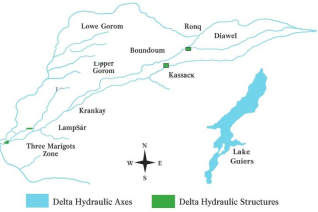
Figure 1. The hydraulic axes of the Senegal River Delta
[4]
Ahmed Dame MBOUP, "Assessment of Heavy Metals in the Waters of the Senegal River Delta," American Journal of Water Resources, vol. 13, 2025.
[4]
The Senegal River Delta is a transitional area between Senegal and Mauritania. It is part of a hydrosystem, the Senegal Valley, which originates in the Guinean zone with very high rainfall
[5]
Saliou Kamara, "Developpements hydrauliques et gestion d'un hydrosysteme largement anthropise: le delta du fleuve Senegal," 2013.
[5]
. This resource, shared by several countries (Senegal, Mauritania, Mali, Guinea), provides a sustainable supply of fresh water to an area located between the Sahel, the Ferlo and the Atlantic Ocean, where the presence of water has always been an opportunity for development. Thus, from the French West Africa (AOF) to the establishment of the Organization for the Development of the Senegal River (OMVS), development projects have multiplied
[6]
Doods and King, "Relation entre les composes trihalomethanes et les malformations congenitales," 2001.
[6]
. In the case of this study, the projects concerned are those of the OMVS with the installation of water purification and treatment units (UPT) in some of the tributaries of the Senegal River. These continuous flow water treatment plants all use chlorine as a disinfectant to eliminate microorganisms present in the drinking water distribution network after treatment. However, the surface water collected by these treatment units is not free of organic matter, and the coexistence of the latter with chlorine in the water would lead to the formation of chlorinated by-products (CBPs), including trihalomethanes (THMs), which are sources of carcinogenic diseases
[7]
Nieuwenhuijsen al., "Relation entre les composes trihalomethanes et les malformations congenitales," 2001.
[7]
, given that these waters themselves contain metals that are sources of waterborne diseases.
1.1. Economic Activities in the Studies Area
The economy around the SRD is based mainly on agriculture. In fact, it was seasonal rain-fed agriculture, which, due to climatic uncertainties, found itself in a very difficult situation. However, irrigation has made it possible to remove agricultural constraints in this area
[8]
Mame Ramatoulaye Faye, "contribution a l’amelioration de l’acces a l’eau pour l’agriculture irriguee face a la proliferation des plantes aquatiques dont le typha australis dans le delta du fleuve senegal: cas du canal principal a de la CSS," 2025.
[8]
. Irrigated agriculture has continued to develop since the construction of dams and the establishment of structures to supervise and monitor developments such as the SAED in the delta area. Lake Guiers and the various river effluents make this area a pioneer in irrigated agriculture, in addition to the evolution of the area's hydrological context thanks to the major developments installed since 1985. Indeed, following the construction of dams, the delta region has seen an explosion of private initiatives in the context of village irrigation schemes, which has led to a decline in rural exodus
[9]
Awa NIANG, "Amenagement du lac de guiers de 1824 a l’avenement des grands barrages du fleuve senegal: prospective geographique. Climat et developpement," 1999.
[9]
. In addition, the delta region contributes significantly to national cereal production, particularly rice, as well as ensuring total sugar cane production through the CSS. It is also an area of onion and industrial tomato production, with the Societe de Conserve Alimentaire du Senegal (Senegal Food Preservation Company) for tomatoes
[10]
ANSD, "Situation economique et sociale regionale," 2019.
[10]
. This activity contributes to food security and, consequently, improves the country's economic performance. Also known as the “sylvo-pastoral zone,” livestock farming is the second most common activity in the delta region, regardless of ethnicity, with large herds of cattle
[11]
Penda DIOP, "Vers une strategie de gestion participative multi-usages de la ressource en eau dans le delta du fleuvesenegal: processus de decision et outils de regulation autour du lac de guiers," 2017.
[11]
.
1.2. Livestock Farming
The livestock sector, like agriculture, is part of the first pillar of the structural transformation of the Senegalese economy. It is an activity that contributes to food security and, consequently, to improving the country's economic performance. Also known as the “sylvo-pastoral zone,” livestock farming is the second most common activity in the delta region, practiced by all ethnic groups and involving large herds of cattle
[12]
Mahamadou Maiga, "Le bassin du fleuve senegal de la traite negriere à la cooperation sous regionale," 2011.
[12]
. Extensive and transhumant livestock farming by the Fulani is indeed a traditional practice based on the use of natural pastures. This method of farming allows livestock farmers to adapt to seasonal variations and the availability of fodder throughout the year
[13]
SCOPELA, "Le report sur pied des vegetations," 2014.
[13]
. On the other hand, it is intensive, i.e., a sedentary village activity among the Wolof and Moors with small ruminants
[14]
S. GUEYE, "Etude de l’evolution de la region du lac de guiers," 1999.
[14]
.
1.3. Fishing
Fishing contributes to the dynamism of the country's local economy. It is an industry that plays a major role in feeding the local population and also contributes significantly to the country's gross domestic product
[10]
ANSD, "Situation economique et sociale regionale," 2019.
[10]
.
Inland fishing has long been a highly developed activity in the Senegal Delta. It was practiced using traditional methods, with immediate consumption by local populations, and was considered a means of subsistence for riverside dwellers
[15]
Stephanie DUVAIL, "Scenarios hydrologiques et modèles de developpement en aval d’un grand barrage: les usages de l’eau et le partage des ressources dans le delta mauritanien du fleuve senegal. These de doctorat," 2001.
[15]
. Today, in addition to inland fishing, aquaculture is also being developed in the area with the implementation of development projects such as P2RS. These are often community or private farms, supported by the National Aquaculture Agency (ANA). However, this activity, like livestock farming, also faces obstacles such as reduced catches due to aquatic plants, including typha and ceratophillum, which invade water bodies, preventing fishermen from accessing them
[16]
Marième MBOUP, "Changement socio-environnementaux et dynamique de la vegetation aquatique envahissante dans le delta du fleuve senegal," 2014.
[16]
. Between 2013 and 2014, there was a 15% decline in weight and an 11.47% decline in value in fishing around Lake Guiers. This decline is the result of climate change and the proliferation of cattails in the water bodies
[17]
PGIRE II, "Caracterisation de la pêche continentale et de l’aquaculture dans le departement de Dagana et des mares des departements de Matam et de Kanel en Republique du Senegal," 2016.
[17]
.
2. Methodology
2.1. Study Area
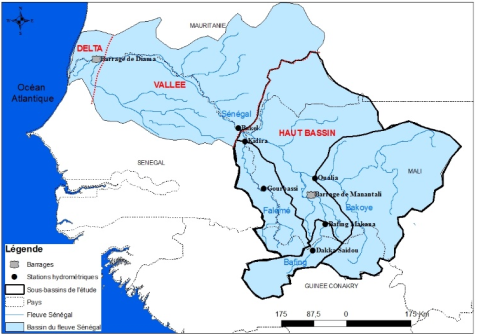
The Senegal Delta is a buffer zone between the Republics of Senegal and Mauritania. It is part of the Senegal River hydrosystem (Figure 1), which has now been largely artificialized by dams of different generations (from Diama-Manantali in 1986 to Felou-Gouina today). The Senegal River therefore has significant hydraulic potential for development (hydro-agricultural or drinking water supply) and hydroelectric power (to meet energy needs).
Figure 2. The three regions of the Senegal River valley
[18]
El Hadji Salif DIOP, Ibrahima MBAYE, Cheikh FAYE, "Impacts des changements de climat et des amenagements sur les ressources en eau du fleuve Senegal: caracterisation et evolution des regimes hydrologiques de sous-bassins versants naturels et amenages," Revue Belge de Geographie, 2015.
[18]
.
This resource, shared by several countries (Senegal, Mauritania, Mali, Republic of Guinea) ensures a sustainable supply of fresh water to an area located between the Senegalese Sahel (approx. 300 mm/year) – including Ferlo (approx. 250 mm/year) – and the Atlantic Ocean, where the temporary presence of fresh water has always provided an opportunity for development through its control. The Senegalese Sahel region, a transition zone between the desert regions of the Sahara and the Sudanian climate region, has been greatly affected by climate deterioration, which has contributed to the fragility of largely agro-pastoral societies
[19]
Souleymane NIANG, "Milieux, secheresse climatique et erosion eolienne. Etude geomorphologique du Sahel senegalais," Universite Gaston Berger de Saint-Louis, Saint-Louis, 2008.
[19]
.
2.2. In-situ Measurements and Sampling
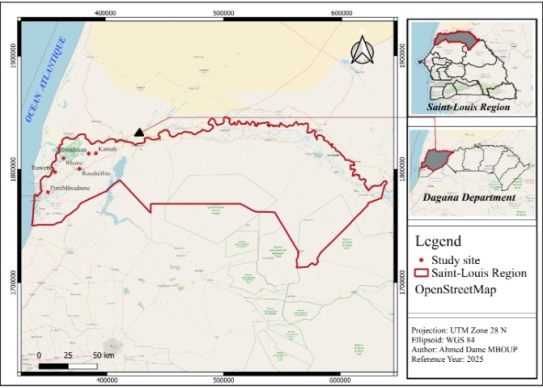
Strategies for in-situ measurement of physical parameters were implemented at all sampling points, followed by sample collection, packaging, transport, and storage in the laboratory prior to physical and chemical analysis. To carry out this study, two campaigns of in-situ measurements of temperature (°C) and pH. as well as sampling, were carried out on December 22, 2023 (just after the rainy season) at the sites of Rawette, Ronkh, and Ross Bethio, followed by measurements on January 9, 2025, at the Pont Mboubène, Kassak, and Mboundoum sites. For the first campaign, six (3) samples were taken, two (2) per site, while for the second campaign, three (3) samples were taken, one (1) per site (Figure 2). The nine samples were packaged in 500 mL polyethylene bottles and transported in a cooler to the Sen'Eau KMS3 plant laboratory in Louga for physical and chemical analysis (turbidity, major ions, and heavy metals).
Ahmed Dame MBOUP, "Assessment of Heavy Metals in the Waters of the Senegal River Delta," American Journal of Water Resources, vol. 13, 2025.
[4]
.
3. Results
3.1. Laboratory Measurements
The physical parameters of the treated water, such as pH and electrical conductivity (µS/cm), were measured at all study sites (Map 4) using a METTLER TOLEDO multiparameter device. Trihalomethanes were analyzed using a HACH DR 6000 spectrophotometer.
3.1.1. pH
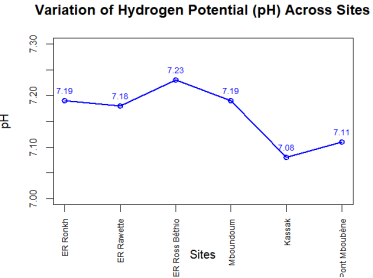
Figure 3 shows the variation in pH at the six study sites. These values were measured in December 2023 for the first three sites and in May 2025 for the last three sites. In the figure, the highest pH values (7.18 to 7.23) were recorded during the first measurements taken in December 2023, a period corresponding to the immediate end of the rainy season and the beginning of winter, with the exception of the Boundoum site, which had a pH of 7.19 measured in May 2025. On the other hand, the minimum pH values (7.08 to 7.11) were recorded in the summer of May 2025 at the Kassak and Mboundoum sites. However, all these values measured at the study sites and during the two campaigns comply with the SEQ-EAU 2003 standard.
These minimum pH values recorded at the end of the rainy season can be explained by the use of large quantities of aluminum sulfate in the coagulation-flocculation phase due to the significant presence of suspended solids in the raw water.
pH is an important factor, as alkaline environments act as catalysts for the reaction between chlorine and MON. The WHO review indicates that, in general, a higher pH is associated with higher THM concentrations
[20]
COSTET-DEIBER, "Effets sanitaires de l'exposition des sous-produits chloration de l'eau," Universite de rennes 1 sous le seau de l'Universite Europeenne de Bretagne, Rennes, 2013.
[20]
. The results show that the treated water from the treatment plants all have a relatively neutral pH. This explains why the presence of THMs in the water at the study sites is not due to pH.
3.1.2. Turbidity
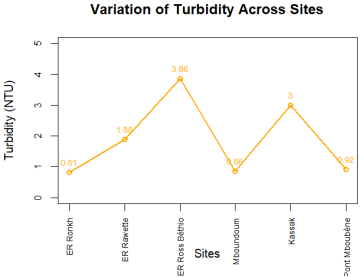
Figure 5 shows the variation in turbidity over the two measurement campaigns in December 2023 and May 2025. The results obtained during the first campaign show value of 3.86 NTU for the Ross Bethio site and 1.88 NTU for the Rawette site, which do not comply with the SEQ-EAU 2003 standard (1 NTU), and 0.81 NTU for the Ronkh site. For the second campaign, the turbidity values for the Boundoum and Pont Mboubène sites comply with the above standard (Boundoum 0.86 NTU and Mboubène 0.92 NTU), except for the Kassak site, which does not comply with the standard with a value of 3 NTU. (Figure 5).
The high turbidity values can be explained by the fact that the measurements were taken immediately after the end of the rainy season. This period corresponds to the influx of runoff water loaded with organic and mineral matter by the river, on the one hand. On the other hand, it corresponds to the influx of runoff water loaded with organic and mineral matter from the river, as well as agro-industrial activities present in the water to be treated. This makes them difficult to eliminate.
On the other hand, the low values observed during the second campaign (May) can be explained simply by the low levels of organic and mineral elements in the raw water to be treated.
Since all turbidity values comply with the WHO standard of 5 NTU after treatment, it can be said that the presence of organic matter is not significant enough to allow the identification of THMs in the analyzed water.
3.2. Trihalomethanes
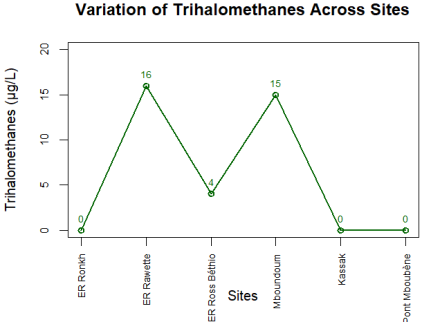
For total THMs (Figure 6), the Ronkh and Ross Bethio sites showed minimum concentrations of 0 and 4µg/L, respectively, and a maximum concentration of 16µg/L for the first sampling and laboratory analysis campaign. For the second campaign, the minimum concentrations (0µg/L) were recorded at the Kassak and Mboubène sites, compared with a maximum concentration of 15µg/L recorded at the Boundoum site. Based on this spatial and temporal variation in total THMs analyzed in the drinking water supply networks at the study sites during the two seasons, the SEQ-EAU 2003 standard (75µg/L) is met.
These total THMs are likely to originate from the presence of organic matter in the network and residual chlorine from chlorine injection during disinfection. The presence of these organic materials in drinking water supply networks is the result of the significant and variable turbidity of the effluent collected by the UPTs. In this study, as the turbidity of the treated water does not exceed the standard of 5 NTU, we can say that the presence of THMs in the analyzed water is not due to organic materials.
In fact, at the Rawette site, the dosing pump (chlorine injection) is electric and breaks down very often. This situation requires the treatment operator to inject chlorine manually, resulting in a lack of control over the amount of chlorine injected and, therefore, the significant amount of THMs noted in the network.
At the Ross Bethio site, the large population size has led to the installation of a large treatment and purification unit (UPT) to meet the demand for water in terms of both quantity and quality. This requires the gradual use of chlorine by injection from the dosing pump, causing the traces of THM noted in the network. However, the amount of THM analyzed in the drinking water supply network is not significant because the treatment plant is run by highly qualified personnel who are experts in the treatment chain, and by electrical engineers who prevent and repair any breakdowns in the electromechanical equipment.
Like the Rawette site, the Boundoum dam site shows peaks in THM concentration recorded in the network. This situation is due to the fact that the site's UPT does not have an electric chlorine dosing pump. However, as chlorine injection is manual, the uncontrolled quantity of disinfectant injected has led to the high concentration of THM analyzed in the network after final disinfection.
4. Conclusion
This work made it possible to evaluate trihalomethanes in water treated by several UPTs installed in the tributaries of the Senegal River Delta (the source of water supply for the population) and to determine their origins. The results showed the presence of total trihalomethanes in both campaigns corresponding to the two seasons, namely the rainy season and the dry season. According to the analyses, the presence of THMs is due to the uncontrolled use of chlorine during disinfection in areas where THMs have been identified.
Consequently, it is recommended that:
1) The installation of electric dosing pumps in all UPTs in the Senegal River Delta;
2) The recruitment of an electrical engineer in all UPTs in the study area. Failing that, the provision of electrical engineering training for all operators and laboratory technicians in the study area so that any chlorine injection pump breakdowns can be repaired as soon as possible;
Looking ahead:
1) Add total THM analysis to the analysis of drinking water quality parameters in Senegal;
2) Conduct a study on the automation of dosing pumps so that they are sensitive to variations in organic matter.
Abbreviations
UPT
Treatment and Purification Unit
NTU
Nephelometric Turbidity Unit
THM
Trihalomethanes
pH
Hydrogen Potential
WHO
World Health Organisation
DFS
Senegal River Delta
ANA
National Aquaculture Agency
P2RS
Program to Strengthen Resilience to Food and Nutritional Insecurity in the Sahel
SRD
Senegal River Delta
SAED
National Company for the Development and Exploitation of the Senegal River Delta and the Senegal and Faleme River Valleys
OMVS
Organization for the Development of the Senegal River
AOF
French West Africa
SEQ
Water Quality Assessment System for Watercourses
Conflicts of Interest
There is no conflicts of interest.
References
[1]
Moustapha SANE, "Note sur les ressources en eaux du Senegal: zones potentielles pour le transfert d'eau," 2015.
[2]
pS-Eau, "Principales ressources et Qualite de l’eau au Senegal," 2019.
[3]
El Hadji KEITA M. S. S. Mokhtar SECK, "MANUEL D'EXPLOITATION DE LA STATION DE POTALISATION DE RHONE," 2020.
[4]
Ahmed Dame MBOUP, "Assessment of Heavy Metals in the Waters of the Senegal River Delta," American Journal of Water Resources, vol. 13, 2025.
[5]
Saliou Kamara, "Developpements hydrauliques et gestion d'un hydrosysteme largement anthropise: le delta du fleuve Senegal," 2013.
[6]
Doods and King, "Relation entre les composes trihalomethanes et les malformations congenitales," 2001.
[7]
Nieuwenhuijsen al., "Relation entre les composes trihalomethanes et les malformations congenitales," 2001.
[8]
Mame Ramatoulaye Faye, "contribution a l’amelioration de l’acces a l’eau pour l’agriculture irriguee face a la proliferation des plantes aquatiques dont le typha australis dans le delta du fleuve senegal: cas du canal principal a de la CSS," 2025.
[9]
Awa NIANG, "Amenagement du lac de guiers de 1824 a l’avenement des grands barrages du fleuve senegal: prospective geographique. Climat et developpement," 1999.
[10]
ANSD, "Situation economique et sociale regionale," 2019.
[11]
Penda DIOP, "Vers une strategie de gestion participative multi-usages de la ressource en eau dans le delta du fleuvesenegal: processus de decision et outils de regulation autour du lac de guiers," 2017.
[12]
Mahamadou Maiga, "Le bassin du fleuve senegal de la traite negriere à la cooperation sous regionale," 2011.
[13]
SCOPELA, "Le report sur pied des vegetations," 2014.
[14]
S. GUEYE, "Etude de l’evolution de la region du lac de guiers," 1999.
[15]
Stephanie DUVAIL, "Scenarios hydrologiques et modèles de developpement en aval d’un grand barrage: les usages de l’eau et le partage des ressources dans le delta mauritanien du fleuve senegal. These de doctorat," 2001.
[16]
Marième MBOUP, "Changement socio-environnementaux et dynamique de la vegetation aquatique envahissante dans le delta du fleuve senegal," 2014.
[17]
PGIRE II, "Caracterisation de la pêche continentale et de l’aquaculture dans le departement de Dagana et des mares des departements de Matam et de Kanel en Republique du Senegal," 2016.
[18]
El Hadji Salif DIOP, Ibrahima MBAYE, Cheikh FAYE, "Impacts des changements de climat et des amenagements sur les ressources en eau du fleuve Senegal: caracterisation et evolution des regimes hydrologiques de sous-bassins versants naturels et amenages," Revue Belge de Geographie, 2015.
[19]
Souleymane NIANG, "Milieux, secheresse climatique et erosion eolienne. Etude geomorphologique du Sahel senegalais," Universite Gaston Berger de Saint-Louis, Saint-Louis, 2008.
[20]
COSTET-DEIBER, "Effets sanitaires de l'exposition des sous-produits chloration de l'eau," Universite de rennes 1 sous le seau de l'Universite Europeenne de Bretagne, Rennes, 2013.
Mboup, A. D., Thiam, A., Sarr, A. B. (2026). Spatio-temporal Evolution of Trihalomethanes in the Waters of the Senegal River Delta. Journal of Water Resources and Ocean Science, 15(1), 1-7. https://doi.org/10.11648/j.wros.20261501.11
Mboup, A. D.; Thiam, A.; Sarr, A. B. Spatio-temporal Evolution of Trihalomethanes in the Waters of the Senegal River Delta. J. Water Resour. Ocean Sci.2026, 15(1), 1-7. doi: 10.11648/j.wros.20261501.11
Mboup AD, Thiam A, Sarr AB. Spatio-temporal Evolution of Trihalomethanes in the Waters of the Senegal River Delta. J Water Resour Ocean Sci. 2026;15(1):1-7. doi: 10.11648/j.wros.20261501.11
@article{10.11648/j.wros.20261501.11,
  author = {Ahmed Dame Mboup and Alassane Thiam and Amadou Babacar Sarr},
  title = {Spatio-temporal Evolution of Trihalomethanes in the Waters of the Senegal River Delta},
  journal = {Journal of Water Resources and Ocean Science},
  volume = {15},
  number = {1},
  pages = {1-7},
  doi = {10.11648/j.wros.20261501.11},
  url = {https://doi.org/10.11648/j.wros.20261501.11},
  eprint = {https://article.sciencepublishinggroup.com/pdf/10.11648.j.wros.20261501.11},
  abstract = {The objectives of this study are to analyze trihalomethanes (THMs) and their origins in treated wastewater from the Senegal River Delta, the main source of water supply for local populations. THMs are by-products of water chlorination, formed mainly by the reaction of chlorine with natural organic substances present in the water. They are potentially carcinogenic, toxic to the liver and kidneys, and cause skin and eye irritation. To carry out this study, two in-situ sampling campaigns of treated water were conducted to measure pH, turbidity (NTU), and total trihalomethanes. The first sampling was carried out on December 22, 2023 (just after the rainy season) at the Rawette, Ronkh, and Ross Bethio sites, while the second was carried out on May 21, 2025, at the Pont Mboubène, Kassak, and Mboundoum sites. For the first campaign, three (03) tap water samples were taken, one (01) per site, and for the second campaign, three (03) samples were taken, one (01) per site. The six samples were packaged in 500 mL polyethylene bottles and then transported in a cooler to the Sen'Eau laboratory at the KMS3 plant in Louga for physical and chemical analysis (pH, turbidity, and THM). The results obtained during the first campaign show values of 3.86 NTU for the Ross Bethio site and 1.88 NTU for the Rawette site, which do not comply with the SEQ-EAU 2003 standard (1 NTU), and 0.81 NTU for the Ronkh site. For the second campaign, the turbidity values for the Boundoum and Pont Mboubène sites comply with the above standard (Boundoum 0.86 NTU and Mboubène 0.92 NTU), except for the Kassak site, which does not comply with the standard with a value of 3 NTU. For total THMs, the Ronkh and Ross Bethio sites showed minimum concentrations of 0 and 4µg/L, respectively, and a maximum concentration of 16µg/L for the first sampling and laboratory analysis campaign. For the second campaign, the minimum concentrations (0µg/L) were recorded at the Kassak and Mboubène sites, compared to a maximum concentration of 15µg/L recorded at the Boundoum site. Based on this spatial and temporal variation in total THMs analyzed in the drinking water supply networks at the study sites during the two seasons, the SEQ-EAU 2003 standard (75µg/L) is met. However, the presence of THMs at certain sites could be avoided by completely removing organic matter before distribution.},
 year = {2026}
}
TY  - JOUR
T1  - Spatio-temporal Evolution of Trihalomethanes in the Waters of the Senegal River Delta
AU  - Ahmed Dame Mboup
AU  - Alassane Thiam
AU  - Amadou Babacar Sarr
Y1  - 2026/01/16
PY  - 2026
N1  - https://doi.org/10.11648/j.wros.20261501.11
DO  - 10.11648/j.wros.20261501.11
T2  - Journal of Water Resources and Ocean Science
JF  - Journal of Water Resources and Ocean Science
JO  - Journal of Water Resources and Ocean Science
SP  - 1
EP  - 7
PB  - Science Publishing Group
SN  - 2328-7993
UR  - https://doi.org/10.11648/j.wros.20261501.11
AB  - The objectives of this study are to analyze trihalomethanes (THMs) and their origins in treated wastewater from the Senegal River Delta, the main source of water supply for local populations. THMs are by-products of water chlorination, formed mainly by the reaction of chlorine with natural organic substances present in the water. They are potentially carcinogenic, toxic to the liver and kidneys, and cause skin and eye irritation. To carry out this study, two in-situ sampling campaigns of treated water were conducted to measure pH, turbidity (NTU), and total trihalomethanes. The first sampling was carried out on December 22, 2023 (just after the rainy season) at the Rawette, Ronkh, and Ross Bethio sites, while the second was carried out on May 21, 2025, at the Pont Mboubène, Kassak, and Mboundoum sites. For the first campaign, three (03) tap water samples were taken, one (01) per site, and for the second campaign, three (03) samples were taken, one (01) per site. The six samples were packaged in 500 mL polyethylene bottles and then transported in a cooler to the Sen'Eau laboratory at the KMS3 plant in Louga for physical and chemical analysis (pH, turbidity, and THM). The results obtained during the first campaign show values of 3.86 NTU for the Ross Bethio site and 1.88 NTU for the Rawette site, which do not comply with the SEQ-EAU 2003 standard (1 NTU), and 0.81 NTU for the Ronkh site. For the second campaign, the turbidity values for the Boundoum and Pont Mboubène sites comply with the above standard (Boundoum 0.86 NTU and Mboubène 0.92 NTU), except for the Kassak site, which does not comply with the standard with a value of 3 NTU. For total THMs, the Ronkh and Ross Bethio sites showed minimum concentrations of 0 and 4µg/L, respectively, and a maximum concentration of 16µg/L for the first sampling and laboratory analysis campaign. For the second campaign, the minimum concentrations (0µg/L) were recorded at the Kassak and Mboubène sites, compared to a maximum concentration of 15µg/L recorded at the Boundoum site. Based on this spatial and temporal variation in total THMs analyzed in the drinking water supply networks at the study sites during the two seasons, the SEQ-EAU 2003 standard (75µg/L) is met. However, the presence of THMs at certain sites could be avoided by completely removing organic matter before distribution.
VL  - 15
IS  - 1
ER  -
Mboup, A. D., Thiam, A., Sarr, A. B. (2026). Spatio-temporal Evolution of Trihalomethanes in the Waters of the Senegal River Delta. Journal of Water Resources and Ocean Science, 15(1), 1-7. https://doi.org/10.11648/j.wros.20261501.11
Mboup, A. D.; Thiam, A.; Sarr, A. B. Spatio-temporal Evolution of Trihalomethanes in the Waters of the Senegal River Delta. J. Water Resour. Ocean Sci.2026, 15(1), 1-7. doi: 10.11648/j.wros.20261501.11
Mboup AD, Thiam A, Sarr AB. Spatio-temporal Evolution of Trihalomethanes in the Waters of the Senegal River Delta. J Water Resour Ocean Sci. 2026;15(1):1-7. doi: 10.11648/j.wros.20261501.11
@article{10.11648/j.wros.20261501.11,
  author = {Ahmed Dame Mboup and Alassane Thiam and Amadou Babacar Sarr},
  title = {Spatio-temporal Evolution of Trihalomethanes in the Waters of the Senegal River Delta},
  journal = {Journal of Water Resources and Ocean Science},
  volume = {15},
  number = {1},
  pages = {1-7},
  doi = {10.11648/j.wros.20261501.11},
  url = {https://doi.org/10.11648/j.wros.20261501.11},
  eprint = {https://article.sciencepublishinggroup.com/pdf/10.11648.j.wros.20261501.11},
  abstract = {The objectives of this study are to analyze trihalomethanes (THMs) and their origins in treated wastewater from the Senegal River Delta, the main source of water supply for local populations. THMs are by-products of water chlorination, formed mainly by the reaction of chlorine with natural organic substances present in the water. They are potentially carcinogenic, toxic to the liver and kidneys, and cause skin and eye irritation. To carry out this study, two in-situ sampling campaigns of treated water were conducted to measure pH, turbidity (NTU), and total trihalomethanes. The first sampling was carried out on December 22, 2023 (just after the rainy season) at the Rawette, Ronkh, and Ross Bethio sites, while the second was carried out on May 21, 2025, at the Pont Mboubène, Kassak, and Mboundoum sites. For the first campaign, three (03) tap water samples were taken, one (01) per site, and for the second campaign, three (03) samples were taken, one (01) per site. The six samples were packaged in 500 mL polyethylene bottles and then transported in a cooler to the Sen'Eau laboratory at the KMS3 plant in Louga for physical and chemical analysis (pH, turbidity, and THM). The results obtained during the first campaign show values of 3.86 NTU for the Ross Bethio site and 1.88 NTU for the Rawette site, which do not comply with the SEQ-EAU 2003 standard (1 NTU), and 0.81 NTU for the Ronkh site. For the second campaign, the turbidity values for the Boundoum and Pont Mboubène sites comply with the above standard (Boundoum 0.86 NTU and Mboubène 0.92 NTU), except for the Kassak site, which does not comply with the standard with a value of 3 NTU. For total THMs, the Ronkh and Ross Bethio sites showed minimum concentrations of 0 and 4µg/L, respectively, and a maximum concentration of 16µg/L for the first sampling and laboratory analysis campaign. For the second campaign, the minimum concentrations (0µg/L) were recorded at the Kassak and Mboubène sites, compared to a maximum concentration of 15µg/L recorded at the Boundoum site. Based on this spatial and temporal variation in total THMs analyzed in the drinking water supply networks at the study sites during the two seasons, the SEQ-EAU 2003 standard (75µg/L) is met. However, the presence of THMs at certain sites could be avoided by completely removing organic matter before distribution.},
 year = {2026}
}
TY  - JOUR
T1  - Spatio-temporal Evolution of Trihalomethanes in the Waters of the Senegal River Delta
AU  - Ahmed Dame Mboup
AU  - Alassane Thiam
AU  - Amadou Babacar Sarr
Y1  - 2026/01/16
PY  - 2026
N1  - https://doi.org/10.11648/j.wros.20261501.11
DO  - 10.11648/j.wros.20261501.11
T2  - Journal of Water Resources and Ocean Science
JF  - Journal of Water Resources and Ocean Science
JO  - Journal of Water Resources and Ocean Science
SP  - 1
EP  - 7
PB  - Science Publishing Group
SN  - 2328-7993
UR  - https://doi.org/10.11648/j.wros.20261501.11
AB  - The objectives of this study are to analyze trihalomethanes (THMs) and their origins in treated wastewater from the Senegal River Delta, the main source of water supply for local populations. THMs are by-products of water chlorination, formed mainly by the reaction of chlorine with natural organic substances present in the water. They are potentially carcinogenic, toxic to the liver and kidneys, and cause skin and eye irritation. To carry out this study, two in-situ sampling campaigns of treated water were conducted to measure pH, turbidity (NTU), and total trihalomethanes. The first sampling was carried out on December 22, 2023 (just after the rainy season) at the Rawette, Ronkh, and Ross Bethio sites, while the second was carried out on May 21, 2025, at the Pont Mboubène, Kassak, and Mboundoum sites. For the first campaign, three (03) tap water samples were taken, one (01) per site, and for the second campaign, three (03) samples were taken, one (01) per site. The six samples were packaged in 500 mL polyethylene bottles and then transported in a cooler to the Sen'Eau laboratory at the KMS3 plant in Louga for physical and chemical analysis (pH, turbidity, and THM). The results obtained during the first campaign show values of 3.86 NTU for the Ross Bethio site and 1.88 NTU for the Rawette site, which do not comply with the SEQ-EAU 2003 standard (1 NTU), and 0.81 NTU for the Ronkh site. For the second campaign, the turbidity values for the Boundoum and Pont Mboubène sites comply with the above standard (Boundoum 0.86 NTU and Mboubène 0.92 NTU), except for the Kassak site, which does not comply with the standard with a value of 3 NTU. For total THMs, the Ronkh and Ross Bethio sites showed minimum concentrations of 0 and 4µg/L, respectively, and a maximum concentration of 16µg/L for the first sampling and laboratory analysis campaign. For the second campaign, the minimum concentrations (0µg/L) were recorded at the Kassak and Mboubène sites, compared to a maximum concentration of 15µg/L recorded at the Boundoum site. Based on this spatial and temporal variation in total THMs analyzed in the drinking water supply networks at the study sites during the two seasons, the SEQ-EAU 2003 standard (75µg/L) is met. However, the presence of THMs at certain sites could be avoided by completely removing organic matter before distribution.
VL  - 15
IS  - 1
ER  -




 Share This Article
 Twitter
 Linked In
 Facebook
 Copy
Copy Download