1. Introduction
The world is under the influence of natural and human-made crises that shake it and threaten its existence. Likewise, humankind, through its many actions, contributes to the ongoing degradation of its environment. Air, soil, and water pollution, as well as climate crises, are all threats weighing on the planet and its inhabitants. Waste management has long been a problem, particularly an environmental one, in developing countries, in Africa as well as in Senegal, especially due to rapid urbanization
| [2] | CISSE O. 2012, Garbage dumps in Africa Mbeubeuss in Dakar, Senegal, Karthala and CREPOS, 329 p. |
| [7] | HOUNKPATIN Romance and KOTTIN Marie Caroline, 2009: Household Solid Waste (HSW) Management in Cotonou: Proposal for an Appropriate Planning Framework Territory, 178 P. |
| [9] | ONIBOKUN AG 2001. Urban waste management: solutions for Africa. Paris: IDRC-Karthala, 250 p. |
| [10] | OOSTERVEER, P. 2009. “Urban environmental services and the state in East Africa; between neo-developmental and network governance approaches”. GeoForum, vol. 40, n° 6, November, pp. 1061-1068. |
| [16] | 2015: MBENGUE Ramatoulaye: Local management strategies for urban solid waste in Ngor. Forms of sanitation organization and problems. Doctoral thesis, EDEQUE, FST, UCAD, 266 p. |
[2, 7, 9, 10, 16]
, Like other major African cities, Dakar is among the municipalities experiencing serious problems with household solid waste management
| [1] | CISSÉ O., 2007, The Money of Waste: The Informal Economy in Dakar, KARTHALA-CREPOS. |
| [7] | HOUNKPATIN Romance and KOTTIN Marie Caroline, 2009: Household Solid Waste (HSW) Management in Cotonou: Proposal for an Appropriate Planning Framework Territory, 178 P. |
| [14] | MBENGUE R., 2010: Management And Environmental Impacts Of Municipal Solid Waste In The Municipality District Of Ngor, Master Dissertation 2 Gidel, Department Of Geography Ucad, 75 Pages. |
| [15] | Nouvel Horizon, 2016, http://www.seneweb.com/ |
[1, 7, 14, 15]
. Garbage collection is currently provided by the Dakar Agglomeration Community and the Rufisque Agglomeration Community (CADAK CAR). However, the socio-political and economic changes that have occurred have led to the emergence of a new private and non-profit system for managing household solid waste. It was the most recent administrative reform that enshrined the effectiveness of decentralization
| [3] | CISSE O. & WONE S. S, 2013, Waste management in Dakar (2000-2012): The institutional imbroglio. Momar-Coumba Diop (ed.), CRES-Karthala, (2012) pp 759-788. |
| [4] | Local Government Code, 1996, Law No. 96-06 of March 22, 1996 establishing the Local Government Code, 76 p. |
[3, 4]
. Despite the numerous efforts of the Senegalese state and management institutions, some areas of cities and surrounding regions still suffer from unsanitary conditions.
According to the
| [5] | Environmental Code 2001, Law No. 2001-01 of January 15, 2001 establishing the Environmental Code, Decree No. 2001-282 of April 12, 2001 implementing the Environmental Code, Ministry of Youth, Environment and Classified Establishments, GTZ, 79 p. |
[5]
, waste is "any residue from a production, transformation or use process, any substance, material, product (etc.) abandoned or which its holder intends to abandon".
In Dakar, the amount of household waste collected was 780 tons per day in 1986. It exceeded 900 tons per day in 1996, representing only 75% of the target
| [2] | CISSE O. 2012, Garbage dumps in Africa Mbeubeuss in Dakar, Senegal, Karthala and CREPOS, 329 p. |
| [6] | DIENE KANE Ahmadou, 2010: The problem of household waste management in the Borough Communes of Dakar. Case of the Borough Commune of Grand Dakar, final year dissertation at the National School of Specialized Social Workers (ENTSS), 17th class, 133 p. |
| [14] | MBENGUE R., 2010: Management And Environmental Impacts Of Municipal Solid Waste In The Municipality District Of Ngor, Master Dissertation 2 Gidel, Department Of Geography Ucad, 75 Pages. |
[2, 6, 14]
. In 2006, the amount collected was 1,200 tons per day, and by August 2006, this amount had doubled due to the cessation of AMA Senegal's operations
. Today, waste production in the city of Dakar is estimated at 516,925 tons per day of solid household waste
| [1] | CISSÉ O., 2007, The Money of Waste: The Informal Economy in Dakar, KARTHALA-CREPOS. |
| [12] | ROCHER L., 2006: Governing waste. Territorial management of household waste and public participation, 2006, Doctoral thesis in spatial planning-urbanism (dir. Larrue C.), University of Tours, 409 p. |
| [13] | TCHAOU MC 2011, contribution to the improvement of the urban solid waste management system in the municipality of Lomé: case of the Gbadago district, International Master, Environment, Water and Health, 51 p. |
| [14] | MBENGUE R., 2010: Management And Environmental Impacts Of Municipal Solid Waste In The Municipality District Of Ngor, Master Dissertation 2 Gidel, Department Of Geography Ucad, 75 Pages. |
[1, 12-14]
. The increase in waste production is correlated with population growth and rapid urbanization (96.16% in 2002; ANSD/RGPHAE-2013). For better waste management, the department of Dakar has been subdivided into 19 municipalities, including that of Ngor.
This study aims to create a dynamic map of waste collection routes to identify points of failure and areas of illegal dumping. Using Geographic Information Systems (GIS), this analysis seeks to model waste flows from their point of origin to their final destination, often the sea, due to runoff and wind. In conclusion, the study will propose territorial optimization solutions to preserve the environmental integrity of the Ngor municipality within a sustainable development framework
| [8] | MODECOM 2006, Method for Characterizing Household Waste / 3rd edition, ADEME editions, Paris, 64p. |
| [9] | ONIBOKUN AG 2001. Urban waste management: solutions for Africa. Paris: IDRC-Karthala, 250 p. |
| [10] | OOSTERVEER, P. 2009. “Urban environmental services and the state in East Africa; between neo-developmental and network governance approaches”. GeoForum, vol. 40, n° 6, November, pp. 1061-1068. |
| [11] | PATIN R. H & KOTTIN MC, 2009, Household solid waste (HSW) management in Cotonou: Proposal for an appropriate pre-collection planning framework, EEAM/UAC-DST in Planning and Land Use, Study report, 50 p. |
[8, 9, 10, 11]
.
2. Materials and Methods
The method adopted is essentially based on a combination of techniques for collecting data in the field. This is the so-called empirical method. It includes qualitative data, such as interviews, interview guides, and focus groups. Quantitative data, such as questionnaires, is also included. On-site observation allowed for the production of visual material through photography and filming.
For sampling, we proceeded using a reasoned selection process based on the number of concessions retained for each neighborhood. In this study, sampling was carried out at 1/4 of the recorded number The choice is explained by the desire to focus more on field monitoring and observations in selected concessions. The number of households to be interviewed (
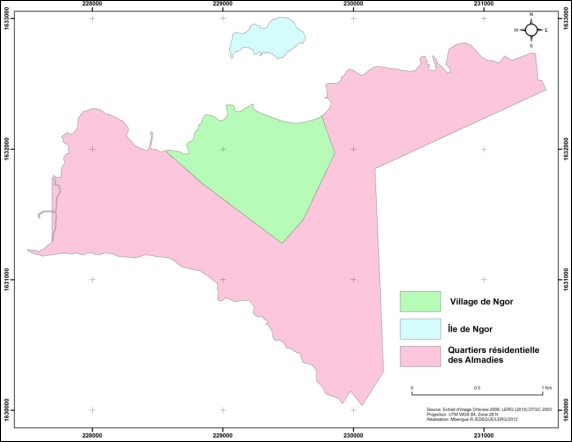
Table 1) covered the area of Ngor village (
Figure 1), the so-called residential neighborhoods, and Ngor Island. For each concession, one household was interviewed. Thus, a total of 104 households were interviewed, providing a representative sample. The survey results are analyzed taking into account the entire population.
Figure 1. Diagram of the sampled areas.
Table 1. Distribution of the number of households to be surveyed.
Neighborhood names | Number of concessions | Number of households surveyed |
Ngor village | 107 | 54 |
Residential neighborhoods | 92 | 46 |
Ngor Island | 4 | 4 |
Total | | 104 |
Collection monitoring was carried out to determine, firstly, the routes used by the concession holder and, secondly, the tonnage of municipal solid waste collected daily and monthly. The monitoring covered Groupe Delta and DAP, for a period of one month for each.
In total, two months were needed for the monitoring/collection, in the dry season and in the rainy season for the two dump trucks, from Ngor village to the Mbeubeuss landfill, to determine the length and duration of the journey.
4. Results
4.1. Mapping of Collection Routes
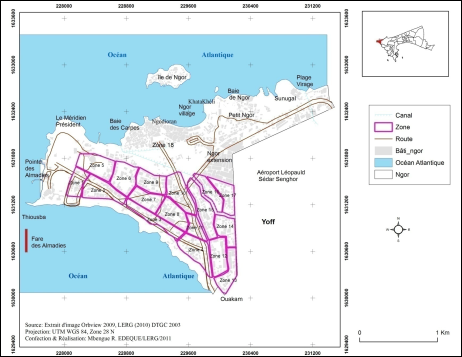
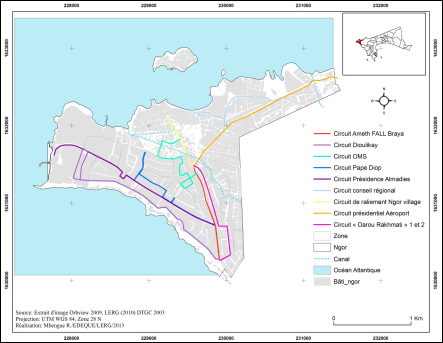
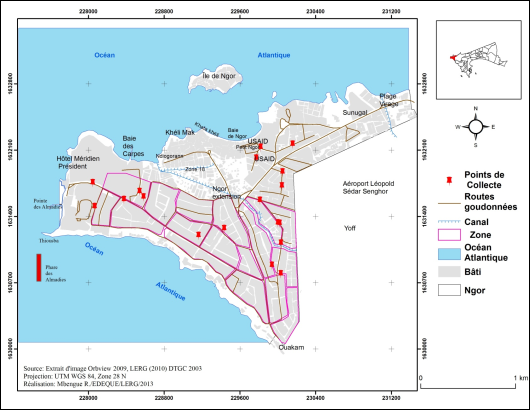
The household solid waste management system requires sound organization, encompassing several aspects from the production to the landfilling of household solid waste. Household waste management is governed by institutional rules and mechanisms. To ensure daily collection, the concession holder has subdivided the municipality into nine (9) circuits (
Figure 3). These are: Almadies presidential circuit; Presidential circuit Airport, “Darou Rakhmati” circuit 1 and 2, WHO (World Health Organization) circuit, Pape Diop circuit; Regional Council circuit, Ameth FALL Braya circuit, Ngor village circuit and “Diouli kaay” circuit.
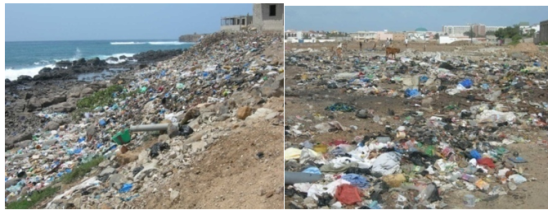
In a site like Ngor village, the only usable route for garbage trucks is the main road from the village entrance to the "TATA" bus garage; the remaining roads are impassable for vehicles or carts. This can create difficulties in providing adequate service. Household waste from poorly served properties is disposed of by dumping garbage on the beach or at the village entrance. Photographic Plate 1 provides an overview of the condition of these locations, which were the focus of this study.
Figure 4. Illegal dumpsites in Ngor.
The figure on the left shows an illegal dump on the beach. People come to dump their garbage there because there are no bins in their area. A pipe is also visible, indicating that some households are disposing of their wastewater there.
On the right, an illegal dump can be seen in a vacant lot. The proximity of houses means that domestic animals come there to find food. This situation leads to a risk of disease because the animals can be carriers of pathogens.
The village is therefore littered with illegal dumpsites (photograph 12) despite daily collection by a garbage truck.
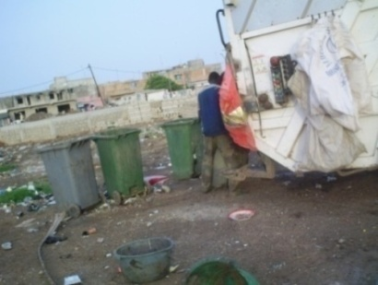
Figure 14 shows the main illegal and permanent dumpsites in Ngor village. The neighborhoods lack adequate road infrastructure, leading to problems (the existence and proliferation of illegal dumpsites). The illegal dumpsite on the beach is particularly significant, as all the poorly served properties near the beach dump their household waste there. The dumpsites at the village entrance are also substantial, but unlike the one on the beach, they are periodically cleaned. Furthermore, the population has become accustomed to living with the waste. Indeed, the illegal dumpsites are close to their homes and can pose a threat to their health. During monitoring, the garbage truck travels along accessible streets, honking loudly between three and five times. It was observed that the vehicle always stops after passing two or even three houses; consequently, residents put out their garbage, wait for the truck to reach their house, and then hand the garbage over to the collectors. Sometimes, when the collectors are overwhelmed, residents themselves pour the waste into the truck. Some of the collectors are equipped with gloves, aprons, sunglasses, and boots. However, according to them, this protective equipment was not provided; they purchased it themselves. During monitoring, it was noted that the team leader, after answering the phone, asked the driver to change direction. This is explained by the fact that some household heads pay for the garbage collectors to come and collect their waste from their homes. The diversion of a circuit also contributes to its irregularity. A number of zones were identified through GPS surveys. Security guards were very helpful in determining these zones by providing water, electricity, or telephone bills. This was one way they could locate us within the different areas. The residents of Almadies don't think in terms of zones but rather in terms of individual inhabitants. During the monitoring, waste collection was a two-way street. Items such as bottles and utensils (butter tubs, buckets, etc.) were collected and placed in empty rice sacks attached to the ends of the vehicle. The garbage collectors then resell the collected items, and the proceeds are shared. This is why the garbage collectors and the team leader systematically search (photo 1) the garbage bins before placing them in the truck.
Figure 5. Garbage collector/recycler.
A garbage collector rummages through a bin, searching for items that can be resold on the market, which are kept in bags hanging from the back of the truck. This practice is common and allows them to supplement their income, or even to buy the protective equipment necessary for their work.
These salvage practices cause delays in the collection system because garbage collectors waste time searching for valuable items. However, this practice is motivated by their low wages. Garbage dumps (
Figure 4) are located in truck traffic areas (
Figure 5).
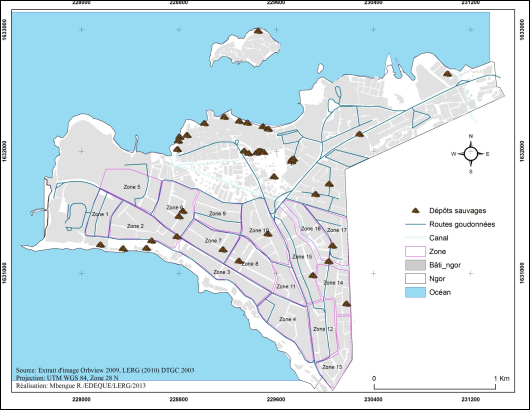
Figure 6. Location of illegal dumps.
Figure 7. Marking of Collection Points.
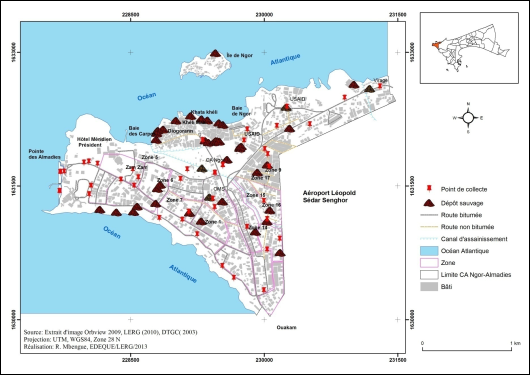
Figure 8. Illegal dumping and collection points.
In addition to the PCs, there are illegal garbage dumps (
Figure 6). According to the team leader, Mr. Abdoulaye SENE Laye:
1) Illegal dumping at collection points results from nighttime production (restaurants, bars, hotels, etc.);
2) The illegal dumping is the work of cart drivers who, after collecting garden waste, come and dump it along the presidential circuit, knowing that the garbage collectors do not dare to let the illegal dumping develop;
3) The deposits come from waste pickers who dump garbage during their search for recyclable items.
4) Finally, it is the work of those responsible for garbage removal from homes who also come to deposit the waste.
With the garbage collectors/waste pickers, we noticed that a large quantity of waste is no longer reaching Mbeubeuss. The collection bag attached to the vehicle allows the group to know the quantity and approximate value of the collected waste.
Monitoring in the study area indicates that waste management quickly revealed its limitations. These include, among other things, insufficient daily adherence to all collection routes and inaccessibility within Ngor village. Furthermore, it should be noted that while the efforts undertaken by CADAK-CAR, in collaboration with concessionaires for household waste management in Ngor, are significant, they remain inadequate. Garbage trucks should be increased to two round trips, morning and evening, to cover all routes within the area. The current truck rotation, reduced to a maximum of once a day, needs to be reviewed.
Here too, routes are unpredictable, and residents have resorted to using illegal dumps. Consequently, the equipment used for household waste collection is inadequate and inefficient, in addition to being unsuitable for certain neighborhoods. Knowledge about household waste production is also problematic: waste types are generally poorly understood, and the service personnel are insufficient and underqualified. Following the daily collection route, the dump truck was escorted to the Mbeubeuss landfill for the final processing of the collected waste.
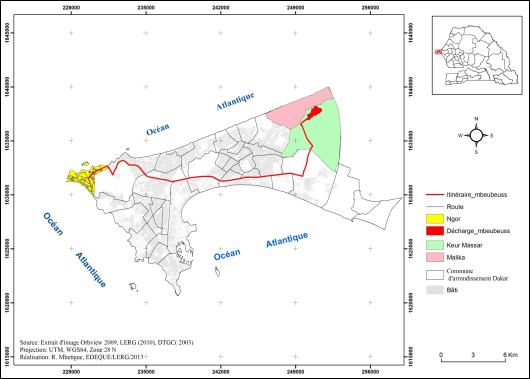
Figure 7 shows the route taken by the vehicles towards the Mbeubeuss landfill.
4.2. Ngor/Mbeubeuss Route
Following the daily collection, the garbage collectors transport the waste to Mbeubeuss, a distance of 29.7 km from Ngor to the landfill. The truck departs Ngor at 2:02 PM and arrives in Mbeubeuss at 3:30 PM. It takes the airport road, passes the Yoff municipality, follows the highway to the "Patte d'Oie" roundabout, and then takes the highway leading to Keur Massar. The vehicle then takes the road towards Malika to reach Mbeubeuss. During the journey, the truck driver encounters difficulties due to traffic congestion and a long queue at the landfill.
Figure 7 below illustrates the route from Ngor to Mbeubeuss.
Figure 9. Route from Ngor to Mbeubeuss.
Monitoring revealed that it is impossible for the compactor truck to make more than one trip per day. Drivers informed us that the road from Ngor to Mbeubeuss is the longest route traveled by vehicles in the Dakar region: traffic jams are common in certain areas, and there is always a long queue for weighing. Once at the landfill, the truck faced difficulties finding space to unload the garbage onto the platform.
4.3. The Causes of the Irregularity in Collection
The problem of regularity is determined by several factors, including the scheduling of the garbage collection team. The practice of pre-collection by the garbage collectors is a primary obstacle to the speed of operations. They rummage through the bins before putting the garbage in the truck. Although pre-collection is well-regulated, they directly remove various types of waste, which leads to wasted time and delays for households waiting outside their homes.
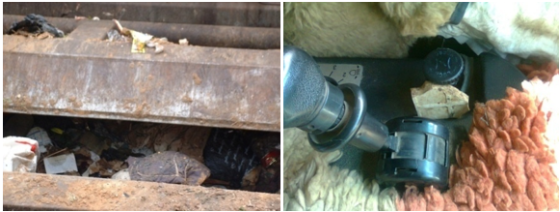
Each garbage collector has a bag attached to the rear edge of the truck. One collects scrap metal (kitchen utensils, iron scrap, etc.), two collectors handle empty plastic bottles, and the fourth takes empty aluminum cans and glass jars. It must be acknowledged that the work of these collectors deserves more than their wages, which they must use to cover the costs of adequate protective equipment (clothing, gloves, boots, and face masks). The garbage truck frequently breaks down (photograph plate 2).
Figure 10. Technical failures.
On the right, a faulty truck lever that the driver is holding with a small stone to get it working. On the left, a malfunctioning compressor on a dump truck. The volume of waste can no longer be compacted. The dumpster fills up faster, and some waste goes uncollected, causing collection points to overflow and encouraging illegal dumping.
4.4. The Environmental Impacts of Waste from the Municipality of Ngor
The environment is a fundamental pillar in the development process. Therefore, to protect the environment in Ngor, it is necessary to focus on the degradation of the living environment and its impacts on nature.
The factors contributing to environmental degradation in Ngor are numerous. These include coastal erosion, domestic wastewater, stormwater runoff, and solid waste. In this study, we analyzed the environmental impacts of household waste and examined the technical management methods for its collection, as well as the challenges encountered in its implementation.
6. Conclusions
Sanitation in Ngor, particularly in recent decades, has been characterized by the thorny problem of urban waste management. This is evidenced by a decrease in resources, both logistical and human, allocated to preserving environmental quality. The municipality is experiencing a sustained increase in its household solid waste, leading to a proliferation of illegal dumpsites, both in Ngor village and in the residential neighborhoods of Almadies.
This observation led the Government to seriously address the issue of waste management by adopting a specific law for the Senegalese capital, Dakar. This law aims to improve the quality of waste services and, consequently, the quality of the environment and public health. An evaluation of this new integrated waste management system, conducted by CADAK CAR, revealed that efforts have been made in the area of street cleaning. Waste collectors are working to eliminate illegal dumpsites and are seeking new equipment and personnel.
However, limitations exist in the management of household waste by concessionary companies. These companies sometimes favor certain areas based on the price per ton. During field investigations, shifts in collection zones were observed in the search for waste. This allows them to collect a larger volume of waste and receive more money. Payment by tonnage to concessionary companies hinders effective solid waste management in the city of Dakar.
Furthermore, implementing a selective sorting system requires a whole series of measures. First, all stakeholders must be clearly defined and their respective responsibilities well established. Those involved in waste collection must work together to ensure an effective upstream sorting system. Specific equipment must be installed to facilitate collection and support sorting, through the creation of designated areas. Sorting encompasses paper, glass, plastic, metal, etc., the main recovery/recycling streams for each type of material, and ultimately, recycling facilities. Indeed, household participation in sorting is key to the success of any policy aimed at reducing waste at the source. Awareness and information campaigns targeting households to encourage them to make an effort to sort their waste are essential. Sorting will, on the one hand, reduce the amount of waste sent to landfills, and on the other hand, increase the amount of packaging waste that can be recovered.
Finally, we can conclude that, for good governance in household waste management, household participation must become widespread. The Mayor is an active member of the Civil Society movement known as the Civil Forum. This membership hinders the proper functioning of his municipal activities. Households dump garbage indiscriminately, disregarding the risks to their own health and the environment. Therefore, the population must be made aware that environmental management is not solely the responsibility of municipal actors. By reducing environmental degradation, there will necessarily be a decrease in public health costs.






 Share This Article
 Twitter
 Linked In
 Facebook
 Copy
Copy Download