
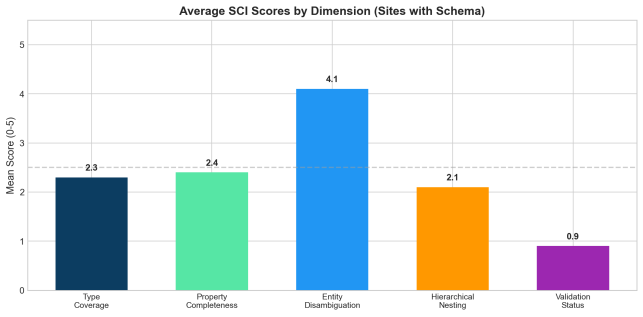
Structured data markup, particularly JSON-LD implementations of the Schema.org vocabulary, has become a critical factor in how search engines interpret, classify, and surface web content. Despite growing recognition of schema markup's role in search engine optimization (SEO), there has been limited empirical investigation into its adoption within specific professional service verticals. This study presents a systematic analysis of schema markup implementation across 500 personal injury (PI) law firm websites operating in the United States. Through automated crawling and programmatic code inspection, we examine the prevalence of key schema types, including LegalService, Attorney, Organization, FAQPage, BreadcrumbList, and WebPage, and assess the completeness, accuracy, and semantic richness of deployed structured data. Our findings reveal significant gaps: 67.6% of sampled firms implement some form of JSON-LD markup, yet only 40.0% deploy the LegalService schema type specifically designed for legal service providers. The mean Schema Completeness Index (SCI) across sites with structured data was 11.8 out of a possible 25. Entity disambiguation remains the weakest dimension: only 84.0% of sites with schema include @id properties and 81.4% include sameAs references. These findings have implications for legal services discoverability in both traditional search engine results pages (SERPs) and emerging AI-mediated answer engines. We propose a Structured Data Maturity Model for legal service websites and outline directions for future research.
| Published in | International Journal of Law and Society (Volume 9, Issue 3) |
| DOI | 10.11648/j.ijls.20260903.16 |
| Page(s) | 361-369 |
| Creative Commons |
This is an Open Access article, distributed under the terms of the Creative Commons Attribution 4.0 International License (http://creativecommons.org/licenses/by/4.0/), which permits unrestricted use, distribution and reproduction in any medium or format, provided the original work is properly cited. |
| Copyright |
Copyright © The Author(s), 2026. Published by Science Publishing Group |
Schema Markup, JSON-LD, Structured Data, Personal Injury Law, Legal Services SEO, Schema.org, Search Engine Optimization, Entity Optimization
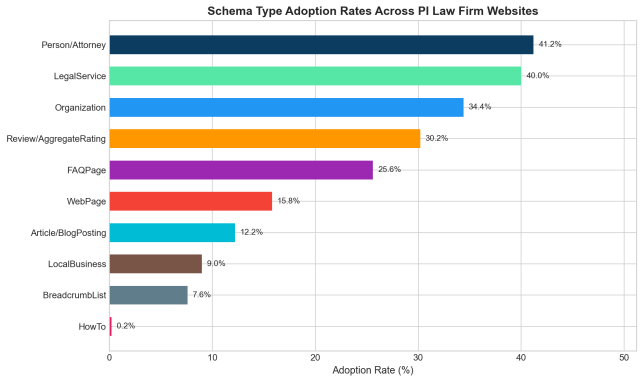
Schema Type | Sites (n) | Adoption (%) | Avg Property Completeness (%) |
|---|---|---|---|
Organization | 172 | 34.4% | 39.9% |
LocalBusiness | 45 | 9.0% | 57.8% |
WebPage | 79 | 15.8% | 41.0% |
BreadcrumbList | 38 | 7.6% | 100.0% |
FAQPage | 128 | 25.6% | 29.5% |
Person/Attorney | 206 | 41.2% | 33.1% |
LegalService | 200 | 40.0% | 47.9% |
Review/AggregateRating | 151 | 30.2% | — |
HowTo | 1 | 0.2% | — |
Article/BlogPosting | 61 | 12.2% | 76.4% |
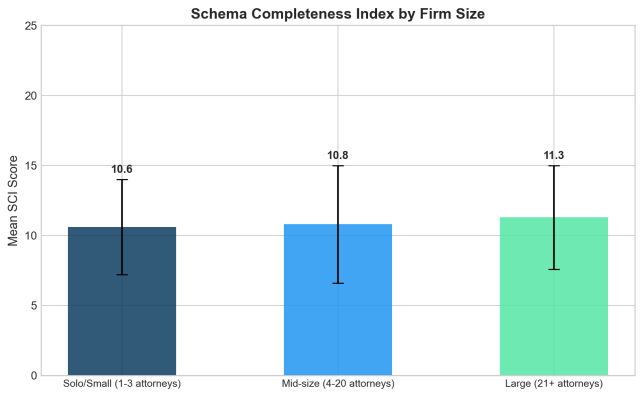
Firm Size | n | Mean SCI | SD | With Schema (%) |
|---|---|---|---|---|
Solo/Small (1-3 attorneys) | 143 | 10.6 | 3.4 | 79.7% |
Mid-size (4-20 attorneys) | 58 | 10.8 | 4.2 | 77.6% |
Large (21+ attorneys) | 52 | 11.3 | 3.7 | 82.7% |
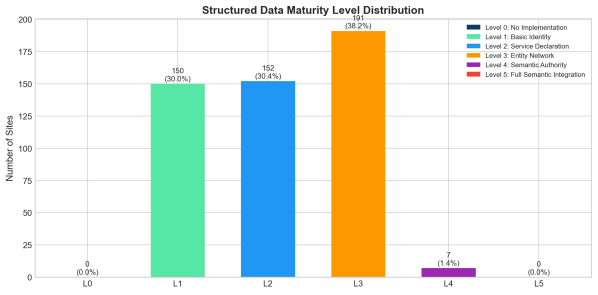
Level | Description | Sites (n) | Percentage |
|---|---|---|---|
Level 0 | No Implementation | 0 | 0.0% |
Level 1 | Basic Identity | 150 | 30.0% |
Level 2 | Service Declaration | 152 | 30.4% |
Level 3 | Entity Network | 191 | 38.2% |
Level 4 | Semantic Authority | 7 | 1.4% |
Level 5 | Full Semantic Integration | 0 | 0.0% |
Schema Type Combination | Sites (n) |
|---|---|
LegalService, Organization | 137 |
LegalService | 105 |
Organization | 63 |
Attorney, LegalService, Organization | 12 |
Attorney | 11 |
LocalBusiness | 10 |
LegalService, LocalBusiness, Organization | 9 |
LocalBusiness, Organization | 8 |
Property | Org (%) | LocalBiz (%) | LegalSrv (%) |
|---|---|---|---|
name | 98.8% | 100.0% | 100.0% |
url | 97.5% | 97.1% | 83.8% |
logo | 91.3% | 42.9% | 43.8% |
image | 59.5% | 80.0% | 90.4% |
description | 20.2% | 51.4% | 58.1% |
telephone | 12.0% | 88.6% | 69.9% |
5.0% | 31.4% | 20.2% | |
address | 12.8% | 100.0% | 93.8% |
sameAs | 69.8% | 60.0% | 52.6% |
areaServed | 3.7% | 22.9% | 32.4% |
@id | 86.8% | 31.4% | 51.5% |
geo | 0.8% | 62.9% | 43.8% |
priceRange | 1.2% | 65.7% | 51.5% |
openingHoursSpecification | 2.9% | 28.6% | 22.8% |
Schema Type | Sites Using Type | With @id | Coverage (%) |
|---|---|---|---|
WebSite | 336 | 314 | 93.5% |
WebPage | 305 | 292 | 95.7% |
BreadcrumbList | 284 | 267 | 94.0% |
LegalService | 272 | 140 | 51.5% |
Organization | 242 | 210 | 86.8% |
Person | 148 | 124 | 83.8% |
Attorney | 39 | 13 | 33.3% |
LocalBusiness | 35 | 11 | 31.4% |
ProfessionalService | 4 | 3 | 75.0% |
LawFirm | 1 | 1 | 100.0% |
Person Property | Coverage (%) |
|---|---|
name | 99.4% |
image | 92.5% |
url | 78.1% |
@id | 45.7% |
sameAs | 43.0% |
telephone | 41.3% |
worksFor | 32.5% |
description | 27.8% |
alumniOf | 19.8% |
jobTitle | 17.5% |
knowsAbout | 11.0% |
award | 7.5% |
AI | Artificial Intelligence |
API | Application Programming Interface |
BERT | Bidirectional Encoder Representations from Transformers |
DOI | Digital Object Identifier |
E-E-A-T | Experience, Expertise, Authoritativeness, Trustworthiness |
FAQ | Frequently Asked Questions |
HTML | HyperText Markup Language |
JSON-LD | JavaScript Object Notation for Linked Data |
LLM | Large Language Model |
ORCID | Open Researcher and Contributor ID |
PI | Personal Injury |
SCI | Schema Completeness Index |
SEO | Search Engine Optimization |
SERP | Search Engine Results Page |
URL | Uniform Resource Locator |
| [1] | Aggarwal, P., Murahari, V., Rajpurohit, T., Kalyan, A., Narasimhan, K., & Deshpande, A. (2024). GEO: Generative Engine Optimization. Proceedings of the 30th ACM SIGKDD Conference on Knowledge Discovery and Data Mining (KDD ’24), 5654–5665. |
| [2] | Barnard, J. (2022). The Fundamentals of Brand SERPs for Business. Kalicube Pro Publishing. |
| [3] | Berners-Lee, T., Hendler, J., & Lassila, O. (2001). The Semantic Web. Scientific American, 284(5), 34–43. |
| [4] | Bizer, C., Meusel, R., & Primpeli, A. (2024). Web Data Commons: Extraction of Structured Data from the Common Crawl (JSON-LD, Microdata, RDFa Corpus, October 2024). University of Mannheim. |
| [5] | Clio. (2023). Legal Trends Report 2023. Themis Solutions Inc. |
| [6] | Clio. (2024). Legal Trends Report 2024. Themis Solutions Inc. |
| [7] | Devlin, J., Chang, M. W., Lee, K., & Toutanova, K. (2019). BERT: Pre-training of Deep Bidirectional Transformers for Language Understanding. Proceedings of NAACL-HLT 2019, 4171–4186. |
| [8] |
Google Developers. (2024). Introduction to Structured Data Markup in Google Search. Google Search Central Documentation.
https://developers.google.com/search/docs/appearance/structured-data/intro-structured-data |
| [9] | Google LLC. (2025). Search Quality Rater Guidelines (September 2025 edition). Google LLC. |
| [10] | Guha, R. V., Brickley, D., & Macbeth, S. (2016). Schema.org: Evolution of Structured Data on the Web. Communications of the ACM, 59(2), 44–51. |
| [11] | Gübür, K. T. (2023). Holistic SEO & Digital Marketing. Holistic SEO Digital. |
| [12] | HTTP Archive. (2024). Structured Data. The 2024 Web Almanac. |
| [13] | Hu, X., Li, X., Chen, J., Li, Y., Wang, Y., Liu, Q., Wen, L., & Yu, P. S. (2024). Evaluating Robustness of Generative Search Engines on Adversarial Factual Questions. arXiv preprint arXiv: 403.12077. |
| [14] | Mika, P. (2015). On Schema.org and Why It Matters for the Web. IEEE Internet Computing, 19(4), 52–55. |
| [15] | Pan, S., Luo, L., Wang, Y., Chen, C., Wang, J., & Wu, X. (2024). Unifying Large Language Models and Knowledge Graphs: A Roadmap. IEEE Transactions on Knowledge and Data Engineering, 36(7), 3580–3599. |
| [16] | Sharma, N., Liao, Q. V., & Xiao, Z. (2024). Generative Echo Chamber? Effects of LLM-Powered Search Systems on Diverse Information Seeking. Proceedings of the 2024 CHI Conference on Human Factors in Computing Systems (CHI ’24), 1–17. |
| [17] |
Singhal, A. (2012). Introducing the Knowledge Graph: Things, Not Strings. Google Official Blog.
https://blog.google/products/search/introducing-knowledge-graph-things-not/ |
APA Style
Hussain, B. (2026). Schema Markup Adoption in Personal Injury Law Firm Websites: A Systematic Analysis of Structured Data Implementation Across North American Legal Services. International Journal of Law and Society, 9(3), 361-369. https://doi.org/10.11648/j.ijls.20260903.16
ACS Style
Hussain, B. Schema Markup Adoption in Personal Injury Law Firm Websites: A Systematic Analysis of Structured Data Implementation Across North American Legal Services. Int. J. Law Soc. 2026, 9(3), 361-369. doi: 10.11648/j.ijls.20260903.16
@article{10.11648/j.ijls.20260903.16,
  author = {Behzad Hussain},
  title = {Schema Markup Adoption in Personal Injury Law Firm Websites: A Systematic Analysis of Structured Data Implementation Across North American Legal Services},
  journal = {International Journal of Law and Society},
  volume = {9},
  number = {3},
  pages = {361-369},
  doi = {10.11648/j.ijls.20260903.16},
  url = {https://doi.org/10.11648/j.ijls.20260903.16},
  eprint = {https://article.sciencepublishinggroup.com/pdf/10.11648.j.ijls.20260903.16},
  abstract = {Structured data markup, particularly JSON-LD implementations of the Schema.org vocabulary, has become a critical factor in how search engines interpret, classify, and surface web content. Despite growing recognition of schema markup's role in search engine optimization (SEO), there has been limited empirical investigation into its adoption within specific professional service verticals. This study presents a systematic analysis of schema markup implementation across 500 personal injury (PI) law firm websites operating in the United States. Through automated crawling and programmatic code inspection, we examine the prevalence of key schema types, including LegalService, Attorney, Organization, FAQPage, BreadcrumbList, and WebPage, and assess the completeness, accuracy, and semantic richness of deployed structured data. Our findings reveal significant gaps: 67.6% of sampled firms implement some form of JSON-LD markup, yet only 40.0% deploy the LegalService schema type specifically designed for legal service providers. The mean Schema Completeness Index (SCI) across sites with structured data was 11.8 out of a possible 25. Entity disambiguation remains the weakest dimension: only 84.0% of sites with schema include @id properties and 81.4% include sameAs references. These findings have implications for legal services discoverability in both traditional search engine results pages (SERPs) and emerging AI-mediated answer engines. We propose a Structured Data Maturity Model for legal service websites and outline directions for future research.},
 year = {2026}
}
TY  - JOUR
T1  - Schema Markup Adoption in Personal Injury Law Firm Websites: A Systematic Analysis of Structured Data Implementation Across North American Legal Services
AU  - Behzad Hussain
Y1  - 2026/08/10
PY  - 2026
N1  - https://doi.org/10.11648/j.ijls.20260903.16
DO  - 10.11648/j.ijls.20260903.16
T2  - International Journal of Law and Society
JF  - International Journal of Law and Society
JO  - International Journal of Law and Society
SP  - 361
EP  - 369
PB  - Science Publishing Group
SN  - 2640-1908
UR  - https://doi.org/10.11648/j.ijls.20260903.16
AB  - Structured data markup, particularly JSON-LD implementations of the Schema.org vocabulary, has become a critical factor in how search engines interpret, classify, and surface web content. Despite growing recognition of schema markup's role in search engine optimization (SEO), there has been limited empirical investigation into its adoption within specific professional service verticals. This study presents a systematic analysis of schema markup implementation across 500 personal injury (PI) law firm websites operating in the United States. Through automated crawling and programmatic code inspection, we examine the prevalence of key schema types, including LegalService, Attorney, Organization, FAQPage, BreadcrumbList, and WebPage, and assess the completeness, accuracy, and semantic richness of deployed structured data. Our findings reveal significant gaps: 67.6% of sampled firms implement some form of JSON-LD markup, yet only 40.0% deploy the LegalService schema type specifically designed for legal service providers. The mean Schema Completeness Index (SCI) across sites with structured data was 11.8 out of a possible 25. Entity disambiguation remains the weakest dimension: only 84.0% of sites with schema include @id properties and 81.4% include sameAs references. These findings have implications for legal services discoverability in both traditional search engine results pages (SERPs) and emerging AI-mediated answer engines. We propose a Structured Data Maturity Model for legal service websites and outline directions for future research.
VL  - 9
IS  - 3
ER  -
Rank Brilliance, Semantic SEO Research, Lahore, Pakistan
Biography: Behzad Hussain is an Independent Researcher and Certified Semantic SEO Expert, serving as CEO and Founder of Rank Brilliance, a Semantic SEO agency based in Lahore, Pakistan. His research investigates the intersection of entity-based search optimization, structured data adoption, and legal services discoverability, with a particular focus on personal injury law firm websites across North American markets. Trained in Chartered Accountancy under the Institute of Chartered Accountants of Pakistan (ICAP), Hussain brings quantitative rigor to applied SEO research, bridging practitioner expertise with empirical methodology. He holds certification in Semantic SEO under the framework developed by Koray Tugberk Gübür and has led structured data implementations for legal, healthcare, SaaS, and FinTech clients across the United States and Canada.


Information



 Share This Article
 Twitter
 Linked In
 Facebook
 Copy
Copy Download