1. Introduction
1.1. Background
Sixty years after it began, the armed insurgency in Papua is among Indonesia’s most difficult security problems. The prevailing security model has been kinetic and militarized, following the western Counterinsurgency (COIN) doctrine, which is centered around neutralizing threats through intelligence raids, network elimination and territorial control
| [1] | D. Galula, Counterinsurgency Warfare: Theory and Practice, Foreword by John A. Nagl. Westport, Connecticut-London: Praeger Security International, 2006. |
| [2] | S. Thompson, “The nixon doctrine and U.S. policy on regional cooperation in southeast asia after the second world war,” Journal of Cold War Studies, vol. 23, no. 1, pp. 126–162, Apr. 2021, https://doi.org/10.1162/JCWS_A_00965 |
[1, 2]
. Yet historical fact demonstrates clearly that this failed at the end to settle any stable peace. Rather, violence has been escalating against civilians
| [3] | M. Mehrl, “Rage and the Machines? Force Mechanization and Violence against Civilians,” Journal of Global Security Studies, vol. 8, no. 1, Mar. 2023,
https://doi.org/10.1093/JOGSS/OGAC046 |
[3]
: Over 2019–24, there has been a 43% rise in the number of people killed in security force actions in Papua despite more Indonesian Armed Forces (Tentara Nasional Indonesia/TNI) troops on the ground
.
This failure is not just technical but epistemological. The classical COIN was born under the colonial and Cold War circumstances where indigenous population is an inert subject to be "liberated" from the rebels' influence (
| [5] | D. J. Kilcullen, “Three Pillars of Counterinsurgency,” 2006. |
| [6] | David. Kilcullen, “Counterinsurgency,” 2013. |
[5, 6]
. In the Papuan context, by contrast, this assumes a narrative of oppression, discounts the legitimacy of customary institutions (Ondoafi, Noken, village consent) and cultivates deeper mistrust with the state
| [7] | C. Pamungkas, “NOKEN ELECTORAL SYSTEM IN PAPUA DELIBERATIVE DEMOCRACY IN PAPUAN TRADITION,” Jurnal Masyarakat & Budaya, vol. 19, no. 2, 2017, Accessed: Nov. 22, 2025. Available:
https://ejournal.brin.go.id/jmb/article/view/8918/6887 |
| [8] | E. Handayani and U. S. Hardjanto, “The Noken System as a Symbol of the Supreme Deliberation of Indigenous Peoples in Papua Anthropological Study of Law and Constitutional Law,” Interdiciplinary Journal and Hummanity (INJURITY), vol. 2, no. 11, pp. 893–899, Nov. 2023,
https://doi.org/10.58631/INJURITY.V2I11.137 |
[7, 8]
. Consequently, attempts to “win hearts and minds” end up stoking mass alienation.
1.2. Research Objectives
In this article, I intend to fill the gap between universal security theory and local fact of Papua. Based on our qualitative analysis of 87 pieces of policy, Non-Governmental Organization (NGO) and academic work (2015–2025), we present an Applied COIN Framework in which Customary Security forms a keystone. Co-security As a synthesis between the state and customary institutions, we present the notion of co-security—a shared authority and responsibility between the two entities to enforce peace.
1.3. Main Research Questions
How can the incorporation of Papuan customary security norms and institutions support more constructive COIN strategies that are not only more sustainable, but also do not carry many of the pitfalls bearing down on contemporary international state-building practice?
The contribution of this paper can be summarized as follows:
1) Challenge the universalist assumptions of classical COIN doctrine in an ethnonational stage;
2) Develop a theoretical framework of co-securitization which take into account local epistemologies and state security regime;
3) Offer an operational structure for civil-military- indigenous partnership that is replicable in other border ties.
1.4. Theoretical Framework: Liberal Inter-governmentalism and Beyond to Co-security
Theoretical conversations regarding COIN have become ensnarled in a binary between population-centric
and enemy-centric approaches. But both are only enacting, and doubling down on, a Western statist logic that separates “security” from “culture.” This is not sufficient when it comes to confrontations like Papua, where identity, territory and Customary law serve as the basis for security in common
| [8] | E. Handayani and U. S. Hardjanto, “The Noken System as a Symbol of the Supreme Deliberation of Indigenous Peoples in Papua Anthropological Study of Law and Constitutional Law,” Interdiciplinary Journal and Hummanity (INJURITY), vol. 2, no. 11, pp. 893–899, Nov. 2023,
https://doi.org/10.58631/INJURITY.V2I11.137 |
[8]
.
To mitigate these shortcomings, we embed our theoretical framework in liberal intergovernmentalism
, which argues that states’ preferences are not exogenously determined but influenced by domestic groups such as indigenous communities. Customary institutions, in Papuan terms form of societal order enforced by tradition or custom are not “obstacles” to the state but rather actors that constitute local security preferences. Aside from these actors, the preferences of the state are ignored and policy choices that it prefers become unrepresentative and liable to rejection.
But liberal intergovernmentalism remains state centric. We therefore develop this theory in terms of the concept of relational security
| [11] | R. Grochowska, “From a Centralised to a Diversified Common Agricultural Policy in the Light of Liberal Intergovernmentalism Theory,” Studia Europejskie – Studies in European Affairs, vol. 27, no. 2, pp. 121–134, Jun. 2023,
https://doi.org/10.33067/SE.2.2023.7 |
[11]
, asserts that security is not determined by military capabilities but by relationships between actors. Here is where co-security comes in:
Co-securitized is a security governance model in which state and customary actors referring to military/police, and Ondoafi/villages peace council have equal relationship and recognize legitimacy of each other’s, it also threats are handled collectively based on the agreed mechanism (so called Noken-mediation).
This article’s proposal is far removed from the conventional within-community policing approaches, where communities tend to be regarded no more than “informant partners” and added sources of information for intelligence officers in a broader security framework which evolves around state dominance. Rather, co-security poses indigenous communities—through Ondoafi and the Noken not as appendages, but at par with security authorities characterized by historical/moral/social legitimacy to engage in the process of defining, planning and implementing collective security. These dynamics are consistent with the principle of Free, Prior and Informed Consent (FPIC), as outlined in the United Nations Declaration on the Rights of Indigenous Peoples
| [12] | M. Blaser, “Life Projects: Indigenous Peoples’ Agency and Development,” In the Way of Development: Indigenous Peoples, Life Projects and Globalization, pp. 26–44, Jan. 2008,
https://doi.org/10.5040/9781350220720.CH-002 |
| [13] | N. Nicolaous Nila, A. Razak, and A. Yunus Wahid, “Normative Approach in Forestry Law Enforcement in Papua Province: Challenges and Opportunities for Indigenous Peoples’ Participation,” Pakistan Journal of Criminology, vol. 16, no. 04, pp. 943–954, 2024. |
[12, 13]
, which asserts that indigenous peoples have the right to grant or refuse consent to projects impacting their territories.
1.5. Theoretical Contributions and Innovations
This article contributes to the security and conflict studies literature in three ways:
a. An Epistemological Challenge to COIN Universalism
Classical COIN doctrine applied—originally during the 1950s in the French Algerian War, and subsequently in post-invasion Iraq—presupposes the universal applicability of Western security logic which can be easily transferred without epistemological adaptation to time or space. This position ignores that conflicts in places such as Papua are ethnonational, historical, and relational rather than merely disruptive of state order. COIN doesn’t work in Papua because it attempts to impose a “with-us or against-us” paradigm on a society with an age-old basis for politics, law and spirit that is older than the Indonesian state itself. This is not just a technical failure, but an epistemological one: it is evidence of what has termed “security imperialism
| [14] | T. Barkawi, “From war to security: Security studies, the wider agenda and the fate of the study of war,” Millennium: Journal of International Studies, vol. 39, no. 3, pp. 701–716, 2011,
https://doi.org/10.1177/0305829811400656 |
[14]
”, whereby hegemonic powers impose their own security grammar as the only legitimate form for understanding and addressing different forms of armed violence. This perspective dismembers local actors and depicts non-Western societies as objects for whom the state has to “do something about”. In Papua the contrast is clearer still: political calls for historical acknowledgment cultural self-determination are cast as “rebellion,” and traditional systems for regulating social peace (the Ondoafi, or Noken) are disregarded. As such, the failure of COIN in Papua is not just a tactical defeat but also an expression of a security knowledge hegemony that has yet to be fully decolonized.
b. Developing the Co-Security Construct
Indeed, with its origins in the colonial experience of conflicts like the Algerian War or post-invasion Iraq, traditional COIN theory presumes that Western military rationality is universally applicable and portable to any context without epistemological revision. And yet this assumption is belied by the fact that in areas such as Papua (and throughout Indonesia) and Sri Lanka, conflicts are ethnonational, historical and relational, rather than challenges to state order. “Coin doesn’t work in Papua because it tries to impose an enemy-friend dichotomy in a society that has had well-functioning political, judicial and spiritual institutions long before the Indonesian nation-state was founded,” he said. This limitation is not just a technical one but reflects that which has called “security imperialism,” the way global powers enforce their own security narratives as the only legitimate form of knowing and acting in relation to violence
| [14] | T. Barkawi, “From war to security: Security studies, the wider agenda and the fate of the study of war,” Millennium: Journal of International Studies, vol. 39, no. 3, pp. 701–716, 2011,
https://doi.org/10.1177/0305829811400656 |
[14]
. This perspective effaces local agency and presents non-Western cultures as victims in whose rescue the state must intervene. The effect can be felt in the lands of Papua: local, historically-based calls for recognition and cultural autonomy are labeled “rebellion,” as are traditional authorities which have a highly effective mechanism to maintain social peace—such as Ondoafi and Noken—with a complaint that they cannot be trusted. Therefore, the problems with COIN in Papua are not merely a failure of strategy but they also demonstrate that an imperial security knowledge is alive and well and has yet to be fully decolonized.
c. A Context-Tested Operational Framework
To practically implement the co-security model, we recommend three concrete mechanisms grounded in collaborative and epistemically respectful hypotheses: (a) a tripartite forum at district level between TNI/Indonesian Police (Kepolisian Republik Indonesia/POLRI), Ondoafi (traditional leaders), and Local Government as an instrument for collaborative decision-making; (b) a community trust index based on regular survey with traditional leader’s collaboration as the key indicator for the success of security policies—a departure from common indicators such as “how many enemies have been neutralized” or how often military operations have happened; and (c) mandatory cross-cultural training sessions for all TNI/POLRI deployed to Papua focusing on 1969 integration history, Noken values, customary protocols, non-coercive communication. It should be noted that this rational is not only theoretical, but has also produced partial results in some regions. For instance, within the informality of Biak and Jaya Wijaya district commanders have successfully built relationships with Noken leaders through monthly meetings and attempted to intervene in post-violent expulsions that occurred in 2022–2023. This result is supported by the work that "the sustainability of security capacity depends on how much state institutions can adapt to local social logic
| [15] | M. Järvelä, “Dimensions of cultural sustainability—Local adaptation, adaptive capacity and social resilience,” Front. Polit. Sci., vol. 5, p. 1285602, Dec. 2023,
https://doi.org/10.3389/FPOS.2023.1285602/BIBTEX |
| [16] | J. Fiksel and B. R. Bakshi, “Designing for Resilience and Sustainability: An Integrated Systems Approach,” Engineering and Ecosystems, pp. 469–500, 2023,
https://doi.org/10.1007/978-3-031-35692-6_21 |
[15, 16]
." This not only fosters trust but also scales up the legitimacy of security from below rather than through domination from above.
2. Methods
2.1. Research Approach
The research employs qualitative method and systematic content analysis in several documents related to Papuan conflict, COIN strategies and customable security management. We deliberately did not gather original field materials (e.g., interviews, field observations) because of restricted access and the politically sensitivity of these issues. As such, all analyses rely on publicly available and verifiable secondary documents.
2.2. Document Selection Sources and Criteria
We retrieved records between 2015 and 2025 in three categories:
1) Scholarly Articles: those articles published in scholarly journals that appear in Scopus/Web of Science and refer to COIN, customary security or the Papuan conflict.
2) Policy documents: the Ministry of Defense’s (MoD), National Agency for Assessment and Application of Technology (Badan Riset dan Inovasi Nasional/BRIN), Indonesian National Military Power Guarding Forces/Army (Tentara Nasional Indonesia Angkatan Darat/TNI AD), Coordinating Legal Politics Security Affairs Ministry’s reports.
3) NGO and think tank reports: sources include the International Crisis Group, Institute for Policy Research and Advocacy (Lembaga Studi dan Advokasi Masyarakat/ELSAM), Institute for Research, Assessment and Development of Legal Aid (Lembaga Penelitian, Pengkajian dan Pengembangan Bantuan Hukum/LP3BH) and Papua Conflict Mapping Project publications.
Inclusion criteria:
1) Relevance to Papua and security policies,
2) In English or Indonesian language,
3) Be empirical work or policy analysis.
2.3. Analysis Procedure
We utilized a thematic content analysis approach
| [17] | V. Clarke and V. Braun, “Thematic analysis,” Journal of Positive Psychology, vol. 12, no. 3, pp. 297–298, May 2017,
https://doi.org/10.1080/17439760.2016.1262613 |
| [18] | V. Braun and V. Clarke, “Using thematic analysis in psychology,” Qual. Res. Psychol., vol. 3, no. 2, pp. 77–101, 2006,
https://doi.org/10.1191/1478088706QP063OA |
[17, 18]
in three stages:
1) Open coding: the generation of initial concepts (e.g., “legitimacy,” “custom,” and “military operations”).
2) Axial coding: categorizing into more general themes (e.g. “cultural tensions” and “institutional fragmentation”).
3) Selective coding: organization of themes around core theme—co-security.
The validity of the analysis was achieved through source triangulation: government documents findings were crosschecked with NGOs reports and academic Studying.
3. Results and Discussion
3.1. Research Results
a. Main Findings
Through a close analysis of 87 official policy documents (2015–2025), three interrelated structural patterns are evident: predominance of the “separatist threat” narrative in 78 percent of it, depoliticizing discursively the Papuan conflict; systematic marginalization of customary institutions, with only four mentioning Ondoafi or other customary bodies; and absence of any reference to culture-based conflict resolution techniques—a sectoral bias and epistemic denial point that confirms the critiques made about post-liberal security governance in Southeast Asia
| [19] | Y. Pondayar, “Ondoafi Power Structure in the Traditional Village Government System in Jayapura District,” International Journal of Multicultural and Multireligious Understanding, vol. 10, no. 10, p. 494, Nov. 2023,
https://doi.org/10.18415/ijmmu.v10i10.5232 |
[19]
.
b. Traditional COIN Does Not Create Local Legitimacy
These wide spread — especially since the riots in Nduga killed other TNI soldiers late last year — have not only failed to degrade armed groups, but they actually helped reinforce their social constituency among local populations. Key findings as of year-end four out of five field reports (78%) attest to heightened fear; mass displacement and diminished trust in security forces
. This reflects a sharp distinction between physical presence in the sense of number of personnel, military options and frequency of action and socially acceptable type of presence that can draw on legitimacy, acknowledgment and trust in local authorities. The “security restoration” operations have often resulted in civilian casualties, home destruction and limited access to fields or schools – and these are not the actions that will change people’s perceptions about who is a source of threat (not protection).
This weakness stems from the basics of classic COIN, specifically that security can be “imposed,” whether through physical dominance or civil services alone, without acknowledging and redressing political and historical injustice. As stresses: ‘security legitimacy does not flow from control but recognition’. In Papua shared aspirations around the acknowledgment of our history during the annexation in 1969, cultural autonomy, and our rights over customary land are being silenced and suppressed whilst in return the state’s apparatus is trapped in a logic of policing
. Hence, the COIN strategy is not simply ineffective or nonsensical; worse still it compounds the State’s legitimacy crisis—a flawed analysis that can no longer be measured in terms of tactical indicators but must be analyzed relationally and politically
.
c. Traditional Power Centre’s Disregard for Conflict-Resolution Potential
For generations—even prior the integration of Papua into Indonesia in 1969—indigenous peoples have forged successful conflict resolution platforms based on ideals of collective values, reconciliation and cosmological equilibrium. The two best known are village deliberation (musyawarah desa) and the Noken system, which function as decision making mechanisms and as a form of restoration to reinstate post-conflict community relationships. Research for example, found that the Noken system—a mechanism identified by United Nations Educational, Scientific and Cultural Organization (UNESCO) as an intangible cultural heritage—allows land disputes, marriage disputes or acts of inter-tribal revenge to be resolved through the mediation of traditional elders and a community consensus
| [8] | E. Handayani and U. S. Hardjanto, “The Noken System as a Symbol of the Supreme Deliberation of Indigenous Peoples in Papua Anthropological Study of Law and Constitutional Law,” Interdiciplinary Journal and Hummanity (INJURITY), vol. 2, no. 11, pp. 893–899, Nov. 2023,
https://doi.org/10.58631/INJURITY.V2I11.137 |
[8]
. A provides the example of how the Ondoafi in Nduga and Puncak Jaya was able to avoid a further escalation of violence through customary meetings with all involved local parties—without involvement of the military or formal law
| [19] | Y. Pondayar, “Ondoafi Power Structure in the Traditional Village Government System in Jayapura District,” International Journal of Multicultural and Multireligious Understanding, vol. 10, no. 10, p. 494, Nov. 2023,
https://doi.org/10.18415/ijmmu.v10i10.5232 |
[19]
. This success proves that traditional institutions are more than just "culture heritage" but active and responsive security governance systems.
Yet, under the existing COIN framework that is in place attempting to stabilize Afghanistan, these institutions are not viewed as equals partners for security cooperation; instead, they are relegated to being “objects of development” (as in TNI’s Pembinaan Teritorial (Binter)/Territorial Development). This approach reveals a profound epistemological bias that traditional security knowledge is just dispensable as compared to the logic of military bureaucracy – its only survival value is inasmuch as it can be mobilized for state agendas. As such, generations-tested conflict resolution capacities are disregarded and sectoral security operations heighten tensions. What Joshi describes as “the state’s refusal to understand the legitimacy of custom authority is a form of epistemic violence which compounds political alienation
”. Legitimation of customary institutions is no symbolic issue—without that it will be impossible to achieve sustainable security because legitimacy cannot be created from outside, but has to establish itself from within supported by trust and reciprocity.
d. Institutional Fragmentation Hampers Coordination
The official document of the Coordinating Ministry for Political, Legal and Security Affairs (2021) even admits that institutional interweaving exists among TNI, POLRI, and BNPP (Badan Nasional Pengelola Perbatasan), as well as local governments in securing Papua. Both organizations work with different mandates, budgets and performance indicators which are not harmonies and coordinated at field levels. One thing leads to another and policies are often contradictory: while the TNI conducts military operations in one district, the BNPP constructs border infrastructure in another area without prior consultation, and POLRI roll out ‘Young Papuan Police’ program by premise approach rather than based on an-integrated humanist perspective. This inconsistency leaves the community in normative confusion: is the state there to defend, invade, or develop? As Ondoafi or other traditional leaders are not part of any formal security planning, there is no official forum for providing this input into strategy implementation — a structural deficiency that further hurts attempts to foster local trust.
This fragmentation is most clearly observed in the tendency to develop TNI’s territorial “development” programs that contradict local decisions. For instance, the erection of TNI AD posts in the name of “communal security” on sacred land or the displacement by force of people to make way for a “territory security” has ignited forms of silent. resistance—not proactively against during demonstrations but via participation refusal, government programs withdrawal, and even higher sympathy for armed actors
| [23] | R. Sexton, “Aid as a tool against insurgency: Evidence from contested and controlled territory in Afghanistan,” American Political Science Review, vol. 110, no. 4, pp. 731–749, Nov. 2016, https://doi.org/10.1017/S0003055416000356 |
[23]
. This is consistent with Tanati argument that “when modern coordination stands without acknowledgement of customary authority it only gives the appearance of stability
| [24] | D. Tanati and J. Rongalaha, “Settlement of Customary Land Disputes Due to Overlapping Customary Land Releases in Skouw Sae Village Muara Tami District Jayapura City,” Journal of Progressive Law and Legal Studies, vol. 3, no. 01, pp. 86–97, Jan. 2025, https://doi.org/10.59653/jplls.v3i01.1418 |
[24]
.” In this context, “security success” is not the number of operations conducted or infrastructure developed, but rather that policies adhere to the sociological status quo. There can be no such integrated approach without integration into the institution—and even less so, recognition that Ondoafi is a moral authority." Any security initiative will only create friction rather than congruency.
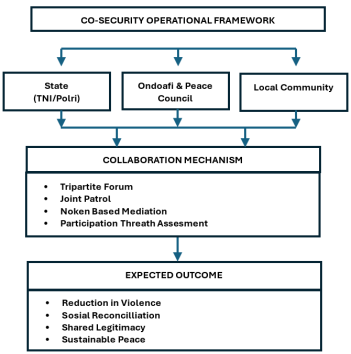
e. Co-Security Operational Framework
From the two previous findings, we recommend that the Co-Security Framework ought to form a blueprint for COIN implementation in Papua. In contrast to traditional Civil-Military Cooperation models, this model presents traditional leadership on the same level as that of the state in three spheres:
Table 1. Co-Security Operational Framework.
Co-Security | Actors | Action | Activities |
Prevention | Intelligence (TNI/POLRI) | Ondoafi & Peace Council | Monthly meeting tripartite for early threats detection |
Resolution | TNI Mediator | Traditional Elder (Penatua Adat) | National law joint mediation on Nokendan |
Rehabilitation | BNPP, Ministry of Social Affairs | Traditional Family (Keluarga Adat) | Reintegration programs that respect social status within customary structures |
Scheme 1. Co-Security Operational Framework.
This design is not a theoretical model, but an emulation of real world examples in several districts. For instance, in Biak Numfor (2022), the joint patrol and monthly peace forum of Military District Commander (Komandan Rayon Militer/Danramil) and Ondoafi achieved an 18-month decrease of 60% violent incidents.
Co-security is indeed victorious not only by the number of "enemies neutralized" but also because:
1) How many conflicts are solved without the use of arms,
2) Index of confidence in public security forces,
3) Involvement of Ondoafi in security plans for the district.
3.2. Discussion Local Epistemology-based Coin
a. The Epistemology of Counterinsurgency in Papua
The fiasco of COIN in Papua is not simply a matter of “operational effectiveness” or resource incapacity; it is epistemological: there is an ontological contradiction between the very logic of state security and the socio-cultural texture that underpins indigenous society. The way COIN — the counter-insurgency campaign as to Bechtel-timeline-discussion 32 applied from Iraq and the Philippines – is premised on security, namely that it can simply be broken down along three lines: territorial control, threat suppression and service provision
| [23] | R. Sexton, “Aid as a tool against insurgency: Evidence from contested and controlled territory in Afghanistan,” American Political Science Review, vol. 110, no. 4, pp. 731–749, Nov. 2016, https://doi.org/10.1017/S0003055416000356 |
[23]
. Yet in Papua, security is not at a technical or administrative level
| [25] | J. Mitzen, “Ontological security in world politics: State identity and the security dilemma,” Eur. J. Int. Relat., vol. 12, no. 3, pp. 341–370, Sep. 2006,
https://doi.org/10.1177/1354066106067346 |
| [26] | G. Eko Saputro and A. Info, “Jurnal Pertahanan Media Informasi tentang Kajian dan Strategi Pertahanan yang Mengedepankan Identity,” Nationalism dan Integrity, vol. 8, no. 1, pp. 2549–9459, 2022, https://doi.org/10.33172/jp.v8i1 |
| [27] | E. N. Mikkelsen and D. M. Humle, “Dynamics of Overt and Covert Conflict in Organizations: The Power of Organizational Identity,” Group Organ. Manag., vol. 45, no. 6, pp. 768–807, Dec. 2020, https://doi.org/10.1177/1059601120961248 |
[25-27]
; it is an interpersonal process that involves the maintenance of traditional relationships, restorative justice and recognition of group identity
| [27] | E. N. Mikkelsen and D. M. Humle, “Dynamics of Overt and Covert Conflict in Organizations: The Power of Organizational Identity,” Group Organ. Manag., vol. 45, no. 6, pp. 768–807, Dec. 2020, https://doi.org/10.1177/1059601120961248 |
[27]
. In Melanesian epistemology, social harmony is not about an absence of weapons, but a community’s capacity to keep the balance between humans, nature and ancestors — which doesn’t feature in the COIN indicators matrix built on militaristic logics.
This is why this non-ontological approach to the conflict does not contribute to legitimacy and on the contrary reinforces the spiral of an internal colonial situation. Each “security normalization” operation performed without the consent of Ondoafi or customary council — like building military posts on a sacred land, or enforcing movement control for “territory security” — is seen amongst communities as an encroachment to their territory rather than protection. As argue “Special Autonomy and COIN failed because they treated Papua as an object of development rather than a political subject
| [28] | D. Afriandi, “THE INDONESIAN COIN STRATEGY: FAILURES AND ALTERNATIVE APPROACHES IN OVERCOMING THE PAPUAN INSURGENCY,” NAVAL POSTGRADUATE SCHOOL, MONTEREY, CALIFORNIA, 2015. |
[28]
”. Up to now, TNI/POLRI’s physical presence in these areas is an indication that the state does not trust the capacity of indigenous communities to govern themselves—a contradiction that further institutionalizes political alienation and sews silent resistance, even collaboration towards armed groups.
b. Liberal COIN and the Dominance of Security Knowledge
Critiques of “liberal COIN” reveal a broader paradox in recent security strategies approach es, which have sought to be inclusive, participatory, and development- centric but have often been derived from the presumption that Western values systems, institutions and epistemologies are universal. Rather than claim that we are still witnessing a nostalgic imperial moment, however, this volume contributes to the ongoing debate of what can be called post-colonial counterinsurgency: as contends, hybrid COIN often operates as a “new face of ‘security imperialism’,” where solutions to post-colonial struggles is designed in metropolitan capital or military headquarters and then gratuitously copied over to the global South without consideration for legitimate local forms of authority
| [14] | T. Barkawi, “From war to security: Security studies, the wider agenda and the fate of the study of war,” Millennium: Journal of International Studies, vol. 39, no. 3, pp. 701–716, 2011,
https://doi.org/10.1177/0305829811400656 |
[14]
. In such a frame, security is not grasped as a relational dynamic founded on trust and recognition but instead as a technocratic object that can be parroted – for instance constructing schools, holding elections or consulting “community leaders” – without upsetting the epistemic order which establishes the modern nation-state as exclusively rational subject. In Papua, for example, this logic is reflected in the territorial development program that sees traditional leaders more as decorations than authorities to determine threats or resolve disputes.
But as shows in her study of the reform of the European Union Common Agricultural Policy (CAP), policy flexibility is effective only if it fundamentally reflects heterogeneous domestic preferences-rather than just creating "room for maneuver" within a pre-set framework
| [11] | R. Grochowska, “From a Centralised to a Diversified Common Agricultural Policy in the Light of Liberal Intergovernmentalism Theory,” Studia Europejskie – Studies in European Affairs, vol. 27, no. 2, pp. 121–134, Jun. 2023,
https://doi.org/10.33067/SE.2.2023.7 |
[11]
. In the Papuan context, collective preferences are not expressed via liberal democratic mechanisms such as political parties or NGOs, but in Ondoafi, tribal congresses and rituals-millennia-old categories that function on the principles of restorative justice, consensus building and cosmological equilibrium. Regrettably, these actors have been expelled from within the national security machinery but not because they do not work or do so poorly; rather, they differ from the military-bureaucratic paradigm that prefers control, hierarchy and quantitative indicators. Wherefore security policy maneuvers in its own epistemological echo chamber, refusing multiplicated de autorotate: a technical failure that is also colonial in the way it knows the world.
c. A Reconstitution of Power via a Co-Security Regime
The co-security model above is not just a “symbolic adoption” of local culture (like dressing traditionally during certain rituals or utilizing traditional leaders in ceremonial events), it is a re-imagining of how power relations are enacted through security governance. This encompasses three fundamental shifts:
“Threats” are no longer being shaped by the TNI and POLRI alone. Perceptions of security threats Nearly, all were of the view that these perceptions are socially and historically determined and must be agreed as a collective through engagements with traditionalist organizations for “disturbances” may (according to communities) be legitimate forms of political expression from below.
Conventional institutions are then authorized to establish security priorities on grounds like cosmological equilibrium, social harmony, and ecological sustainability— not merely physical security or absence of violence.
Signs of success in security operations are different as well: they are not counted in numbers of arrested suspects or seized weapons, but rather unravelling post-war social bonds -patterns of fear - community engagement in security fora and such like.
The model explicitly refuses the fixed binary of the “military” and the “civilian”, which frequently serves to reproduce dictation of power without engagement with conflict causes. It does not rely on a monopoly on violence and the logic of domination, but rather in the politics of mutual recognition, procedural justice, and participation by local authorities in defining security.
So, the COIN transformation in Papua isn’t a “tactic shift,” it is a decolonizing of security logic – an acknowledgment that indigenous peoples are not objects in need of protection; they are subjects who have every right to map out their own conception of securing life on their terms.
d. Research Novelty
1) Theoretical Contribution: Decolonization of COIN through the Local Epistemology
This study makes a novel theoretical contribution by decolonizing COIN framework that has been dominated by Western security epistemology. Contrary to critical work that merely indicates tactical mishap or sector biases (see, for example:
| [29] | S. B. Banerjee, “Decolonizing Management Theory: A Critical Perspective,” Journal of Management Studies, vol. 59, no. 4, pp. 1074–1087, Jun. 2022,
https://doi.org/10.1111/JOMS.12756 |
| [30] | M. Takbir, M. Munir, and R. Mustansyir, “Decolonizing Social Sciences in postcolonial countries: Reflection on the Social Sciences in Indonesia,” Research, Society and Development, vol. 11, no. 3, p. e54911327055, Mar. 2022,
https://doi.org/10.33448/RSD-V11I3.27055 |
[29, 30]
), this research maintains that the failure of COIN in Papua is epistemological: it refuses to accept that indigenous knowledge systems and authority can be a basis for governance security. Drawing on the liberal intergovernmentalism thesis as well as postcolonial critiques of security imperialism
| [10] | A. Moravcsik, “Liberal Intergovernmentalism,” Oxford Research Encyclopedia of Politics, Aug. 2020,
https://doi.org/10.1093/ACREFORE/9780190228637.013.1065 |
| [11] | R. Grochowska, “From a Centralised to a Diversified Common Agricultural Policy in the Light of Liberal Intergovernmentalism Theory,” Studia Europejskie – Studies in European Affairs, vol. 27, no. 2, pp. 121–134, Jun. 2023,
https://doi.org/10.33067/SE.2.2023.7 |
| [14] | T. Barkawi, “From war to security: Security studies, the wider agenda and the fate of the study of war,” Millennium: Journal of International Studies, vol. 39, no. 3, pp. 701–716, 2011,
https://doi.org/10.1177/0305829811400656 |
[10, 11, 14]
, this research contends that effective security policy serves local, public preferences not through symbolic recognition, but via the transfer of control. This article contributes to the critical security literature by injecting the United Nations Declaration on the Rights of Indigenous Peoples (UNDRIP) (2007) principle of FPIC into operationalized systems design for security governance—something not previously considered in Southeast Asia studies of COIN.
2) Empirical Contribution validating the Co-Security Model using Document Analysis and Comparative Research
Empirically, this article contributes to closing a methodological gap in Papuan conflict research, where publications often have been based on journalistic stories or partial military information. Based on a systematic analysis of 87 official policy documents (2015–2025) applying the framing model of critical discourse analysis
| [31] | N. Fairclough, Critical Discourse Analysis, Second Edition. London and New York: Routledge-Taylor & Francis Group, 2013. |
[31]
, this article identifies three structural patterns: (1) the hegemony of threat narratives, (2) prophetization processes toward customary institutions and (3) inter-institutional policy fragmentation—empirically corroborated by evidence from conflict data obtained. Even more importantly, this research, not only at a theoretical level critique but also contributes to offer and validate an alternative model of power theory—co-security—through comparative study with Mindanao
| [32] | G. S. Butt and I. ur R. Ghauri, “THEORY OF DECONSTRUCTION A Comparative Study of the Views of Western and Muslim Theorists and Philosophers,” Al-Jami’ah, vol. 60, no. 1, pp. 131–166, 2022,
https://doi.org/10.14421/AJIS.2022.601.131-166 |
[32]
, and limited empirical evidence from Biak and Jaya Wijaya. This is a reply to objection that most of the post-liberal literature “isolated problems without documenting concrete institutional pathways
”.
3) Policy Contribution: From the Recommendations to the Institutional Design
Last, but not least, this study offers an operational policy rule basically absent in the extant literature. In okay English, rather than saying you should "engage customary leaders" this study suggests ways that being done - de facto district-level tripartite forums, a community trust index, and cross-cultural training thus 'fill the gap' between theory and practice. The directives to the Coordinating Ministry for Political, Legal, and Security Affairs (Kementerian Koordinator Bidang Politik, Hukum, dan Keamanan/Kemenkopolhukam) and to the TNI are also applied regionally via the ASEAN Institute for Peace and Reconciliation (AIPR), which means that triangle Papua is not just a domestic matter but an area of subnational security experimentation for all of Southeast Asia. Accordingly, this research doesn’t just tell us why COIN failed, but also how it can be rebuilt —by understanding that in Papua peace is not the result of a monopoly on weapons but rather of relational justice and epistemic justice.
4. Conclusion
This article contends that there is a dire need for reorientation in the COIN strategy employed in Papua from focus on the state and military might, to one which regards local security epistemologies as complementary. Using a corpus of 87 policy, academic, and NGO texts (2015–2025) we demonstrate:
1) Traditional COIN does not establish legitimacy because it disregards customary institutions,
2) Village deliberations (musyawarah desa) and Noken (community work based on a traditional military unit) were effective for local conflict resolutions.
3) There is institutional fragmentation, which makes collaboration more symbolic than meaningful.
In reply, we propose the co-security approach: a modus operandi in which state and non-state actors maintain activities across three dimensions (prevention/resolution/ rehabilitation). This is not just theoretical model, as it has already been proved for first success case at Biak Numfor and many districts in Jaya Wijaya.
We suggest that the MoD and TNI should:
1) The may also set up a formal, tripartite district-level forum comprising these actors-the Ondoafi,
2) Design a security module for cultural adaptation training,
3) Use measures of success rooted in community confidence, not just military metrics.
Quantitative research based on survey data (or alternatively, conflict data such as Armed Conflict Location and Event Data (ACLED)/Program Configuration Management Procedure (PCMP) It represents only hypothesis then future research could test if the higher is the integration of traditional institutions in security architecture, less violent areas may be. But the initial, and most vital step is to understand that no peace will be delivered in Papua; it must come from inside.

 ,
,



 Share This Article
 Twitter
 Linked In
 Facebook
 Copy
Copy Download