
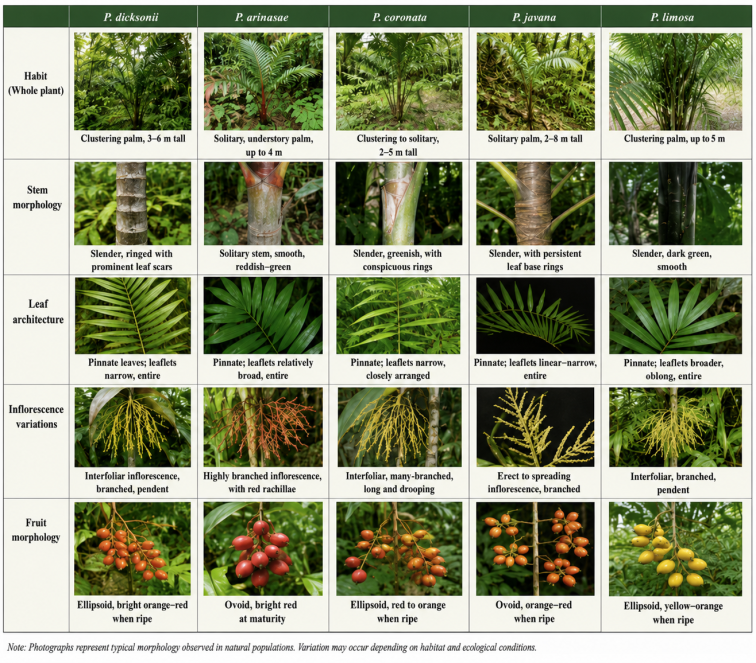
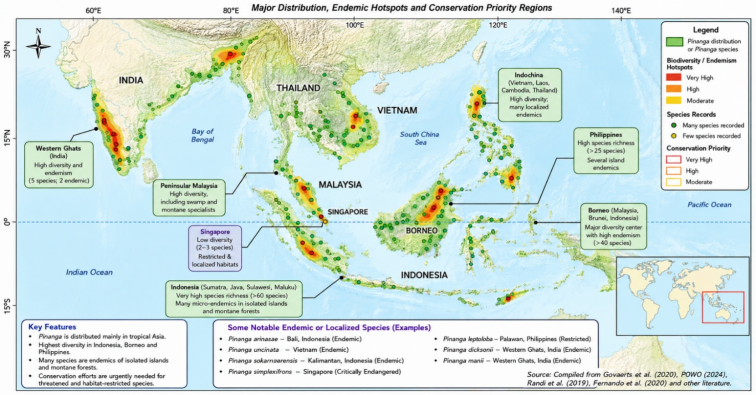
Palms are an important group of plants that grow in tropical and subtropical areas. They are not only significant for their beauty but also play a key role in providing food and raw materials for the economy. In 1839, a scientist named Blume introduced the genus Pinanga. While he described some new species, P. schwanerensis was described much later, and the precise timing of his descriptions of P. patula, P. salicifolia, and P. albescens in relation to the genus introduction is unclear from the available evidence. Later, more species, such as P. arinasae, P. javana, P. leonardcoi, and P. coronata, along with P. lepidota, P. salicifolia, P. mirabilis, P. chaiana, and P. veitchii, were added. There are also other species, such as P. gruezoi, P. samarana, P. limosa, P. riparia Ridley, P. auriculata Becc. var. merguensis Becc. and a new variety, P. auriculata Becc. var. leucocarpa and P. nuichuensis. These species grow in various places, such as Java, montane forests, and on islands such as Samar, Bucas Grande, Dinagat, and northeastern Mindanao in the Philippines, Vietnam, Malaysia, and many other parts of the world. In India, five species of Pinanga—P. dicksonii, P. gracilis, P. griffithii, P. manii, and P. sylvestris—exist, of which P. dicksonii and P. manii occur only in this region and are thus endemic to the region. A review article studied the karyomorphology of Pinanga species in Java and Bali, such as P. arinasae, P. javana, and P. coronata, and explored how their physical features and molecular characteristics are related. The present review further examines the complete chloroplast genome of the rare endemic species P. arinasae. Cytotoxic activity has also been reported for P. limosa, which is commonly referred to as P. puteri. In addition, microsatellite-based investigations have provided information on the molecular diversity of wild P. dicksonii (Roxb.) Blume populations occurring in the Western Ghats of Karnataka. Traditional uses and scientific studies highlight Pinanga as one of the most widely used genera in certain regions. Researchers have focused on identifying new species within this genus, underscoring its importance as a medicinal plant. This review provides an updated overview of the taxonomy and pharmacological aspects of the Pinanga genus.
| Published in | Journal of Diseases and Medicinal Plants (Volume 12, Issue 3) |
| DOI | 10.11648/j.jdmp.20261203.15 |
| Page(s) | 136-144 |
| Creative Commons |
This is an Open Access article, distributed under the terms of the Creative Commons Attribution 4.0 International License (http://creativecommons.org/licenses/by/4.0/), which permits unrestricted use, distribution and reproduction in any medium or format, provided the original work is properly cited. |
| Copyright |
Copyright © The Author(s), 2026. Published by Science Publishing Group |
Pinanga, Arecaceae, Taxonomy, Distribution, Pharmacological Studies, P. Dicksonii, P. Arinasae
Species | Extract | Bioactivity | Experimental Model | Key Findings |
|---|---|---|---|---|
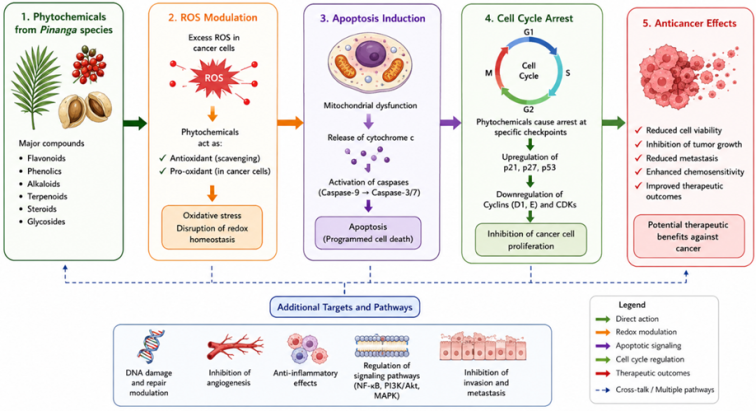
P. limosa | Methanol extract | Cytotoxic activity | MCF-7 cell line | Significant apoptosis induction |
P. dicksonii | Genomic DNA | Molecular diversity | SSR markers | High genetic polymorphism |
P. arinasae | Chloroplast genome | Phylogenetic analysis | cpDNA sequencing | Clarified evolutionary relationship |
ICUN | International Union for Conservation of Nature |
MCF-7 | Michigan Cancer Foundation-7 |
SSR | Simple Sequence Repeat |
cpDNA | Chloroplast DNA |
ITS | Internal Transcribed Spacer |
ISSR | Inter-Simple Sequence Repeat |
MTT | 3-(4, 5-Dimethylthiazol-2-yl)-2, 5-Diphenyltetrazolium Bromide |
IC50 | Half-maximal Inhibitory Concentration |
DOX | Doxorubicin |
SSR | Simple Sequence Repeat |
PIC | Polymorphic Information Content |
NTSYS-pc | Numerical Taxonomy and Multivariate Analysis System – Personal Computer |
UPGMA | Unweighted Pair Group Method With Arithmetic Mean |
| [1] | Abdullah, M. F., Md Jaafar, S., Ahmad, N., & Sukri, R. S. (2024). Tropical palms and factors influencing their distributions and diversity, with a focus on Pinanga diversity in Southeast Asia. BIOTROPIA, 31(2), 291-307. |
| [2] | Ang, W. F., Lok, A. F. S. L., & Tan, H. T. W. (2010). Rediscovery in Singapore of Pinanga simplicifrons (Miq.) Becc. (Arecaceae). Nature in Singapore, 3, 83-86. |
| [3] | Asih, S. N. P., Pratiwi, R. A., Prihatini, I., Kuswandi, P. C., Yulianti, E., & Priyadi, A. (2025). Comparative analysis of the complete chloroplast genome of the rare endemic palm Pinanga arinasae Witono from Bali, Indonesia. Turkish Journal of Botany, 49(5), 432-446. |
| [4] | Couvreur, T. L. P., Forest, F., & Baker, W. J. (2011). Origin and global diversification patterns of tropical rain forests: inferences from a complete genus-level phylogeny of palms. BMC Biology, 9, 44. |
| [5] | Dransfield, J., Uhl, N. W., Asmussen, C. B., Baker, W. J., Harley, M. M., & Lewis, C. E. (2008). Genera Palmarum: The Evolution and Classification of Palms. London: Royal Botanic Gardens, Kew. |
| [6] | Dransfield, J. (1980). Systematic notes on Pinanga (Palmae) in Borneo. Kew Bulletin, 34, 769-788. |
| [7] | Dransfield, J. (1974). Notes on the palm flora of Central Sumatra. Reinwardtia, 8, 519-531. |
| [8] | Fernando, E. S., Logatoc, E. L. R., Malabrigo, P. L., Jr., & Adorador, J. T. (2020). Pinanga lepidota (Arecaceae: Arecoideae), a new record for the Philippines from Palawan Island. Philippine Journal of Systematic Biology, 14(3), 1-6. |
| [9] | Govaerts, R., Dransfield, J., Zona, S., Hodel, D. R., & Henderson, A. (2020). World Checklist of Arecaceae. Royal Botanic Gardens, Kew. |
| [10] | Guan, S. L. (2024). Pinanga of Peninsular Malaysia and Singapore. Palms, 68(4), 160-203. |
| [11] | Haji Ramlan, N. S. (2020). The influence of soil properties on Pinanga palms at two contrasting Mixed Dipterocarp forests in Brunei Darussalam [desertation]. Universiti Brunei Darussalam. |
| [12] | Henderson, A., & Dung, N. Q. (2017). New species of Lanonia, Licuala and Pinanga (Arecaceae) from Vietnam. Phytotaxa, 323(2), 159-172. |
| [13] | Henderson, A., Ban, N. K., & Thanh, B. V. (2010). New species of Areca, Pinanga, and Licuala (Arecaceae) from Vietnam. Phytotaxa, 8(1), 34-40. |
| [14] | IUCN. (2024). The IUCN Red List of Threatened Species. Version 2024-1. |
| [15] | Jaganathan, G. K. (2021). Ecological insights into the coexistence of dormancy and desiccation-sensitivity in Arecaceae species. Annals of Forest Science, 78, 10. |
| [16] | Lim, J., Chong, R., Chia, Z., Jinying, T., & Foong, A. W. (2022). Biodiversity record: New locality record for the palm, Pinanga simplicifrons, in Singapore. Nature in Singapore, 15, e2022043. |
| [17] | Lim, C. K. (2005). Two new species of Pinanga Blume (Arecaceae) from Sarawak, Malaysia. Folia Malaysiana, 6(3-4), 73-82. |
| [18] | Loo, A. H. B., Ang, W. F., Baker, W. J., & Tan, H. T. W. (2014). A Guide to the Native Palms of Singapore. Singapore: Science Centre Singapore. |
| [19] | Madar, U., Thangadurai, D., Angadi, K. P., Sreekumar, V. B., & Sangeetha, J. (2019). Molecular diversity in wild populations of Pinanga dicksonii (Roxb.) Blume (Arecaceae) from Western Ghats of Karnataka using microsatellite markers. Scientific Bulletin Series F. Biotechnologies, 23, 49-56. |
| [20] | Magurran, A. E. (2017). The important challenge of quantifying tropical diversity. BMC Biology, 15, 14. |
| [21] | Mainasara, M. M., Bakar, M. A., & Linatoc, A. C. (2019). Cytotoxic activities of Pinanga limosa (Pinang Puteri) from Endau Rompin Johor, Malaysia. IOP Conference Series: Earth and Environmental Science, 269(1), 012027. |
| [22] | Mane, R. N., Lekhak, M. M., & Yadav, S. (2019). Lectotypification of Areca dicksonii Roxburgh (Arecaceae). Phytotaxa, 401(2), 146-148. |
| [23] | Mehmud, S., & Roy, H. (2021). Diversity and distribution of palms (Arecaceae) in Assam, India. Check List, 17(1), 69-93. |
| [24] | Nakamura, K., Noerdjito, W. A., & Hasyim, A. (1994). Regional difference and seasonality of rainfall in Java, with special reference to Bogor. Tropics, 4(1), 93-103. |
| [25] | Odufuwa, P. (2019). DNA barcoding of Pinanga (Arecaceae) of Borneo [Dissertation]. University of London. |
| [26] | Phengklai, C., Niyomdham, C., & Ueachirakan, W. (1991). Flora in Peat Swamp Areas of Narathiwat. Narathiwat, Thailand: Pikun Thong Royal Development Study Centre. |
| [27] | Plants of the World Online. (2024). Plants of the World Online. Royal Botanic Gardens, Kew. |
| [28] | Prance, G. T., Beentje, H., Dransfield, J., & Johns, R. (2000). The tropical flora remains undercollected. Annals of the Missouri Botanical Garden, 87(1), 67-71. |
| [29] | Raes, N., Roos, M. C., Slik, J. W. F., van Loon, E. E., & ter Steege, H. (2009). Botanical richness and endemicity patterns of Borneo derived from species distribution models. Ecography, 32, 180-192. |
| [30] | Randi, A., Hikmat, A., & Heatubun, C. D. (2019). Pinanga schwanerensis, a new species of Pinanga (Arecaceae) from Kalimantan, Indonesia. Phytotaxa, 402(2), 121-125. |
| [31] | Reichgelt, T., West, C. K., & Greenwood, D. R. (2018). The relation between global palm distribution and climate. Scientific Reports, 8, 4721. |
| [32] | Renuka, C., & Sreekumar, V. B. (2012). A Field Guide to the Palms of India. Kerala: Kerala Forest Research Institute. |
| [33] | Sutomo, S., Darma, I. D. P., Sujarwo, W., Priyadi, A., Kuswantoto, F., & Iryadi, R. (2018). Ecology of Bedugul Basin Bali. Bogor, Indonesia: SEAMEO BIOTROP. |
| [34] | Syahida-Emiza, S., Syazwani, A., Rafidah, A. R., Nor-Ezzawanis, A. T., & Ummul-Nazrah, A. R. (2018). Heart of Borneo: Exploring the Beauty of Long Banga. Conservation Malaysia. |
| [35] | Syauqina, M. Y., Meekiong, K., Aimi Syazana, S., & Miraadila, M. I. (2017). Diversity of palms in Dered Krian National Park, Bau. In: Meekiong, K., Azahari, O., Pungga, R. S., Wasli, M. E., Freddy, Y. K. S., & Marconi, S. J. (Eds.), Proceedings of Colloquium on the Dered Krian National Park—Scientific Expedition 2016. Kuching, Sarawak, pp. 15-19. |
| [36] | ter Steege, H., Henkel, T. W., Helal, N., Marimon, B. S., Marimon-Junior, B. H., Huth, A., et al. (2019). Rarity of monodominance in hyperdiverse Amazonian forests. Scientific Reports, 9, 13822. |
| [37] | Tissot, C., Chikhi, H., & Nayar, T. S. (1994). Pollen of Wet Evergreen Forests of the Western Ghats, India. Pondicherry: Institut Français de Pondichéry. |
| [38] | Vormisto, J., Svenning, J. C., Hall, P., & Balslev, H. (2004). Diversity and dominance in palm (Arecaceae) communities in terra firme forests in the western Amazon basin. Journal of Ecology, 92, 577-588. |
| [39] | Wahyuni, A. S., Prasetyo, L. B., & Zuhud, E. A. (2017). Population and distribution pattern of the Paliasa plant (Kleinhovia hospita L.) in Bontobahari District. Media Konservasi, 22(1), 11-18. |
| [40] | Witono, J. R., Mogea, J. P., & Somadikarta, S. (2002). Pinanga in Java and Bali. Palms, 46, 193-201. |
| [41] | Witono, J. R., Fijridiyanto, I. A., & Kondo, K. (2024). Karyomorphology of genus Pinanga (Arecaceae) in Java and Bali, Indonesia. Pakistan Journal of Botany, 56(1). |
| [42] | Wong, S. Y. (2023). Flora of Borneo: The vascular plant genera. Webbia, 78(2), 5-309. |
| [43] | Yao, G., Xue, B., Wang, W., Barrett, C., Liu, T. J., Rivas-Chamorro, M., et al. (2025). Pre-Miocene evolutionary dynamics of tropical rainforests from a dated phylogeny of the palm family. New Phytologist, 248, 968-983. |
| [44] | Zulkarnaen, R. N., Nisyawati, & Witono, J. R. (2020). The growth and distribution pattern of endemic Java palm (Pinanga javana Blume) in Mt. Slamet, Central Java, Indonesia. AIP Conference Proceedings, 2231(1), 040056. |
APA Style
Prasanna, P. M., Kandhasami, S. M., Selvaraj, P., Alagarmalai, J. (2026). Diversity and Medicinal Significance of the Genus Pinanga: A Review of Taxonomic and Pharmacological Studies. Journal of Diseases and Medicinal Plants, 12(3), 136-144. https://doi.org/10.11648/j.jdmp.20261203.15
ACS Style
Prasanna, P. M.; Kandhasami, S. M.; Selvaraj, P.; Alagarmalai, J. Diversity and Medicinal Significance of the Genus Pinanga: A Review of Taxonomic and Pharmacological Studies. J. Dis. Med. Plants 2026, 12(3), 136-144. doi: 10.11648/j.jdmp.20261203.15
@article{10.11648/j.jdmp.20261203.15,
  author = {Prajwal Mysore Prasanna and Shri Mathi Kandhasami and Premalatha Selvaraj and Jeyasankar Alagarmalai},
  title = {Diversity and Medicinal Significance of the Genus Pinanga: A Review of Taxonomic and Pharmacological Studies},
  journal = {Journal of Diseases and Medicinal Plants},
  volume = {12},
  number = {3},
  pages = {136-144},
  doi = {10.11648/j.jdmp.20261203.15},
  url = {https://doi.org/10.11648/j.jdmp.20261203.15},
  eprint = {https://article.sciencepublishinggroup.com/pdf/10.11648.j.jdmp.20261203.15},
  abstract = {Palms are an important group of plants that grow in tropical and subtropical areas. They are not only significant for their beauty but also play a key role in providing food and raw materials for the economy. In 1839, a scientist named Blume introduced the genus Pinanga. While he described some new species, P. schwanerensis was described much later, and the precise timing of his descriptions of P. patula, P. salicifolia, and P. albescens in relation to the genus introduction is unclear from the available evidence. Later, more species, such as P. arinasae, P. javana, P. leonardcoi, and P. coronata, along with P. lepidota, P. salicifolia, P. mirabilis, P. chaiana, and P. veitchii, were added. There are also other species, such as P. gruezoi, P. samarana, P. limosa, P. riparia Ridley, P. auriculata Becc. var. merguensis Becc. and a new variety, P. auriculata Becc. var. leucocarpa and P. nuichuensis. These species grow in various places, such as Java, montane forests, and on islands such as Samar, Bucas Grande, Dinagat, and northeastern Mindanao in the Philippines, Vietnam, Malaysia, and many other parts of the world. In India, five species of Pinanga—P. dicksonii, P. gracilis, P. griffithii, P. manii, and P. sylvestris—exist, of which P. dicksonii and P. manii occur only in this region and are thus endemic to the region. A review article studied the karyomorphology of Pinanga species in Java and Bali, such as P. arinasae, P. javana, and P. coronata, and explored how their physical features and molecular characteristics are related. The present review further examines the complete chloroplast genome of the rare endemic species P. arinasae. Cytotoxic activity has also been reported for P. limosa, which is commonly referred to as P. puteri. In addition, microsatellite-based investigations have provided information on the molecular diversity of wild P. dicksonii (Roxb.) Blume populations occurring in the Western Ghats of Karnataka. Traditional uses and scientific studies highlight Pinanga as one of the most widely used genera in certain regions. Researchers have focused on identifying new species within this genus, underscoring its importance as a medicinal plant. This review provides an updated overview of the taxonomy and pharmacological aspects of the Pinanga genus.},
 year = {2026}
}
TY  - JOUR
T1  - Diversity and Medicinal Significance of the Genus Pinanga: A Review of Taxonomic and Pharmacological Studies
AU  - Prajwal Mysore Prasanna
AU  - Shri Mathi Kandhasami
AU  - Premalatha Selvaraj
AU  - Jeyasankar Alagarmalai
Y1  - 2026/08/27
PY  - 2026
N1  - https://doi.org/10.11648/j.jdmp.20261203.15
DO  - 10.11648/j.jdmp.20261203.15
T2  - Journal of Diseases and Medicinal Plants
JF  - Journal of Diseases and Medicinal Plants
JO  - Journal of Diseases and Medicinal Plants
SP  - 136
EP  - 144
PB  - Science Publishing Group
SN  - 2469-8210
UR  - https://doi.org/10.11648/j.jdmp.20261203.15
AB  - Palms are an important group of plants that grow in tropical and subtropical areas. They are not only significant for their beauty but also play a key role in providing food and raw materials for the economy. In 1839, a scientist named Blume introduced the genus Pinanga. While he described some new species, P. schwanerensis was described much later, and the precise timing of his descriptions of P. patula, P. salicifolia, and P. albescens in relation to the genus introduction is unclear from the available evidence. Later, more species, such as P. arinasae, P. javana, P. leonardcoi, and P. coronata, along with P. lepidota, P. salicifolia, P. mirabilis, P. chaiana, and P. veitchii, were added. There are also other species, such as P. gruezoi, P. samarana, P. limosa, P. riparia Ridley, P. auriculata Becc. var. merguensis Becc. and a new variety, P. auriculata Becc. var. leucocarpa and P. nuichuensis. These species grow in various places, such as Java, montane forests, and on islands such as Samar, Bucas Grande, Dinagat, and northeastern Mindanao in the Philippines, Vietnam, Malaysia, and many other parts of the world. In India, five species of Pinanga—P. dicksonii, P. gracilis, P. griffithii, P. manii, and P. sylvestris—exist, of which P. dicksonii and P. manii occur only in this region and are thus endemic to the region. A review article studied the karyomorphology of Pinanga species in Java and Bali, such as P. arinasae, P. javana, and P. coronata, and explored how their physical features and molecular characteristics are related. The present review further examines the complete chloroplast genome of the rare endemic species P. arinasae. Cytotoxic activity has also been reported for P. limosa, which is commonly referred to as P. puteri. In addition, microsatellite-based investigations have provided information on the molecular diversity of wild P. dicksonii (Roxb.) Blume populations occurring in the Western Ghats of Karnataka. Traditional uses and scientific studies highlight Pinanga as one of the most widely used genera in certain regions. Researchers have focused on identifying new species within this genus, underscoring its importance as a medicinal plant. This review provides an updated overview of the taxonomy and pharmacological aspects of the Pinanga genus.
VL  - 12
IS  - 3
ER  -
Department of Botany, Government Arts College (Autonomous), Coimbatore, India
Department of Botany, Government Arts College (Autonomous), Coimbatore, India
Department of Botany, Government Arts College (Autonomous), Coimbatore, India
Department of Zoology, Government Arts College (Autonomous), Coimbatore, India

Information



 Share This Article
 Twitter
 Linked In
 Facebook
 Copy
Copy Download