
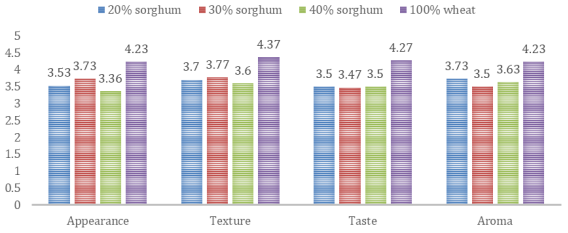
West Africa imports most of its wheat. Local grains such as sorghum could reduce this dependence on cereal products, but only if the resulting food still tastes acceptable. This study made wheat-sorghum composite vermicelli with sorghum flour grown in Togo and tested three incorporation levels for sensory acceptance, nutritional composition, mineral content, contaminant levels, and microbiological safety to identify the best incorporation level. Vermicelli was produced at 20%, 30%, and 40% sorghum flour, and compared against a 100% wheat control. Thirty untrained consumers scored the samples on a five-point hedonic scale. Moisture, protein, fat, fibre, carbohydrate, and energy content were measured alongside mineral profile, heavy metal levels, and microbiological quality, using standard analytical procedures. Among the sorghum blends, the 20% formulation scored highest with consumers: 3.50 for appearance, 3.67 for texture, 3.50 for taste, 3.68 for aroma. Nutritional value rose with sorghum content. The 40% formulation reached the highest protein (14.92%), fibre (1.45%), fat (13.07%), and energy (419.05 kcal/100 g). Iron more than doubled across the series, from 17.99 mg/kg in the wheat control to 38.05 mg/kg at 40% sorghum, while lead and cadmium stayed below detection limits and within Codex thresholds throughout. The 20% formulation — the one consumer preferred — also cleared microbiological screening: 50,633 CFU/g total mesophilic aerobic flora, 3,033 CFU/g moulds, and no Salmonella spp., E. coli, S. aureus, or sulphite-reducing anaerobes. Sorghum can replace up to 20% of the wheat in vermicelli without consumers noticing, while adding measurable nutritional value and staying within safety limits. That is a tested, practical route for reducing wheat imports in West African food systems.
| Published in | Journal of Food and Nutrition Sciences (Volume 14, Issue 5) |
| DOI | 10.11648/j.jfns.20261405.18 |
| Page(s) | 341-348 |
| Creative Commons |
This is an Open Access article, distributed under the terms of the Creative Commons Attribution 4.0 International License (http://creativecommons.org/licenses/by/4.0/), which permits unrestricted use, distribution and reproduction in any medium or format, provided the original work is properly cited. |
| Copyright |
Copyright © The Author(s), 2026. Published by Science Publishing Group |
Sorghum Flour, Composite Vermicelli, Nutritional Enhancement, Food Safety, West African Food Systems
Parameters | 20% sorghum | 30% sorghum | 40% sorghum | 100% wheat | P value (α = 0.05) |
|---|---|---|---|---|---|
Moisture (%) | 9.84 ± 0.18ᵇ | 10.25 ± 0.10ᵃ | 8.51 ± 0.14ᶜ | 10.00 ± 0.09ᵃᵇ | <0.001 |
Fat (%) | 6.62 ± 0.002ᵇ | 6.21 ± 0.002ᶜ | 13.07 ± 0.002ᵃ | 4.95 ± 0.069ᵈ | <0.001 |
Protein (%) | 13.34 ± 0.02ᶜ | 14.77 ± 0.02ᵃ | 14.92 ± 0.03ᵃ | 14.01 ± 0.16ᵇ | <0.001 |
Fibre (%) | 0.88 ± 0.02ᵇ | 1.08 ± 0.03ᵃ | 1.45 ± 0.10ᵃ | 0.71 ± 0.08ᵇ | <0.001 |
Carbohydrates (%) | 67.96 ± 0.16ᵇ | 66.21 ± 0.12ᶜ | 60.44 ± 0.08ᵈ | 69.48 ± 0.06ᵃ | <0.001 |
Energy (kcal/100 g) | 384.75 ± 0.72ᵇ | 379.82 ± 0.56ᶜ | 419.05 ± 0.21ᵃ | 378.50 ± 0.93ᵈ | < 0.001 |
Parameters | 20% sorghum | 30% sorghum | 40% sorghum | 100% wheat | P value (α = 0.05) |
|---|---|---|---|---|---|
Ash (%) | 1.367 ± 0.019ᶜ | 1.485 ± 0.009ᵇ | 1.614 ± 0.004ᵃ | 0.846 ± 0.010ᵈ | <0.001 |
Iron (mg/kg) | 31.13 ± 0.02ᶜ | 32.79 ± 0.03ᵇ | 38.05 ± 0.03ᵃ | 17.99 ± 0.02ᵈ | <0.001 |
Zinc (mg/kg) | 19.56 ± 0.03ᵇ | 18.15 ± 0.04ᶜ | 19.99 ± 0.03ᵃ | 9.97 ± 0.03ᵈ | <0.001 |
Calcium (mg/kg) | 496.26 ± 0.29ᵃ | 373.38 ± 0.20ᵈ | 463.21 ± 0.29ᵇ | 438.86 ± 0.30ᶜ | <0.001 |
Potassium (mg/kg) | 819.40 ± 1.21ᵈ | 932.33 ± 0.85ᶜ | 1439.73 ± 0.81ᵇ | 1761.10 ± 0.79ᵃ | <0.001 |
Sodium (mg/kg) | 121.07 ± 0.55ᶜ | 179.91 ± 0.20ᵇ | 239.49 ± 0.21ᵃ | 58.80 ± 0.36ᵈ | <0.001 |
Magnesium (mg/kg) | 212.53 ± 0.40ᵈ | 238.70 ± 0.85ᶜ | 280.71 ± 0.45ᵇ | 324.58 ± 0.61ᵃ | <0.001 |
Parameters | 20% sorghum | 30% sorghum | 40% sorghum | 100% wheat | Codex CXS 193-1995 |
|---|---|---|---|---|---|
Lead (µg/kg) | < 0.06 | < 0.06 | < 0.06 | < 0.06 | 0.2 mg/kg |
Cadmium (µg/kg) | < 0.006 | < 0.006 | < 0.006 | < 0.006 | 0.1 mg/kg |
Parameters microbiological | 20% sorghum (CFU/g) | 100% wheat (CFU/g) | Microbiological criteria (CFU/g) * |
|---|---|---|---|
Total Mesophilic Aerobic Flora (TMAF) | 50633±642.91 | < 10 | 105 |
Escherichia coli | < 10 | < 10 | 10 |
Staphylococcus aureus | < 100 | < 100 | 102 |
Sulfite-Reducing Anaerobic Bacteria (SRB) | < 10 | < 10 | 102 |
Mould | 3033±115.47 | < 10 | 104 |
Salmonella spp. | NS | NS | Absent |
ANOVA | Analysis of Variance |
CFU | Colony-Forming Units |
ISO | International Organization for Standardization |
AFNOR | French Standardization Association |
NF | French Standard |
| [1] | Abis S. Le ble au cœur des enjeux geostrategiques mondiaux. Herodote. 4 juin 2015; 156(1), 125‑37. |
| [2] | FAO, FIDA, OMS, PAM, UNICEF. L’Etat de la securite alimentaire et de la nutrition dans le monde 2019: Se premunir contre les ralentissements et les flechissements economiques. Vol. 2019. Rome. p. 229. |
| [3] | FAO E, ECA, CUA. Vue d’ensemble regionale de la securite alimentaire et la nutrition. 2020. |
| [4] | Hadjici L, Houche Z. Amelioration des qualites sensorielles et nutritionnelles des farines sans gluten, PhD Thesis, Universite Mouloud Mammeri, 2024, p. 78 |
| [5] | Aguiar EV, Santos FG, Queiroz VAV, Capriles VD. A Decade of Evidence of Sorghum Potential in the Development of Novel Food Products: Insights from a Bibliometric Analysis. Foods. 2023; 12(20), 3790. |
| [6] | Macauley H, Ramadjita T. Les cultures cerealières: riz, maïs, millet, sorgho et ble. Africa Rice. 2015, p. 38. |
| [7] | Taylor JRN, Schober TJ, Bean SR. Novel food and non-food uses for sorghum and millets. Journal of Cereal Science. 2006; 44(3), 252‑71. |
| [8] | Kebbab S, Ogal D. Contribution à l’etude des Caracteristiques physico-chimiques et technologiques des pâtes alimentaires issues des differents passages. Moulins Industriels du Sebaou (MIS) Tizi-Ouzou, PhD Thesis, Universite Mouloud Mammeri, 2015. |
| [9] | Scarton M, Clerici MTPS. Gluten-free pastas: ingredients and processing for technological and nutritional quality improvement. Food Sci Technol. 2022; 42: e65622. |
| [10] | Schober TJ, Messerschmidt M, Bean SR, Park SH, Arendt EK. Gluten-Free Bread from Sorghum: Quality Differences Among Hybrids. Cereal Chemistry. 2005; 82(4), 394‑404. |
| [11] | Agoura D, Mazabalo A, Gott’Liebe GM, Mamatchi M, Kokouvi AA, Tchadjobo T. Optimization of the Brewing of “Kable-Missine”, Togo Northern Local Sorghum Beer. International Journal of Scientific Research and Management (IJSRM). 2024; 12(09), 189‑94. |
| [12] | Gambogou B, Koukpere S, Bakoumle MM, Paka E, Ameyapoh Y. Impact of Microorganisms and Physicochemical Factors on Consumer Preferences for Tchakpalo. Journal of Food Quality. 2026; 2026(1), 4327211. |
| [13] | Kogno E, Soncy K, Taale E, Anani K, Karou SD, Ameyapoh Y. Molecular characterization of lactic acid bacteria involved in Togolese traditional fermented cereal foods. 2016, Vol. 04, Issue 02, pp. 2308-2312. |
| [14] | Marie-France B, Batcha O, Marie-Estelle KN. Physico-chemical and microbiological characterization of local beers of the city of Kara in Togo. International Journal of Innovation and Applied Studies. 2023; 41(1), 137‑44. |
| [15] | Novidzro KM, Melila M, Houndji BVS, Koudouvo K, Dotse K, Koumaglo KH. Etude de quelques caracteristiques physico-chimiques de «Tchoukoutou», un type de bières locales produit au Togo et evaluation de la performance de quatre methodes de determination du degre alcoolique. Int J Biol Chem Sci. 2018; 12(6), 2871‑84. |
| [16] | Bresciani A, Pagani MA, Marti A. Pasta-making process: A narrative review on the relation between process variables and pasta quality. Foods. 2022; 11(3), 256. |
| [17] | Cecchini C, Bresciani A, Menesatti P, Pagani MA, Marti A. Assessing the rheological properties of durum wheat semolina: A review. Foods. 2021; 10(12), 2947. |
| [18] | Mercier S, Mondor M, Moresoli C, Villeneuve S, Marcos B. Drying of Durum Wheat Pasta and Enriched Pasta: A Review of Modeling Approaches. Critical Reviews in Food Science and Nutrition. 2016; 56(7), 1146‑68. |
| [19] | Fakfare P. Influence of service attributes of food delivery application on customers’ satisfaction and their behavioural responses: The IPMA approach. International Journal of Gastronomy and Food Science. 2021; 25: 100392. |
| [20] | Lawless HT, Heymann H. Sensory Evaluation of Food: Principles and Practices. New York, NY: Springer; 2010. (Food Science Text Series). |
| [21] | Buchholz AL, Davidson GR, Ryser ET. Microbiology of Fresh and Processed Vegetables. In: Handbook of Vegetables and Vegetable Processing. John Wiley & Sons, 2024. pp. 159‑81. |
| [22] | Chillo S, Laverse J, Falcone PM, Del Nobile MA. Quality of spaghetti in base amaranthus wholemeal flour added with quinoa, broad bean and chick pea. Journal of Food Engineering. 2008; 84(1), 101‑7. |
| [23] | Mensah RT, Eklou-Lawson M, Gambogou B, Kangni-Dossou M, Ameyapoh Y. Acceptability of optimized fresh moringa oleifera and soymilk beverage. CyTA - Journal of Food. 31 dec 2025; 23(1), 2448491. |
| [24] | Sene M, Berger A, Catalayud C, Rios M, Bonicel J, Morel MH, et al. Construction du grain de sorgho: une feuille de route transcriptomique ciblant la teneur et digestibilite des proteines. In: Colloque Graines, INRAE. 2023. p. 1. |
| [25] | Tawaba JCB, Ba K, Destain J, Malumba P, Bera F, Thonart P. Vers une integration du sorgho comme matière première pour la brasserie moderne (synthèse bibliographique). Biotechnol Agron Soc Environ. 2013; 17(4), 622‑33. |
| [26] | Shahidi F, Zhong Y. Lipid oxidation and improving the oxidative stability. Chem Soc Rev. 2010; 39(11), 4067‑79. |
| [27] | Lúcio HG, Lopes R de CSO, Gomes MJC, da Silva A, Grancieri M, Della Lucia CM, et al. A Symbiotic Meal Containing Extruded Sorghum and Probiotic (Bifidobacterium longum) Ameliorated Intestinal Health Markers in Individuals with Chronic Kidney Disease: A Secondary Analysis of a Subsample from a Previous Randomized and Controlled Clinical Trial. Nutrients. 2024; 16(12), 1852. |
| [28] | Davidson VJ, Stockwell D. Food safety risk management: Evidence-Informed policies and decisions, considering multiple factors. Food Safety and Quality Series (FAO) eng no 4. 2017, 91p. |
| [29] | Dhingra D, Michael, M., Rajput, H., Patil R. T. Dietary fibre in foods: a review | Journal of Food Science and Technology. 2012. |
| [30] | Akomo P, Bahwere P, Murakami H, Banda C, Maganga E, Kathumba S, et al. Soya, maize and sorghum ready-to-use therapeutic foods are more effective in correcting anaemia and iron deficiency than the standard ready-to-use therapeutic food: randomized controlled trial. BMC Public Health. 2019; 19(1), 806. |
| [31] | Bonaventura P, Benedetti G, Albarède F, Miossec P. Zinc and its role in immunity and inflammation. Autoimmunity Reviews. 2015; 14(4), 277‑85. |
| [32] | Modern Food Microbiology. Food Protection with Chemicals, and by Biocontrol. In: Modern Food Microbiology. Boston, MA: Springer US; 2005. pp. 301‑50. (Food Science Text Series). |
| [33] | Pitt JI, Hocking AD. Fungi and Food Spoilage. Boston, MA: Springer US; 2009. |
| [34] | Eskola M, Kos G, Elliott CT, Hajšlová J, Mayar S, Krska R. Worldwide contamination of food-crops with mycotoxins: Validity of the widely cited ‘FAO estimate’ of 25%. Critical Reviews in Food Science and Nutrition. 2020; 60(16), 2773‑89. |
| [35] | Argudín MÁ, Mendoza MC, Rodicio MR. Food Poisoning and Staphylococcus aureus Enterotoxins. Toxins. 2010; 2(7), 1751‑73. |
| [36] | Eng SK, Pusparajah P, Ab Mutalib NS, Ser HL, Chan KG, Lee LH. Salmonella: A review on pathogenesis, epidemiology and antibiotic resistance. Frontiers in Life Science. 2015; 8(3), 284‑93. |
| [37] | Bintsis T. Foodborne pathogens. AIMSMICRO. 2017; 3(3), 529‑63. |
| [38] | Division de la securite alimentaire du Luxembourg. Critères microbiologiques applicables aux denrees alimentaires : lignes directrices pour l’interpretation. Direction de la Sante. 2015, p. 59. |
APA Style
Mensah, R. T., Gambogou, B., Sena, M. D., Anonwodji, A. M., Soumah, F. S., et al. (2026). Development and Quality Assessment of Sorghum-enriched Vermicelli: Nutritional, Sensory and Microbiological Evaluation. Journal of Food and Nutrition Sciences, 14(5), 341-348. https://doi.org/10.11648/j.jfns.20261405.18
ACS Style
Mensah, R. T.; Gambogou, B.; Sena, M. D.; Anonwodji, A. M.; Soumah, F. S., et al. Development and Quality Assessment of Sorghum-enriched Vermicelli: Nutritional, Sensory and Microbiological Evaluation. J. Food Nutr. Sci. 2026, 14(5), 341-348. doi: 10.11648/j.jfns.20261405.18
AMA Style
Mensah RT, Gambogou B, Sena MD, Anonwodji AM, Soumah FS, et al. Development and Quality Assessment of Sorghum-enriched Vermicelli: Nutritional, Sensory and Microbiological Evaluation. J Food Nutr Sci. 2026;14(5):341-348. doi: 10.11648/j.jfns.20261405.18
@article{10.11648/j.jfns.20261405.18,
  author = {Raouf Tonyi Mensah and Banfitebiyi Gambogou and Messan Donatien Sena and Akossiwa Mawusse Anonwodji and Fode Salifou Soumah and Abdoulaye Sankhon},
  title = {Development and Quality Assessment of
Sorghum-enriched Vermicelli: Nutritional, Sensory and Microbiological Evaluation},
  journal = {Journal of Food and Nutrition Sciences},
  volume = {14},
  number = {5},
  pages = {341-348},
  doi = {10.11648/j.jfns.20261405.18},
  url = {https://doi.org/10.11648/j.jfns.20261405.18},
  eprint = {https://article.sciencepublishinggroup.com/pdf/10.11648.j.jfns.20261405.18},
  abstract = {West Africa imports most of its wheat. Local grains such as sorghum could reduce this dependence on cereal products, but only if the resulting food still tastes acceptable. This study made wheat-sorghum composite vermicelli with sorghum flour grown in Togo and tested three incorporation levels for sensory acceptance, nutritional composition, mineral content, contaminant levels, and microbiological safety to identify the best incorporation level. Vermicelli was produced at 20%, 30%, and 40% sorghum flour, and compared against a 100% wheat control. Thirty untrained consumers scored the samples on a five-point hedonic scale. Moisture, protein, fat, fibre, carbohydrate, and energy content were measured alongside mineral profile, heavy metal levels, and microbiological quality, using standard analytical procedures. Among the sorghum blends, the 20% formulation scored highest with consumers: 3.50 for appearance, 3.67 for texture, 3.50 for taste, 3.68 for aroma. Nutritional value rose with sorghum content. The 40% formulation reached the highest protein (14.92%), fibre (1.45%), fat (13.07%), and energy (419.05 kcal/100 g). Iron more than doubled across the series, from 17.99 mg/kg in the wheat control to 38.05 mg/kg at 40% sorghum, while lead and cadmium stayed below detection limits and within Codex thresholds throughout. The 20% formulation — the one consumer preferred — also cleared microbiological screening: 50,633 CFU/g total mesophilic aerobic flora, 3,033 CFU/g moulds, and no Salmonella spp., E. coli, S. aureus, or sulphite-reducing anaerobes. Sorghum can replace up to 20% of the wheat in vermicelli without consumers noticing, while adding measurable nutritional value and staying within safety limits. That is a tested, practical route for reducing wheat imports in West African food systems.},
 year = {2026}
}
TY  - JOUR
T1  - Development and Quality Assessment of
Sorghum-enriched Vermicelli: Nutritional, Sensory and Microbiological Evaluation
AU  - Raouf Tonyi Mensah
AU  - Banfitebiyi Gambogou
AU  - Messan Donatien Sena
AU  - Akossiwa Mawusse Anonwodji
AU  - Fode Salifou Soumah
AU  - Abdoulaye Sankhon
Y1  - 2026/10/09
PY  - 2026
N1  - https://doi.org/10.11648/j.jfns.20261405.18
DO  - 10.11648/j.jfns.20261405.18
T2  - Journal of Food and Nutrition Sciences
JF  - Journal of Food and Nutrition Sciences
JO  - Journal of Food and Nutrition Sciences
SP  - 341
EP  - 348
PB  - Science Publishing Group
SN  - 2330-7293
UR  - https://doi.org/10.11648/j.jfns.20261405.18
AB  - West Africa imports most of its wheat. Local grains such as sorghum could reduce this dependence on cereal products, but only if the resulting food still tastes acceptable. This study made wheat-sorghum composite vermicelli with sorghum flour grown in Togo and tested three incorporation levels for sensory acceptance, nutritional composition, mineral content, contaminant levels, and microbiological safety to identify the best incorporation level. Vermicelli was produced at 20%, 30%, and 40% sorghum flour, and compared against a 100% wheat control. Thirty untrained consumers scored the samples on a five-point hedonic scale. Moisture, protein, fat, fibre, carbohydrate, and energy content were measured alongside mineral profile, heavy metal levels, and microbiological quality, using standard analytical procedures. Among the sorghum blends, the 20% formulation scored highest with consumers: 3.50 for appearance, 3.67 for texture, 3.50 for taste, 3.68 for aroma. Nutritional value rose with sorghum content. The 40% formulation reached the highest protein (14.92%), fibre (1.45%), fat (13.07%), and energy (419.05 kcal/100 g). Iron more than doubled across the series, from 17.99 mg/kg in the wheat control to 38.05 mg/kg at 40% sorghum, while lead and cadmium stayed below detection limits and within Codex thresholds throughout. The 20% formulation — the one consumer preferred — also cleared microbiological screening: 50,633 CFU/g total mesophilic aerobic flora, 3,033 CFU/g moulds, and no Salmonella spp., E. coli, S. aureus, or sulphite-reducing anaerobes. Sorghum can replace up to 20% of the wheat in vermicelli without consumers noticing, while adding measurable nutritional value and staying within safety limits. That is a tested, practical route for reducing wheat imports in West African food systems.
VL  - 14
IS  - 5
ER  -
Agrifood department, Institute for Research into Endogenous Technologies of Guinea (IRTEG), Kindia, Guinea;Scientific Directorate, Togolese Institute for Agricultural Research (ITRA), Lome, Togo

Information



 Share This Article
 Twitter
 Linked In
 Facebook
 Copy
Copy Download