
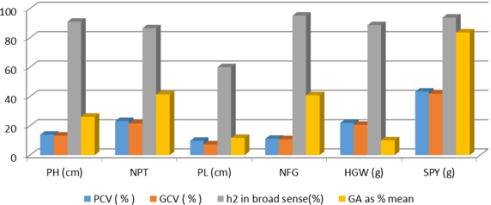
Rice is one of the most important staple food crops worldwide, and increasing its productivity is essential to meet the growing demand for food. Genetic variability and the identification of important yield-contributing traits play a crucial role in developing high-yielding rice varieties. The present study was undertaken to assess the genetic variability, heritability, genetic advance, correlation, and path coefficient of six quantitative traits in the F2 segregating population derived from the cross CO 51 × VGD 1. Genetic parameters, including genotypic coefficient of variation (GCV), phenotypic coefficient of variation (PCV), broad-sense heritability, and genetic advance as a percentage of the mean (GAM), were estimated to understand the nature and extent of genetic variation among the segregants. Among the traits evaluated, the number of productive tillers per plant and single plant yield exhibited high GCV and PCV, coupled with high heritability and genetic advance as a percentage of the mean, suggesting the predominance of additive gene effects and the potential for effective selection. Correlation analysis revealed a significant positive association between the number of productive tillers per plant and single plant yield. Furthermore, path coefficient analysis indicated a strong positive direct effect of productive tillers per plant on single plant yield. These findings suggest that the number of productive tillers per plant is an important yield-contributing trait and can serve as a reliable selection criterion for improving grain yield in rice. Overall, the study highlights the potential of the CO 51 × VGD 1 F2 population as a useful genetic resource for selecting superior segregants and developing high-yielding rice varieties.
| Published in | Journal of Plant Sciences (Volume 14, Issue 5) |
| DOI | 10.11648/j.jps.20261405.12 |
| Page(s) | 176-181 |
| Creative Commons |
This is an Open Access article, distributed under the terms of the Creative Commons Attribution 4.0 International License (http://creativecommons.org/licenses/by/4.0/), which permits unrestricted use, distribution and reproduction in any medium or format, provided the original work is properly cited. |
| Copyright |
Copyright © The Author(s), 2026. Published by Science Publishing Group |
Genetic Parameters, Selection, Additive Gene Action, F2 Segregant
Characters | Mean | Range | PCV (%) | GCV (%) | h2 in broad sense (%) | GA as% mean | |
|---|---|---|---|---|---|---|---|
Min | Max | ||||||
Plant height (cm) | 102.50 | 74.50 | 124.10 | 13.93 | 13.29 | 91.01 | 26.12 |
Number of productive tillers per plant | 24.02 | 13.00 | 34.00 | 23.23 | 21.61 | 86.53 | 41.42 |
Panicle length (cm) | 24.92 | 14.20 | 34.20 | 9.76 | 7.33 | 60.01 | 11.70 |
Number of filled grains per panicle | 143.27 | 104.00 | 226.00 | 11.13 | 10.83 | 95.16 | 40.81 |
Hundred grain grain weight (g) | 1.38 | 0.91 | 2.24 | 21.91 | 20.64 | 88.70 | 10.05 |
Single plant yield (g) | 21.06 | 9.20 | 41.10 | 43.30 | 41.93 | 93.79 | 83.66 |
Characters | PH | NPT | PL | NFG | HGW | SPY |
|---|---|---|---|---|---|---|
PH | 1.000 | - 0.075 | 0.431** | - 0.128 | - 0.107 | - 0.061 |
NPT | 1.000 | 0.372** | 0.228** | 0.177* | 0.614** | |
PL | 1.000 | 0.080 | 0.053 | 0.345** | ||
NFG | 1.000 | - 0.026 | 0.184* | |||
HGW | 1.000 | 0.093 | ||||
SPY | 1.000 |
Characters | PH | NPT | PL | NFG | HGW | SPY |
|---|---|---|---|---|---|---|
PH | 0.069 | -0.043 | 0.043 | -0.007 | 0.005 | 0.016 |
NPT | -0.005 | 0.571 | 0.037 | 0.012 | -0.008 | 0.614** |
PL | 0.030 | 0.213 | 0.099 | 0.004 | -0.003 | 0.345** |
NFG | -0.009 | 0.131 | 0.008 | 0.054 | 0.001 | 0.184* |
HGW | -0.007 | 0.101 | 0.005 | -0.001 | -0.005 | 0.093 |
F2 | Second Filial Generation |
GCV | Genotypic Coefficient of Variation |
PCV | Phenotypic Coefficient of Variation |
h2 | Broad-Sense Heritability |
GAM | Genetic Advance as Percentage of Mean |
SPY | Single Plant Yield |
PH | Plant Height |
NPT | Number of Productive Tillers per Plant |
PL | Panicle Length |
NFGP | Number of Filled Grains per Panicle |
HGW | Hundred-Grain Weight |
cm | Centimetre |
g | Gram |
kg | Kilogram |
ha | Hectare |
Mt | Million Tonnes |
| [1] | Darko, A. M., Danquah, E. O., Dormatey, R., Keteku, A. K., Frimpong, F., Adjah, K. L., Osei-Wusu, M. O., Ayamba, B. E., Ofosu, K. A., Dankwa, K. O. and Danquah, F. O., 2025. Global rice production: Current status, challenges, and future scenarios. In Rice Cultivation Under Abiotic Stress (pp. 3-21). |
| [2] | Patel, H. R., V. P. Patel, P. B. Patel, A. J. Rathod, and A. G. Pampaniya. 2018. Genetic variability, correlation and path analysis for grain yield and component traits in F3 segregating population of rice (Oryza sativa L). International Journal of Chemical Studies 6(2): 2327-2331. |
| [3] | INDIASTAT (2024-2025). Socio-Economic statistical information about India. |
| [4] | Aboyousef, M. I., Talha, I. A., Bahgt, M. M. and Ghidan, W. F., 2026. Genetic Behavior of Yield and Its Components in Early Generations to Select Promising New Rice Lines (Oryza sativa L.). Journal of Plant Production, 17(6), pp. 151-163. |
| [5] | Butardo Jr, V. M. and Sreenivasulu, N., 2018. Improving head rice yield and milling quality: state-of-the-art and future prospects. Rice grain quality: methods and protocols, pp. 1-18. |
| [6] | Ismaeel, M., S. M. Ali Shah, S. Suliman, A. Raza, and M. Anwar. 2019. Assessment of genetic variability, heterosis and heritability for morphological parameters in rice. " Pure and Applied Biology (PAB) 8(1): 160-168. |
| [7] | Sathishkumar, R., Gnanamalar, R. P., Suresh, R., Anand, G. and Vellaikumar, S., 2020. Genetic variability, correlation and path coefficient studies in F2 generation of short slender aromatic and medium slender non-aromatic rice (Oryza sativa L). Electronic Journal of Plant Breeding, 11(2), pp. 505-510. |
| [8] | Dhurai, S. Y, D. Mohan Reddy, and S. Ravi. 2016. Correlation and path analysis for yield and quality characters in rice (Oryza sativa L.). Rice Genomics and Genetics 7(4): 105-114. |
| [9] | Bagudam, R., K. B. Eswari, J. Badri, and P. Raghuveer Rao. 2018. Correlation and path analysis for yield and its component traits in NPT core set of rice (Oryza sativa L). Int. J. Curr. Microbiol. App. Sci. 7(9): 97-108. |
| [10] | Ray, S. R., Rasul, M. G., Saikat, M. H., Ahmed, J. U. and Islam, A. A., 2026. Estimates of Genetic Variability and Boxplot Analyses in F2 Populations of Rice (Oryza sativa L) for Yield-Related Traits. Vietnam Journal of Agricultural Sciences, 9(1), pp. 2846-2855. |
| [11] | Tohid, M., Wazuddin, M., Mahmud, E., Morshed, N. M. and Rani, R., 2026. Genetic Variability, Inbreeding Depression, and Inheritance Pattern in F₃ Segregating Generations of Ten Exotic Hybrid Rice in Bangladesh. Journal of Agroforestry and Environment, 19(1), pp. 85-95. |
| [12] | Parari, T. Y., Karamang, S., Dare, D. and Putri, S. S., 2026, April. Genetic Diversity, Heritability, and Correlation Between Yield Components of the F3 Lines of the New Red Rice Type. In IOP Conference Series: Earth and Environmental Science (Vol. 1614, No. 1, p. 012009). IOP Publishing. |
| [13] | Khandappagol, M., M. P. Rajanna, and S. K. Savita. 2019. Variability and frequency distribution studies in F2 population of two crosses involving traditional varieties of rice (Oryza sativa L). Journal of Pharmacognosy and Phytochemistry 8(1): 1630-1634. |
| [14] | Priyanka, A. R., R. P. Gnanamalar, S. Banumathy, N. Senthil, and G. Hemalatha. 2019. segregating generation of rice. Electronic Journal of Plant Breeding 10(3): 988-994. |
| [15] | Haleem, A., Hassan, G., Iqbal, A., Khan, F. U., Sajid, M., Ahmad, F., Khan, R. U. and Ilyas, M., 2022. Genetic variability and correlation analysis in F2 wheat populations. |
| [16] | Vignesh, S., Kalaiyarasi, R., Devi, S. M., Joel, A. J., Raveendran, M., Pushpa, R., Pushpam, R., Bama, K. S., Swamy, M. R., Manonmani, S. and Ramalingam Suresh, N. S., 2025. Genetic variability, association and path analysis in the F2 population of rice (Oryza sativa L). Plant Sci. Today, 12, pp. 1-8. |
| [17] | Sarkar, S., Sarkar, J., Shil, P., Yonzon, B. T., Limboo, S. and Roy, S. C., 2025. Study of genetic variation related to yield attributing traits in F2: 3 rice segregating populations developed through interspecific hybridization. Tropical Plant Biology, 18(1), p. 69. |
| [18] | Perves, M., Hasibuzzaman, A. S. M., Hasan, R., Emon, M. M. H., Chowdhory, M., Haque, M. S., Hasan, A., Ahamad, I., Khanam, S. and Begum, S. N., 2025. Exploring phenotypic variability in quantitative and qualitative traits in F2 population of local red rice. Reproduction and Breeding, 5(4), pp. 202-213. |
| [19] | Agarwal, A. K., Chakraborty, M., Verma, N., Prasad, K., Pande, A., Barnwal, M. K., Panda, S., Mishra, S. K. and Mishra, D. K., 2025. Genetic variability and trait relationships in M2F2 rice population derived from combined chemical mutagenesis. |
| [20] | Nanda, K., Bastia, D. N. and Nanda, A., 2019. Character association and path coefficient analysis for yield and its component traits in slender grain rice (Oryza sativa L.). 963-969. |
| [21] | Manojkumar, D., Srinivas, T., Rao, L. S., Suneetha, Y., Sundaram, R. M. and Kumari, V. P., 2022. Study of genetic variability and trait associations in F2 Population of YH3 x AKDRMS 21-54 intra-specific cross of rice. The Pharma Innovation Journal, 11(9), pp. 1735-1742. |
APA Style
Sathishkumar, R., Gnanamalar, R. P. (2026). Studies on Genetic Variability, Correlation and Path Coefficient Analysis in F2 Derivatives of Co 51 × VGD 1 for Yield and Yield Component Traits in Rice (Oryza Sativa L.). Journal of Plant Sciences, 14(5), 176-181. https://doi.org/10.11648/j.jps.20261405.12
ACS Style
Sathishkumar, R.; Gnanamalar, R. P. Studies on Genetic Variability, Correlation and Path Coefficient Analysis in F2 Derivatives of Co 51 × VGD 1 for Yield and Yield Component Traits in Rice (Oryza Sativa L.). J. Plant Sci. 2026, 14(5), 176-181. doi: 10.11648/j.jps.20261405.12
@article{10.11648/j.jps.20261405.12,
  author = {R. Sathishkumar and R. P. Gnanamalar},
  title = {Studies on Genetic Variability, Correlation and Path Coefficient Analysis in F2 Derivatives of Co 51 × VGD 1 for Yield and Yield Component Traits in Rice (Oryza Sativa L.)},
  journal = {Journal of Plant Sciences},
  volume = {14},
  number = {5},
  pages = {176-181},
  doi = {10.11648/j.jps.20261405.12},
  url = {https://doi.org/10.11648/j.jps.20261405.12},
  eprint = {https://article.sciencepublishinggroup.com/pdf/10.11648.j.jps.20261405.12},
  abstract = {Rice is one of the most important staple food crops worldwide, and increasing its productivity is essential to meet the growing demand for food. Genetic variability and the identification of important yield-contributing traits play a crucial role in developing high-yielding rice varieties. The present study was undertaken to assess the genetic variability, heritability, genetic advance, correlation, and path coefficient of six quantitative traits in the F2 segregating population derived from the cross CO 51 × VGD 1. Genetic parameters, including genotypic coefficient of variation (GCV), phenotypic coefficient of variation (PCV), broad-sense heritability, and genetic advance as a percentage of the mean (GAM), were estimated to understand the nature and extent of genetic variation among the segregants. Among the traits evaluated, the number of productive tillers per plant and single plant yield exhibited high GCV and PCV, coupled with high heritability and genetic advance as a percentage of the mean, suggesting the predominance of additive gene effects and the potential for effective selection. Correlation analysis revealed a significant positive association between the number of productive tillers per plant and single plant yield. Furthermore, path coefficient analysis indicated a strong positive direct effect of productive tillers per plant on single plant yield. These findings suggest that the number of productive tillers per plant is an important yield-contributing trait and can serve as a reliable selection criterion for improving grain yield in rice. Overall, the study highlights the potential of the CO 51 × VGD 1 F2 population as a useful genetic resource for selecting superior segregants and developing high-yielding rice varieties.},
 year = {2026}
}
TY  - JOUR
T1  - Studies on Genetic Variability, Correlation and Path Coefficient Analysis in F2 Derivatives of Co 51 × VGD 1 for Yield and Yield Component Traits in Rice (Oryza Sativa L.)
AU  - R. Sathishkumar
AU  - R. P. Gnanamalar
Y1  - 2026/11/19
PY  - 2026
N1  - https://doi.org/10.11648/j.jps.20261405.12
DO  - 10.11648/j.jps.20261405.12
T2  - Journal of Plant Sciences
JF  - Journal of Plant Sciences
JO  - Journal of Plant Sciences
SP  - 176
EP  - 181
PB  - Science Publishing Group
SN  - 2331-0731
UR  - https://doi.org/10.11648/j.jps.20261405.12
AB  - Rice is one of the most important staple food crops worldwide, and increasing its productivity is essential to meet the growing demand for food. Genetic variability and the identification of important yield-contributing traits play a crucial role in developing high-yielding rice varieties. The present study was undertaken to assess the genetic variability, heritability, genetic advance, correlation, and path coefficient of six quantitative traits in the F2 segregating population derived from the cross CO 51 × VGD 1. Genetic parameters, including genotypic coefficient of variation (GCV), phenotypic coefficient of variation (PCV), broad-sense heritability, and genetic advance as a percentage of the mean (GAM), were estimated to understand the nature and extent of genetic variation among the segregants. Among the traits evaluated, the number of productive tillers per plant and single plant yield exhibited high GCV and PCV, coupled with high heritability and genetic advance as a percentage of the mean, suggesting the predominance of additive gene effects and the potential for effective selection. Correlation analysis revealed a significant positive association between the number of productive tillers per plant and single plant yield. Furthermore, path coefficient analysis indicated a strong positive direct effect of productive tillers per plant on single plant yield. These findings suggest that the number of productive tillers per plant is an important yield-contributing trait and can serve as a reliable selection criterion for improving grain yield in rice. Overall, the study highlights the potential of the CO 51 × VGD 1 F2 population as a useful genetic resource for selecting superior segregants and developing high-yielding rice varieties.
VL  - 14
IS  - 5
ER  -
Department of Plant Breeding and Genetics, Tamil Nadu Agricultural University, Madurai, India

Information



 Share This Article
 Twitter
 Linked In
 Facebook

 Copy
 Download