
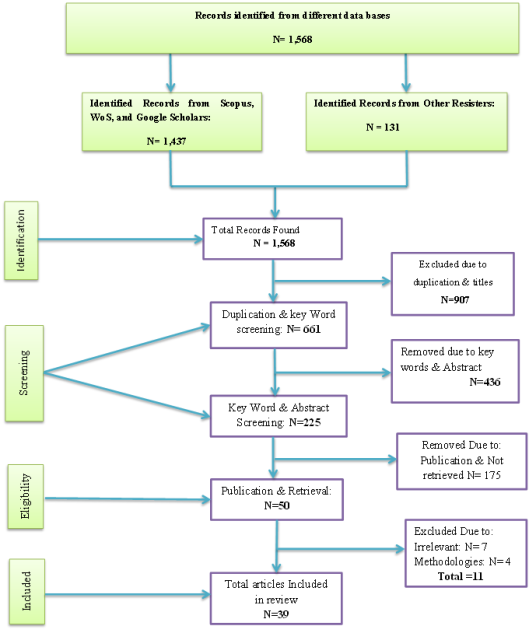
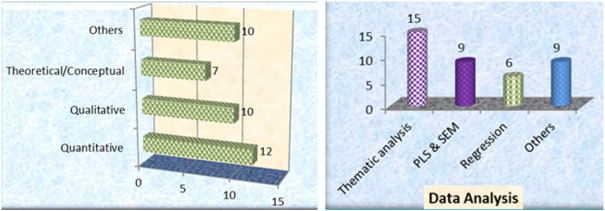
The main purpose of this systematic review is to examine the empirical findings with regard to global supply chain management and resilience. The review focuses on identifying insights and empirical findings, theoretical foundations used, the methodologies employed and the existing gaps and possible future recommendations in the topic areas. The researcher used screening criteria as per the PRISMA guide lines to select articles from reputable databases. A total of 39 articles were meet the selection criteria used to identifies the relevant and quality studies to be reviewed. Descriptive and thematic analysis was used to in this review to review the articles qualitatively. The review result shows dynamic capability and resource based view was the most frequently utilized theory in the reviewed articles; methodologically majority of the studies employed quantitative and qualitative approaches separately; PLS-SEM, SEM and regression analysis were the dominant data analysis methods applied in the study and finally lack of theoretical integration studies, lack of longitudinal studies, lack of standardized scales, limited mixed studies and geographically concentrations, and exploring newly emerging topics are some of the major gaps identified in the reviewed paper. The researcher recommended that organizations should develop balanced resilience capability portfolios that include redundancy, flexibility, visibility, and collaboration rather than relying on any single approach and also supply chain relationships should be managed as strategic assets that provide resilience benefits beyond operational performance.
| Published in | Research and Innovation (Volume 2, Issue 4) |
| DOI | 10.11648/j.ri.20260204.13 |
| Page(s) | 257-273 |
| Creative Commons |
This is an Open Access article, distributed under the terms of the Creative Commons Attribution 4.0 International License (http://creativecommons.org/licenses/by/4.0/), which permits unrestricted use, distribution and reproduction in any medium or format, provided the original work is properly cited. |
| Copyright |
Copyright © The Author(s), 2026. Published by Science Publishing Group |
Supply Chain Management, Supply Chain Resilience, Supply Chain, Resilience, Global Supply Chain, Systematic Literature Review
No | Authors | Title Research | Research design | Data analysis | Finding of the study | Journals | Country |
|---|---|---|---|---|---|---|---|
1 | [1] | Supply chain resilience: an adaptive cycle approach | Theoretical | Thematic analysis | The adaptive cycle idea can expand our comprehension of SCRes beyond specific scales, incorporating resilience across various scales. Adaptive cycles might also provide us with fresh perspectives on the types of skills needed to prevent stagnation and foster system renewal as resilience fluctuates over time | The international journals of logistics Mgt | USA |
2 | [2] | Enhancing resilience and sustainable healthcare supply chains: integrating circular economy and dynamic barrier management | Conceptual | Thematic analysis | The study investigated the role of dynamic risk Mgt in mitigating significant product shortages and enhancing the resilience and sustainability of healthcare supply chains. | Discover Sustainability | Multiple |
3 | [3] | Achieving resilience through knowledge management practices and risk management culture in agri-food supply chains | Quantitative | SEM | This study fills the existing knowledge gap in earlier research using an empirical framework exploring the connection between SC risk, KM, RMC, and SCRes within the Australian agri-food supply chains. | Supply Chain Mgt: An International Journal | Multiple |
4 | [4] | The impact of supply chain transparency and SCR on supply chain risk management: a moderation effect modelling | Quantitative | PLS-SEM | The findings indicated that the proposed r/ships were statistically significant, and all connections were positive. | Supply Chain Mgt: An International Journal | Multiple |
5 | [5] | Artificial intelligence driven innovation for enhancing SCR and performance under the effect of supply chain dynamism: an empirical investigation | Quantitative | SEM | Our results indicate that although AI directly influences SC performance in the short run, it is advisable to use its information processing abilities to develop SCR for enduring SC performance. | Annals of Operation Research | Multiple |
6 | [6] | Exploring the interplay b/n green practices, resilience, and viability in SC: a systematic literature review | Systematic review | Thematic analysis | The research uncovered commonly used eco-friendly practices and examined their influence on supply chain robustness and sustainable outcomes. | Logistics | Moroco |
7 | [7] | Flexibility in enhancing SC resilience: developing a resilience capability portfolio in the event of severe disruption | Mixed method | Thematic analysis | The findings indicated that using resilience strategies by themselves does not effectively improve SCP, whereas combining resilience strategies with the elimination of risk factors does enhance SCP. | Global Journal of Flexible Systems Mgt | Bangladesh |
8 | [9] | Supply chain resilience for managing the ripple effect in Industry 4.0 for green product diffusion | Simulation experiments | Mathematical Modeling | The adoption trends following the Bass model, alongside recovery speed and production on AM during the disruption period, indicate that trade-off choices exist among different combinations of I&PP strategies and information-sharing | IJ of Physical Distribution & Logistics Mgt | Multiple |
9 | [10] | The 4Rs supply chain resilience framework: a capability perspective | Qualitative | Thematic analysis | The research results reveal four distinct abilities referred to as the 4Rs: retooling, repurposing, recalibrating, and reconfiguring. Thus, the research offers a conceptual model of operational resilience to comprehend how production transition can be realized | Journal of contingencies and Crisis mgt | Multiple |
10 | [11] | Sustainable supply chain management - a key to resilience in the global pandemic | Quantitative | OLS Regression | Purchasing firms' SSCM efforts positively influence their SCRES. The harm caused by unforeseen supply chain interruptions is less severe when firms possess elevated SSCM levels and greater experience with it. | Supply Chain Mgt: An International Journal | Germany |
11 | [12] | Exploring supply chain and regional resilience through the analysis of the transport dimension | Quantitative | Panel data Regression | They have created an index that assesses regional supply chain resilience by analyzing transportation activities across various dimensions | Case Studies on Transport Policy | Spain |
12 | [13] | Achieving supply chain resilience in an era of disruptions: a configuration approach of capacities and strategies | Qualitative | Comparative analysis | The results show various SCR strategy setups viewed through absorptive, reactive, and restorative capabilities to attain resilience. | Supply Chain Mgt: An International Journal | Italy |
13 | [14] | Supply chain resilience: a review from the inventory management perspective | Systematic review | Thematic analysis | This article offers an extensive literature review on inventory management techniques to improve SCM, including stockpiling, multi-sourcing, capacity reservation, and adaptable supply contracts. | Fundamental Research | China |
14 | [15] | Building resilient and sustainable supply chains: a distributed ledger-based learning feedback loop | Qualitative | Thematic analysis | The research introduces the DLT- LFL framework, merging sensing, decision-making, adaptation, and predictive learning from decentralized operational data, enabling SC to more effectively foresee disruptions, modify processes in real-time, and consistently enhance resilience and sustainable practices. | Sustainability | Multiple |
15 | [17] | Neo-institutionalism in supply chain management: from supply chain susceptibility to SCR | Conceptual review | Theoretical synthesis | This study examines the present situational significance to gain insights into the diverse and systematic ways in which logics impact both SC vulnerability and SC robustness. They formulate six propositions regarding how complexity can be lowered for SC vulnerability | Management Research Review | Multiple |
16 | [18] | Resilience in global SC: analysis of responses, recovery actions and strategic changes triggered by major disruptions | Qualitative | Thematic analysis | Our research indicates that the occurrence of persistent and regular disruptions becoming the new operating environment for global supply chains is leading to a secondary transformation at the organizational level | Supply Chain Mgt: An International Journal | Multiple |
17 | [19] | Blockchain in supply chain mgt: a comprehensive review of success measurement methods | Systematic Review | Thematic analysis | Our results highlight the widespread relevance of blockchain technology across multiple industries, connecting both operational and strategic goals. | Management Review Quarterly | Germany |
18 | [20] | From SCR to supply chain disruption orientation: the moderating role of supply chain complexity | Quantitative | SEM | The findings indicated that SCR notably mediated the connection b/n SCR enablers and the orientation towards SC disruption. Moreover, SC complexity positively influenced the enablers of supply chain resilience and the overall supply chain resilience | Journal of Enterprise Information Management | Multiple |
19 | [21] | How firm level responsiveness influences supply chain network resilience | Systematic Review | Thematic Analysis | Our examination indicates that changes in processes and structures at the organizational level are essential factors that affect resilience. | Journal of Physical Distribution & Logistics mgt | USA |
20 | [22] | An integrated model of supply chain resilience considering supply and demand uncertainties | Conceptual | Framework development | The outcomes of computational experiments illustrate methods to manage uncertainty via adaptability and redundancy. | International Transactions in OR | Multiple |
21 | [23] | Enhancing resilience in logistics: the role of HR-SCM practices and AI technology readiness | Quantitative | PLS-SEM | The results suggest that organizational resilience, supported by robust human resource practices and artificial intelligence integration is essential for sustaining long-term resilience and competitive advantage amid global disruptions. | International Journal of IS and SCM | Multiple |
22 | [24] | Sustainable supply chain and organizational resilience: evidence from China | Quantitative | Regression Analysis | The finding show a positive r/ship b/n the level of sustainability of the SC network nearby a company and its organizational resilience, as enhanced risk resistance and adaptability allow companies to better utilize sustainable SC to boost their resilience | Accounting and Finance | China |
23 | [25] | Resilience in supply chain risk management in disruptive world: rerouting research directions during and after pandemic | Bibliographic Review | Thematic analysis | Through the examination of articles released since 2020, this study observed a shift in research focus regarding SC risk and resilience, pinpointing three additional titles that were not previously identified as separate areas. | Annals of Operation research | Multiple |
24 | [26] | Enhancing supply chain resilience through industry specific approaches to mitigating disruptions | Conceptual review | Theoretical synthesis | This research scrutinizes the adaptive strategies and resilience processes employed by businesses across different sectors to handle risks and ensure continuous operations. | OPSEARCH | India |
25 | [27] | The effect of SCR strategies on operational performance of humanitarian organizations in Zimbabwe during the Coronavirus period | Mixed approach | SEM | The study results indicates that strategies SCR positively influenced operative performance in humanitarian organizations throughout the Coronavirus period | Cogent Business & Management | Zimbabwe |
26 | [28] | Unraveling the resilience strategies for supply chain network designs | Quantitative | Both Factor & Comparative analysis | Results indicate that distributed SC show greater correlations with 14 of the resilience indicators. | Supply Chain Mgt: An International Journal | Multiple |
27 | [29] | New normal, new norms: towards sustainable and resilient global logistics and supply chain management | Conceptual review | Theoretical synthesis | This consolidates original and significant studies that reconsider the future of GLSC, explores its continuous evolution, analyzes the changing terrain of management research within this field, and recognizes new paradigms, methods, and frameworks that are facilitating the shift | Transportation Research Part E | Multiple |
28 | [30] | Resilience of global supply chains with logistics service uncertainty: on shoring versus offshoring strategy | Simulation | Mathematical modeling | This study examined the relationship between shoring strategies and logistics service networks amid uncertainty and their joint effect on SCR | Transportation Research Part E | Multiple |
29 | [31] | Building sustainable SCR through digitalization and circular practices: evidence from emerging economies | Quantitative | SEM | The results emphasize the significance of cohesive digital and circular policy structures for boosting resilience and promoting sustainable growth in developing economies | Sustainability | Multiple |
30 | [32] | Nurturing family business resilience through strategic supply chain management | Qualitative | Thematic analysis | This study demonstrates how elements like the focus on quality products & services by family firms aid in reaching non-economic goals that owners pursue to balance family and business demands, generating inherent added value for the organization | Journal of Family Business Management | Multiple |
31 | [33] | Developing supply chain resilience through integration: An empirical study on an e-commerce platform | Quantitative | Regression | The findings improve existing knowledge regarding the elements that lead to the creation of SCR and indicate that the connection b/n mixture and resilience must be explored within a contingency framework. | Journal of Operations Management | China |
32 | [34] | The role of SCR and absorptive capacity in the r/ship b/n marketing SC Mgt alignment and firm performance: a moderated mediation analysis | Quantitative | Regression | The alignment capabilities b/n marketing and SCM has a clear direct effect on SC responsiveness, which subsequently plays a crucial indirect role in firm performance | Journal of Business & Industrial Marketing | Saudi Arabia |
33 | [35] | Enhancing Supply Chain Resilience Through a Fuzzy AHP and TOPSIS to Mitigate Transportation Disruption | Qualitative | Thematic analysis | The results indicated that in manufacturing SC, the greatest danger was linked to travel time, and the most efficient way to reduce it was identified as enhancing highway networks. | Sustainability | Multiple |
34 | [36] | The influence of global value chain governance on supply network resilience | Qualitative | Thematic analysis | The finding revealed at the network level, governance r/ships based on market and relational factors resulted in increased vulnerabilities during COVID-19 when contrasted with hierarchical and modular governance relationships. | Supply Chain Mgt: An International Journal | Multiple |
35 | [37] | Enhancing sustainable global SC performance: a multi-criteria decision-making-based approach to industry 4.0 and AI integration | Qualitative | Thematic analysis | Findings indicate that monitoring and reducing emissions, along with energy efficiency, are paramount in the environmental aspect, whereas SC traceability and intelligent inventory mgt lead in the operational sector. | Sustainability | Multiple |
36 | [38] | Understanding the r/ships b/n global SC risk and supply chain resilience: the role of mitigating strategies | Quantitative | SEM | Enhancing supply Chain capability serves as a key mediating factor between SC risks and resilience, with the connections hinging on the effectiveness of seven mitigating strategies | Supply Chain Mgt: An International Journal | Multiple |
37 | [39] | Supply chain capability and performance under environmental uncertainty: the mediating role of multidimensional resilience | Quantitative | SEM | The study discovered that resilience, which includes absorptive, reactive, and recovery capability, notably mediates the link b/n SC capability and performance. | Systems | China |
38 | [40] | Two perspectives on supply chain resilience | Theoretical | Theoretical synthesis | It recognizes that supply chains must evolve over time to stay relevant, necessitating that managers focus on adaptability and transformability, while anticipating and shaping changes that happen outside the supply chain | Journal of Business Logistics | Multiple |
39 | [41] | Exploring the mechanism of how the market-based allocation of data elements affects the supply chain resilience of manufacturing enterprises: a perspective on data as a production factor | Quantitative | Regression | The results indicated that marketization of data factors greatly improves the resilience of SC in manufacturing firms, as verified through thorough robustness assessments. Mechanism analysis shows that the marketization of data factors enhances resilience by lowering information asymmetries, increasing Mgt efficiency, reducing reliance on SC, and improving financing within the supply chain | Sustainable | China |
List Journals | No of Articles Reviewed | Percentage |
|---|---|---|
Supply chain mgt: an international journal | 8 | 21% |
Sustainability | 5 | 13% |
Transportation research part E | 2 | 5% |
International journal of physical distribution & logistics mgt | 2 | 5% |
Systems | 1 | 3% |
Opsearch | 1 | 3% |
Operation management research | 1 | 3% |
Management review quarterly | 1 | 3% |
Management research review | 1 | 3% |
Logistics | 1 | 3% |
Journals of operation mgt | 1 | 3% |
Journal of supply chain management | 1 | 3% |
Journal of family business mgt | 1 | 3% |
Journal of enterprise and international mgt | 1 | 3% |
Journal of business & industrial marketing | 1 | 3% |
International transactions in operational research | 1 | 3% |
International journal of production research | 1 | 3% |
International journal of information systems & scm | 1 | 3% |
International journal logistics mgt | 1 | 3% |
Global of flexible systems mgt | 1 | 3% |
Discover sustainability | 1 | 3% |
Cogent business and management | 1 | 3% |
Case studies on transport policy | 1 | 3% |
Annals of operation research | 1 | 3% |
Accounting and finance | 1 | 3% |
Annals of operation research | 1 | 3% |
Total | 39 | 100 |
SC | Supply Chain |
SCR | Supply Chain Resilience |
RBv | Resource Based View |
KBV | Knowledge Based View |
SCP | Supply Chain Performance |
SCM | Supply Chain Management |
SEM | Structural Equation Modeling |
PLS | Partial List Square |
| [1] | Adobor, H. (2020). Supply chain resilience: an adaptive cycle approach. The International Journal of Logistics Management, 31(3), 443-463. |
| [2] | Alfina, K. N., Ratnayake, R. M. C., Wibisono, D., Basri, M. H., & Mulyono, N. B. (2025). Enhancing resilience and sustainable healthcare supply chains: integrating circular economy and dynamic barrier management. Discover Sustainability, 6(1). |
| [3] | Ali, I., Golgeci, I., & Arslan, A. (2021). Achieving resilience through knowledge management practices and risk management culture in agri-food supply chains. Supply Chain Management an International Journal, 28(2), 284-299. |
| [4] | Al-Khatib, A. W. (2025). The impact of supply chain transparency and supply chain resilience on supply chain risk management: a moderation effect modeling. Supply Chain Management an International Journal, 30(5), 566-581. |
| [5] | Belhadi, A., Mani, V., Kamble, S. S., Khan, S. a. R., & Verma, S. (2024). Artificial intelligence-driven innovation for enhancing supply chain resilience and performance under the effect of supply chain dynamism: an empirical investigation. Annals of Operations Research, 333(2-3), 627-652. |
| [6] | Chajae, H., Oualidi, M. a. E., Hebaz, A., & Mharzi, H. (2026). Exploring the interplay between green practices, resilience, and viability in supply chains: A systematic literature review. Logistics, 10(1), 23. |
| [7] | Chowdhury, M. M. H., Chowdhury, P., Quaddus, M., Rahman, K. W., & Shahriar, S. (2024). Flexibility in enhancing supply chain resilience: Developing a resilience capability portfolio in the event of severe disruption. Global Journal of Flexible Systems Management, 25(2), 395-417. |
| [8] | Christopher, M., & Peck, H. (2004). Building the resilient supply chain. The International Journal of Logistics Management, 15(2), 1-14. |
| [9] | Dev, N. K., Shankar, R., Zacharia, Z. G., & Swami, S. (2021). Supply chain resilience for managing the ripple effect in Industry 4.0 for green product diffusion. International Journal of Physical Distribution & Logistics Management, 51(8), 897-930. |
| [10] | Dwaikat, N. Y., Zighan, S., Abualqumboz, M., & Alkalha, Z. (2022). The 4Rs supply chain resilience framework: A capability perspective. Journal of Contingencies and Crisis Management, 30(3), 281-294. |
| [11] | Eggert, J., & Hartmann, J. (2022). Sustainable supply chain management - a key to resilience in the global pandemic. Supply Chain Management an International Journal, 28(3), 486-507. |
| [12] | Feo-Valero, M., Botella-Andreu, A., Martínez-Moya, J., Pallardó-López, V. J., Requena-Silvente, F., & Sala-Garrido, R. (2024). Exploring supply chain and regional resilience through the analysis of the transport dimension. Case Studies on Transport Policy, 16, 101216. |
| [13] | Gaudenzi, B., Pellegrino, R., & Confente, I. (2023). Achieving supply chain resilience in an era of disruptions: a configuration approach of capacities and strategies. Supply Chain Management an International Journal, 28(7), 97-111. |
| [14] | Guo, Y., Liu, F., Song, J., & Wang, S. (2024). Supply chain resilience: A review from the inventory management perspective. Fundamental Research, 5(2), 450-463. |
| [15] | Gurpinar, T., & Gulum, M. A. (2025). Building resilient and sustainable supply chains: a distributed Ledger-Based Learning feedback Loop. Sustainability, 17(20), 9023. |
| [16] | Habibi, F., Chakrabortty, R. K., Abbasi, A., & Ho, W. (2025). Building resilient closed-loop supply chains: resilience enablers and diversified sourcing under global disruptions. International Journal of Production Research, 64(1), 192-219. |
| [17] | Herold, D. M., & Marzantowicz, Ł. (2024). Neo-institutionalism in supply chain management: from supply chain susceptibility to supply chain resilience. Management Research Review, 47(8), 1199-1220. |
| [18] | Holgado, M., Blome, C., Schleper, M. C., & Subramanian, N. (2024). Brilliance in resilience: operations and supply chain management’s role in achieving a sustainable future. International Journal of Operations & Production Management, 44(5), 877-899. |
| [19] | Hubschke, M., Buss, E., Holschbach, E., & Lier, S. (2025). Blockchain in supply chain management: a comprehensive review of success measurement methods. Management Review Quarterly, |
| [20] | Hussain, G., Nazir, M. S., Rashid, M. A., & Sattar, M. A. (2022). From supply chain resilience to supply chain disruption orientation: the moderating role of supply chain complexity. Journal of Enterprise Information Management, 36(1), 70-90. |
| [21] | Jensen, J., Cole, D., Roath, A. S., Richey, R. G., Jr, & Thornton, L. (2025). How firm level responsiveness influences supply chain network resilience. International Journal of Physical Distribution & Logistics Management, 56(11), 47-69. |
| [22] | Lee, J., & Moon, I. (2024). An integrated model of supply chain resilience considering supply and demand uncertainties. International Transactions in Operational Research, 32(4), 1834-1860. |
| [23] | Li, Y., & Ndiaye, A. (2026). Enhancing resilience in logistics. International Journal of Information Systems and Supply Chain Management, 19(1), 1-21. |
| [24] | Liu, H., Liu, Y., & Wang, Y. (2025). Sustainable supply chain and organizational resilience: evidence from China. Accounting and Finance, 65(4), 3649-3663. |
| [25] | Madzík, P., Falát, L., Copuš, L., & Čarnogurský, K. (2024). Resilience in supply chain risk management in disruptive world: rerouting research directions during and after pandemic. Annals of Operations Research. |
| [26] | Maheshwari, S., & Jaggi, C. K. (2024). Enhancing supply chain resilience through industry-specific approaches to mitigating disruptions. OPSEARCH, 62(4), 1687-1720. |
| [27] | Mawonde, D., Samuel, B., Nyoni, J., & Muzenda, A. C. (2023). The effect of supply chain resilient strategies on operational performance of humanitarian organisations in Zimbabwe during the Coronavirus period. Cogent Business & Management, 10(2). |
| [28] | Moatari-Kazerouni, A., Antonucci, Y. L., & Kirchmer, M. (2025). Unraveling the resilience strategies for supply chain network designs. Supply Chain Management an International Journal, 30(2), 263-282. |
| [29] | Pan, S., Ivanov, D., Chutani, A., Xing, X., Jia, F. J., & Huang, G. Q. (2025). New normal, new norms: Towards sustainable and resilient global logistics and supply chain management. Transportation Research Part E Logistics and Transportation Review, 201, 104276. |
| [30] | Pang, Y., Pan, S., Zhou, W., & Ballot, E. (2025). Resilience of global supply chains with logistics service uncertainty: Onshoring versus offshoring strategy. Transportation Research Part E Logistics and Transportation Review, 204, 104416. |
| [31] | Pawar, P. S., & Alsedais, B. A. (2026). Building Sustainable Supply Chain Resilience Through Digitalisation and Circular Practices: Evidence from Emerging Economies. Sustainability, 18(3), 1393. |
| [32] | Pont, A., & Simon, A. (2024). Nurturing family business resilience through strategic supply chain management. Journal of Family Business Management, 15(1), 68-101. |
| [33] | Qi, Y., Wang, X., Zhang, M., & Wang, Q. (2022). Developing supply chain resilience through integration: An empirical study on an e‐commerce platform. Journal of Operations Management, 69(3), 477-496. |
| [34] | Salam, M. A., & Bajaba, S. (2022). The role of supply chain resilience and absorptive capacity in the relationship between marketing-supply chain management alignment and firm performance: a moderated-mediation analysis. Journal of Business and Industrial Marketing, 38(7), 1545-1561. |
| [35] | Samhouri, M., Abualeenein, M., & Al-Atrash, F. (2025). Enhancing supply chain resilience through a fuzzy AHP and TOPSIS to mitigate transportation disruption. Sustainability, 17(16), 7375. |
| [36] | Statsenko, L., Scholten, K., & Stevenson, M. (2025). The influence of global value chain governance on supply network resilience. Supply Chain Management an International Journal. |
| [37] | Štreimikienė, D., Bathaei, A., & Streimikis, J. (2025). Enhancing sustainable global supply chain performance: a Multi-Criteria Decision-Making-Based approach to industry 4.0 and AI integration. Sustainability, 17(10), 4453. |
| [38] | Um, J., & Han, N. (2020). Understanding the relationships between global supply chain risk and supply chain resilience: the role of mitigating strategies. Supply Chain Management an International Journal, 26(2), 240-255. |
| [39] | Wang, J., Liu, Y., & Li, J. (2025). Supply chain capability and performance under environmental uncertainty: the mediating role of multidimensional resilience. Systems, 13(8), 618. |
| [40] | Wieland, A., & Durach, C. F. (2021). Two perspectives on supply chain resilience. Journal of Business Logistics, 42(3), 315-322. |
| [41] | Yuan, H., & Du, X. (2025). Exploring the mechanism of how the Market-Based allocation of data elements affects the supply chain resilience of manufacturing enterprises: A Perspective on data as a production factor. Sustainability, 17(17), 7950. |
APA Style
Biru, H. D., Birbirsa, Z. A. (2026). Global Supply Chain Management and Resilience: A Systematic Literature Review. Research and Innovation, 2(4), 257-273. https://doi.org/10.11648/j.ri.20260204.13
ACS Style
Biru, H. D.; Birbirsa, Z. A. Global Supply Chain Management and Resilience: A Systematic Literature Review. Res. Innovation 2026, 2(4), 257-273. doi: 10.11648/j.ri.20260204.13
@article{10.11648/j.ri.20260204.13,
  author = {Hika Debela Biru and Zerihun Ayenew Birbirsa},
  title = {Global Supply Chain Management and Resilience:
A Systematic Literature Review},
  journal = {Research and Innovation},
  volume = {2},
  number = {4},
  pages = {257-273},
  doi = {10.11648/j.ri.20260204.13},
  url = {https://doi.org/10.11648/j.ri.20260204.13},
  eprint = {https://article.sciencepublishinggroup.com/pdf/10.11648.j.ri.20260204.13},
  abstract = {The main purpose of this systematic review is to examine the empirical findings with regard to global supply chain management and resilience. The review focuses on identifying insights and empirical findings, theoretical foundations used, the methodologies employed and the existing gaps and possible future recommendations in the topic areas. The researcher used screening criteria as per the PRISMA guide lines to select articles from reputable databases. A total of 39 articles were meet the selection criteria used to identifies the relevant and quality studies to be reviewed. Descriptive and thematic analysis was used to in this review to review the articles qualitatively. The review result shows dynamic capability and resource based view was the most frequently utilized theory in the reviewed articles; methodologically majority of the studies employed quantitative and qualitative approaches separately; PLS-SEM, SEM and regression analysis were the dominant data analysis methods applied in the study and finally lack of theoretical integration studies, lack of longitudinal studies, lack of standardized scales, limited mixed studies and geographically concentrations, and exploring newly emerging topics are some of the major gaps identified in the reviewed paper. The researcher recommended that organizations should develop balanced resilience capability portfolios that include redundancy, flexibility, visibility, and collaboration rather than relying on any single approach and also supply chain relationships should be managed as strategic assets that provide resilience benefits beyond operational performance.},
 year = {2026}
}
TY  - JOUR
T1  - Global Supply Chain Management and Resilience:
A Systematic Literature Review
AU  - Hika Debela Biru
AU  - Zerihun Ayenew Birbirsa
Y1  - 2026/08/27
PY  - 2026
N1  - https://doi.org/10.11648/j.ri.20260204.13
DO  - 10.11648/j.ri.20260204.13
T2  - Research and Innovation
JF  - Research and Innovation
JO  - Research and Innovation
SP  - 257
EP  - 273
PB  - Science Publishing Group
SN  - 3070-6297
UR  - https://doi.org/10.11648/j.ri.20260204.13
AB  - The main purpose of this systematic review is to examine the empirical findings with regard to global supply chain management and resilience. The review focuses on identifying insights and empirical findings, theoretical foundations used, the methodologies employed and the existing gaps and possible future recommendations in the topic areas. The researcher used screening criteria as per the PRISMA guide lines to select articles from reputable databases. A total of 39 articles were meet the selection criteria used to identifies the relevant and quality studies to be reviewed. Descriptive and thematic analysis was used to in this review to review the articles qualitatively. The review result shows dynamic capability and resource based view was the most frequently utilized theory in the reviewed articles; methodologically majority of the studies employed quantitative and qualitative approaches separately; PLS-SEM, SEM and regression analysis were the dominant data analysis methods applied in the study and finally lack of theoretical integration studies, lack of longitudinal studies, lack of standardized scales, limited mixed studies and geographically concentrations, and exploring newly emerging topics are some of the major gaps identified in the reviewed paper. The researcher recommended that organizations should develop balanced resilience capability portfolios that include redundancy, flexibility, visibility, and collaboration rather than relying on any single approach and also supply chain relationships should be managed as strategic assets that provide resilience benefits beyond operational performance.
VL  - 2
IS  - 4
ER  -
Department of Marketing, Wollega University, Nekemte, Ethiopia
Department of Management, Jimma University, Jimma, Ethiopia

Information



 Share This Article
 Twitter
 Linked In
 Facebook
 Copy
Copy Download