
This study aimed to provide future insights into the sustainability of clean energy-based learning. It employed a rigorous descriptive methodology, compiling relevant studies and literature on green energy and sustainability for the period 2024-2026. This involved an inductive, exploratory, and evaluative analysis. Based on the researchers' perspectives, the study developed future visions. The findings revealed that transforming educational institutions into green schools is a significant challenge requiring intensive efforts and local, national, and international partnerships. Based on multiple studies, this research identifies key challenges and potential solutions that can leverage renewable energy sources. The study recommends accelerating the implementation of renewable energy solutions, such as solar panels, in educational institutions to improve energy efficiency and ensure the sustainability of operational processes. These initiatives should encompass all educational levels, from schools to universities, with financial and technical support from governments and civil society organizations.
| Published in | Science Discovery (Volume 14, Issue 3) |
| DOI | 10.11648/j.sd.20261403.13 |
| Page(s) | 66-77 |
| Creative Commons |
This is an Open Access article, distributed under the terms of the Creative Commons Attribution 4.0 International License (http://creativecommons.org/licenses/by/4.0/), which permits unrestricted use, distribution and reproduction in any medium or format, provided the original work is properly cited. |
| Copyright |
Copyright © The Author(s), 2026. Published by Science Publishing Group |
Green Energy, Environmental Technology, Sustainability, Sustainable Learning, Renewable Energy
M | Researcher(s) and Year | Study Objective | Methodology | Key Results | Recommendations |
|---|---|---|---|---|---|
1 | [8] | Exploring the role of digital education in achieving the concept of a green campus by reducing energy consumption and ensuring sustainability. | Descriptive analytical methodology based on survey analysis and digital assessment tools. | The results showed that digital education contributes to reducing the carbon footprint and improving energy efficiency in educational institutions. | The need to adopt digital tools to promote sustainable education, and to train academic staff on green education practices. |
2 | [ 7] | Analyzing contemporary research trends in the field of educational sustainability through bibliometric analysis. | Bibliometric analysis of Web of Science data. | A global increase in research output with a shift from environmental education to education for sustainable development. | Encouraging applied research and integrating sustainable development goals at all levels of education. |
3 | [ 3] | Studying the impact of green transformational leadership on the success of sustainable projects through green learning in renewable energy projects. | Quantitative survey methodology using an electronic questionnaire from a sample of 325 participants. | A strong positive effect of green transformational leadership on the success of projects through green learning, with a regulatory impact from government legislation. | Enhancing transformational leadership in green institutions, and activating regulatory frameworks to support sustainable learning. |
4 | [ 13] | Assessing the impact of project-based learning in teaching renewable energy to engineering students in Latin America. | Applied case study using project-based learning at a Peruvian university. | The project improved students' practical skills by 100% and highlighted energy potential in fish farms. | Adopting project-based learning to train engineers on sustainability concepts and renewable energy. |
5 | [ 15] | Studying the relationship between digital learning environments, academic achievement, and motivation towards sustainability in Saudi universities. | Quantitative methodology using a multi-stage survey of students from different disciplines. | The results showed a positive impact of the digital environment on academic achievement and achieving Saudi Vision 2030. | Integrating motivation towards sustainability in the design of digital learning environments to achieve sustainable education quality. |
6 | [ 18] | Developing AI models to predict energy consumption in educational buildings for sustainability. | Experimental comparative methodology between algorithms (Decision Tree, KNN, LSTM, Gradient Boosting). | The Gradient Boosting model outperformed with the least prediction error (3.58%) and identified the most impactful variables (school size and air conditioning capacity). | Integrating AI in energy management in educational institutions as a practical model for sustainable environmental learning. |
7 | [ 12] | Identifying effective teaching methods to enhance awareness and sustainability among university youth. | Triangulation methodology (survey + interviews + comparison between experimental and control groups). | The study results showed that inquiry-based learning was effective in enhancing sustainable development education. | Integrating inquiry-based strategies into university curricula to raise student awareness of sustainability. |
8 | [ 1] | Exploring green professions teaching strategies and enabling students to engage in the green economy. | Analytical study based on a literature review and application of Carroll's model of sustainable responsibility. | The study highlighted the importance of project-based learning and community involvement in preparing students for sustainability careers. | Integrating green economy skills into educational curricula and developing sustainable leadership among educators. |
9 | [ 20] | Analyzing the global research perspective on environmental sustainability education in primary education. | Bibliometric analysis of 391 articles using VOSviewer tool. | The number of studies has increased, and the topics have expanded towards interdisciplinary systems thinking skills. | Encouraging integrative research to enhance the incorporation of sustainable development in primary education. |
10 | [ 1] | Examine the role of AI in enhancing sustainable marketing for green products and clean energy. | Literature review and marketing campaign analysis. | Analytical Literature Review | AI is effective in content personalization and targeted marketing; facilitates matching influencers with sustainability campaigns. |
11 | [ 6] | Present the Sustainability Singularity Theory (SST) to accelerate sustainable transformation. | Conceptual + Applied Examples | Analytical and Theoretical Methodology | SST illustrates the intersection of AI, green innovation, and environmental governance to accelerate sustainable transitions. |
12 | [ 17] | Improve green energy forecasting to increase grid reliability. | Solar and wind energy production data. | DTCN + Feature Selection + Metaheuristic Optimization | Significant reduction in MSE and increased accuracy for energy forecasting; supports decision-making in energy management. |
13 | [ 11] | Forecast production and consumption needs for green energy. | US Data (1965–2023) | Gated Recurrent Unit (GRU) | High accuracy in energy forecasts; integration of economic and weather data improves prediction. |
14 | [ 2] | To examine how artificial intelligence enhances sustainable green influencer marketing practices and supports environmentally responsible digital promotion. | Conceptual and analytical chapter within a sustainability and AI framework discussing emerging digital marketing practices. | AI-driven influencer marketing improves audience targeting, enhances sustainability awareness, and supports environmentally conscious consumer behavior. The study highlighted the growing integration of AI technologies in green branding strategies. | Organizations should adopt AI-supported green marketing strategies, strengthen ethical digital practices, and encourage sustainable consumer engagement through intelligent technologies. |
15 | [ 4] | To investigate the relationship between green human resource management (GHRM) and green innovation in promoting environmental sustainability. | Meta-analytic review synthesizing findings from previous empirical studies on GHRM and green innovation. | The study found a strong positive relationship between GHRM practices and green innovation performance. Strategic HR practices significantly contribute to environmental sustainability and organizational green transformation. | Institutions should integrate green HR policies, employee environmental training, and sustainability-oriented leadership to enhance innovation and long-term sustainability outcomes. |
16 | [ 14] | To explore the impact of green innovation and green sustainability practices on manufacturing firms’ performance. | Empirical sustainability-focused research examining manufacturing firms and environmental performance indicators. | Green innovation positively influenced organizational performance and strengthened sustainable manufacturing practices. Firms adopting green sustainability strategies achieved higher environmental and operational efficiency. | Manufacturing firms should invest in green innovation technologies and embed sustainability principles into strategic planning and production systems. |
17 | [ 19] | To examine the role of digital education in achieving sustainable green campuses in educational institutions. | Educational and analytical study focusing on digital transformation and sustainability practices in higher education. | Digital education contributes to reducing paper consumption, improving environmental awareness, and supporting sustainable campus management. Technology integration enhanced eco-friendly educational practices. | Universities should expand digital learning environments, adopt sustainable educational technologies, and promote environmental awareness through digital education initiatives. |
No. | Similarities with This study | Differences | What Makes This study Unique |
|---|---|---|---|
1 | Focus on reducing emissions and achieving operational sustainability | Focused only on the technical aspect | This study links green energy with curricula and educational values |
2 | Focus on sustainable learning environments | Did not address green educational leadership | This study adds a dimension of leadership and environmental citizenship |
3 | Integration of green energy in curricula | Limited to a specific scientific subject | This c study adopts an integrated approach at the whole educational system level |
4 | Focus on environmental awareness among students | Focused only on awareness without practical infrastructure | This study offers a comprehensive theoretical and practical framework |
5 | Integrating education and the environment | Focused on content rather than infrastructure | This study integrates infrastructure, content, and curriculum |
6 | Use of technology to achieve sustainability | Focused only on higher education | This study includes education at all levels |
7 | Enhancing green digital learning | Did not link green energy with educational equity | This study adds an element of educational equity in remote areas |
8 | Integrating energy into experiential learning | Did not provide a comprehensive philosophical framework | This study offers an integrated philosophical and forward-looking perspective |
9 | Inclusion of sustainability in curricula | Did not focus specifically on green energy | This study clearly connects energy with curricula |
10 | Highlighting policies supporting clean energy | Focused on policies rather than educational practices | This study blends policies with practices within the institution |
No. | challenges | Solution |
|---|---|---|
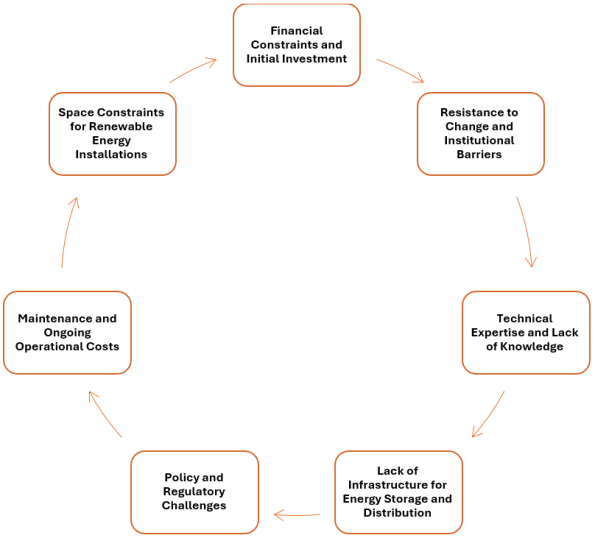
1 | Financial Constraints and Initial Investment: One of the primary challenges educational institutions face when transitioning to green schools is the high initial cost of implementing renewable energy systems, such as solar panels, wind turbines, and energy-efficient infrastructure. This includes the costs of purchasing and installing the necessary technologies, as well as retrofitting existing buildings to meet green standards. | To overcome financial barriers, educational institutions can seek government grants, subsidies, and incentives designed to promote green energy adoption. Programs such as tax credits for renewable energy systems or funding for energy-efficient building upgrades can help reduce initial capital expenditure. Additionally, adopting a phased approach to implementation allows schools to gradually introduce renewable energy technologies while spreading the costs over time. Long-term savings in energy bills from the use of renewable energy can also offset the initial investment. |
2 | Resistance to Change and Institutional Barriers: Many educational institutions, particularly those with limited resources or those operating in traditional environments, may face resistance to change. This can come from various stakeholders, including administrators, faculty members, and even students, who may be unfamiliar with green technologies or reluctant to alter established routines | Overcoming resistance requires a strong commitment from educational leaders and policymakers. This involves creating awareness and understanding of the long-term benefits of renewable energy and sustainability practices. Professional development programs for teachers and administrators can be essential in increasing their capacity to lead green initiatives effectively. Moreover, engaging students in green school projects can foster a culture of environmental responsibility, with students themselves acting as advocates for the change. Providing real-world examples of successful green schools can help overcome skepticism and build support across the institution |
3 | Technical Expertise and Lack of Knowledge: Many educational institutions lack the technical expertise needed to design, install, and maintain renewable energy systems. This can be a significant barrier to the adoption of solar panels, geothermal heating systems, or wind turbines, as well as the integration of energy-efficient technologies into existing infrastructures. | Collaborating with renewable energy experts, consultants, and technology providers is crucial. Educational institutions can partner with local renewable energy firms or universities with expertise in sustainable technologies to design and implement these systems. Additionally, institutions can offer training for their staff and maintenance teams to ensure that the systems are properly operated and maintained. Incorporating green energy education into the curriculum itself could also equip students with the knowledge to support these transitions and maintain the systems over time |
4 | Lack of Infrastructure for Energy Storage and Distribution: While renewable energy sources like solar and wind can provide sustainable energy, the variability of these sources can create challenges in ensuring a consistent energy supply. Schools often lack the necessary infrastructure for energy storage (e.g., batteries) or energy distribution systems to ensure that the energy generated is used efficiently and consistently | The installation of energy storage systems, such as batteries, can help ensure that the energy generated during peak production times (e.g., sunny or windy days) can be stored and used later. This will allow educational institutions to rely on renewable energy even when the energy supply is intermittent. Additionally, integrating smart grid systems can optimize the use and distribution of energy within the school, ensuring that energy is distributed efficiently throughout the campus |
5 | Policy and Regulatory Challenges: In many regions, the policy and regulatory framework may not be conducive to the rapid adoption of renewable energy in educational institutions. These challenges can include outdated energy codes, lack of incentives, or bureaucratic hurdles that slow down the approval and implementation processes | Advocacy for policy change and closer collaboration with local and national governments can help address regulatory challenges. Educational institutions can work with policymakers to align energy codes with modern renewable energy technologies and ensure that green schools are incentivized through tax credits or subsidies. Establishing green certification programs, such as LEED (Leadership in Energy and Environmental Design), can also provide institutions with frameworks for making renewable energy adoption a central part of their building plans. |
6 | Maintenance and Ongoing Operational Costs: While renewable energy systems generally offer long-term cost savings, they require regular maintenance and occasional upgrades to remain efficient. This ongoing cost can be a concern for schools with tight operational budgets. | Developing maintenance schedules and partnerships with local energy firms can help reduce the cost and complexity of maintaining renewable energy systems. Educational institutions can also consider implementing energy performance contracts (EPCs) with energy service companies (ESCOs), which offer guaranteed energy savings over time, helping to mitigate maintenance costs. Schools can also invest in energy-efficient appliances and systems, reducing the overall demand on renewable energy infrastructure and lowering long-term operational costs. |
7 | Space Constraints for Renewable Energy Installations: Many educational institutions, especially those in urban areas, may face space limitations that prevent them from installing large-scale renewable energy systems such as solar panels or wind turbines. | To overcome space constraints, schools can explore creative solutions such as installing solar panels on rooftops, using vertical wind turbines, or incorporating energy-efficient solutions in underutilized spaces (e.g., parking lots or outdoor areas). Urban schools could also consider community partnerships to access shared renewable energy installations, or participate in local energy-sharing initiatives that allow schools to benefit from renewable energy generation without having to manage it independently. |
AI | Artificial Intelligence |
SST | Sustainability Sin-gularity Theory |
| [1] | Abdallah, A. K., Ismail, L. S., & Alkaabi, A. M. (2024). Green careers: Educating for the future of sustainability. In Legal Frameworks and Educational Strategies for Sustainable Development (pp. 337-366). IGI Global. |
| [2] | Agrawal, H., Agrawal, S. (2026). AI Meets Sustainability: Evolving Green Influencer Marketing Practices. In: Poonia, R. C., Thakur, D., Thakur, I. (eds) Intelligent Systems for Sustainable Infrastructure: AI Solutions Shaping a Green Future. Engineering Cyber-Physical Systems and Critical Infrastructures, vol 17. Springer, Cham. |
| [3] | Apostu, S., Jabeen, R., Hussain, A. “A study among green transformational leadership, green learning, government regulation and sustainable project success across renewable energy investments.” RISUS, 2024. |
| [4] | Bindeeba, D. S., Tukamushaba, E. K., Bakashaba, R. et al. (2025). Green human resources management and green innovation: a meta-analytic review of strategic human resources levers for environmental sustainability. Discov Sustain 6, 650 |
| [5] | Chauhan, A., Pandey, N. K., Diwakar, M. et al. (2025). A survey of deep reinforcement learning techniques for Energy-efficient green cloud computing. Cluster Comput 28, 989 |
| [6] | Dhar, B. K., Sarkar, S. M. (2025). Sustainability singularity theory for AI green innovation climate governance and future generations. Discov Sustain 6, 1261 |
| [7] | Dönmez, İ. (2024). Sustainability in Educational Research: Mapping the Field with a Bibliometric Analysis. Sustainability, 16(13), 5541. |
| [8] | Gul, R., Hussain, S., Shaikh, A. et al. (2025). Examining the impact of green finance and green innovation on sustainable economic development using machine learning methods. Discov Sustain 6, 1333 |
| [9] | Islam, M. S. et al. (2026). Green Machine Learning (GML): Energy-Aware Approaches for Sustainable Computing. In: Dutta, S., Bhattacharya, A., Bose, S., Polkowski, Z. (eds) Proceedings of International Conference on Computational Intelligence and Information Retrieval. ICCIIR 2025. Lecture Notes in Networks and Systems, vol 1617. Springer, Cham. |
| [10] | Li, Y., Hoang, NK., Tien, N. H. et al. (2025). The role of green entrepreneurship and fintech in promoting sustainability. Int Entrep Manag J 21, 105 |
| [11] | Liu, Y., Rashid, J., Saleem, M. S. et al. (2026). Deep learning for green energy: predicting consumption and production trends across the Americas. Electr Eng 108, 5 |
| [12] | MuhammedZein, F. A., & Abdullateef, S. T. (2025). Quality Education for Sustainable Development: Evolving Pedagogies to Maintain a Balance Between Knowledge, Skills, and Values-Case Study of Saudi Universities. Sustainability, 17(2), 635. |
| [13] | Pastor, M. A. S., Cervantes-Marreros, M. D., Cubas-Pérez, J. D., Reategui-Apagueño, L. A., Tito-Pezo, D., Piña-Rimarachi, J. M., Vasquez-Perez, C. A., Correa-Vasquez, C. L., Soplin Rios, J. A., del Pino, L. F., & Botelho Junior, A. B. (2025). Project-Based Learning at Universities: A Sustainable Approach to Renewable Energy in Latin America—A Case Study. Sustainability, 17(12), 5492. |
| [14] | performance: the roles of green innovation and green sustainability of manufacturing firms. Discov Sustain 6, 961 |
| [15] | Qamrul Islam, Syed Md Faisal Ali Khan (2024). Sustainability-Infused Learning Environments: Investigating the Role of Digital Technology and Motivation for Sustainability in Achieving Quality Education. Vol 23, No 1. |
| [16] | Qiao, C., Cai, W. & Chen, S. (2025). Green fintech contributes to environmental sustainability—based on empirical evidence from China. Humanit Soc Sci Commun 12, 1895 |
| [17] | Shabrawy, M., Sh. Gaber, K., M. Eid, M. et al. (2025). Explainable AI for intelligent green energy forecasting: deep learning with iHow optimization algorithm (iHOW). Sci Rep 15, 41158 |
| [18] | Tariq R, Mohammed A, Alshibani A, Ramírez-Montoya MS. Complex artificial intelligence models for energy sustainability in educational buildings. Sci Rep. 2024 Jul 1; 14(1): 15020. |
| [19] | Tobel, I. (2024). The Role of Digital Education in Achieving Sustainable Green Campuses. Journal of Applied Technical and Educational Sciences, 14(1), Art No: 372. |
| [20] | Zhiteng Yan, Mohd Hanafi Mohd Yasin, Mohd Sofian Omar Fauzee, & WanSuraya WanNik. (2025). The Research Landscape of Environmental Education for Sustainable Development in Basic Education: A Bibliometric Analysis. The Eastasouth Journal of Learning and Educations, 3(02), 104–122. |
APA Style
Eyadah, H. T. A., Odibat, A. A. (2026). Forward-looking Visions Sustainability of Green Energy-based Learning. Science Discovery, 14(3), 66-77. https://doi.org/10.11648/j.sd.20261403.13
ACS Style
Eyadah, H. T. A.; Odibat, A. A. Forward-looking Visions Sustainability of Green Energy-based Learning. Sci. Discov. 2026, 14(3), 66-77. doi: 10.11648/j.sd.20261403.13
@article{10.11648/j.sd.20261403.13,
  author = {Heba Tawfiqe Abu Eyadah and Anas Adnan Odibat},
  title = {Forward-looking Visions Sustainability of Green
Energy-based Learning},
  journal = {Science Discovery},
  volume = {14},
  number = {3},
  pages = {66-77},
  doi = {10.11648/j.sd.20261403.13},
  url = {https://doi.org/10.11648/j.sd.20261403.13},
  eprint = {https://article.sciencepublishinggroup.com/pdf/10.11648.j.sd.20261403.13},
  abstract = {This study aimed to provide future insights into the sustainability of clean energy-based learning. It employed a rigorous descriptive methodology, compiling relevant studies and literature on green energy and sustainability for the period 2024-2026. This involved an inductive, exploratory, and evaluative analysis. Based on the researchers' perspectives, the study developed future visions. The findings revealed that transforming educational institutions into green schools is a significant challenge requiring intensive efforts and local, national, and international partnerships. Based on multiple studies, this research identifies key challenges and potential solutions that can leverage renewable energy sources. The study recommends accelerating the implementation of renewable energy solutions, such as solar panels, in educational institutions to improve energy efficiency and ensure the sustainability of operational processes. These initiatives should encompass all educational levels, from schools to universities, with financial and technical support from governments and civil society organizations.},
 year = {2026}
}
TY  - JOUR
T1  - Forward-looking Visions Sustainability of Green
Energy-based Learning
AU  - Heba Tawfiqe Abu Eyadah
AU  - Anas Adnan Odibat
Y1  - 2026/05/28
PY  - 2026
N1  - https://doi.org/10.11648/j.sd.20261403.13
DO  - 10.11648/j.sd.20261403.13
T2  - Science Discovery
JF  - Science Discovery
JO  - Science Discovery
SP  - 66
EP  - 77
PB  - Science Publishing Group
SN  - 2331-0650
UR  - https://doi.org/10.11648/j.sd.20261403.13
AB  - This study aimed to provide future insights into the sustainability of clean energy-based learning. It employed a rigorous descriptive methodology, compiling relevant studies and literature on green energy and sustainability for the period 2024-2026. This involved an inductive, exploratory, and evaluative analysis. Based on the researchers' perspectives, the study developed future visions. The findings revealed that transforming educational institutions into green schools is a significant challenge requiring intensive efforts and local, national, and international partnerships. Based on multiple studies, this research identifies key challenges and potential solutions that can leverage renewable energy sources. The study recommends accelerating the implementation of renewable energy solutions, such as solar panels, in educational institutions to improve energy efficiency and ensure the sustainability of operational processes. These initiatives should encompass all educational levels, from schools to universities, with financial and technical support from governments and civil society organizations.
VL  - 14
IS  - 3
ER  -
Educational Sciences School, University of Jordan, Amman, Jordan
Educational Sciences School, International Islamic University, Amman, Jordan

Information



 Share This Article
 Twitter
 Linked In
 Facebook
 Copy
Copy Download