Research Article | | Peer-Reviewed

Assessment of Pesticide Contamination in Agricultural Soils According to Crop Type in the Niayes Zone

Received: 22 May 2026     Accepted: 3 June 2026     Published: 23 June 2026
Views:       Downloads:
Abstract

The Niayes constitute a unique ecosystem in Senegal, providing the bulk of the country's horticultural production. However, this area is undergoing severe ecological degradation due to the combined effects of several factors, including agricultural activities, urban and industrial development and climate change. Agriculture is becoming increasingly intensive, with high levels of chemical inputs, including pesticides. In 2021, studies showed that 100% of agricultural soils contained pesticides that could have harmful effects on soil health. Soil samples were taken in the study area in 2022 and 2023 and analyzed for residues of thirty-five pesticides, including persistent organic pollutants. The results obtained in 2022 revealed that 100% of the study sites were contaminated by pesticides, including profenofos (88% of plots), dimethoate (89%), bromacil and chlorpyrifos (64%) and abamectin (48%). The same trend was observed in 2023, when all sites were contaminated, with abamectin (89% of plots), cypermethrin, bromacil and profenofos (80%) the most frequently found molecules. These were followed by lambda-cyhalothrin, trifluralin and pendimethalin (76%), chlorpyrifos (71%), DDT (62%) and lindane (38%). These results were used to map contamination in the Niayes area in 2022 and 2023 using Geographic Information System (GIS) software, and to identify the most polluting crops. As a result, all soils hosting onions, carrots, turnips, peppers and tomatoes were contaminated. In addition, the highest pesticide residue levels were found in the soils of onion and tomato fields.

Published in Science Journal of Analytical Chemistry (Volume 14, Issue 2)
DOI 10.11648/j.sjac.20261402.12
Page(s) 28-35
Creative Commons

This is an Open Access article, distributed under the terms of the Creative Commons Attribution 4.0 International License (http://creativecommons.org/licenses/by/4.0/), which permits unrestricted use, distribution and reproduction in any medium or format, provided the original work is properly cited.

Copyright

Copyright © The Author(s), 2026. Published by Science Publishing Group

Keywords

Pesticides, Crops, Soils, Niayes Area, Senegal

1. Introduction
Studies have shown that land and soil degradation is very advanced in Senegal, which loses between 128 and 144 million dollars every year. Indeed, studies carried out by the Permanent Inter-State Committee for Drought Control in the Sahel in November 2010, indicate that of the 3,805,000 ha of arable land available to the country, 2,400,000 ha are severely degraded (63%) . In 2016, a study carried out by the International Food Policy Research Institute (IFPRI) in partnership with the Senegalese National Institute of Pedology (INP), revealed that around 13% of Senegal's land (3.8 million hectares), on which 22% of the country's 13 million inhabitants live, is degraded. Factors identified include water erosion, wind erosion, salinization and acidification . Two other studies, by Gunstone et al (2021) and Riedo et al (2021), showed that pesticides also have a negative effect on the biological life of soils, and that they could directly harm the growth of fungal hyphae or interfere with specific physiological processes such as the uptake and transport of metabolites and nutrients in the soil . These studies have shown that soil biodiversity provides a number of services, such as the degradation of organic matter for the proper functioning of the nitrogen and carbon cycle, phosphorus mobilization, pest regulation, soil porosity and water infiltration. In the same vein, Marlatt et al. (2022) have shown that, in addition to killing target species, pesticides are ubiquitous in the environment, contaminating the food chain and affecting other non-target species. Some natural enemies of crop pests are also affected, as are certain bird, reptile and fish populations .
For pest control, Senegalese agriculture uses an average of 598 tons of solid pesticides and 1,336,560 liters of pesticides per year . Average national consumption is approximately 5 l/ha for liquid formulations alone. These quantities are comparable to those in Mali, where cultivated land is ten times more extensive . Nearly 300 commercial specialties (for almost 80 active ingredients) are used, compared with 189 authorized.
In 2023, Froger et al. demonstrated the unexpected persistence of pesticide molecules in the environment, well beyond their theoretical degradation time and at higher concentrations than expected .
The aim of this study is to map soil contamination in the Niayes area, with a view to contributing to food and nutritional security through the preservation of natural resources and adaptation to climate change.
2. Materials and Methods
2.1. Materials
2.1.1. Study Area
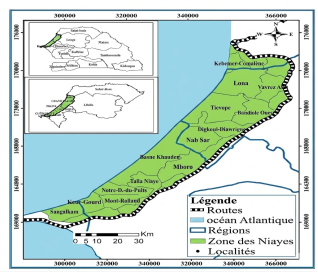
The Niayes zone is situated along the northern coastal belt of Senegal and spans four major regions (Dakar, Thiès, Louga, and Saint-Louis) which together represent more than 48% of the national population . Covering an area of approximately 510 km², this zone benefits from particularly favorable physical conditions for agricultural production, including suitable climatic, pedological, and hydrogeological characteristics.
The Niayes landscape is distinguished by a succession of depressions and dune systems overlying a shallow groundwater table. Historically, its hydrographic network was rich in lakes and wetlands, creating conditions conducive to the development of dense vegetation despite its location within the Sahelian zone. Annual rainfall remains limited and generally does not exceed 500 mm.
Figure 1. Location of the Niayes area .
Although most of Senegal experiences a tropical Sahelian climate, the Niayes region benefits from a specific sub-Canarian microclimate influenced by the boreal maritime trade winds. During the period from December to May, when northerly winds (NNW-NNE) dominate, temperatures remain relatively mild with low thermal variability (average temperatures ranging from 19 to 22°C), while humidity levels stay high and stable. In contrast, inland areas are exposed to the hot and dry Harmattan winds, where temperatures may reach 30 - 40°C. Owing to these favorable environmental conditions, the Niayes region constitutes the country’s principal horticultural production zone and supplies the majority of Senegal’s vegetables (Figure 1).
2.1.2. Equipment
The equipment used in this study included materials for sampling, extraction, and analytical determination. Sampling equipment comprised augers, a GPS device, wide-neck amber glass vials, sampling bags, and insulated coolers for sample preservation and transport. Extraction procedures were carried out using a centrifuge, analytical balance, vortex mixer, mechanical shaker, separating funnel, filtration flask, Büchner funnel, rotary evaporator, and an ultrasonic bath. Analytical determinations were performed using high-performance liquid chromatography (HPLC 1260 Infinity), gas chromatography-mass spectrometry (GC-MS 5957C), and gas chromatography equipped with an electron capture detector (GC-ECD 6890N).
All solvents and reagents employed were of analytical grade. These included acetonitrile, magnesium sulfate, sodium sulfate, petroleum ether, dichloromethane, and acetone obtained from Chemlab, Oxford, and VWR through local distributors. Certified analytical pesticide standards were procured from Ehrenstorfer and Sigma-Aldrich through LGC South Africa.
2.2. Methods
2.2.1. Sampling
Soil sampling was conducted directly on agricultural plots, where each randomly selected sampling location was georeferenced using a GPS device. At each plot, seven (07) primary soil subsamples were collected at a depth of 10 cm using an auger. The subsamples were then pooled in a large Teflon container to obtain a composite sample and thoroughly homogenized using a spoon. From the homogenized material, a 500 g representative portion was collected as the laboratory sample and transferred into a glass vial for subsequent pesticide residue analysis.
In total, ninety (90) composite soil samples were collected. Each sample was labeled using the geographical coordinates of the corresponding sampling point to ensure traceability and was transported under controlled conditions in an insulated cooler containing ice packs until arrival at the laboratory.
2.2.2. Extraction
Pesticide residue analysis in soil samples was performed according to ISO 10382, a standardized multi-residue analytical method. Briefly, 20 g of the homogenized laboratory sample was transferred into an amber glass vial, to which 75 mL of acetone was added. The mixture was shaken mechanically at a speed of 500 oscillations per minute for 15 minutes to facilitate extraction of pesticide residues. The suspension was then allowed to settle for 10 minutes, after which the extract was recovered by filtration through glass wool into a separatory funnel.
Subsequently, 75 mL of petroleum ether was added to the same flask containing the soil residue, and the extraction process was repeated under identical shaking conditions for 15 minutes. The resulting organic phase was collected by filtration into the same separatory funnel. This extraction step was repeated once more with an additional volume of petroleum ether to maximize recovery of analytes.
The combined filtrates were washed with 500 mL of distilled water and shaken for 5 minutes, followed by a settling period to ensure complete phase separation. After removal of the aqueous phase, the organic phase containing the extracted pesticide residues was passed through anhydrous sodium sulfate to remove residual moisture and collected in an evaporation flask. A second washing step with distilled water was then performed under the same conditions. Finally, the solvent was evaporated to dryness using a rotary evaporator, and the resulting extract was recovered and subjected to instrumental analysis by liquid and gas chromatography.
2.2.3. Chromatographic Reading Conditions
Instrumental analysis of pesticide residues was performed using gas chromatography coupled with mass spectrometry (GC-MS), gas chromatography with electron capture detection (GC-ECD), and high-performance liquid chromatography with diode array detection (HPLC-DAD).
For GC-MS analysis, an Agilent Technologies 7890A gas chromatograph coupled to an Agilent Technologies 5975C inert mass selective detector (MSD) was employed. Separation was achieved using an HP-5MS capillary column (30 m). The chromatographic conditions included a carrier gas flow velocity of 35 cm/s, a purge flow of 45 mL/min initiated at 0.5 min, and an injector temperature maintained at 250°C under splitless injection mode using helium as the carrier gas. The oven temperature program was set to an initial temperature of 50°C, followed by an increase from 50 to 100°C at a rate of 25°C/min, then from 100 to 300°C at 7.5°C/min, with a final hold at 300°C for 3 minutes. Mass spectrometric detection was performed under electron ionization (EI) at 70 eV in selected ion monitoring (SIM) mode. The quadrupole and ion source temperatures were maintained at 180°C and 230°C, respectively. Quantification was conducted using a five-point calibration curve (0.05, 0.1, 0.2, 0.5, and 1 ppm) prepared from certified reference standards, with PCB 28 used as the internal standard.
GC-ECD analysis was carried out using an Agilent Technologies 6890N gas chromatograph equipped with an electron capture detector and fitted with a DB-17 capillary column (30 m). The oven temperature program began at 75°C, followed by heating from 75 to 175°C at 10°C/min, then to 225°C at 15°C/min with a hold time of 13 minutes, and finally to 310°C at 10°C/min with a final hold of 5 minutes. The carrier gas velocity was maintained at 35 cm/s with a purge flow of 45 mL/min at 0.5 min. The injector temperature was set at 250°C and injections were performed in splitless mode using an autosampler. Nitrogen was used as carrier gas. Quantification was also achieved through a five-level calibration approach (0.05-1 ppm) using certified standards and PCB 28 as the internal standard.
For HPLC-DAD analysis, chromatographic separation was performed on a C18 column using a mobile phase composed of water and acetonitrile, with solvent proportions adjusted according to the target analytes. Detection wavelengths were set at 205, 220, and 244 nm. The injection volume was 10 µL and the total run time was 30 minutes. Quantification was performed using external calibration based on five concentration levels (0.05, 0.1, 0.2, 0.5, and 1 ppm) prepared from certified analytical standards.
2.2.4. Quality Control
Quality assurance and quality control procedures were implemented throughout the analytical process to ensure the reliability and accuracy of pesticide residue determination. PCB 28 was used as the internal standard and was added at a constant volume of 100 µL to each sample and calibration standard. Under these conditions, recovery rates ranging from 70 to 120% were obtained, indicating acceptable analytical performance.
To verify the absence of contamination during analysis, a procedural blank was prepared and processed in the same manner as the samples. This blank was used to confirm that the analytical equipment, reagents, and consumables were free from pesticide residues. In addition, a solvent blank corresponding to the extraction solvent was included systematically throughout the analytical sequence to monitor potential contamination originating from solvents or laboratory procedures.
Method performance was further assessed through recovery experiments using a fortified sample spiked at a concentration of 10 ppb and subjected to the same extraction and analytical protocol as the study samples. The recovery values obtained also ranged between 70 and 120%, demonstrating satisfactory extraction efficiency and analytical accuracy.
Furthermore, each analytical batch included a sequence of injections comprising the solvent blank, procedural blank, mixed standard solutions, and sample extracts. This injection sequence was used to verify the sensitivity, stability, and reproducibility of the chromatographic system throughout the analysis.
3. Results and Discussion
3.1. Soil Contamination Frequencies and Levels
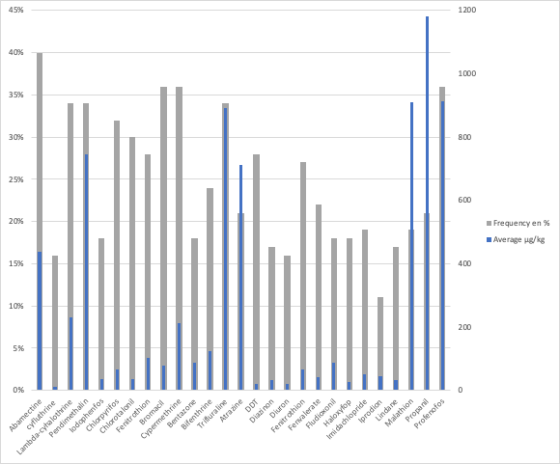
Abamectin and profenofos were the pesticide residues most frequently detected in the soil samples, followed by lambda-cyhalothrin, pendimethalin, cypermethrin, bromacil, and trifluralin. According to the Pesticide Properties DataBase, all of these compounds, except bromacil, exhibit low mobility in soils, which may partly explain their persistence and accumulation in the sampled environments .
Figure 2. Detection frequencies and average concentrations of pesticide residues in soil.
The high detection frequency of these active substances is likely associated with their extensive use in the Niayes agricultural production system. These molecules are widely represented in pesticide formulations authorized and marketed at the sub-regional level. Data from the Sahelian Pesticide Committee (CSP), responsible for the registration of plant protection products, indicate that approved formulations include 26 products containing lambda-cyhalothrin, 23 containing profenofos, 18 containing pendimethalin and cypermethrin, and 10 containing abamectin . Previous studies conducted in the Niayes area have similarly documented the widespread application of these pesticides across different crop systems . In addition, a survey conducted by Ly (2021) in the Niayes reported that the most commonly used active ingredients among producers were profenofos (53%), dimethoate (9%), acetamiprid/lambda-cyhalothrin (8%), and abamectin (7%) .
The analytical results further revealed that propanil, malathion, profenofos, trifluralin, atrazine, and abamectin recorded the highest residue concentrations. Maximum concentrations measured in the soil samples reached 1180 µg/kg for propanil, 912 µg/kg for profenofos, 910 µg/kg for malathion, 893 µg/kg for trifluralin, 745 µg/kg for pendimethalin, 712 µg/kg for atrazine, 439 µg/kg for abamectin, and 231 µg/kg for lambda-cyhalothrin. These high residue levels likely reflect intensive and repeated pesticide application practices associated with market gardening activities in the Niayes zone.
Comparable findings have been reported in several African countries, including Benin, Côte d’Ivoire, Ghana, and Togo, where intensive vegetable production systems have also been associated with significant pesticide contamination of agricultural soils . Moreover, the continued detection of persistent organic pollutants (POPs) remains a concern, with DDT identified in 28% of sampling sites and lindane detected in 17%, suggesting either historical contamination, environmental persistence, or possible continued unauthorized use.
3.2. Impact of Crop on Soil Contamination
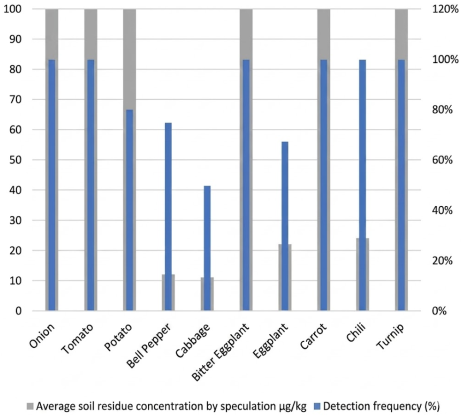
The highest average pesticide residue concentrations were recorded in soils collected from onion plots (1142 ppb), followed by tomato plots (842 ppb), potato plots (471 ppb), bitter eggplant plots (471 ppb), and carrot plots (284 ppb). These differences may reflect variations in crop protection practices and pest pressure across production systems.
One possible explanation for the high residue levels observed in onion and tomato fields is the intensive and frequent application of pesticides in response to recurrent pest and disease infestations. Several studies have reported that producers often apply pesticides more frequently than recommended and do not always comply with prescribed application rates, resulting in increased environmental contamination . This hypothesis is particularly relevant for onion and tomato cultivation, which are among the most economically important and phytosanitary-sensitive crops in Senegal. Onion represents the country’s leading vegetable crop in terms of cultivated area and ranks second in production volume, while tomato production is frequently constrained by severe pest and disease outbreaks associated with substantial yield losses .
These observations are supported by the findings of Ly (2021), who reported that tomato was the crop most affected by pest attacks (38%), followed by cabbage (30%) and onion (12%) in the Niayes production zone. The increased phytosanitary pressure on these crops likely encourages repeated pesticide applications, contributing to the accumulation of residues in soils .
Figure 3. Pesticide detection frequencies and average soil residue concentrations according to speculation.
Another factor that may explain the high contamination levels is inadequate management of pesticide products and associated waste. Improper handling practices, including poor storage conditions, disposal of empty containers within cultivated areas, and the abandonment or continued use of obsolete pesticide products, may contribute significantly to environmental contamination. Several studies conducted in West Africa have demonstrated that inappropriate management of plant protection products by producers can lead to adverse environmental impacts, including soil contamination and ecosystem degradation . These findings highlight the importance of strengthening good agricultural practices, pesticide stewardship, and awareness programs to promote more sustainable crop protection strategies.
3.3. Spatial Distribution of Contamination
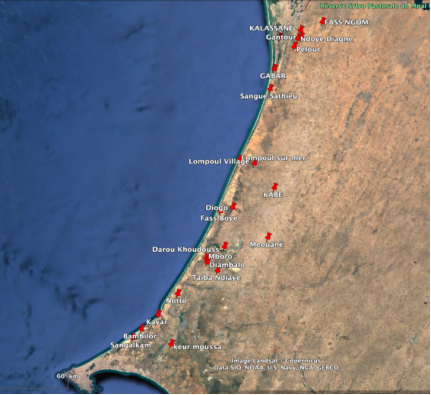
The GPS coordinates recorded during field sampling were used to georeference pesticide-contaminated sites and generate the spatial distribution map of contamination (Figure 4). Considering that agricultural soils should ideally remain free from pesticide residues in order to limit long-term environmental and human exposure, the detection of targeted pesticides in all sampled soils indicates widespread contamination across the study area.
The results showed that all 23 investigated sites exhibited measurable levels of pesticide contamination during the 2022-2023 sampling campaigns. These findings are consistent with earlier studies conducted in the Niayes area over the last two decades, suggesting the persistence of pesticide residues in agricultural soils. As early as 2003, Cissé et al. highlighted the risk of groundwater contamination resulting from pesticide accumulation in soils, and similar concerns were subsequently reported by Ngom et al. (2012), reinforcing evidence of sustained environmental pressure in this production zone .
Figure 4 illustrates the spatial distribution of contaminated sites, where red markers represent localities affected by pesticide contamination. The highest contamination levels were observed in an onion-growing plot located in Sangalkam, followed by a tomato production site in Darou Khoudoss. Several factors may explain these observations. Producers in these areas operate under increasing land-use pressure, which reduces access to cultivable land while maintaining the need to sustain agricultural productivity . This situation may encourage intensified farming practices and greater dependence on chemical inputs such as pesticides and fertilizers.
In addition, the environmental context of these localities may further exacerbate contamination risks. Sangalkam has experienced rapid urban expansion, resulting in increasing pressure on agricultural ecosystems. In Darou Khoudoss, extractive activities have been identified as an important driver of environmental degradation and ecosystem disturbance . These combined pressures may contribute to intensified agricultural practices and reinforce the persistence of pesticide residues in soils.
Figure 4. Spatial distribution of soil contamination in The Niayes zone.
4. Conclusion
The results of this study confirm that soil contamination by pesticide residues is a reality in the Niayes zone, with contamination levels varying according to crop type and agricultural practices. This situation raises concerns regarding both environmental sustainability and public health due to the potential transfer of residues to agricultural products and water resources.
As soil is a non-renewable resource whose degradation may occur rapidly while regeneration remains slow, urgent and appropriate measures are needed to preserve the quality and productivity of this strategic agricultural area. Strengthening pesticide management practices and promoting sustainable agricultural approaches appear essential to protect the environmental and socio-economic value of the Niayes zone.
Abbreviations

DDT

Dichlorodiphenyltrichloroethane

IFPRI

International Food Policy Research Institute

INP

Senegalese National Institute of Pedology

PCB 28

Polychlorobiphenyl 28

Acknowledgments
Gratitude is expressed the “Ceres-Locustox Foundation and Senegalese Agriculture Research Institute (ISRA)” of the Senegalese Ministry of Agriculture, Food Sovereignty and Livestock for its technical support.
Author Contributions
Marie Ndao: Conceptualization, Writing – review & editing
Alioune Badara Paye: Writing – original draft
Adama Ndiaye: Investigation
Saliou Ngom: Investigation
Sokhna Ndao Diao: Writing – original draft
Amadou Diop: Validation, Project administration, Supervision
Conflicts of Interest
The authors declare no conflicts of interest.
References
[1] Permanent Inter-State Committee for Drought Control in the Sahel (CILSS). Common Regulations of CILSS Member States on the Registration of Pesticides. Ouagadougou: CILSS; 1992.
[2] Nkonya EM, Mirzabaev A, von Braun J. Economics of land degradation and improvement: A global assessment for sustainable development. Cham, Switzerland: Springer; 2016.
[3] Gunstone T, Cornelisse T, Klein K, et al. Pesticides and soil invertebrates: A hazard assessment. Frontiers in Environmental Science 2021; 9: 643847.
[4] Riedo J, Wettstein FE, Rösch A, et al. Widespread occurrence of pesticides in organically managed agricultural soils—the ghost of a conventional agricultural past? Environ Sci Technol 2021; 55: 2919-28.
[5] Marlatt VL, Bayen S, Castaneda-Cortès D, et al. Impacts of endocrine disrupting chemicals on reproduction in wildlife and humans. Environmental Research 2022; 208: 112584.
[6] Diouf I. Dynamics of an Urban Wetland: The Case of the Niaye de Patte d’oie in the Dakar Metropolitan Area. Dakar: Enda, 2008.
[7] Dieng PM, Thioune PBD, Diouf M, et al. Estimation of Unconfined Aquifer Recharge in the Niayes Region (Senegal) Using the Thornthwaite Balance Method. International Journal of Advanced Research 2020; 8.
[8] Froger C, Jolivet C, Budzinski H, et al. Pesticide Residues in French Soils: Occurrence, Risks, and Persistence. Environ Sci Technol 2023; 57: 7818-27.
[9] Diedhiou F, Gueye DEM, François A. Economic and Social Situation in Senegal. National Agency for Statistics and Demography (ANSD); 2023.
[10] Ngom S, Gravel A, Sambou M, et al. Types of Farms in the Niayes Region of Senegal: Perceptions of Environmental Risks and the Potential for Sustainable Agriculture. ScienceLib 2015; 7.
[11] Database of pesticide properties, n.d.
[12] Diarra A, Diallo B. Implementation of Regional Pesticide Policies in West Africa: Case Study Report on Senegal. 2017.
[13] Cissé I, Tandia AA, Fall ST, et al. Unregulated use of pesticides in peri-urban agriculture: the case of the Niayes region in Senegal. Agriculture section. 2003; 12(1): 181-186.
[14] Diop A. Assessment of pesticide use practices and quantification of pesticide residues in the Niayes region of Dakar (Senegal). Theses. Université du Littoral Côte d’Opale, 2013.
[15] Gaillard B. Crop Protection and Pesticide Dependence in Vegetable Farming: A Case Study of a Vegetable-Farming Community in the Niayes Region (Senegal). VertigO—The Electronic Journal of Environmental Sciences 2022; 22.
[16] Ly S, Sarr I, Martinez RT, et al. Characterization of Plant Protection Practices in the Niayes Vegetable-Growing Region of Senegal. International Journal of Progressive Sciences and Technologies 2021; 30: 301-13.
[17] Sougnabe SP, Yandia A, Acheleke J, et al. Peasant Plant Protection Practices in the Savannas of Central Africa. Developing African Savannas: Innovating for Sustainability, CIRAD; 2009, pp. 13 p.
[18] Ahouangninou C, Fayomi BE, Martin T. Assessment of the health and environmental risks associated with the plant protection practices of vegetable farmers in the rural commune of Tori-Bossito (Southern Benin). Cahiers Agricultures 2011; 20(1): 216-222.
[19] Kanda M, Djaneye-Boundjou G, Wala K, et al. Pesticide Use in Vegetable Farming in Togo. VertigO: The International Journal of Environmental Sciences 2013.
[20] Mawussi G, Kolani L, Devault DA, et al. Use of Chemical Pesticides in Vegetable Production Systems in West Africa and Their Impact on Soil and Water Resources: The Case of Togo. Proceedings of the Symposium, 44th Congress of the French Pesticide Group, May 26-29, 2014, Schoelcher, France, 2015, pp. 46-53.
[21] Mondedji AD, Nyamador WS, Amevoin K, et al. Analysis of Selected Aspects of the Vegetable Production System and Producers’ Perceptions of the Use of Botanical Extracts in the Management of Insect Pests in Vegetable Crops in Southern Togo. International Journal of Biological and Chemical Sciences 2015; 9: 98-107.
[22] Doumbia M, Kwadjo KE. Pesticide Use and Management Practices Among Market Gardeners in Côte d’Ivoire: The Case of Abidjan and Two of Its Suburbs (Dabou and Anyama). Journal of Applied Biosciences 2009; 18: 992-1002.
[23] Belhadi A, Mehenni M, Reguieg L, et al. Pest control practices among vegetable greenhouse growers in three localities in eastern Ziban and their potential impact on human health and the environment. Revue Agriculture 2016.
[24] Naré RWA, Savadogo PW, Gnankambary Z, et al. Effect of three pesticides on soil dehydrogenase and fluorescein diacetate activities in vegetable garden in Burkina Faso. Current Research Journal of Biological Sciences 2014; 6: 102-6.
[25] Ahmed Aidara Mbengue. Analysis of Marketing Strategies for Local Onions in the Niayes Region, 2007.
[26] Haougui A, Basso A, Aissa K, et al. Integrated Management of Major Pests and Diseases of Vegetable Crops in Niger. Technical Document: Protection To-mate, PromAp 2016.
[27] Toé AM. Pilot Study on Agricultural Pesticide Poisoning in Burkina Faso. Secretariat of the Rotterdam Convention, 2010.
[28] Ngom S, Traore S, Thiam MB, et al. Pesticide contamination of agricultural produce and groundwater in the Niayes region of Senegal. Summary. Journal of Science and Technology 2012; 25: 119-30.
[29] Gnankiné O, Hema O, Namountougou M, et al. Impact of pest management practices on the frequency of insecticide-resistant alleles in Bemisia tabaci (Hemiptera: Aleyrodidae) populations in three West African countries. Crop Protection 2018; 104: 86-91.
[30] Naré RWA, Savadogo PW, Gnankambary Z, et al. Analyzing risks related to the use of pesticides in vegetable gardens in Burkina Faso. Agriculture, Forestry and Fisheries 2015; 4: 165-72.
[31] Roditakis E, Vasakis E, Grispou M, et al. First report of Tuta absoluta resistance to diamide insecticides. J Pest Sci 2015; 88: 9-16.
[32] Lehmann E, Morgan Fargues M, Congo N, et al. Pesticide application in gardening: assessment of resulting impact on water resources quality using grab samples and pocis, case study of Loumbila lake, Burkina Faso. 9th European Conference on Pesticides and Related Organic Micropollutants in the Environment (Santiago de Compostela), 2016.
[33] Kesseler S, Tine V. A necessary evil?, Industrial influences at the urban-rural interface: the impact of ICS on the Mboro area, Senegal. Enda Sahel and West Africa, Ecocite-Senegal Report 2004: 1-78.
Cite This Article
  • APA Style

    Ndao, M., Paye, A. B., Ndiaye, A., Ngom, S., Diao, S. N., et al. (2026). Assessment of Pesticide Contamination in Agricultural Soils According to Crop Type in the Niayes Zone. Science Journal of Analytical Chemistry, 14(2), 28-35. https://doi.org/10.11648/j.sjac.20261402.12

    Copy | Download

    ACS Style

    Ndao, M.; Paye, A. B.; Ndiaye, A.; Ngom, S.; Diao, S. N., et al. Assessment of Pesticide Contamination in Agricultural Soils According to Crop Type in the Niayes Zone. Sci. J. Anal. Chem. 2026, 14(2), 28-35. doi: 10.11648/j.sjac.20261402.12

    Copy | Download

    AMA Style

    Ndao M, Paye AB, Ndiaye A, Ngom S, Diao SN, et al. Assessment of Pesticide Contamination in Agricultural Soils According to Crop Type in the Niayes Zone. Sci J Anal Chem. 2026;14(2):28-35. doi: 10.11648/j.sjac.20261402.12

    Copy | Download

  • @article{10.11648/j.sjac.20261402.12,
      author = {Marie Ndao and Alioune Badara Paye and Adama Ndiaye and Saliou Ngom and Sokhna Ndao Diao and Amadou Diop},
      title = {Assessment of Pesticide Contamination in Agricultural Soils According to Crop Type in the Niayes Zone},
      journal = {Science Journal of Analytical Chemistry},
      volume = {14},
      number = {2},
      pages = {28-35},
      doi = {10.11648/j.sjac.20261402.12},
      url = {https://doi.org/10.11648/j.sjac.20261402.12},
      eprint = {https://article.sciencepublishinggroup.com/pdf/10.11648.j.sjac.20261402.12},
      abstract = {The Niayes constitute a unique ecosystem in Senegal, providing the bulk of the country's horticultural production. However, this area is undergoing severe ecological degradation due to the combined effects of several factors, including agricultural activities, urban and industrial development and climate change. Agriculture is becoming increasingly intensive, with high levels of chemical inputs, including pesticides. In 2021, studies showed that 100% of agricultural soils contained pesticides that could have harmful effects on soil health. Soil samples were taken in the study area in 2022 and 2023 and analyzed for residues of thirty-five pesticides, including persistent organic pollutants. The results obtained in 2022 revealed that 100% of the study sites were contaminated by pesticides, including profenofos (88% of plots), dimethoate (89%), bromacil and chlorpyrifos (64%) and abamectin (48%). The same trend was observed in 2023, when all sites were contaminated, with abamectin (89% of plots), cypermethrin, bromacil and profenofos (80%) the most frequently found molecules. These were followed by lambda-cyhalothrin, trifluralin and pendimethalin (76%), chlorpyrifos (71%), DDT (62%) and lindane (38%). These results were used to map contamination in the Niayes area in 2022 and 2023 using Geographic Information System (GIS) software, and to identify the most polluting crops. As a result, all soils hosting onions, carrots, turnips, peppers and tomatoes were contaminated. In addition, the highest pesticide residue levels were found in the soils of onion and tomato fields.},
     year = {2026}
    }
    

    Copy | Download

  • TY  - JOUR
    T1  - Assessment of Pesticide Contamination in Agricultural Soils According to Crop Type in the Niayes Zone
    AU  - Marie Ndao
    AU  - Alioune Badara Paye
    AU  - Adama Ndiaye
    AU  - Saliou Ngom
    AU  - Sokhna Ndao Diao
    AU  - Amadou Diop
    Y1  - 2026/06/23
    PY  - 2026
    N1  - https://doi.org/10.11648/j.sjac.20261402.12
    DO  - 10.11648/j.sjac.20261402.12
    T2  - Science Journal of Analytical Chemistry
    JF  - Science Journal of Analytical Chemistry
    JO  - Science Journal of Analytical Chemistry
    SP  - 28
    EP  - 35
    PB  - Science Publishing Group
    SN  - 2376-8053
    UR  - https://doi.org/10.11648/j.sjac.20261402.12
    AB  - The Niayes constitute a unique ecosystem in Senegal, providing the bulk of the country's horticultural production. However, this area is undergoing severe ecological degradation due to the combined effects of several factors, including agricultural activities, urban and industrial development and climate change. Agriculture is becoming increasingly intensive, with high levels of chemical inputs, including pesticides. In 2021, studies showed that 100% of agricultural soils contained pesticides that could have harmful effects on soil health. Soil samples were taken in the study area in 2022 and 2023 and analyzed for residues of thirty-five pesticides, including persistent organic pollutants. The results obtained in 2022 revealed that 100% of the study sites were contaminated by pesticides, including profenofos (88% of plots), dimethoate (89%), bromacil and chlorpyrifos (64%) and abamectin (48%). The same trend was observed in 2023, when all sites were contaminated, with abamectin (89% of plots), cypermethrin, bromacil and profenofos (80%) the most frequently found molecules. These were followed by lambda-cyhalothrin, trifluralin and pendimethalin (76%), chlorpyrifos (71%), DDT (62%) and lindane (38%). These results were used to map contamination in the Niayes area in 2022 and 2023 using Geographic Information System (GIS) software, and to identify the most polluting crops. As a result, all soils hosting onions, carrots, turnips, peppers and tomatoes were contaminated. In addition, the highest pesticide residue levels were found in the soils of onion and tomato fields.
    VL  - 14
    IS  - 2
    ER  - 

    Copy | Download

Author Information
  • Laboratory of Analytical Chemistry and Food Sciences, Cheikh Anta Diop University, Dakar, Senegal;Ceres-Locustox Foundation, Ministry of Agriculture and Livestock, Dakar, Senegal

  • Laboratory of Analytical Chemistry and Food Sciences, Cheikh Anta Diop University, Dakar, Senegal;Ceres-Locustox Foundation, Ministry of Agriculture and Livestock, Dakar, Senegal

  • Ceres-Locustox Foundation, Ministry of Agriculture and Livestock, Dakar, Senegal

  • Plants Protection Directorate, Ministry of Agriculture and Livestock, Dakar, Senegal

  • Laboratory of Analytical Chemistry and Food Sciences, Cheikh Anta Diop University, Dakar, Senegal
  • Laboratory of Analytical Chemistry and Food Sciences, Cheikh Anta Diop University, Dakar, Senegal