
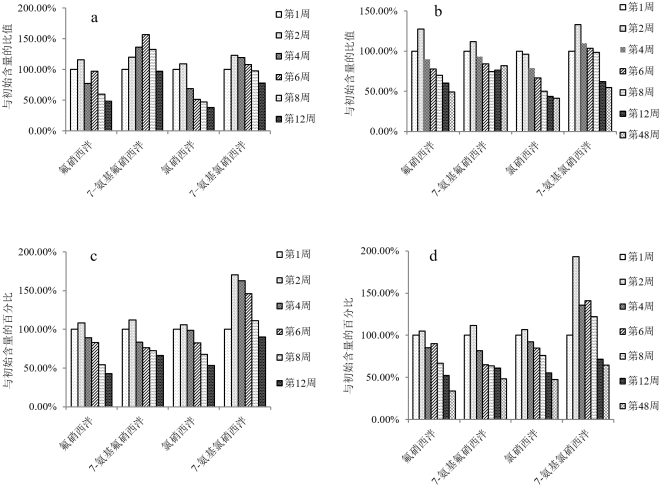
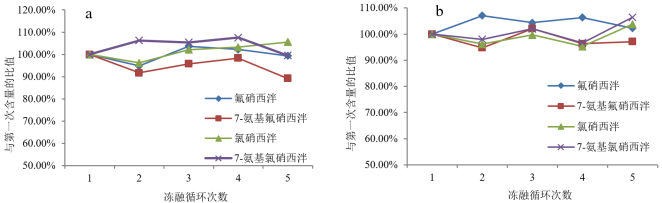
This study investigated the effects of storage temperature and freeze-thaw cycles on the stability of flunitrazepam, clonazepam, and their 7-amino metabolites in whole blood, and clarified the patterns of concentration changes of the four target analytes in the whole-blood matrix over storage time, thereby providing scientific data support for interpreting discrepant results between initial and re-testing in actual cases arising from different storage conditions. In the experiments, blank whole blood was used as the matrix and spiked with reference standards to prepare samples at two concentration levels (10 ng/mL and 100 ng/mL). The samples were stored under refrigeration at 4°C and frozen at –20°C. At various time points, aliquots were taken to determine the relative peak?area ratios of each target analyte to the internal standard diazepam-D5. In parallel, the changes in relative content of the four drugs after 1 to 5 freeze?thaw cycles under short-term storage conditions were also evaluated. The results demonstrated that storage temperature significantly influenced drug stability; higher temperatures accelerated the degradation rate and led to more decreases in the concentrations of the target analytes in whole blood. Notably, at the early stage of storage, flunitrazepam and clonazepam showed a slight increase in concentration, which could be attributed to protein?binding effects. However, under short?term storage at –20°C with 1–5 repeated freeze-thaw cycles, the concentrations of the four target analytes did not exhibit any significant decline and remained relatively stable overall. Based on these findings, it is recommended that biological specimens collected after an incident should undergo qualitative and quantitative testing as soon as possible, and that low?temperature conditions be maintained throughout transportation and storage to minimize drug degradation. For samples requiring long-term preservation, the potential impact of storage duration on drug concentrations should be fully considered when interpreting the final results, and conclusions should be drawn cautiously to avoid misinterpretation.
| Published in | Science Research (Volume 14, Issue 5) |
| DOI | 10.11648/j.sr.20261405.13 |
| Page(s) | 280-285 |
| Creative Commons |
This is an Open Access article, distributed under the terms of the Creative Commons Attribution 4.0 International License (http://creativecommons.org/licenses/by/4.0/), which permits unrestricted use, distribution and reproduction in any medium or format, provided the original work is properly cited. |
| Copyright |
Copyright © The Author(s), 2026. Published by Science Publishing Group |
Forensic Science, Stability, Benzodiazepines, Clonazepam, Interpretation of Results
化合物 | 保留时间(min) | 前体离子(m/z) | 产物离子(m/z) | 去簇电压(V) | 碰撞电压(eV) |
|---|---|---|---|---|---|
7-氨基氯硝西泮 | 3.12 | 285.9 | 222.0* 121.0 | 160 | 34,42 |
7-氨基氟硝西泮 | 3.25 | 284.0 | 135.0* 225.9 | 180 | 34,36 |
氯硝西泮 | 3.72 | 316.1 | 214.0* 240.9 | 130 | 51,47 |
氟硝西泮 | 3.74 | 314.0 | 268.1* 239.0 | 160 | 35,46 |
地西泮-D5(内标) | 3.99 | 290.0 | 198.0* 227.0 | 130 | 40,34 |
| [1] | Mei V, Concheiro M, Pardi J. Validation of an LC-MS/MS Method for the Quantification of 13 Designer Benzodiazepines in Blood [J]. Journal of Analytical Toxicology. 2019, 43(9): 1-8. |
| [2] | 刘东应. GC/MS检验氯硝西泮投毒杀人案件1例 [J]. 刑事技术. 2013(3): 56-57. |
| [3] | 陈航, 向平, 沈敏. 头发中氯硝西泮的分段分析在药物辅助犯罪案件中的作用 [J]. 法医学杂志. 2017, 33(3): 252-257. |
| [4] | 舒翠霞, 龚丹, 常靖等. 氟硝西泮滥用及检测研究进展 [J]. 刑事技术. 2021, 46(2): 182-186. |
| [5] | Melo, Paula. Benzodiazepine Stability in Postmortem Samples Stored at Different Temperatures. [J]. Journal of Analytical Toxicology. 2012, 36(1): 52-60. |
| [6] | Aldubayyan A A, Erika C, Elliott S, et al. Influence of long-term storage temperatures and sodium fluoride preservation on the stability of synthetic cathinones and dihydro-metabolites in human whole blood [J]. Forensic toxicology. 2023, 41(1): 81-93. |
| [7] | Skopp G, Klingmann A, Pötsch L, et al. In vitro stability of cocaine in whole blood and plasma including ecgonine as a target analyte [J]. Therapeutic Drug Monitoring. 2001, 23(2): 174-181. |
| [8] | Skopp G, Lucia P, Klingmann A, et al. Stability of Morphine, Morphine-3-Glucuronide, and Morphine-6-Glucuronide in Fresh Blood and Plasma and Postmortem Blood Samples [J]. Journal of Analytical Toxicology. 2001, 25(1): 2-7. |
| [9] | Clauwaert K M, Bocxlaer J, Leenheer A. Stability study of the designer drugs "MDA, MDMA and MDEA" in water, serum, whole blood, and urine under various storage temperatures [J]. Forensic Science International. 2001, 124(1): 36-42. |
| [10] | Nagata T, Kimura K, Hara K, et al. Methamphetamine and amphetamine concentrations in postmortem rabbit tissues [J]. Forensic Science International. 1990, 48(1): 39-47. |
| [11] | Jiménez C, Torre R D L, Ventura M, et al. Stability studies of amphetamine and ephedrine derivatives in urine [J]. Journal of Chromatography B Analytical Technologies in the Biomedical & Life Sciences. 2006, 843(1): 84-93. |
| [12] | Papadoyannis I N, Uddin M N, Samanidou V F. Stability study of six 1,4-benzodiazepines in bio-fluids stored at -20°C [J]. Chiang Mai Journal of Science. 2010, 37(3): 451-463. |
| [13] | Mahjoub A E, Staub C. Stability of benzodiazepines in whole blood samples stored at varying temperatures [J]. Journal of Pharmaceutical & Biomedical Analysis. 2000, 23(6): 1057-1063. |
| [14] | Cornelissen P J G, Beijersbergen M J. Photochemical activity of 7-nitro-1,4-benzodiazepines [J]. Pharmaceutisch Weekblad. 1981, 3(1): 800-809. |
| [15] | Zaitsu K, Miki A, Katagi M, et al. Long-term stability of various drugs and metabolites in urine, and preventive measures against their decomposition with special attention to filtration sterilization [J]. Forensic Science International. 2008, 174(2): 189-196. |
| [16] | Chuang V T G, Otagiri M. Flunitrazepam, a 7-nitro-1,4-benzodiazepine that is unable to bind to the indole-benzodiazepine site of human serum albumin [J]. Biochimica et Biophysica Acta. 2001, 1546(2): 337-345. |
| [17] | Valdez E C N, Paulino E T, Carla P M C, et al. Modeling the accessibility of the interaction of clonazepan to albumins [J]. International Conference of Computational Methods in Sciences and Engineering. 2016, 1790(1): 100005-1-100005-4. |
| [18] | Robertson M D, Drummer O H. Postmortem drug metabolism by bacteria [J]. Journal of Forensic Sciences. 1995, 40(3): 382-386. |
APA Style
Zhao, P., Wu, X., Zhang, Y. (2026). Influence of Temperature and Freeze-thaw Cycles on the Stability of Flunitrazepam and Clonazepam in Blood. Science Research, 14(5), 280-285. https://doi.org/10.11648/j.sr.20261405.13
ACS Style
Zhao, P.; Wu, X.; Zhang, Y. Influence of Temperature and Freeze-thaw Cycles on the Stability of Flunitrazepam and Clonazepam in Blood. Sci. Res. 2026, 14(5), 280-285. doi: 10.11648/j.sr.20261405.13
@article{10.11648/j.sr.20261405.13,
  author = {Peng Zhao and Xiaojun Wu and Yunfeng Zhang},
  title = {Influence of Temperature and Freeze-thaw Cycles on the Stability of Flunitrazepam and Clonazepam in Blood},
  journal = {Science Research},
  volume = {14},
  number = {5},
  pages = {280-285},
  doi = {10.11648/j.sr.20261405.13},
  url = {https://doi.org/10.11648/j.sr.20261405.13},
  eprint = {https://article.sciencepublishinggroup.com/pdf/10.11648.j.sr.20261405.13},
  abstract = {This study investigated the effects of storage temperature and freeze-thaw cycles on the stability of flunitrazepam, clonazepam, and their 7-amino metabolites in whole blood, and clarified the patterns of concentration changes of the four target analytes in the whole-blood matrix over storage time, thereby providing scientific data support for interpreting discrepant results between initial and re-testing in actual cases arising from different storage conditions. In the experiments, blank whole blood was used as the matrix and spiked with reference standards to prepare samples at two concentration levels (10 ng/mL and 100 ng/mL). The samples were stored under refrigeration at 4°C and frozen at –20°C. At various time points, aliquots were taken to determine the relative peak?area ratios of each target analyte to the internal standard diazepam-D5. In parallel, the changes in relative content of the four drugs after 1 to 5 freeze?thaw cycles under short-term storage conditions were also evaluated. The results demonstrated that storage temperature significantly influenced drug stability; higher temperatures accelerated the degradation rate and led to more decreases in the concentrations of the target analytes in whole blood. Notably, at the early stage of storage, flunitrazepam and clonazepam showed a slight increase in concentration, which could be attributed to protein?binding effects. However, under short?term storage at –20°C with 1–5 repeated freeze-thaw cycles, the concentrations of the four target analytes did not exhibit any significant decline and remained relatively stable overall. Based on these findings, it is recommended that biological specimens collected after an incident should undergo qualitative and quantitative testing as soon as possible, and that low?temperature conditions be maintained throughout transportation and storage to minimize drug degradation. For samples requiring long-term preservation, the potential impact of storage duration on drug concentrations should be fully considered when interpreting the final results, and conclusions should be drawn cautiously to avoid misinterpretation.},
 year = {2026}
}
TY  - JOUR
T1  - Influence of Temperature and Freeze-thaw Cycles on the Stability of Flunitrazepam and Clonazepam in Blood
AU  - Peng Zhao
AU  - Xiaojun Wu
AU  - Yunfeng Zhang
Y1  - 2026/09/04
PY  - 2026
N1  - https://doi.org/10.11648/j.sr.20261405.13
DO  - 10.11648/j.sr.20261405.13
T2  - Science Research
JF  - Science Research
JO  - Science Research
SP  - 280
EP  - 285
PB  - Science Publishing Group
SN  - 2329-0927
UR  - https://doi.org/10.11648/j.sr.20261405.13
AB  - This study investigated the effects of storage temperature and freeze-thaw cycles on the stability of flunitrazepam, clonazepam, and their 7-amino metabolites in whole blood, and clarified the patterns of concentration changes of the four target analytes in the whole-blood matrix over storage time, thereby providing scientific data support for interpreting discrepant results between initial and re-testing in actual cases arising from different storage conditions. In the experiments, blank whole blood was used as the matrix and spiked with reference standards to prepare samples at two concentration levels (10 ng/mL and 100 ng/mL). The samples were stored under refrigeration at 4°C and frozen at –20°C. At various time points, aliquots were taken to determine the relative peak?area ratios of each target analyte to the internal standard diazepam-D5. In parallel, the changes in relative content of the four drugs after 1 to 5 freeze?thaw cycles under short-term storage conditions were also evaluated. The results demonstrated that storage temperature significantly influenced drug stability; higher temperatures accelerated the degradation rate and led to more decreases in the concentrations of the target analytes in whole blood. Notably, at the early stage of storage, flunitrazepam and clonazepam showed a slight increase in concentration, which could be attributed to protein?binding effects. However, under short?term storage at –20°C with 1–5 repeated freeze-thaw cycles, the concentrations of the four target analytes did not exhibit any significant decline and remained relatively stable overall. Based on these findings, it is recommended that biological specimens collected after an incident should undergo qualitative and quantitative testing as soon as possible, and that low?temperature conditions be maintained throughout transportation and storage to minimize drug degradation. For samples requiring long-term preservation, the potential impact of storage duration on drug concentrations should be fully considered when interpreting the final results, and conclusions should be drawn cautiously to avoid misinterpretation.
VL  - 14
IS  - 5
ER  -
Institute of Forensic Science, Ministry of Public Security, Beijing, China
Institute of Forensic Science, Ministry of Public Security, Beijing, China
Institute of Forensic Science, Ministry of Public Security, Beijing, China

Information


 Share This Article
 Twitter
 Linked In
 Facebook
 Copy
Copy Download