
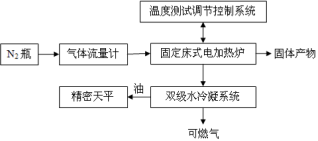
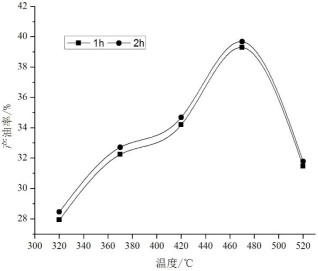
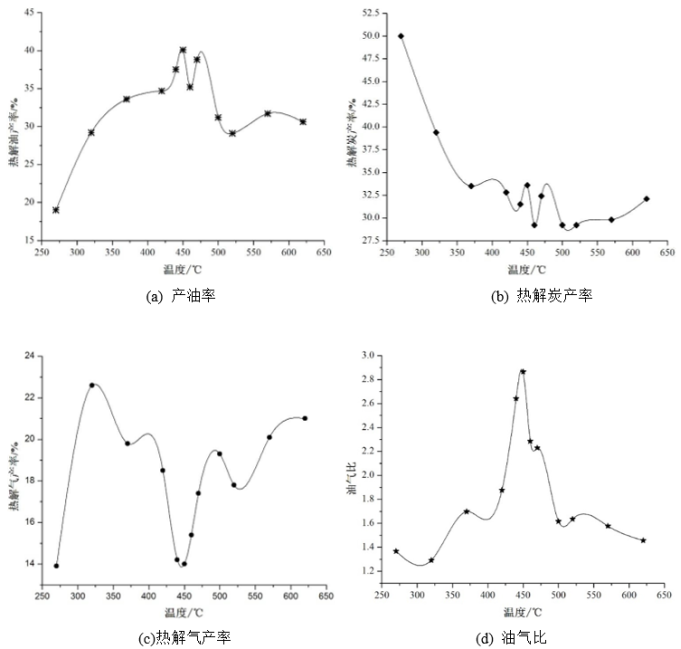
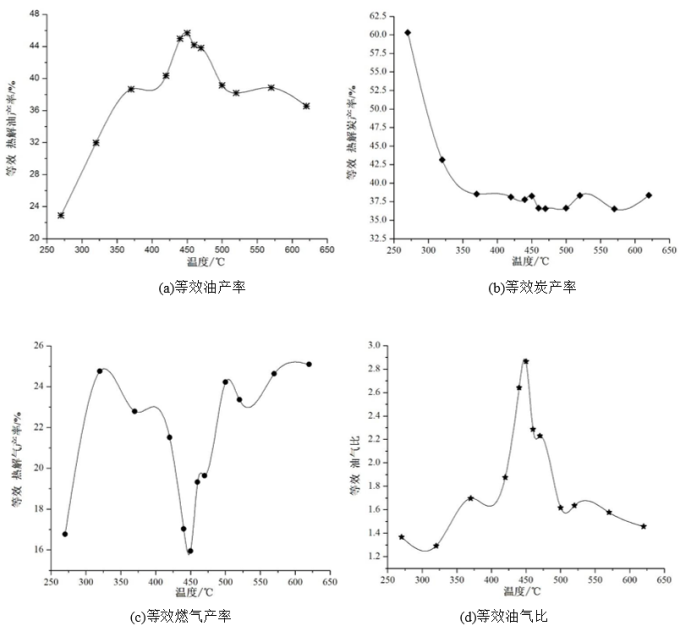
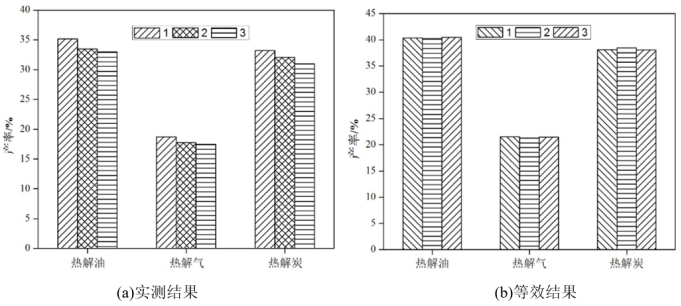
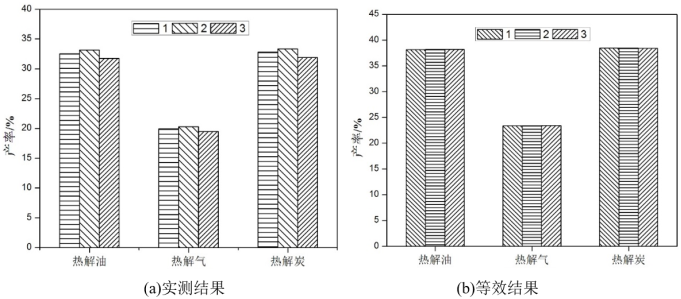
Pyrolysis of waste tires for oil production is an effective approach for resource utilization. To optimize the process parameters of fixed-bed pyrolysis of waste tires and clarify the product characteristics, this study employed a fixed-bed electric heating system to conduct pyrolysis experiments on waste tire chunks under a nitrogen atmosphere. The effects of pyrolysis time (1h and 2h) and pyrolysis temperature (270°C~620°C) on product yields were investigated, and the reliability of the experimental data was verified through repeated tests. Furthermore, the chemical composition of the pyrolytic oil was analyzed using gas chromatography-mass spectrometry (GC-MS), while the pyrolytic char was subjected to proximate analysis, calorific value measurement, and ash fusibility testing. The results showed that extending the pyrolysis time from 1h to 2h resulted in a limited increase in oil yield (less than 1%), indicating that the tires were essentially completely cracked within 1h. As the pyrolysis temperature increased, the oil yield first rose and then declined. The optimal pyrolysis temperature range was 440°C~460°C, under which the oil yield reached 35.2%~40.1% and the oil-to-gas ratio was 2.3~2.9. The average yield of solid products ranged from 44% to 53%, with an average steel wire content of 15.5%. After the temperature exceeded 320°C, the pyrolytic carbon black yield stabilized at 29%~34%. A total of 218 effective components were detected in the pyrolytic oil, among which 13 substances, including limonene (11.87%), ethanol, and phenol, each accounted for more than 1%. The pyrolytic carbon black had a fixed carbon content exceeding 80%, a calorific value of approximately 30 MJ/kg, and an ash melting point ranging from 1170°C to 1220°C. This study provides data support for the optimization of fixed-bed pyrolysis processes for waste tires and the graded utilization of pyrolysis products.
| Published in | Science Research (Volume 14, Issue 5) |
| DOI | 10.11648/j.sr.20261405.19 |
| Page(s) | 328-334 |
| Creative Commons |
This is an Open Access article, distributed under the terms of the Creative Commons Attribution 4.0 International License (http://creativecommons.org/licenses/by/4.0/), which permits unrestricted use, distribution and reproduction in any medium or format, provided the original work is properly cited. |
| Copyright |
Copyright © The Author(s), 2026. Published by Science Publishing Group |
Waste Tires, Fixed-bed Pyrolysis, Pyrolytic Oil, Pyrolytic Carbon Black, Oil Yield, Pyrolysis Temperature, Resource Utilization
项目 | 结果 | |
|---|---|---|
元素分析(收到基,%) | C | 79.93 |
H | 6.69 | |
O | 4.44 | |
N | 0.49 | |
S | 1.67 | |
工业分析(干燥基,%) | M | 2.09 |
A | 7.56 | |
V | 59.98 | |
FC | 30.37 | |
热值(kJ/kg) | 33595.49 | |
序号 | 成分比例/% | 成分名称 |
|---|---|---|
1 | 11.87 | 柠檬油精 |
2 | 2.90 | 乙醇 |
3 | 2.28 | 苯酚 |
4 | 2.07 | 二甲基环辛二烯 |
5 | 1.69 | 二甲基八三烯 |
6 | 1.56 | 苯 |
7 | 1.49 | 喹啉 |
8 | 1.19 | 螺环烃 |
9 | 1.15 | 苯并噻唑 |
10 | 1.11 | 二氢化吡唑 |
11 | 1.10 | 双环庚烷 |
12 | 1.06 | 蛇麻烯 |
13 | 1.02 | 苯乙烯 |
项目 | 名称 | 结果 |
|---|---|---|
工业分析/% | 水分 | 0.84 |
灰分 | 14.18 | |
挥发分 | 4.49 | |
固定碳 | 80.49 | |
热值/kJ·kg-1 | 29721.92 | |
灰熔融性/°C | 变形温度 | 1172 |
软化温度 | 1224 | |
流动温度 | 1239 |
| [1] | 严智慧. 废旧轮胎热解制备炭材料装备及工艺研究 [D]. 河南科技学院, 2023. |
| [2] | 唐丹宁, 徐英志, 张远文, 王晓东等. 废轮胎的资源化处理与热解技术研究进展 [J]. 弹性体, 2026, 36(2): 71-76. |
| [3] | 纪德强, 彭佳, 王玉迎, 苑丹丹等. 废旧轮胎热解理论与技术研究进展 [J]. 材料工程, 2026, 54(4): 176-190. |
| [4] | 李伟, 杨程, 刘亚青, 王中天. 反应温度对废轮胎热解油催化加氢反应性能的影响 [J]. 石化技术与应用, 2025, 43(3): 187-191. |
| [5] | 赵光杰, 金建龙, 金亮, 毛宇炜等. 废轮胎与生物质共热解特性及产物分布研究 [J]. 低碳化学与化工, 2025, 50(6): 74-80. |
| [6] | 夏勇, 阳宇, 朱聪, 欧阳少波等. 废轮胎热解过程中的动力学与热力学特性及热解油组分分析 [J]. 低碳化学与化工, 2023, 48(4): 36-45. |
| [7] | 马良妍. 废轮胎分质转化及热解焦油催化提质性能研究 [D]. 大连理工大学, 2025. |
| [8] | 潘宇涵. 废轮胎梯级热解装置开发及产物高值化利用研究 [D]. 浙江大学, 2023. |
| [9] | 沈孟飞, 宋虎潮, 邢定一, 王博等. 废旧轮胎热解吸附强化重整制氢特性及经济性分析 [J]. 西安交通大学学报, 2024, 58(10): 222-232. |
| [10] | 吴淑澄. 废轮胎热解的化学品产物制炭黑关键工艺集成与10万t/a工程应用评估 [D]. 浙江大学, 2024. |
| [11] | 郭怡君, 李 军, 黄宏宇, 小林敬幸. 有机固体废弃物热解技术及热解气组成综述 [J]. 新能源进展, 2023, 11(2): 106-122. |
| [12] | 刘晓伟, 庞赟佶, 吴孟, 杨辰等. CaO原位催化废轮胎热解产气特性研究 [J]. 应用化工, 2026, 55(6): 1489-1494. |
| [13] | 单体仑, 高晓东, 田晓龙, 边慧光等. 多种动力学模型应用于废旧轮胎的热解机理研究 [J]. 橡胶工业, 2024, 71(3): 197-203. |
| [14] | 蒋好. 废轮胎高温热解特性及炭黑形成与调控机制研究 [D]. 华中科技大学, 2024. |
| [15] | 陈亚娟. 废轮胎热解/气化特性及反应机理研究 [D]. 北京交通大学, 2024. |
| [16] | 张鑫. 高温烟气热解废轮胎过程中硫及重金属的转化特性研究 [D]. 山东大学, 2024. |
| [17] | 郝东杰. 基于组分解析的废轮胎热解特性研究 [D]. 中北大学, 2025. |
| [18] | 王树宇, 薛志亮, 朱静, 付鑫等. 废弃全钢胎颗粒热解过程中质量和形态变化研究 [J]. 化工学报, 2025, 76(7): 3459-3467. |
| [19] | 吴孟. 氧化钙添加下废旧橡胶轮胎热裂解产物特性研究 [D]. 内蒙古科技大学, 2023. |
| [20] | 严智慧, 徐贝贝, 刘恒辰, 冯宜鹏等. 制备方法对废旧轮胎热解制备的炭材料性能的影响 [J]. 湖北理工学院学报, 2023, 39(4): 21-25. |
| [21] | 马玉芹. 城市固体废弃物热化学处理实验研究 [D]. 华北电力大学, 2014. |
APA Style
Fan, X., Yang, L., Chen, H. (2026). Study on Fuel Oil Production from Waste Tires via Fixed-Bed Pyrolysis. Science Research, 14(5), 328-334. https://doi.org/10.11648/j.sr.20261405.19
ACS Style
Fan, X.; Yang, L.; Chen, H. Study on Fuel Oil Production from Waste Tires via Fixed-Bed Pyrolysis. Sci. Res. 2026, 14(5), 328-334. doi: 10.11648/j.sr.20261405.19
@article{10.11648/j.sr.20261405.19,
  author = {Xiaoxu Fan and Liguo Yang and Hongjian Chen},
  title = {Study on Fuel Oil Production from Waste Tires via
Fixed-Bed Pyrolysis},
  journal = {Science Research},
  volume = {14},
  number = {5},
  pages = {328-334},
  doi = {10.11648/j.sr.20261405.19},
  url = {https://doi.org/10.11648/j.sr.20261405.19},
  eprint = {https://article.sciencepublishinggroup.com/pdf/10.11648.j.sr.20261405.19},
  abstract = {Pyrolysis of waste tires for oil production is an effective approach for resource utilization. To optimize the process parameters of fixed-bed pyrolysis of waste tires and clarify the product characteristics, this study employed a fixed-bed electric heating system to conduct pyrolysis experiments on waste tire chunks under a nitrogen atmosphere. The effects of pyrolysis time (1h and 2h) and pyrolysis temperature (270°C~620°C) on product yields were investigated, and the reliability of the experimental data was verified through repeated tests. Furthermore, the chemical composition of the pyrolytic oil was analyzed using gas chromatography-mass spectrometry (GC-MS), while the pyrolytic char was subjected to proximate analysis, calorific value measurement, and ash fusibility testing. The results showed that extending the pyrolysis time from 1h to 2h resulted in a limited increase in oil yield (less than 1%), indicating that the tires were essentially completely cracked within 1h. As the pyrolysis temperature increased, the oil yield first rose and then declined. The optimal pyrolysis temperature range was 440°C~460°C, under which the oil yield reached 35.2%~40.1% and the oil-to-gas ratio was 2.3~2.9. The average yield of solid products ranged from 44% to 53%, with an average steel wire content of 15.5%. After the temperature exceeded 320°C, the pyrolytic carbon black yield stabilized at 29%~34%. A total of 218 effective components were detected in the pyrolytic oil, among which 13 substances, including limonene (11.87%), ethanol, and phenol, each accounted for more than 1%. The pyrolytic carbon black had a fixed carbon content exceeding 80%, a calorific value of approximately 30 MJ/kg, and an ash melting point ranging from 1170°C to 1220°C. This study provides data support for the optimization of fixed-bed pyrolysis processes for waste tires and the graded utilization of pyrolysis products.},
 year = {2026}
}
TY  - JOUR
T1  - Study on Fuel Oil Production from Waste Tires via
Fixed-Bed Pyrolysis
AU  - Xiaoxu Fan
AU  - Liguo Yang
AU  - Hongjian Chen
Y1  - 2026/09/04
PY  - 2026
N1  - https://doi.org/10.11648/j.sr.20261405.19
DO  - 10.11648/j.sr.20261405.19
T2  - Science Research
JF  - Science Research
JO  - Science Research
SP  - 328
EP  - 334
PB  - Science Publishing Group
SN  - 2329-0927
UR  - https://doi.org/10.11648/j.sr.20261405.19
AB  - Pyrolysis of waste tires for oil production is an effective approach for resource utilization. To optimize the process parameters of fixed-bed pyrolysis of waste tires and clarify the product characteristics, this study employed a fixed-bed electric heating system to conduct pyrolysis experiments on waste tire chunks under a nitrogen atmosphere. The effects of pyrolysis time (1h and 2h) and pyrolysis temperature (270°C~620°C) on product yields were investigated, and the reliability of the experimental data was verified through repeated tests. Furthermore, the chemical composition of the pyrolytic oil was analyzed using gas chromatography-mass spectrometry (GC-MS), while the pyrolytic char was subjected to proximate analysis, calorific value measurement, and ash fusibility testing. The results showed that extending the pyrolysis time from 1h to 2h resulted in a limited increase in oil yield (less than 1%), indicating that the tires were essentially completely cracked within 1h. As the pyrolysis temperature increased, the oil yield first rose and then declined. The optimal pyrolysis temperature range was 440°C~460°C, under which the oil yield reached 35.2%~40.1% and the oil-to-gas ratio was 2.3~2.9. The average yield of solid products ranged from 44% to 53%, with an average steel wire content of 15.5%. After the temperature exceeded 320°C, the pyrolytic carbon black yield stabilized at 29%~34%. A total of 218 effective components were detected in the pyrolytic oil, among which 13 substances, including limonene (11.87%), ethanol, and phenol, each accounted for more than 1%. The pyrolytic carbon black had a fixed carbon content exceeding 80%, a calorific value of approximately 30 MJ/kg, and an ash melting point ranging from 1170°C to 1220°C. This study provides data support for the optimization of fixed-bed pyrolysis processes for waste tires and the graded utilization of pyrolysis products.
VL  - 14
IS  - 5
ER  -
Energy Research Institute of Shandong Academy of Sciences, Jinan, China
Energy Research Institute of Shandong Academy of Sciences, Jinan, China
Shandong Environmental Protection Industry Research Institute Co., Ltd., Jinan, China

Information



 Share This Article
 Twitter
 Linked In
 Facebook
 Copy
Copy Download