
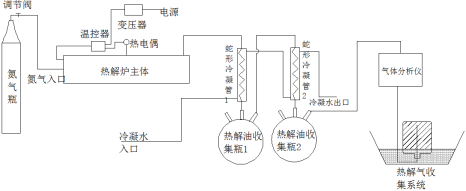
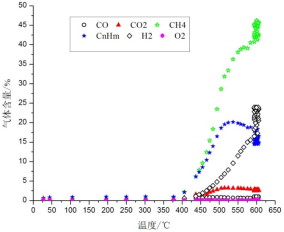
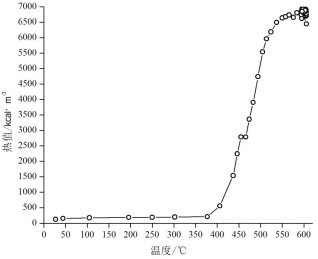
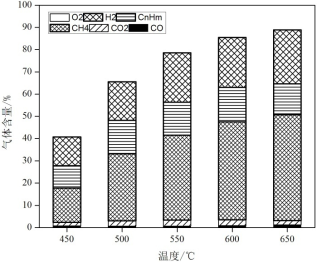
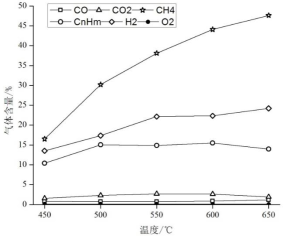
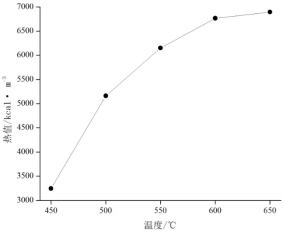
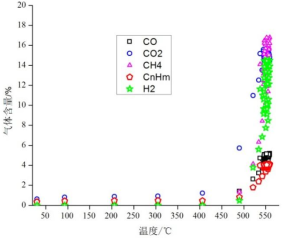
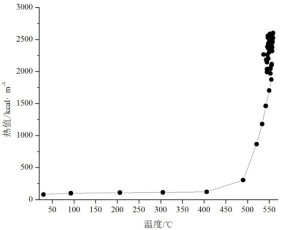
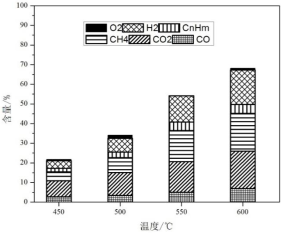
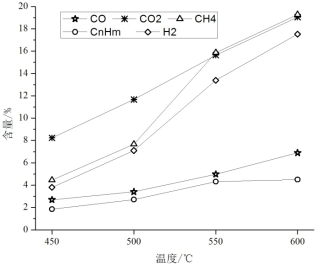
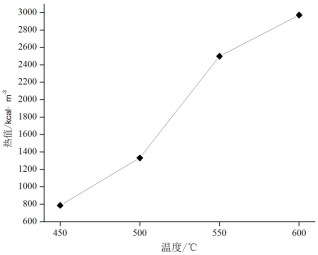
To investigate the gas product evolution characteristics and heating value variation of typical municipal solid wastes during fixed-bed pyrolysis, this study selected waste tires and municipal sewage sludge as research objects. Pyrolysis experiments were conducted in an externally heated fixed-bed reactor under nitrogen atmosphere. The composition, distribution characteristics of gas products, and their heating value variations with pyrolysis temperature were systematically examined for both materials, followed by a comparative analysis of their pyrolysis product properties. The results showed that the pyrolysis gas from waste tires was mainly composed of CH4, H2, and CnHm, accounting for more than 70% of the total gas, with CH4 reaching up to 47%, H2 up to 22%, and CnHm up to 15%. Each gas component began to evolve noticeably at approximately 400°C, and the CnHm content reached its peak around 530°C before declining due to intensified secondary cracking reactions. The heating value of tire pyrolysis gas increased significantly with the rising final temperature, reaching approximately 6800 kcal/m3 at 650°C, which is comparable to that of natural gas. For municipal sewage sludge, the pyrolysis gas was mainly composed of CO2, CH4, and H2. At final temperatures ≤500°C, CO2 accounted for the highest proportion, while CH4 became dominant above 500°C. The onset temperature for significant gas evolution was about 480°C, approximately 80°C higher than that of waste tires. The heating value of sludge pyrolysis gas approached 3000 kcal/m3 at 600°C, which was only about 40%–50% of that from waste tires. The differences in pyrolysis gas characteristics between the two materials originated from their intrinsic compositional distinctions: waste tires are rich in carbon and hydrogen with low ash and oxygen contents, favoring the generation of high-quality fuel gas, while sludge possesses high ash and oxygen contents, resulting in higher CO2 proportion and lower heating value in its pyrolysis gas. This study provides fundamental experimental data for the graded pyrolysis treatment and differentiated energy utilization of municipal solid wastes.
| Published in | Science Research (Volume 14, Issue 5) |
| DOI | 10.11648/j.sr.20261405.21 |
| Page(s) | 343-349 |
| Creative Commons |
This is an Open Access article, distributed under the terms of the Creative Commons Attribution 4.0 International License (http://creativecommons.org/licenses/by/4.0/), which permits unrestricted use, distribution and reproduction in any medium or format, provided the original work is properly cited. |
| Copyright |
Copyright © The Author(s), 2026. Published by Science Publishing Group |
Waste Tires, Municipal Sewage Sludge, Fixed-bed Pyrolysis, Pyrolysis Gas, Heating Value, Waste Resource Utilization
项目 | 轮胎 | 污泥 | |
|---|---|---|---|
元素分析(收到基,%) | C | 79.93 | 26.55 |
H | 6.69 | 3.73 | |
O | 4.44 | 21.53 | |
N | 0.49 | 2.67 | |
S | 1.67 | 2.57 | |
工业分析(干燥基,%) | M | 2.09 | 5.13 |
A | 7.56 | 39.49 | |
V | 59.98 | 47.24 | |
FC | 30.37 | 8.14 | |
热值(kJ/kg) | 33595.49 | 10820.53 | |
| [1] | 生态环境部固体废物与化学品管理技术中心,《全国固体废物污染环境防治信息发布情况研究报告 (2025年)》. |
| [2] | 唐丹宁, 徐英志, 张远文, 王晓东等. 废轮胎的资源化处理与热解技术研究进展 [J]. 弹性体, 2026, 36(2): 71-76. |
| [3] | 纪德强, 彭佳, 王玉迎, 苑丹丹等. 废旧轮胎热解理论与技术研究进展 [J]. 材料工程, 2026, 54(4): 176-190. |
| [4] | 郭怡君, 李军, 黄宏宇, 小林敬幸. 有机固体废弃物热解技术及热解气组成综述 [J]. 新能源进展, 2023, 11(2): 106-122. |
| [5] | 单体仑, 高晓东, 田晓龙, 边慧光等. 多种动力学模型应用于废旧轮胎的热解机理研究 [J]. 橡胶工业, 2024, 71(3): 197-203. |
| [6] | 夏勇, 阳宇, 朱聪, 欧阳少波等. 废轮胎热解过程中的动力学与热力学特性及热解油组分分析 [J]. 低碳化学与化工, 2023, 48(4): 36-45. |
| [7] | 陈亚娟. 废轮胎热解/气化特性及反应机理研究 [D]. 北京交通大学, 2024. |
| [8] | 赵光杰, 金建龙, 金 亮, 毛宇炜等. 废轮胎与生物质共热解特性及产物分布研究 [J]. 低碳化学与化工, 2025, 50(6): 74-80. |
| [9] | 严智慧. 废旧轮胎热解制备炭材料装备及工艺研究 [D]. 河南科技学院, 2023. |
| [10] | 李伟, 杨程, 刘亚青, 王中天. 反应温度对废轮胎热解油催化加氢反应性能的影响 [J]. 石化技术与应用, 2025, 43(3): 187-191. |
| [11] | 吴孟. 氧化钙添加下废旧橡胶轮胎热裂解产物特性研究 [D]. 内蒙古科技大学, 2023. |
| [12] | 刘晓伟, 庞赟佶, 吴孟, 杨辰等. CaO原位催化废轮胎热解产气特性研究 [J]. 应用化工, 2026, 55(6): 1489-1494. |
| [13] | 蒋好. 废轮胎高温热解特性及炭黑形成与调控机制研究 [D]. 华中科技大学, 2024. |
| [14] | 张鑫. 高温烟气热解废轮胎过程中硫及重金属的转化特性研究 [D]. 山东大学, 2024. |
| [15] | 郝东杰. 基于组分解析的废轮胎热解特性研究 [D]. 中北大学, 2025. |
| [16] | 杨金国, 欧志明, 夏明贵, 邹灵松等. 城市化背景下污泥循环流化床气化能源化利用路径研究 [J]. 中国资源综合利用, 2026, 44(5): 113-115. |
| [17] | 史广宇, 沈新怡. 共热解技术对污泥中重金属的固定及资源化利用研究进展 [J]. 应用化工, 2026, 35(2): 323-332. |
| [18] | 李廉明, 潘煜, 宋焜, 李培等. 市政污泥与废塑料共热解特性及动力学研究 [J]. 可再生能源, 2026, 44(1): 8-16. |
| [19] | 姜锦山, 林熙宜, 吴汉军, 潘志权等. 污泥热解炭中持久性自由基的生成与调控研究 [J]. 环境科学与技术, 2026, 49(5): 31-39. |
APA Style
Fan, X., Yang, L., Chen, H. (2026). Experimental Study on Fixed-Bed Pyrolysis of Municipal Solid Waste. Science Research, 14(5), 343-349. https://doi.org/10.11648/j.sr.20261405.21
ACS Style
Fan, X.; Yang, L.; Chen, H. Experimental Study on Fixed-Bed Pyrolysis of Municipal Solid Waste. Sci. Res. 2026, 14(5), 343-349. doi: 10.11648/j.sr.20261405.21
@article{10.11648/j.sr.20261405.21,
  author = {Xiaoxu Fan and Liguo Yang and Hongjian Chen},
  title = {Experimental Study on Fixed-Bed Pyrolysis of Municipal Solid Waste},
  journal = {Science Research},
  volume = {14},
  number = {5},
  pages = {343-349},
  doi = {10.11648/j.sr.20261405.21},
  url = {https://doi.org/10.11648/j.sr.20261405.21},
  eprint = {https://article.sciencepublishinggroup.com/pdf/10.11648.j.sr.20261405.21},
  abstract = {To investigate the gas product evolution characteristics and heating value variation of typical municipal solid wastes during fixed-bed pyrolysis, this study selected waste tires and municipal sewage sludge as research objects. Pyrolysis experiments were conducted in an externally heated fixed-bed reactor under nitrogen atmosphere. The composition, distribution characteristics of gas products, and their heating value variations with pyrolysis temperature were systematically examined for both materials, followed by a comparative analysis of their pyrolysis product properties. The results showed that the pyrolysis gas from waste tires was mainly composed of CH4, H2, and CnHm, accounting for more than 70% of the total gas, with CH4 reaching up to 47%, H2 up to 22%, and CnHm up to 15%. Each gas component began to evolve noticeably at approximately 400°C, and the CnHm content reached its peak around 530°C before declining due to intensified secondary cracking reactions. The heating value of tire pyrolysis gas increased significantly with the rising final temperature, reaching approximately 6800 kcal/m3 at 650°C, which is comparable to that of natural gas. For municipal sewage sludge, the pyrolysis gas was mainly composed of CO2, CH4, and H2. At final temperatures ≤500°C, CO2 accounted for the highest proportion, while CH4 became dominant above 500°C. The onset temperature for significant gas evolution was about 480°C, approximately 80°C higher than that of waste tires. The heating value of sludge pyrolysis gas approached 3000 kcal/m3 at 600°C, which was only about 40%–50% of that from waste tires. The differences in pyrolysis gas characteristics between the two materials originated from their intrinsic compositional distinctions: waste tires are rich in carbon and hydrogen with low ash and oxygen contents, favoring the generation of high-quality fuel gas, while sludge possesses high ash and oxygen contents, resulting in higher CO2 proportion and lower heating value in its pyrolysis gas. This study provides fundamental experimental data for the graded pyrolysis treatment and differentiated energy utilization of municipal solid wastes.},
 year = {2026}
}
TY  - JOUR
T1  - Experimental Study on Fixed-Bed Pyrolysis of Municipal Solid Waste
AU  - Xiaoxu Fan
AU  - Liguo Yang
AU  - Hongjian Chen
Y1  - 2026/09/04
PY  - 2026
N1  - https://doi.org/10.11648/j.sr.20261405.21
DO  - 10.11648/j.sr.20261405.21
T2  - Science Research
JF  - Science Research
JO  - Science Research
SP  - 343
EP  - 349
PB  - Science Publishing Group
SN  - 2329-0927
UR  - https://doi.org/10.11648/j.sr.20261405.21
AB  - To investigate the gas product evolution characteristics and heating value variation of typical municipal solid wastes during fixed-bed pyrolysis, this study selected waste tires and municipal sewage sludge as research objects. Pyrolysis experiments were conducted in an externally heated fixed-bed reactor under nitrogen atmosphere. The composition, distribution characteristics of gas products, and their heating value variations with pyrolysis temperature were systematically examined for both materials, followed by a comparative analysis of their pyrolysis product properties. The results showed that the pyrolysis gas from waste tires was mainly composed of CH4, H2, and CnHm, accounting for more than 70% of the total gas, with CH4 reaching up to 47%, H2 up to 22%, and CnHm up to 15%. Each gas component began to evolve noticeably at approximately 400°C, and the CnHm content reached its peak around 530°C before declining due to intensified secondary cracking reactions. The heating value of tire pyrolysis gas increased significantly with the rising final temperature, reaching approximately 6800 kcal/m3 at 650°C, which is comparable to that of natural gas. For municipal sewage sludge, the pyrolysis gas was mainly composed of CO2, CH4, and H2. At final temperatures ≤500°C, CO2 accounted for the highest proportion, while CH4 became dominant above 500°C. The onset temperature for significant gas evolution was about 480°C, approximately 80°C higher than that of waste tires. The heating value of sludge pyrolysis gas approached 3000 kcal/m3 at 600°C, which was only about 40%–50% of that from waste tires. The differences in pyrolysis gas characteristics between the two materials originated from their intrinsic compositional distinctions: waste tires are rich in carbon and hydrogen with low ash and oxygen contents, favoring the generation of high-quality fuel gas, while sludge possesses high ash and oxygen contents, resulting in higher CO2 proportion and lower heating value in its pyrolysis gas. This study provides fundamental experimental data for the graded pyrolysis treatment and differentiated energy utilization of municipal solid wastes.
VL  - 14
IS  - 5
ER  -
Energy Research Institute of Shandong Academy of Sciences, Jinan, China
Energy Research Institute of Shandong Academy of Sciences, Jinan, China
Shandong Environmental Protection Industry Research Institute Co., Ltd., Jinan, China

Information



 Share This Article
 Twitter
 Linked In
 Facebook
 Copy
Copy Download