
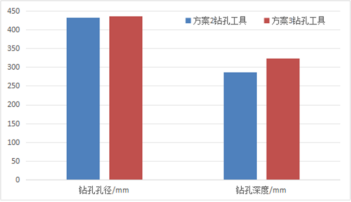
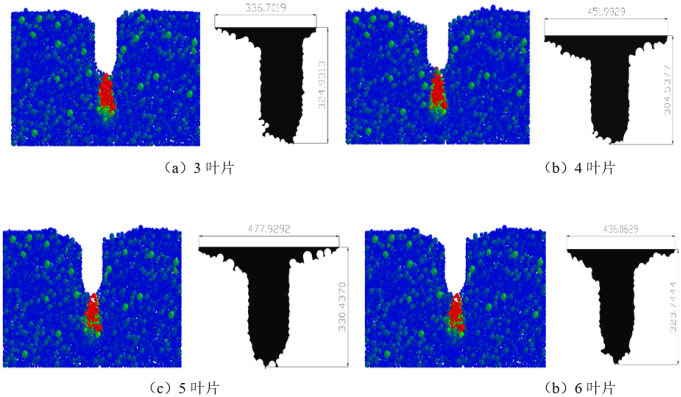
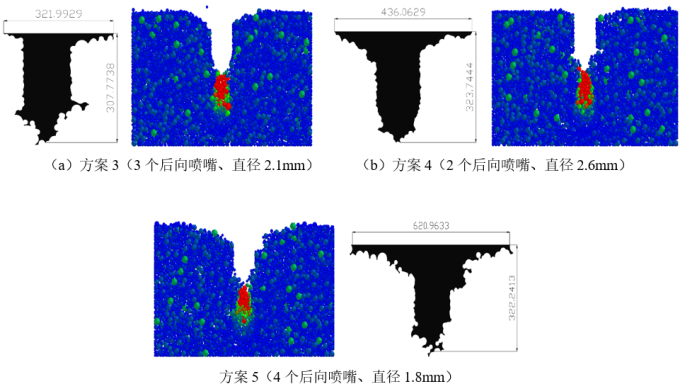
In terrestrial salt cavern gas storage facilities in regions such as Jintan, China, the development of mud interlayers in the formation causes sediment to accumulate at the bottom of the cavern after water-based dissolution, occupying nearly half of the effective storage capacity. To revitalize the void resources of sediment and optimize the rotary jetting drilling process at the cavern bottom, a CFD-DEM two-way coupled numerical simulation method was adopted. By considering both continuous flow of the drilling fluid and the discrete mechanical characteristics of the sediment particles, a numerical simulation study on rotary jetting drilling within the unlithified sediment of salt cavern was. The results show that: Through the coupled numerical simulation, the full-process dynamic characteristics of sediment particle mobilization, migration, and accumulation during the rotaryting drilling within the sediment can be reproduced, and the influence of different drilling flow rates on the sediment fragmentation efficiency and particle upward migration rate can be quantitatively analyzed. Flow rate and the structure of the drilling tool significantly affect the hole-forming effect of rotary jetting drilling within the sediment. Increasing the flow rate can enlarge the hole and depth, but the increase in drilling efficiency slows down after exceeding a critical value. At the same flow rate, the drilling tool with a small-diameter nozzle exhibits drilling efficiency within the sediment, and the nozzle diameter has a negligible effect on the hole-forming area. The drilling tool configured with a 5- guide impeller and3 rear-mounted reverse nozzles achieves the optimal drilling performance, and different nozzle structures correspond to exclusive optimal construction flow rate intervals. The research findings can provide a theoretical basis for the selection of drilling tools for salt cavity sludge, optimization of construction parameters, and the resource utilization of sludge in salt cavern gas storage facilities in regions such as Jintan.
| Published in | Science Research (Volume 14, Issue 5) |
| DOI | 10.11648/j.sr.20261405.24 |
| Page(s) | 365-374 |
| Creative Commons |
This is an Open Access article, distributed under the terms of the Creative Commons Attribution 4.0 International License (http://creativecommons.org/licenses/by/4.0/), which permits unrestricted use, distribution and reproduction in any medium or format, provided the original work is properly cited. |
| Copyright |
Copyright © The Author(s), 2026. Published by Science Publishing Group |
Salt Cavern Gas Storage, Unlithified Sediment, CFD-DEM Coupling, Drilling Efficiency
沉渣分层工况 | 内聚力C/kPa | 内摩擦角/(°) | 无侧限抗压强度/MPa |
|---|---|---|---|
表层松散沉渣 | 2~12 | 22~28 | <0.03 |
中部自重压实沉渣 | 18~35 | 29~33 | 0.05~0.18 |
深部高压压实沉渣 | 50~85 | 34~38 | 0.20~0.35 |
参数方案 | 前向喷嘴 | 后向喷嘴 | |||
|---|---|---|---|---|---|
出口直径 (mm) | 导流叶轮 参数 | 喷嘴数量 (个) | 出口直径 (mm) | 喷嘴轴线与工具轴线夹角(°) | |
方案1 | 8.0 | 右旋, 3、4、5、6叶片, 导程64mm | 3 | 4.1 | 30 |
方案2 | 5.5 | 3 | 2.9 | ||
方案3 | 4.1 | 3 | 2.1 | ||
方案4 | 4.1 | 2 | 2.6 | ||
方案5 | 4.1 | 4 | 1.8 | ||
参数 | 值 | 参数 | 值 |
|---|---|---|---|
颗粒泊松比 | 0.3 | 设备密度(kg/m3) | 7860 |
弹性模量(GPa) | 18 | 静摩擦系数(颗粒-颗粒) | 0.579 |
颗粒密度(kg/m3) | 2200 | 动摩擦系数(颗粒-颗粒) | 0.00192 |
设备泊松比 | 0.288 | 恢复系数(颗粒-设备) | 0.487 |
设备剪切模量(MPa) | 82.3 |
参数 | 值 | 参数 | 值 |
|---|---|---|---|
液体密度 | 1000 kg/m3 | 湍流模型 | 标准k-ε模型 |
液体粘度 | 0.001 Pa∙s | CFD时间步长 | 1E-4 |
颗粒相体积分数 | ≈60% | DEM时间步长 | 5E-6 |
液体相体积分数 | ≈40% | 耦合时间步长 | 1E-4 |
| [1] | 杨春和, 梁卫国, 魏东吼. 中国盐岩能源地下储存可行性研究 [J]. 岩石力学与工程学报, 2005, 24(24): 4409-4417. |
| [2] | 杨春和, 李银平, 陈锋, 等. 层状盐岩力学特性与地下储气库工程[M]. 北京:科学出版社, 2013. |
| [3] | 郑得文. 中国盐穴储气库建设关键技术 [R]. 北京:中国石油勘探开发研究院, 2014. |
| [4] | Berest, P., Brouard, B. , & Durup, J. G. Creep of salt in storage cavities. Oil & Gas Science and Technology , 2001, 56(3), 223-240. |
| [5] | Thoms, R. L., & Gehle, R. M. A brief history of salt cavern use. Solution Mining Research Institute, Fall Symposium , 2000, 1-20. |
| [6] | 任众鑫, 杨海军, 李建君, 等. 盐岩储库腔底堆积物空隙体积试验与计算 [J]. 西南石油大学学报(自然科学版), 2018, 40(2): 142-150. |
| [7] | 王建夫, 莫磊, 陈飞, 等. 多夹层盐矿全溶腔沉渣储气能力评价实验 [J]. 油气储运, 2023, 42(4): 450-456. |
| [8] | 张华宾, 余豪毅, 王来贵, 等. 沉渣颗粒影响下盐穴储气库变形破坏热力耦合分析 [J]. 天然气工业, 2024, 44(12): 137-150. |
| [9] | 李银平, 葛鑫博, 王兵武, 等. 盐穴水溶造腔建槽期不溶物运动性态及应用研究 [J]. 岩石力学与工程学报, 2016, 35(1): 114-122. |
| [10] | 李鹏, 李银平, 施锡林, 梁晓鹏. 多夹层盐矿水采沉渣空隙特征与储气能力评价 [J]. 岩土力学, 2022, 43 (01): 76-86. |
| [11] | 李朋, 施锡林, 李银平, 杨昆, 马洪岭, 杨春和. 沉渣型盐穴储库低位排卤井卤水-颗粒两相运移规律研究 [J]. 岩石力学与工程学报, 2026, 45(01): 218-235. |
| [12] | 陈祥胜, 李银平, 尹洪武, 等. 多夹层盐矿地下储气库气体渗漏评价方法 [J]. 岩土力学, 2016, 37(11): 3297-3304. |
| [13] | 彭丽, 王超, 李银平. 多夹层盐矿水采沉渣空隙特征与储气能力评价 [J]. 岩土力学, 2022, 43(1): 165-173. |
| [14] | Li P, Li Y P, Shi X L, et al. Frictional loss and permeability estimation of sediment in salt cavern: A combined approach of mathematical model, experimental validation, and numerical simulations[J]. Geoenergy Science and Engineering, 2025, 244: 213497. |
| [15] | 葛鑫博, 李银平, 李金龙, 施锡林, 马洪岭. 盐穴储库水溶造腔夹层垮塌块体下落性态及应用 [J]. 岩石力学与工程学报, 2023, 42 (04): 918?929. |
| [16] | 郭凯, 李建君, 郑贤斌. 盐穴储气库造腔过程夹层处理工艺--以西气东输金坛储气库为例 [J]. 油气储运, 2015, 34(2): 162-166. |
| [17] | 张义, 鲁俊, 李隽, 等. 利用腔底沉渣空隙扩大盐腔储气空间机理分析 [C]. 第33届全国天然气学术年会论文集 (05新能源及节能减排). 石油工业出版社, 2023. |
| [18] | Yi Zhang, Kun Zhang, Jun Li, et al. Study on Secondary Brine Drainage and Sand Control Technology of Salt Cavern Gas Storage [J]. Sustainability 2023, 15(10), 7793-7805. |
| [19] | Yi Zhang, Jun Lu, Jun Li, et al. The Flow Law of Brine and Sediment Particles in Gas-Driven Brine Drainage in the Sediments of Salt Cavern Gas Storage [J]. Sustainability 2023, 15(16), 12613-12626. |
| [20] | 任众鑫, 李建君, 汪会盟, 等. 基于分形理论的盐岩储气库腔底堆积物粒度分布特征 [J]. 油气储运, 2017, 36(3): 279-284. |
| [21] | 葛鑫博, 李银平, 王兵武. 盐穴不溶碎屑堆积体颗粒运移及堆积机制 [J]. 岩石力学与工程学报, 2017, 36(S1): 3456-3463. |
| [22] | Wang J, Li P, Bai W, Lu J, Fu X, Fu Y, Shi X. Mechanical Behavior of Sediment-Type High-Impurity Salt Cavern Gas Storage during Long-Term Operation [J]. Energies, 2024, 17(16): 3983. |
| [23] | 李朋, 李银平, 施锡林, 赵凯, 刘恺, 马洪岭. 地下储能盐腔不溶沉渣的压实与约束效应 [J]. Energy, 2022, 249: 123752. |
| [24] | 汪会盟, 李建君, 任众鑫. 金坛盐穴储气库腔底沉渣物理力学特性试验研究 [J]. 石油工程建设, 2018, 44(3):1-6. |
| [25] | Zhang Y, Zhou W D, Wang R H, Xian B A. Design of hydraulic self?rotating jet bit for coal seams [J]. Natural Gas Industry, 2008, 28(3): 61?63. |
| [26] | DEM Solutions Ltd. EDEM 2023 User Guide: Theory and Reference [M]. Edinburgh: DEM Solutions Ltd. , 2023: 45-78. |
| [27] | Chen, X. , Li, Y., Zhang, H. Influence of particle contact parameters on simulation accuracy in discrete element method. Journal of Agricultural Engineering , 2021, 37(8), 30–38. |
APA Style
Lu, J., Zhang, Y., Li, L., Li, J. (2026). Coupling Simulation of Drilling Behavior in Cavity Bottom Sediments of Salt Cavern Gas Storage. Science Research, 14(5), 365-374. https://doi.org/10.11648/j.sr.20261405.24
ACS Style
Lu, J.; Zhang, Y.; Li, L.; Li, J. Coupling Simulation of Drilling Behavior in Cavity Bottom Sediments of Salt Cavern Gas Storage. Sci. Res. 2026, 14(5), 365-374. doi: 10.11648/j.sr.20261405.24
AMA Style
Lu J, Zhang Y, Li L, Li J. Coupling Simulation of Drilling Behavior in Cavity Bottom Sediments of Salt Cavern Gas Storage. Sci Res. 2026;14(5):365-374. doi: 10.11648/j.sr.20261405.24
@article{10.11648/j.sr.20261405.24,
  author = {Jun Lu and Yi Zhang and Luopeng Li and Jun Li},
  title = {Coupling Simulation of Drilling Behavior in Cavity Bottom Sediments of Salt Cavern Gas Storage},
  journal = {Science Research},
  volume = {14},
  number = {5},
  pages = {365-374},
  doi = {10.11648/j.sr.20261405.24},
  url = {https://doi.org/10.11648/j.sr.20261405.24},
  eprint = {https://article.sciencepublishinggroup.com/pdf/10.11648.j.sr.20261405.24},
  abstract = {In terrestrial salt cavern gas storage facilities in regions such as Jintan, China, the development of mud interlayers in the formation causes sediment to accumulate at the bottom of the cavern after water-based dissolution, occupying nearly half of the effective storage capacity. To revitalize the void resources of sediment and optimize the rotary jetting drilling process at the cavern bottom, a CFD-DEM two-way coupled numerical simulation method was adopted. By considering both continuous flow of the drilling fluid and the discrete mechanical characteristics of the sediment particles, a numerical simulation study on rotary jetting drilling within the unlithified sediment of salt cavern was. The results show that: Through the coupled numerical simulation, the full-process dynamic characteristics of sediment particle mobilization, migration, and accumulation during the rotaryting drilling within the sediment can be reproduced, and the influence of different drilling flow rates on the sediment fragmentation efficiency and particle upward migration rate can be quantitatively analyzed. Flow rate and the structure of the drilling tool significantly affect the hole-forming effect of rotary jetting drilling within the sediment. Increasing the flow rate can enlarge the hole and depth, but the increase in drilling efficiency slows down after exceeding a critical value. At the same flow rate, the drilling tool with a small-diameter nozzle exhibits drilling efficiency within the sediment, and the nozzle diameter has a negligible effect on the hole-forming area. The drilling tool configured with a 5- guide impeller and3 rear-mounted reverse nozzles achieves the optimal drilling performance, and different nozzle structures correspond to exclusive optimal construction flow rate intervals. The research findings can provide a theoretical basis for the selection of drilling tools for salt cavity sludge, optimization of construction parameters, and the resource utilization of sludge in salt cavern gas storage facilities in regions such as Jintan.},
 year = {2026}
}
TY  - JOUR
T1  - Coupling Simulation of Drilling Behavior in Cavity Bottom Sediments of Salt Cavern Gas Storage
AU  - Jun Lu
AU  - Yi Zhang
AU  - Luopeng Li
AU  - Jun Li
Y1  - 2026/09/14
PY  - 2026
N1  - https://doi.org/10.11648/j.sr.20261405.24
DO  - 10.11648/j.sr.20261405.24
T2  - Science Research
JF  - Science Research
JO  - Science Research
SP  - 365
EP  - 374
PB  - Science Publishing Group
SN  - 2329-0927
UR  - https://doi.org/10.11648/j.sr.20261405.24
AB  - In terrestrial salt cavern gas storage facilities in regions such as Jintan, China, the development of mud interlayers in the formation causes sediment to accumulate at the bottom of the cavern after water-based dissolution, occupying nearly half of the effective storage capacity. To revitalize the void resources of sediment and optimize the rotary jetting drilling process at the cavern bottom, a CFD-DEM two-way coupled numerical simulation method was adopted. By considering both continuous flow of the drilling fluid and the discrete mechanical characteristics of the sediment particles, a numerical simulation study on rotary jetting drilling within the unlithified sediment of salt cavern was. The results show that: Through the coupled numerical simulation, the full-process dynamic characteristics of sediment particle mobilization, migration, and accumulation during the rotaryting drilling within the sediment can be reproduced, and the influence of different drilling flow rates on the sediment fragmentation efficiency and particle upward migration rate can be quantitatively analyzed. Flow rate and the structure of the drilling tool significantly affect the hole-forming effect of rotary jetting drilling within the sediment. Increasing the flow rate can enlarge the hole and depth, but the increase in drilling efficiency slows down after exceeding a critical value. At the same flow rate, the drilling tool with a small-diameter nozzle exhibits drilling efficiency within the sediment, and the nozzle diameter has a negligible effect on the hole-forming area. The drilling tool configured with a 5- guide impeller and3 rear-mounted reverse nozzles achieves the optimal drilling performance, and different nozzle structures correspond to exclusive optimal construction flow rate intervals. The research findings can provide a theoretical basis for the selection of drilling tools for salt cavity sludge, optimization of construction parameters, and the resource utilization of sludge in salt cavern gas storage facilities in regions such as Jintan.
VL  - 14
IS  - 5
ER  -
Underground Space Technology Research Institute, PipeChina Energy Storage Technology Co., Ltd., Shanghai, China
Oil and Gas Production Engineering Research Institute, PetroChina Research Institute of Petroleum Exploration and Development, Beijing, China
School of Petroleum Engineering, China University of Petroleum (East China), Qingdao, China
Oil and Gas Production Engineering Research Institute, PetroChina Research Institute of Petroleum Exploration and Development, Beijing, China

Information



 Share This Article
 Twitter
 Linked In
 Facebook
 Copy
Copy Download