
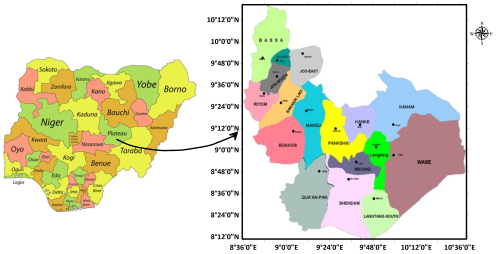
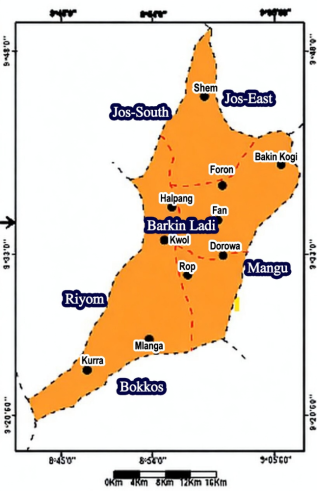
Radionuclides are found not only in the earth's crust but also in all of its environments, including soil, water, and the atmosphere. This is as a result of naturally occurring radioactive series of 238U and 232Th. Barkin Ladi Local Government Area is located in the heart of Northern Nigeria and is distinguished by its rough, low terrain. This area serves as the focal point for younger granites and is the primary center of tin and columbite mineralization. Samples were taken in February and July and examined with a gamma-ray spectrometer to evaluate seasonal variation in radionuclide concentrations. The average ranges of radionuclide concentrations are shown by the results In February: 40K (209.9957 ± 0.27 to 271.3964 ± 0.54 Bq/kg), 226Ra (69.3912 ± 0.16 to 98.0745 ± 0.88 Bq/kg), and 232Th (78.0992 ± 0.86 to 97.4741 ± 0.31 Bq/kg). In July: 40K (184.7383 ± 0.36 to 208.0652 ± 0.08 Bq/kg), 226Ra (65.9556 ± 0.40 to 78.4196 ± 0.76 Bq/kg), and 232Th (75.6379 ± 0.98 to 86.4623 ± 0.94 Bq/kg). The results show a decrease in 40K and 232Th concentrations during the wet season compared to the dry season, with an average decrease of 11.40% and 10.30%, respectively. All 40K results were below the recommended limit of 412 Bq/kg, while 226Ra and 232Th results exceeded the world averages of 33 Bq/kg and 45 Bq/kg, respectively. The pH, electrical conductivity (EC), and organic carbon (OC) values ranged from: Dry season: pH (4.20 - 5.81), EC (397.07 - 697), and OC (0.69 - 1.21). Wet season: pH (5.55 - 6.42), EC (302.16 - 489), and OC (0.43 - 0.86). Excess lifetime cancer risk (ELCR) values were highest in locations N (4.3 x 10⁻⁴) and F (4.2 x 10⁻⁴), indicating elevated cancer risk associated with radiation exposure in these areas. In conclusion, the study reveals that the soil samples in the different locations are polluted with radionuclides 226Ra and 232Th, particularly during the dry season. The results also suggest that people living in the study area may be at risk of developing cancer due to prolonged radiation exposure. Therefore, it is essential to take measures to mitigate radiation exposure and ensure the radiological safety of the area.
| Published in | World Journal of Applied Chemistry (Volume 11, Issue 2) |
| DOI | 10.11648/j.wjac.20261102.12 |
| Page(s) | 37-45 |
| Creative Commons |
This is an Open Access article, distributed under the terms of the Creative Commons Attribution 4.0 International License (http://creativecommons.org/licenses/by/4.0/), which permits unrestricted use, distribution and reproduction in any medium or format, provided the original work is properly cited. |
| Copyright |
Copyright © The Author(s), 2026. Published by Science Publishing Group |
Radionuclides, Soil, Mining Areas, Cancer
Isotope | Gamma Energy (keV) | Energy Window (keV) |
|---|---|---|
Ra-226 | 1764.0 | 1620-1820 |
Th-232 | 2614.5 | 2480-2820 |
K- 40 | 1460.0 | 1380-1550 |
SAMPLE ID | 40K (Bq/kg) | 226Ra (Bq/kg) | 232Th (Bq/kg) | pH | EC (S/m) | OC (%) |
|---|---|---|---|---|---|---|
M | 209.9957±0.27 | 76.6219±0.60 | 81.0756±0.55 | 4.42 | 697.00 | 0.94 |
N | 271.3964±0.54 | 98.0745±0.88 | 93.2645±0.43 | 5.34 | 465.01 | 0.69 |
F | 239.5431±0.48 | 88.8063±0.50 | 97.4741±0.31 | 4.98 | 528.67 | 0.96 |
B | 219.3265±0.91 | 73.3100±0.60 | 89.1831±0.20 | 5.34 | 397.07 | 0.99 |
C | 220.3651±0.16 | 74.1051±0.60 | 91.5159±0.79 | 5.11 | 567.01 | 0.73 |
K | 203.5607±0.80 | 69.3912±0.16 | 78.0992±0.86 | 5.81 | 473.09 | 1.06 |
L | 230.1587±0.75 | 70.4273±0.36 | 87.8778±0.67 | 4.95 | 625.33 | 1.21 |
Control | 120.1324±0.01 | 21.4729±0.02 | 18.6475±0.11 | 6.50 | 123.32 | 0.21 |
Permissible Limit | 412 | 33 | 45 |
Sample ID | 40k Bq/kg | 226Ra Bq/kg | 232Th Bq/kg | pH | EC (S/m) | OC % |
|---|---|---|---|---|---|---|
M | 208.0652±0.08 | 77.3015±0.12 | 86.4623±0.94 | 5.81 | 489.00 | 0.44 |
N | 217.1815±0.16 | 78.2199±0.76 | 76.5933±0.29 | 6.25 | 401.01 | 0.59 |
F | 184.7383±0.36 | 66.8744±0.48 | 83.5896±0.94 | 5.78 | 396.67 | 0.66 |
B | 193.5864±0.18 | 70.5059±0.28 | 77.0967±0.22 | 6.31 | 302.16 | 0.59 |
C | 204.5062±0.17 | 65.9556±0.40 | 69.7874±0.57 | 6.42 | 482.11 | 0.43 |
K | 183.7194±0.23 | 78.4196±0.76 | 75.6379±0.98 | 6.01 | 388.14 | 0.86 |
L | 199.6997±0.17 | 68.5858±0.60 | 82.1373±0.41 | 5.55 | 425.23 | 0.71 |
Control | 98.5631±0.70 | 20.4291±0.02 | 16.6472±0.62 | 6.90 | 93.23 | 0.11 |
Permissible Limit | 412 | 33 | 45 |
SAMPLING POINT | Dr (nGh-1) | AEDR (mSvy-1) | Ra eq (Bqkkg) | Hex | Hin | ELCR |
|---|---|---|---|---|---|---|
M | 95.85 | 0.12 | 217.01 | 0.59 | 0.79 | 4.1x10⁻⁴ |
N | 101.65 | 0.13 | 204.30 | 0.62 | 0.86 | 4.3x10⁻⁴ |
F | 98.04 | 0.12 | 221.98 | 0.60 | 0.81 | 4.2x10⁻⁴ |
B | 91.31 | 0.11 | 206.55 | 0.48 | 0.75 | 3.9x10⁻⁴ |
C | 88.59 | 0.11 | 200.72 | 0.54 | 0.73 | 3.8x10⁻⁴ |
K | 84.90 | 0.10 | 192.04 | 0.52 | 0.70 | 3.6x10⁻⁴ |
L | 89.50 | 0.11 | 207.03 | 0.56 | 0.75 | 3.9x10⁻⁴ |
CONTROL | 24.25 | 0.03 | 53.70 | 0.15 | 0.20 | 1.1x10⁻⁵ |
Permissible Limit | 60.00 | 0.50 | 370.00 | < 1 | < 1 | 2.7x10⁻⁴ |
Dr | Absorbed Dose Rate in Air |
AEDR | Annual Effective Dose Rate |
Raeq | Radium Equivalent |
Hex | External Hazard Index |
Hin | Internal Hazard Index |
ELCR | Excess Life Time Cancer Risk |
EC | Electrical Conductivity |
Ra | Radium |
Th | Thorium |
K | Potassium |
OC | Organic Carbon |
| [1] | J. P. McLaughlin, “Some characteristics and effects of natural radiation,” Radiation protection dosimetry 167 (2015) 2-7. |
| [2] | J. C. Bugher, “Radiation and human health”, American journal of public health and the nation's health, 47.6 (1957) 682-687. |
| [3] | N. R. Das, “Radiation in Everyday Life”, Indian Science Cruiser, 32 (2018) |
| [4] | A. H. Al-khawlany, A. R. Khan, & J. M. Pathan, “Review on studies in natural background radiation”, Radiation Protection and Environment, 41 (2018). 215 – 222 |
| [5] | S. E. L. İ. N. Özden, & S. A. Pehli̇vanoğlu, “Natural and Artificial Radioactivity Concentrations and Health Risks due to Radionuclides in the Soil of Nevşehir (Cappadocia)”, International Journal on Applied Physics and Engineering, 2 (2023) 144-151. |
| [6] | B. M. Mitrović, D. Todorovic, J. Ajtić, & B. Vranjes, “A review: Natural and artificial radionuclides and radiation hazard parameters in the soil of mountain regions in Serbia”, Journal of Agricultural Sciences, Belgrade, 65(2020). 1-18 |
| [7] | M. O. Isinkaye, “Natural radioactivity levels and the radiological health implications of tailing enriched soil and sediment samples around two mining sites in Southwest Nigeria”, Radiation Protection and Environment, 36 (2013), 122. |
| [8] | K. Thabayneh,“Measurement of activity concentration levels of radionuclides in soil samples collected from Bethlehem Province, West Bank, Palestine”, Turkish Journal of Engineering and Environmental Sciences (2015) |
| [9] | R. Mehra, & M. Singh, “Measurement of Radioactivity of 238U, 226 Ra, 232Th and 40K in Soil of Different Geological Origins in Northern India”, Journal of Environmental Protection, 02 (2011). 960-966. |
| [10] | R. C. Ramola, G. S. Gusain, M. Badoni, G. Prasad, & T. V. Ramachandran, “226Ra, 232Th and 40K contents in soil samples from Garhwal Himalaya, India, and its radiological implications,” Journal of Radiological Protection, 28, (2008). 379 – 385 |
| [11] | A. Ajithra, B. Venkatraman, M. T. Jose, S. Chandrasekar, & G. S Shanthi, “Assessment of natural radioactivity and associated radiation indices in soil samples from the high background radiation area, Kanyakumari district, Tamil Nadu, India”, Radiation Protection and Environment, 40 (2017). 27 - 33. |
| [12] | S. K. Sahoo, R. Kierepko, A. Sorimachi, Y. Omori, T. Ishikawa, S. Tokonami, G. Prasad, G. S. Gusain, & R. C. Ramola, “Natural Radioactivity Level and Elemental composition of Soil samples from a high background radiation area on eastern coast of India (Odisha)”, Radiationprotectiondosimetry, 171(2016).172-178 |
| [13] | UNSCotEoA, Radiation, and B. Annex. "Exposures from natural radiation sources." New York, United Nation (2000). |
| [14] | A. Ghazwa, B. S. H. Fauziah, & I. AbdulRahaman, “Assessment of Natural radioactiv- ity Levels and Radiation Hazard in Agricultural and Virgin Soil in the State of Kedah, Norht of Malaysia”, The scientific world Journal 1 (2016) 1-9. |
| [15] | A. El-Taher, “INAA and DNAA for uranium determination in geological samples from Egypt”, Applied Radiation and Isotopes, 68 2010) |
| [16] | B. H. Haribala, W. Chengguo, X. Gerilemandahu, Z. Shuai, B. Shanhu, & L. YUhong, “Assessment of Radioactive Materials and heavy metals in the surface soil around uranium mining area of Tongliao, China,” Ecotoxicology and Environmental Safety 30 (2017) 188-192 |
| [17] | Z. Korkulu, & N. Özkan, “Determination of natural radioactivity levels of beach sand samples in the black sea coast of Kocaeli (Turkey)”, Radiation Physics and Chemistry, 88 (2013). |
| [18] | A. O Ezekiel. Assessment of excess lifetime cancer risk from gamma radiation levels in Effurun and warri city of Delta State Nigeria. Journal of Taibah University for science, 11 (2017). |
| [19] | ICRP (International Commission of Radiological Protection). Nonstochastic effects of ionizing radiation, ICRP Publication No. 41. Oxford, Pergamon Press, (1991). (Annals of the ICRP 14, 3. |
| [20] | B. O. Ogori, S. Lubis, & G. Bakji, “Determination of the Concentrations of Radionuclides and Heavy Metals and Their Transfer Factor from Soil to Crops/Vegetables in Some Agricultural Soils in Barkin Ladi Area, Plateau State, Nigeria”. International Journal of research and innovation in applied Science (IJRIAS) 7 (2023) 124-130. |
| [21] | M. A. Shibdawa, S. Lubis, H. Adamu, & A. M. Bununu, “Assessment of the Level of Some Naturally Occurring Radioactive Element in Soil Used for Cultivation of Crops in Selected Farm Land in Barkin-Ladi Area, Plateau State, Nigeria”, International Journal of Applied Research and Technology. 8 (2019). 74 – 78 |
| [22] | S. S. Kekane, R. P. Chavan, D. N. Shinde, C. L. Patil, & S. S Sagar, “A review on physicochemical properties of soil”, International Journal of Chemical Studies 3(2015), 29-32. |
| [23] | O. A. Olatunji, E. T Komolafe, & S. O. Oke, “Seasonal Variation in Physicochemical Properties of Soil within the Vicinity of an Iron Smelting Factory - Implication on Standing Vegetation”, Notudea Scientia Biologicae, 8 (2016) 220-225 |
| [24] | M. A. Habib, T. Basuki, S. Miyashita, W. Bekelesi, S. Nakashima, K. Phoungthong, R. Khan, M. B. Rashid, A. R. Md, T. Isalm, & K. Techato, “Distribution of naturally occurring radionuclides in soil around a coal-based power plant and their potential radiological risk assessment”, Radiochimica Acta. 2(2018). |
| [25] | I. Smiciklas, & M. Sljivic-Ivanovic, “Radioactive Contamination of the Soil: Assessments of Pollutants Mobility with Implication to Remediation Strategies”, Soil Contamination. (2016). IntechOpen. Rijeka: chapter 13. |
| [26] | N. Rojas-Arias, M. A. Sandoval-Garzón, J. D. Medina-Higuera, L. Sajo-Bohus. S. A. Martínez-Ovalle “Seasonal Variation of the S-index as it Relates to the Concentration of 222Rn inside a bunker that stores radioactive material, 2020. |
| [27] |
M. Abd El-Zaher Seasonal variation of indoor radon concentration in dwellings of Alexandria city, Egypt. Radiat Prot Dosimetry. 2011 Jan; 143(1): 56-62.
https://doi.org/10.1093/rpd/ncq357 Epub 2010 Nov 9. 36 (2018). 137-147. |
| [28] | S M. Matsitsi, M. L. James, M. K. Jeremiah, & M. M. Onesmus “Effects of Seasonal Change on the Levels of Geogenic Radionuclides in Sand and Rocks from Tyaa River deposit in Kitui County.” International Journal of Fundamental Physical Sciences (2019): |
| [29] | B. S. Smith, D. P Child, D. Fierro, J. Harrison, H. Heijnis, M. Hotchkis,, M. P Johansen, S. K Marx, T. Payne, & A Zawadzki, “Measurement of fallout radionuclides, (239)(240) Pu and (137) Cs, in soil and creek sediment: Sydney Basin, Australia”, Journal of environmental radioactivity, 151. (2016). |
| [30] | F. Noli, P. Tsamos “Seasonal variations of natural radionuclides, minor and trace elements in lake sediments and water in a lignite mining area of North-Western Greece. Environmental Science Pollution Resource Int. 2018 25(13): 12222-12233. |
| [31] | A. J. Innocent, M. Y. Onimisi, & S. A. Jonah “ Evaluation of Naturally Occurring Radionuclide Materials in Soil Samples Collected From Some Mining Sites in Zamfara State, Nigeria”, British Journal of Applied Science & Technology, (2013). |
| [32] | USFDA (United States Food and Drug Administration). (2006) Biological Effects of Ionizing Radiation, HEW Publication (FDA) 77-8004. The USA. |
| [33] | Godwin I., Yakovleva V. & Nyabai, N. N. (2022) “Assessment of the Naturally Occurring Radioactive Materials (Norm) In Jos North, Nigeria. A Case Study of the Utan Artisanal Tin Mining Site” Journal of Genetic Engineering and Biotechnology Resources, 4 |
| [34] | J. A. Ademola, (2008). “Exposure to high background radiation levels in the mining areas of Jos Plateau Nigeria”, Journal of Radiological Protection, 28 93-97. |
| [35] | UNSCEAR “Sources and Effects of Ionizing Radiation: Report to the General Assembly, With Scientific Annexes”, 2, (2008) 1–219. United Nations, New York. |
| [36] | J. s Owusu-Banahene, J. K. Amoah, B. O. Manteaw, O. K. Adukpo, C. Kansaana, & E. O. Darko, “Radiation exposure levels in a gold mining area in Ghana,” Journal of Radiation Research and Applied Sciences, 11(2018). 137-144. |
| [37] | F. B. Masok, P. L. Masiteng, & J. I Daniel, “Natural Radioactivity Concentration and Effective Dose Rate from Jos Tin Mining Dumpsites in Rayfield, Nigeria”, Journal of Environment and Earth Science 5(2015), |
| [38] | Ion A., Cosac, A. and Ene, V. V. (2022). “Natural Radioactivity in Soil and Radiological Risk Assessment in Lis, ava Uranium Mining Sector, Banat Mountains, Romania”, Appl. Sci. 12, 12363. |
| [39] | Kolo M. T., Amin Y. M. and Khandaker M. U. (2017). Abdullah. Radionuclide concentrations and excess lifetime cancer risk due to gamma radioactivity in tailing enriched soil around Maiganga coal mine, Northeast Nigeria. International journal of radiation research. 15 |
APA Style
Lubis, S., Otokpa, O. B., Gomerep, B., Christopher, G. W. (2026). Seasonal Variation in the Concentrations of Radionuclides and Radiological Health Assessment of Some Tin Mining Areas of Barkin Ladi Lga of Plateau State Nigeria. World Journal of Applied Chemistry, 11(2), 37-45. https://doi.org/10.11648/j.wjac.20261102.12
ACS Style
Lubis, S.; Otokpa, O. B.; Gomerep, B.; Christopher, G. W. Seasonal Variation in the Concentrations of Radionuclides and Radiological Health Assessment of Some Tin Mining Areas of Barkin Ladi Lga of Plateau State Nigeria. World J. Appl. Chem. 2026, 11(2), 37-45. doi: 10.11648/j.wjac.20261102.12
AMA Style
Lubis S, Otokpa OB, Gomerep B, Christopher GW. Seasonal Variation in the Concentrations of Radionuclides and Radiological Health Assessment of Some Tin Mining Areas of Barkin Ladi Lga of Plateau State Nigeria. World J Appl Chem. 2026;11(2):37-45. doi: 10.11648/j.wjac.20261102.12
@article{10.11648/j.wjac.20261102.12,
  author = {Sati Lubis and Ogori Boniface Otokpa and Bakji Gomerep and Goshit Wubaknenkat Christopher},
  title = {Seasonal Variation in the Concentrations of Radionuclides and Radiological Health Assessment of Some Tin Mining Areas of Barkin Ladi Lga of Plateau State Nigeria},
  journal = {World Journal of Applied Chemistry},
  volume = {11},
  number = {2},
  pages = {37-45},
  doi = {10.11648/j.wjac.20261102.12},
  url = {https://doi.org/10.11648/j.wjac.20261102.12},
  eprint = {https://article.sciencepublishinggroup.com/pdf/10.11648.j.wjac.20261102.12},
  abstract = {Radionuclides are found not only in the earth's crust but also in all of its environments, including soil, water, and the atmosphere. This is as a result of naturally occurring radioactive series of 238U and 232Th. Barkin Ladi Local Government Area is located in the heart of Northern Nigeria and is distinguished by its rough, low terrain. This area serves as the focal point for younger granites and is the primary center of tin and columbite mineralization. Samples were taken in February and July and examined with a gamma-ray spectrometer to evaluate seasonal variation in radionuclide concentrations. The average ranges of radionuclide concentrations are shown by the results In February: 40K (209.9957 ± 0.27 to 271.3964 ± 0.54 Bq/kg), 226Ra (69.3912 ± 0.16 to 98.0745 ± 0.88 Bq/kg), and 232Th (78.0992 ± 0.86 to 97.4741 ± 0.31 Bq/kg). In July: 40K (184.7383 ± 0.36 to 208.0652 ± 0.08 Bq/kg), 226Ra (65.9556 ± 0.40 to 78.4196 ± 0.76 Bq/kg), and 232Th (75.6379 ± 0.98 to 86.4623 ± 0.94 Bq/kg). The results show a decrease in 40K and 232Th concentrations during the wet season compared to the dry season, with an average decrease of 11.40% and 10.30%, respectively. All 40K results were below the recommended limit of 412 Bq/kg, while 226Ra and 232Th results exceeded the world averages of 33 Bq/kg and 45 Bq/kg, respectively. The pH, electrical conductivity (EC), and organic carbon (OC) values ranged from: Dry season: pH (4.20 - 5.81), EC (397.07 - 697), and OC (0.69 - 1.21). Wet season: pH (5.55 - 6.42), EC (302.16 - 489), and OC (0.43 - 0.86). Excess lifetime cancer risk (ELCR) values were highest in locations N (4.3 x 10⁻⁴) and F (4.2 x 10⁻⁴), indicating elevated cancer risk associated with radiation exposure in these areas. In conclusion, the study reveals that the soil samples in the different locations are polluted with radionuclides 226Ra and 232Th, particularly during the dry season. The results also suggest that people living in the study area may be at risk of developing cancer due to prolonged radiation exposure. Therefore, it is essential to take measures to mitigate radiation exposure and ensure the radiological safety of the area.},
 year = {2026}
}
TY  - JOUR
T1  - Seasonal Variation in the Concentrations of Radionuclides and Radiological Health Assessment of Some Tin Mining Areas of Barkin Ladi Lga of Plateau State Nigeria
AU  - Sati Lubis
AU  - Ogori Boniface Otokpa
AU  - Bakji Gomerep
AU  - Goshit Wubaknenkat Christopher
Y1  - 2026/05/29
PY  - 2026
N1  - https://doi.org/10.11648/j.wjac.20261102.12
DO  - 10.11648/j.wjac.20261102.12
T2  - World Journal of Applied Chemistry
JF  - World Journal of Applied Chemistry
JO  - World Journal of Applied Chemistry
SP  - 37
EP  - 45
PB  - Science Publishing Group
SN  - 2637-5982
UR  - https://doi.org/10.11648/j.wjac.20261102.12
AB  - Radionuclides are found not only in the earth's crust but also in all of its environments, including soil, water, and the atmosphere. This is as a result of naturally occurring radioactive series of 238U and 232Th. Barkin Ladi Local Government Area is located in the heart of Northern Nigeria and is distinguished by its rough, low terrain. This area serves as the focal point for younger granites and is the primary center of tin and columbite mineralization. Samples were taken in February and July and examined with a gamma-ray spectrometer to evaluate seasonal variation in radionuclide concentrations. The average ranges of radionuclide concentrations are shown by the results In February: 40K (209.9957 ± 0.27 to 271.3964 ± 0.54 Bq/kg), 226Ra (69.3912 ± 0.16 to 98.0745 ± 0.88 Bq/kg), and 232Th (78.0992 ± 0.86 to 97.4741 ± 0.31 Bq/kg). In July: 40K (184.7383 ± 0.36 to 208.0652 ± 0.08 Bq/kg), 226Ra (65.9556 ± 0.40 to 78.4196 ± 0.76 Bq/kg), and 232Th (75.6379 ± 0.98 to 86.4623 ± 0.94 Bq/kg). The results show a decrease in 40K and 232Th concentrations during the wet season compared to the dry season, with an average decrease of 11.40% and 10.30%, respectively. All 40K results were below the recommended limit of 412 Bq/kg, while 226Ra and 232Th results exceeded the world averages of 33 Bq/kg and 45 Bq/kg, respectively. The pH, electrical conductivity (EC), and organic carbon (OC) values ranged from: Dry season: pH (4.20 - 5.81), EC (397.07 - 697), and OC (0.69 - 1.21). Wet season: pH (5.55 - 6.42), EC (302.16 - 489), and OC (0.43 - 0.86). Excess lifetime cancer risk (ELCR) values were highest in locations N (4.3 x 10⁻⁴) and F (4.2 x 10⁻⁴), indicating elevated cancer risk associated with radiation exposure in these areas. In conclusion, the study reveals that the soil samples in the different locations are polluted with radionuclides 226Ra and 232Th, particularly during the dry season. The results also suggest that people living in the study area may be at risk of developing cancer due to prolonged radiation exposure. Therefore, it is essential to take measures to mitigate radiation exposure and ensure the radiological safety of the area.
VL  - 11
IS  - 2
ER  -
Department of Chemistry, Federal University of Education, Pankshin, Nigeria

Information


 Share This Article
 Twitter
 Linked In
 Facebook
 Copy
Copy Download