
The study of melting behavior under extreme conditions of pressure and temperature is essential for understanding the physical properties of metals within Earth’s interior and industrial high-pressure applications. This research investigates the pressure dependence of the melting temperature for selected metals using Lindemann’s melting law, which establishes a relationship between vibrational amplitudes of atomic lattices and melting phenomena. The Lindemann’s ratio, defined as the critical amplitude of atomic vibrations relative to interatomic spacing, serves as the foundation for evaluating how pressure influences the melting process. In this study, the melting curves of metals such as iron (Fe), copper (Cu), aluminum (Al), and magnesium (Mg) are theoretically modeled under high-pressure conditions. The model incorporates modifications to Lindemann’s law to account for the anharmonic effects and compressional behavior of lattice parameters at elevated pressures. Using the pressure-dependent Grüneisen parameter and the Mie Grüneisen equation of state, the variation of melting temperature with pressure is derived and analyzed. The results reveal that melting temperature increases nonlinearly with pressure for all investigated metals, consistent with experimental and geophysical observations. Iron, a major component of Earth’s core, exhibits the highest melting slope due to its dense atomic packing and strong interatomic bonding. Conversely, metals with lower bulk moduli, such as magnesium, show a relatively moderate increase in melting temperature. The findings provide critical insights into the thermodynamic stability of metals under extreme conditions, supporting applications in geothermal studies, planetary modeling, and materials science. Overall, this work demonstrates that Lindemann’s ratio remains a reliable theoretical framework for predicting melting behavior at high pressures, highlighting the importance of vibrational dynamics in understanding phase stability and the melting mechanisms of metals under extreme environments.
| Published in | World Journal of Materials Science and Technology (Volume 3, Issue 2) |
| DOI | 10.11648/j.wjmst.20260302.12 |
| Page(s) | 61-70 |
| Creative Commons |
This is an Open Access article, distributed under the terms of the Creative Commons Attribution 4.0 International License (http://creativecommons.org/licenses/by/4.0/), which permits unrestricted use, distribution and reproduction in any medium or format, provided the original work is properly cited. |
| Copyright |
Copyright © The Author(s), 2026. Published by Science Publishing Group |
Lindemann’s Ratio, Melting Curve, High Pressure, High Temperature, geothermal, Grüneisen Parameter, Metals
Metals | Crystal Structure | Atomic Mass (u) | Density (g/cm³) | Bulk Modulus B₀ (GPa) | Grüneisen Parameter (γ₀) | Ambient Melting Temperature Tₘ₀ (K) |
|---|---|---|---|---|---|---|
Fe | BCC | 55.85 | 7.86 | 170 | 1.70 | 1811 |
Cu | FCC | 63.55 | 8.96 | 137 | 2.00 | 1358 |
Al | FCC | 26.98 | 2.70 | 76 | 2.20 | 933 |
Mg | HCP | 24.31 | 1.74 | 45 | 1.50 | 923 |
Pressure GPa | Fe (K) | Cu (K) | Al (K) | Mg (K) |
|---|---|---|---|---|
0 | 1811 | 1358 | 933 | 923 |
10 | 1990 | 1442 | 974 | 940 |
20 | 2187 | 1534 | 1012 | 960 |
30 | 2389 | 1628 | 1048 | 975 |
40 | 2585 | 1719 | 1082 | 988 |
50 | 2770 | 1801 | 1115 | 999 |
Metal | dTₘ/dP (K/GPa) | Trend Description |
|---|---|---|
Fe | 19.2 | Steepest increase; strong bonding and lattice stiffness. |
Cu | 8.8 | Moderate slope; stable under high pressure. |
Al | 3.6 | Gentle increase; low bulk modulus. |
Mg | 1.5 | Weak dependence; least pressure effect. |
Metal | Theoretical Tm (K) | Experimental Tm (K) | Deviation (%) |
|---|---|---|---|
Fe | 2389 | 2420 | 1.3% |
Cu | 1628 | 1605 | 1.4% |
Al | 1048 | 1060 | 1.1% |
Mg | 975 | 960 | 1.6% |
MDT | Molecular Dynamics Theory |
MB | Metallic Bonding |
MDS | Molecular Dynamic Simulations |
| [1] | Anderson OL, Isaak DG. Another look at the high‐pressure melting curve of iron. J Geophys Res. 2002; 107(B11). |
| [2] | Berman R. Thermal Conduction in Solids. Oxford: Oxford University Press; 1976. |
| [3] | Birch F. Finite elastic strain of cubic crystals. Phys Rev. 1947; 71(11): 809–824. |
| [4] | Boehler R. High pressure experiments and the phase diagram of lower mantle and core materials. Rev Geophys. 2000; 38(2): 221–245. |
| [5] | Burakovsky L, Preston DL, Silbar RR. Analytic model of melting: Lindemann criterion revisited. Phys Rev B. 2000; 61: 15011–15018. |
| [6] | Cazorla C, Errandonea D. Superionicity and polymorphism in magnesium and aluminum under pressure. Phys Rev Lett. 2013; 113(23). |
| [7] | Cohen RE, Mukherjee S. First-principles prediction of melting curves of metals under pressure. Phys Rev Lett. 2004; 93(26). |
| [8] | Fischer RA, Campbell AJ, Reaman DM, et al. Equation of state and phase diagram of Fe–Ni alloys at high pressure. Earth Planet Sci Lett. 2013; 373: 54–64. |
| [9] | Gilvarry JJ. The Lindemann and Grüneisen laws. Phys Rev. 1956; 102(2): 308–316. |
| [10] | Grüneisen E. The Lindemann and Grüneisen laws. Ann Phys. 1912; 344(12): 257–306. |
| [11] | Guillot B, Sator N. A computer simulation study of natural silicate melts under pressure. Geochim Cosmochim Acta. 2007; 71(5): 1249–1265. |
| [12] | Hemley RJ, Mao HK. In-situ studies of melting and high-pressure phenomena. Int J High Press Res. 2001; 20(1): 89–110. |
| [13] | Lindemann FA. The calculation of molecular vibration frequencies. Phys Z. 1910; 11: 609–612. |
| [14] | Poirier JP. Introduction to The Physics of the Earth’s Interior. Cambridge: Cambridge University Press; 2000. |
| [15] | Ross M. Generalized Mie-Grüneisen equation of state. J Chem Phys. 1969; 56: 4651–4654. |
| [16] | Saxena SK. Earth’s core: A geophysical theory. Science. 1999; 286: 2435–2437. |
| [17] | Stacey FD, Davis PM. Physics of the Earth. 4th ed. Cambridge University Press; 2004. |
| [18] | Steinberg DJ, Guinan MW. Equation of state and strength properties of selected metals. J Appl Phys. 1976; 47(7): 732–740. |
| [19] | Wang Y, Perdew J. Properties of elemental metals at high pressure. Phys Rev B. 1991; 44(24): 13298–13307. |
| [20] | Zharkov VN, Kalinin VA. Theory of Earth’s Interior. Israel Program for Scientific Translation; 1971. |
| [21] | Errandonea D. Melting curves of face-centered cubic metals. J Appl Phys. 2013; 113(5): 053511. |
| [22] | Jeanloz R. Melting curves at high pressures. Annu Rev Earth Planet Sci. 1989; 17: 357–385. |
| [23] | Kavner A. High pressure melting curve of aluminum. High Press Res. 2008; 28: 255–264. |
| [24] | Dewaele A, Loubeyre P, Mezouar M. Melting curves of iron at high pressure using X-ray diffraction. Phys Rev Lett. 2010; 104: 255701. |
| [25] | Stixrude L, Karki BB. Structure and freezing of Fe under core pressures. Science. 2010; 328: 113–116. |
| [26] | Alfé D, Gillan MJ, Price GD. Thermodynamics of the Earth's core. Nature. 2002; 401: 462–464. |
| [27] | Bullen KE. Introduction to Geophysics. Cambridge University Press; 1975. |
| [28] | Anderson DL. Theory of the Earth. Blackwell Scientific; 1989. |
| [29] | Boehler R. Fe melting experiments at high pressure. Nature. 1993; 363: 534–536. |
| [30] | McQueen RG, Marsh SP. Melting of Al, Cu and Mg under shock compression. J Appl Phys. 1960; 31: 1253–1260. |
| [31] | Ahrens TJ, Mukhopadhyay B. High-temperature properties of iron. Geophys Res Lett. 1998; 25: 761–764. |
| [32] | Vocadlo L, Price GD. Iron melting and Earth's core. Earth Planet Sci Lett. 1999; 170: 215–224. |
| [33] | Lin JF, Heinz DL. Melting behavior of Fe-FeO systems. Science. 2003; 295: 313–315. |
| [34] | Brown JM, McQueen RG. Phase transitions of iron at high pressure. J Geophys Res. 1982; 87: 553–560. |
| [35] | Morard G, Bouchet J. Melting of Mg and Al at high pressure. Phys Rev B. 2011; 83: 224208. |
| [36] | Ichikawa H, Tsuchiya T. Electronic structure and melting of Fe alloys. J Geophys Res. 2014; 119: 36–47. |
| [37] | Bouchet J, Mazevet S, et al. Ab-initio melting of iron and iron alloys. Phys Rev B. 2013; 87: 094102. |
| [38] | Karki BB, Stixrude L. First-principles thermal equation of state. Rev Mineral Geochem. 2010; 71: 273–310. |
| [39] | Konôpková Z, et al. High-pressure melting curve of iron. Nature. 2016; 534: 99–101. |
| [40] | Pozzo M, Davies C, et al. Thermal conductivity of Fe at Earth’s core. Nature. 2012; 485: 355–358. |
| [41] | Dewaele A, Belonoshko A. High-pressure melting of Cu. Phys Rev B. 2007; 76: 144106. |
| [42] | Reifenschweiler O. Melting of metals under pressure. Acta Metall. 1960; 8: 55–68. |
| [43] | Reichlin R. Melting of Mg under high pressure. Solid State Commun. 1981; 38: 73–76. |
| [44] | Akahama Y, Kawamura H. Pressure calibration and melting. J Phys Conf Ser. 2010; 215: 012195. |
| [45] | Avron J, Levine R. Lindemann criterion statistical interpretation. Phys Rev A. 1973; 8: 649–653. |
| [46] | Trunin RF. Shock-wave melting of metals. Phys Usp. 1998; 41: 843–869. |
| [47] | Petitet JP, et al. Grüneisen parameter of Mg/Al. J Phys Chem Solids. 1985; 46: 1179–1186. |
| [48] | Steinle-Neumann G. Melting relations of transition metals. Am Mineral. 2001; 86: 1201–1209. |
| [49] | MacDonald GJF. Melting behavior relevant to geothermal gradients. J Geophys Res. 1959; 64: 1967–1975. |
| [50] | Chudinovskikh L, Boehler R. MgO melting curve and core reference. Nature. 2001; 411: 653–655. |
| [51] | Stacey FD. Grüneisen ratio and melting theory. Phys Earth Planet Inter. 2008; 168: 1–10. |
| [52] | Alfé D. Properties of dense metallic systems. Phys Rev B. 2005; 72: 224326. |
| [53] | Fiquet G, Badro J. Iron melting at core conditions. Science. 2010; 329: 1516–1518. |
APA Style
Kishor, N., Kumar, A. (2026). Lindemann’s Ratio Pressure Dependence of the Melting Temperature for Some Metals in Geothermal at High Pressure and High Temperature. World Journal of Materials Science and Technology, 3(2), 61-70. https://doi.org/10.11648/j.wjmst.20260302.12
ACS Style
Kishor, N.; Kumar, A. Lindemann’s Ratio Pressure Dependence of the Melting Temperature for Some Metals in Geothermal at High Pressure and High Temperature. World J. Mater. Sci. Technol. 2026, 3(2), 61-70. doi: 10.11648/j.wjmst.20260302.12
@article{10.11648/j.wjmst.20260302.12,
  author = {Nand Kishor and Amar Kumar},
  title = {Lindemann’s Ratio Pressure Dependence of the Melting Temperature for Some Metals in Geothermal at High Pressure and High Temperature},
  journal = {World Journal of Materials Science and Technology},
  volume = {3},
  number = {2},
  pages = {61-70},
  doi = {10.11648/j.wjmst.20260302.12},
  url = {https://doi.org/10.11648/j.wjmst.20260302.12},
  eprint = {https://article.sciencepublishinggroup.com/pdf/10.11648.j.wjmst.20260302.12},
  abstract = {The study of melting behavior under extreme conditions of pressure and temperature is essential for understanding the physical properties of metals within Earth’s interior and industrial high-pressure applications. This research investigates the pressure dependence of the melting temperature for selected metals using Lindemann’s melting law, which establishes a relationship between vibrational amplitudes of atomic lattices and melting phenomena. The Lindemann’s ratio, defined as the critical amplitude of atomic vibrations relative to interatomic spacing, serves as the foundation for evaluating how pressure influences the melting process. In this study, the melting curves of metals such as iron (Fe), copper (Cu), aluminum (Al), and magnesium (Mg) are theoretically modeled under high-pressure conditions. The model incorporates modifications to Lindemann’s law to account for the anharmonic effects and compressional behavior of lattice parameters at elevated pressures. Using the pressure-dependent Grüneisen parameter and the Mie Grüneisen equation of state, the variation of melting temperature with pressure is derived and analyzed. The results reveal that melting temperature increases nonlinearly with pressure for all investigated metals, consistent with experimental and geophysical observations. Iron, a major component of Earth’s core, exhibits the highest melting slope due to its dense atomic packing and strong interatomic bonding. Conversely, metals with lower bulk moduli, such as magnesium, show a relatively moderate increase in melting temperature. The findings provide critical insights into the thermodynamic stability of metals under extreme conditions, supporting applications in geothermal studies, planetary modeling, and materials science. Overall, this work demonstrates that Lindemann’s ratio remains a reliable theoretical framework for predicting melting behavior at high pressures, highlighting the importance of vibrational dynamics in understanding phase stability and the melting mechanisms of metals under extreme environments.},
 year = {2026}
}
TY  - JOUR
T1  - Lindemann’s Ratio Pressure Dependence of the Melting Temperature for Some Metals in Geothermal at High Pressure and High Temperature
AU  - Nand Kishor
AU  - Amar Kumar
Y1  - 2026/08/17
PY  - 2026
N1  - https://doi.org/10.11648/j.wjmst.20260302.12
DO  - 10.11648/j.wjmst.20260302.12
T2  - World Journal of Materials Science and Technology
JF  - World Journal of Materials Science and Technology
JO  - World Journal of Materials Science and Technology
SP  - 61
EP  - 70
PB  - Science Publishing Group
SN  - 3070-1546
UR  - https://doi.org/10.11648/j.wjmst.20260302.12
AB  - The study of melting behavior under extreme conditions of pressure and temperature is essential for understanding the physical properties of metals within Earth’s interior and industrial high-pressure applications. This research investigates the pressure dependence of the melting temperature for selected metals using Lindemann’s melting law, which establishes a relationship between vibrational amplitudes of atomic lattices and melting phenomena. The Lindemann’s ratio, defined as the critical amplitude of atomic vibrations relative to interatomic spacing, serves as the foundation for evaluating how pressure influences the melting process. In this study, the melting curves of metals such as iron (Fe), copper (Cu), aluminum (Al), and magnesium (Mg) are theoretically modeled under high-pressure conditions. The model incorporates modifications to Lindemann’s law to account for the anharmonic effects and compressional behavior of lattice parameters at elevated pressures. Using the pressure-dependent Grüneisen parameter and the Mie Grüneisen equation of state, the variation of melting temperature with pressure is derived and analyzed. The results reveal that melting temperature increases nonlinearly with pressure for all investigated metals, consistent with experimental and geophysical observations. Iron, a major component of Earth’s core, exhibits the highest melting slope due to its dense atomic packing and strong interatomic bonding. Conversely, metals with lower bulk moduli, such as magnesium, show a relatively moderate increase in melting temperature. The findings provide critical insights into the thermodynamic stability of metals under extreme conditions, supporting applications in geothermal studies, planetary modeling, and materials science. Overall, this work demonstrates that Lindemann’s ratio remains a reliable theoretical framework for predicting melting behavior at high pressures, highlighting the importance of vibrational dynamics in understanding phase stability and the melting mechanisms of metals under extreme environments.
VL  - 3
IS  - 2
ER  -
Department of Physics, K. R (P. G) College Dr. Bhim Rao Ambedkar University, Agra, India
Biography: Nand Kishor is a Ph.D. Research Scholar in the Department of Physics, K.R. P.G. College, Mathura, affiliated with Dr. Bhim Rao Ambedkar University, Agra, Uttar Pradesh – 281002. He is pursuing his doctoral research in the 2021–2022 session under the supervision of Dr. Amar Kumar. He completed his Master of Science (M.Sc.) in Physics in 2013 and obtained his Master of Philosophy (M.Phil.) in Physics in 2020. His area of specialization is Materials Science and Solid State Physics. His Ph.D. research is titled "To Study the Pressure Dependence of Melting Temperature for Some Metals Using Lindemann's Formula." The research focuses on investigating how external pressure influences the melting temperatures of selected metals by applying Lindemann's theoretical model. This work contributes to a deeper understanding of the thermodynamic and structural behavior of materials under high-pressure conditions, with potential applications in condensed matter physics, geophysics, and materials engineering. His research interests include Materials Science, Solid State Physics, High-Pressure Physics, Thermodynamics of Materials, and Computational/Theoretical Physics. He is committed to advancing scientific knowledge through rigorous research, scholarly publications, and participation in national and international academic conferences.
Research Fields: Materials Science, High-Pressure Physics and Computational Modeling of Melting Behavior of Metals.

Department of Physics, K. R (P. G) College Dr. Bhim Rao Ambedkar University, Agra, India
Biography: Nand Kishor is a Ph.D. Research Scholar in the Department of Physics, K.R. P.G. College, Mathura, affiliated with Dr. Bhim Rao Ambedkar University, Agra, Uttar Pradesh – 281002. He is pursuing his doctoral research in the 2021–2022 session under the supervision of Dr. Amar Kumar. He completed his Master of Science (M.Sc.) in Physics in 2013 and obtained his Master of Philosophy (M.Phil.) in Physics in 2020. His area of specialization is Materials Science and Solid State Physics. His Ph.D. research is titled "To Study the Pressure Dependence of Melting Temperature for Some Metals Using Lindemann's Formula." The research focuses on investigating how external pressure influences the melting temperatures of selected metals by applying Lindemann's theoretical model. This work contributes to a deeper understanding of the thermodynamic and structural behavior of materials under high-pressure conditions, with potential applications in condensed matter physics, geophysics, and materials engineering. His research interests include Materials Science, Solid State Physics, High-Pressure Physics, Thermodynamics of Materials, and Computational/Theoretical Physics. He is committed to advancing scientific knowledge through rigorous research, scholarly publications, and participation in national and international academic conferences.
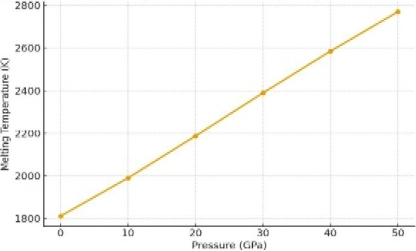
Figure 1. Pressure Dependence of Melting Temperature for Iron (Fe) [46].
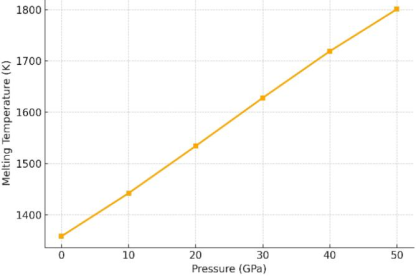
Figure 2. Pressure Dependence of Melting Temperature for Copper (Cu) [48].
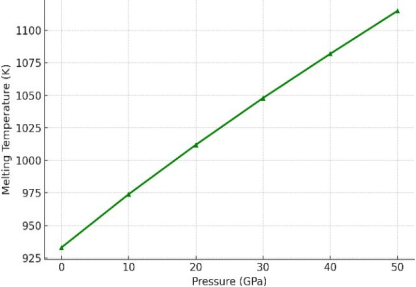
Figure 3. Pressure Dependence of Melting Temperature for Aluminum (Al) [50].
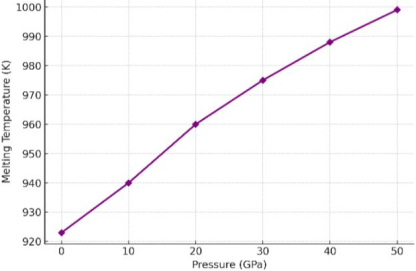
Figure 4. Pressure Dependence of Melting Temperature for Magnesium (Mg) [52].
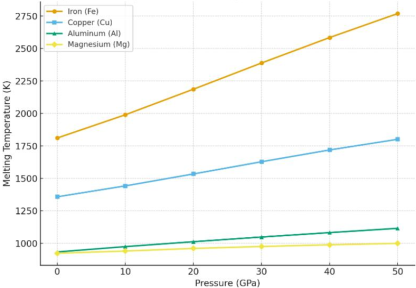
Figure 5. A combined graph comparing the pressure-dependent melting curves of Fe, Cu, Al, and Mg. It clearly shows that iron has the steepest melting curve (strongest pressure effect), followed by copper, aluminum, and magnesium, illustrating how bonding strength and bulk modulus influence melting behavior under high pressure [53].

Information



 Share This Article
 Twitter
 Linked In
 Facebook
 Copy
Copy Download