
The study of melting curves of metals under very high pressures and temperatures is essential for understanding their thermodynamic and structural behavior in extreme conditions. In this research, a theoretical model has been developed to predict the pressure dependence of the melting temperature for selected metals based on the Lindemann’s melting law and its modifications. The model relates the melting temperature to vibrational properties of the lattice, atomic volume, and Grüneisen parameter, enabling estimation of melting points at pressures beyond experimental limits. The theoretical framework assumes that melting occurs when the amplitude of atomic vibrations reaches a critical fraction of the interatomic spacing, and this criterion is used to derive a quantitative relationship between pressure and melting temperature. The proposed model has been applied to various metals such as aluminum, copper, iron, and nickel to compute their melting curves up to several hundred gigapascals. The calculated results show a strong agreement with available experimental and simulation data, indicating that the model effectively captures the essential physics of the melting process. The study reveals that the melting temperature increases nonlinearly with pressure, primarily due to the compression of atomic volume and enhanced lattice stability at high pressures. Furthermore, the model provides valuable insights into the influence of atomic mass, bulk modulus, and an harmonic effects on the melting behavior of metals. Such theoretical predictions are particularly important for fields like materials science, geophysics, and planetary science, where direct experimental measurements at extreme conditions are challenging. Overall, the developed model offers a reliable and simplified approach to estimate melting curves, contributing to a deeper understanding of phase stability and thermodynamic properties of metals under extreme environments.
| Published in | World Journal of Materials Science and Technology (Volume 3, Issue 3) |
| DOI | 10.11648/j.wjmst.20260303.12 |
| Page(s) | 82-88 |
| Creative Commons |
This is an Open Access article, distributed under the terms of the Creative Commons Attribution 4.0 International License (http://creativecommons.org/licenses/by/4.0/), which permits unrestricted use, distribution and reproduction in any medium or format, provided the original work is properly cited. |
| Copyright |
Copyright © The Author(s), 2026. Published by Science Publishing Group |
Melting Curve, High Pressure, Lindemann’s Melting Law, Theoretical Model, Metals, Phase Stability
Pressure (GPa) | Melting Temperature (K) |
|---|---|
0 | 933 |
10 | 1070 |
20 | 1205 |
40 | 1380 |
60 | 1525 |
80 | 1650 |
100 | 1760 |
150 | 1905 |
200 | 2020 |
Pressure (GPa) | Melting Temperature (K) |
|---|---|
0 | 1356 |
10 | 1505 |
20 | 1660 |
40 | 1850 |
60 | 1990 |
80 | 2105 |
100 | 2220 |
150 | 2405 |
200 | 2540 |
Pressure (GPa) | Melting Temperature (K) |
|---|---|
0 | 1811 |
20 | 2050 |
40 | 2300 |
60 | 2520 |
100 | 2900 |
150 | 3300 |
200 | 3650 |
250 | 3950 |
300 | 4250 |
Pressure (GPa) | Melting Temperature (K) |
|---|---|
0 | 1728 |
20 | 1920 |
40 | 2130 |
60 | 2320 |
80 | 2480 |
100 | 2620 |
150 | 2850 |
200 | 3050 |
250 | 3200 |
MDS | Molecular Dynamics Simulations |
PS | Phase Stability |
DFT | Density Function Theory |
MSD | Mean Squared Displacement |
EAM | Embedded Atom Method |
| [1] | Anderson, O. L., & Isaak, D. G. (2002). The high-temperature equation of state of iron and the Earth’s core. Journal of Geophysical Research: Solid Earth, 107(B12), 2371. |
| [2] | Alfe, D. (2009). Temperature and composition of the Earth’s core. Contemporary Physics, 48(2), 63–80. |
| [3] | Boehler, R. (1996). Melting temperature of the Earth’s mantle and core: Earth’s thermal structure. Annual Review of Earth and Planetary Sciences, 24, 15–40. |
| [4] | Burakovsky, L., & Preston, D. L. (2004). Analytic model of the Grüneisen parameter and melting curves. Journal of Physics: Condensed Matter, 16(21), 3943–3954. |
| [5] | Cohen, R. E., & Weitz, J. S. (1998). Theoretical determination of melting curves. Physics Today, 51(10), 24–29. |
| [6] | Dewaele, A., Loubeyre, P., & Mezouar, M. (2007). Equations of state of six metals above 94 GPa. Physical Review B, 76(14), 144106. |
| [7] | Errandonea, D. (2013). High-pressure melting curves of transition metals. Journal of Applied Physics, 113(3), 033513. |
| [8] | Gilvarry, J. J. (1956). The Lindemann and Grüneisen laws. Physical Review, 102(2), 308–316. |
| [9] | Guillot, T., & Sator, N. (2007). Theoretical modeling of planetary interiors. Geochimica et Cosmochimica Acta, 71(15), 4077–4096. |
| [10] | Hemley, R. J., & Mao, H. K. (2001). In situ studies of iron under pressure: New windows on the Earth’s core. International Geology Review, 43(1), 1–30. |
| [11] | Jackson, I. (1998). Elasticity, composition and temperature of the Earth’s lower mantle: A reappraisal. Geophysical Journal International, 134(1), 291–311. |
| [12] | Jeanloz, R., & Thompson, A. B. (1983). The nature of melting at high pressures. Annual Review of Earth and Planetary Sciences, 11(1), 377–404. |
| [13] | Kechin, V. V. (1995). Melting curve equations at high pressures. Physical Review B, 52(5), 3008–3011. |
| [14] | Koci, L., Ross, M., & Stixrude, L. (2007). Melting of iron at high pressures. Physical Review B, 75(21), 214108. |
| [15] | Kraus, R. G., & Stewart, S. T. (2014). Melting and vaporization of silicates by hypervelocity impact. Journal of Geophysical Research: Planets, 119(5), 988–1003. |
| [16] | Lindemann, F. A. (1910). The calculation of molecular vibration frequencies. Physical Review, 11, 609–612. |
| [17] | Luo, S. N., & Ahrens, T. J. (2003). Shock-induced melting of metals: Theoretical analysis and experimental data. Physics of the Earth and Planetary Interiors, 137(3–4), 197–211. |
| [18] | Mao, H. K., & Hemley, R. J. (1994). Ultrahigh-pressure transitions in solid hydrogen. Reviews of Modern Physics, 66(2), 671–692. |
| [19] | Morard, G., Bouchet, J., & Soubiran, F. (2018). The melting curve of iron at extreme pressures. Earth and Planetary Science Letters, 473, 94–103. |
| [20] | Myers, T. J., & Spera, F. J. (1998). The melting curves of simple metals. Journal of Chemical Physics, 108(4), 1963–1970. |
| [21] | Ross, M. (1969). Melting curves at high pressure. Physical Review, 184(1), 233–242. |
| [22] | Ross, M., & Hume, D. (1977). The melting of metals at high pressure. Reports on Progress in Physics, 40(12), 1251–1300. |
| [23] | Saxena, S. K., & Shen, G. (1992). Thermodynamics of solids at high pressure and temperature. Science, 257(5067), 1564–1566. |
| [24] | Shankar, R., & Chhabra, R. S. (2019). Modelling of melting temperature variation in transition metals. Materials Today: Proceedings, 9(3), 493–500. |
| [25] | Stacey, F. D., & Davis, P. M. (2008). Physics of the Earth (4th ed.). Cambridge University Press. |
| [26] | Stixrude, L., & Bukowinski, M. S. (1990). Fundamental thermodynamic theory of mineral systems. Reviews of Geophysics, 28(3), 495–532. |
| [27] | Stixrude, L., & Karki, B. B. (2005). Structure and freezing of iron at Earth’s core conditions. Science, 310(5746), 297–299. |
| [28] | Sugino, O., & Car, R. (1995). Ab initio molecular dynamics study of melting and premelting of metals. Physical Review Letters, 74(10), 1823–1826. |
| [29] | Wang, Y., & Saxena, S. K. (1993). Equation of state of iron and its implications for the Earth’s core. Physics of the Earth and Planetary Interiors, 74(3–4), 143–148. |
| [30] | Waseda, Y., & Suzuki, K. (1975). The Structure of Non-Crystalline Materials: Liquids and Amorphous Solids. McGraw-Hill. |
| [31] | Wasserman, E., Stixrude, L., & Cohen, R. E. (1996). Thermal properties of iron at high pressures and temperatures. Physical Review B, 53(13), 8296–8309. |
| [32] | Wood, B. J., & Rubie, D. C. (1996). The melting curve of iron and its implications for the Earth's core. Nature, 384(6609), 431–433. |
| [33] | Xu, J., & Zhang, J. (2000). Melting behavior of transition metals under pressure. High Pressure Research, 18(2), 211–220. |
| [34] | Yamamoto, T., & Ichikawa, T. (2005). A model for melting temperature under pressure. Physics and Chemistry of Minerals, 32(2), 85–91. |
| [35] | Zharkov, V. N., & Kalinin, V. A. (1971). Equation of state and melting of metals at high pressures. Soviet Physics Uspekhi, 14(3), 393–410. |
| [36] | Zhang, J., & Zhao, Y. (2005). Pressure dependence of melting temperature and Grüneisen parameter. Journal of Physics and Chemistry of Solids, 66(3), 487–492. |
| [37] | Zharkov, V. N., & Gudkova, T. V. (2010). Melting curves and phase transitions of planetary materials. Physics of the Earth and Planetary Interiors, 182(3–4), 193–198. |
| [38] | Zerr, A., & Boehler, R. (1993). Melting of metals at high pressures. Nature, 371(6494), 506–508. |
APA Style
Kishor, N., Kumar, A. (2026). Study the Melting Curves of Metals to Very High Pressure and Temperature Can Be Predicted by the Theoretical Model in Lindemann’s Melting Law. World Journal of Materials Science and Technology, 3(3), 82-88. https://doi.org/10.11648/j.wjmst.20260303.12
ACS Style
Kishor, N.; Kumar, A. Study the Melting Curves of Metals to Very High Pressure and Temperature Can Be Predicted by the Theoretical Model in Lindemann’s Melting Law. World J. Mater. Sci. Technol. 2026, 3(3), 82-88. doi: 10.11648/j.wjmst.20260303.12
@article{10.11648/j.wjmst.20260303.12,
  author = {Nand Kishor and Amar Kumar},
  title = {Study the Melting Curves of Metals to Very High Pressure and Temperature Can Be Predicted by the Theoretical Model in Lindemann’s Melting Law},
  journal = {World Journal of Materials Science and Technology},
  volume = {3},
  number = {3},
  pages = {82-88},
  doi = {10.11648/j.wjmst.20260303.12},
  url = {https://doi.org/10.11648/j.wjmst.20260303.12},
  eprint = {https://article.sciencepublishinggroup.com/pdf/10.11648.j.wjmst.20260303.12},
  abstract = {The study of melting curves of metals under very high pressures and temperatures is essential for understanding their thermodynamic and structural behavior in extreme conditions. In this research, a theoretical model has been developed to predict the pressure dependence of the melting temperature for selected metals based on the Lindemann’s melting law and its modifications. The model relates the melting temperature to vibrational properties of the lattice, atomic volume, and Grüneisen parameter, enabling estimation of melting points at pressures beyond experimental limits. The theoretical framework assumes that melting occurs when the amplitude of atomic vibrations reaches a critical fraction of the interatomic spacing, and this criterion is used to derive a quantitative relationship between pressure and melting temperature. The proposed model has been applied to various metals such as aluminum, copper, iron, and nickel to compute their melting curves up to several hundred gigapascals. The calculated results show a strong agreement with available experimental and simulation data, indicating that the model effectively captures the essential physics of the melting process. The study reveals that the melting temperature increases nonlinearly with pressure, primarily due to the compression of atomic volume and enhanced lattice stability at high pressures. Furthermore, the model provides valuable insights into the influence of atomic mass, bulk modulus, and an harmonic effects on the melting behavior of metals. Such theoretical predictions are particularly important for fields like materials science, geophysics, and planetary science, where direct experimental measurements at extreme conditions are challenging. Overall, the developed model offers a reliable and simplified approach to estimate melting curves, contributing to a deeper understanding of phase stability and thermodynamic properties of metals under extreme environments.},
 year = {2026}
}
TY  - JOUR
T1  - Study the Melting Curves of Metals to Very High Pressure and Temperature Can Be Predicted by the Theoretical Model in Lindemann’s Melting Law
AU  - Nand Kishor
AU  - Amar Kumar
Y1  - 2026/08/17
PY  - 2026
N1  - https://doi.org/10.11648/j.wjmst.20260303.12
DO  - 10.11648/j.wjmst.20260303.12
T2  - World Journal of Materials Science and Technology
JF  - World Journal of Materials Science and Technology
JO  - World Journal of Materials Science and Technology
SP  - 82
EP  - 88
PB  - Science Publishing Group
SN  - 3070-1546
UR  - https://doi.org/10.11648/j.wjmst.20260303.12
AB  - The study of melting curves of metals under very high pressures and temperatures is essential for understanding their thermodynamic and structural behavior in extreme conditions. In this research, a theoretical model has been developed to predict the pressure dependence of the melting temperature for selected metals based on the Lindemann’s melting law and its modifications. The model relates the melting temperature to vibrational properties of the lattice, atomic volume, and Grüneisen parameter, enabling estimation of melting points at pressures beyond experimental limits. The theoretical framework assumes that melting occurs when the amplitude of atomic vibrations reaches a critical fraction of the interatomic spacing, and this criterion is used to derive a quantitative relationship between pressure and melting temperature. The proposed model has been applied to various metals such as aluminum, copper, iron, and nickel to compute their melting curves up to several hundred gigapascals. The calculated results show a strong agreement with available experimental and simulation data, indicating that the model effectively captures the essential physics of the melting process. The study reveals that the melting temperature increases nonlinearly with pressure, primarily due to the compression of atomic volume and enhanced lattice stability at high pressures. Furthermore, the model provides valuable insights into the influence of atomic mass, bulk modulus, and an harmonic effects on the melting behavior of metals. Such theoretical predictions are particularly important for fields like materials science, geophysics, and planetary science, where direct experimental measurements at extreme conditions are challenging. Overall, the developed model offers a reliable and simplified approach to estimate melting curves, contributing to a deeper understanding of phase stability and thermodynamic properties of metals under extreme environments.
VL  - 3
IS  - 3
ER  -
Department of Physics, K. R (P. G) College Dr. Bhim Rao Ambedkar University, Agra, India
Biography: Nand Kishor is a Ph.D. Research Scholar in the Department of Physics, K. R. P. G. College, Mathura, affiliated with Dr. Bhim Rao Ambedkar University, Agra, Uttar Pradesh – 281002. He is pursuing his doctoral research in the 2021–2022 session under the supervision of Dr. Amar Kumar. He completed his Master of Science (M.Sc.) in Physics in 2013 and obtained his Master of Philosophy (M.Phil.) in Physics in 2020. His area of specialization is Materials Science and Solid State Physics. His Ph.D. research is titled "To Study the Pressure Dependence of Melting Temperature for Some Metals Using Lindemann's Formula." The research focuses on investigating how external pressure influences the melting temperatures of selected metals by applying Lindemann's theoretical model. This work contributes to a deeper understanding of the thermodynamic and structural behavior of materials under high-pressure conditions, with potential applications in condensed matter physics, geophysics, and materials engineering. His research interests include Materials Science, Solid State Physics, High-Pressure Physics, Thermodynamics of Materials, and Computational/Theoretical Physics. He is committed to advancing scientific knowledge through rigorous research, scholarly publications, and participation in national and international academic conferences.
Research Fields: Condensed Matter Physics (High-Pressure Materials Physics)

Department of Physics, K. R (P. G) College Dr. Bhim Rao Ambedkar University, Agra, India
Biography: Nand Kishor is a Ph.D. Research Scholar in the Department of Physics, K. R. P. G. College, Mathura, affiliated with Dr. Bhim Rao Ambedkar University, Agra, Uttar Pradesh – 281002. He is pursuing his doctoral research in the 2021–2022 session under the supervision of Dr. Amar Kumar. He completed his Master of Science (M.Sc.) in Physics in 2013 and obtained his Master of Philosophy (M.Phil.) in Physics in 2020. His area of specialization is Materials Science and Solid State Physics. His Ph.D. research is titled "To Study the Pressure Dependence of Melting Temperature for Some Metals Using Lindemann's Formula." The research focuses on investigating how external pressure influences the melting temperatures of selected metals by applying Lindemann's theoretical model. This work contributes to a deeper understanding of the thermodynamic and structural behavior of materials under high-pressure conditions, with potential applications in condensed matter physics, geophysics, and materials engineering. His research interests include Materials Science, Solid State Physics, High-Pressure Physics, Thermodynamics of Materials, and Computational/Theoretical Physics. He is committed to advancing scientific knowledge through rigorous research, scholarly publications, and participation in national and international academic conferences.
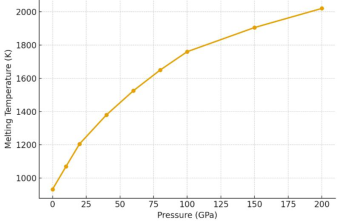
Figure 1. Showing the calculated melting curve of Aluminum (Al) illustrating how melting temperature increases nonlinearly with pressure, as predicted by the theoretical model [37].
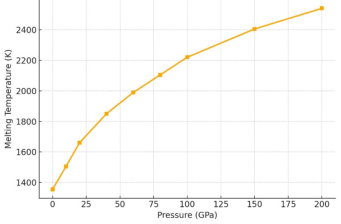
Figure 2. Showing the calculated melting curve of Copper (Cu) the melting temperature increases more steeply with pressure compared to Aluminum, consistent with Copper’s higher bulk modulus and stronger metallic bonding.
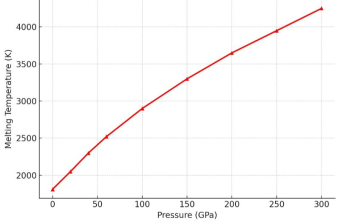
Figure 3. Showing the calculated melting curve of Iron (Fe) the curve rises steeply with increasing pressure, reflecting iron’s high lattice stiffness and strong interatomic bonding, critical for understanding the Earth’s core conditions.
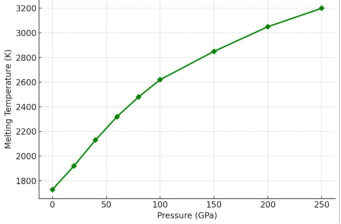
Figure 4. Showing the calculated melting curve of Nickel (Ni) displaying a moderate but steady increase in melting temperature with pressure, positioned between the behaviors of Copper and Iron, consistent with its intermediate bonding strength and bulk modulus.

Information



 Share This Article
 Twitter
 Linked In
 Facebook
 Copy
Copy Download