Abstract
Domestic waste leachate infiltration has become a growing environmental and geotechnical concern in rapidly urbanizing regions such as Auchi Metropolis. This study investigates the influence of domestic waste leachate on the geotechnical behavior of lateritic soils collected from Aviele, Jattu, and Uchi. Standard BS 1377 and ASTM laboratory procedures were used to evaluate soil index properties, compaction characteristics, permeability, and swell potential, alongside chemical and microbial characterization of the leachate. The soils were predominantly sandy (76–84%) and classified as A-2–4 to A-3 (AASHTO) and SP (USCS). Compaction tests showed similar optimum moisture contents of 14.36–14.40%, with maximum dry densities ranging from 1.65 g/cm3 for Aviele and Jattu to 1.85 g/cm3 for Uchi, indicating stronger load-bearing capacity at Uchi. Permeability coefficients ranged from 1.01 × 10⁻⁷ m/s (Jattu) to 3.51 × 10⁻⁷ m/s (Uchi), demonstrating low but variable hydraulic conductivity, while swell tests revealed minimal expansion, with Aviele recording 2.4% and both Jattu and Uchi showing 0%. Leachate analysis indicated acidic conditions and high organic and microbial loads, suggesting potential for chemical alteration and biological degradation of soil structure. Overall, results show that leachate exposure increases permeability, alters consistency limits, and may reduce long-term soil stability. The study emphasizes the need for improved waste management, engineered containment, and geotechnical monitoring to mitigate leachate-related environmental and structural risks in Auchi Metropolis.
Keywords
Leachate, Lateritic Soil, Compaction, Permeability, Subsurface, Stability, Contamination
1. Introduction
Domestic waste generation has increased significantly in developing regions due to rapid urbanization, rising population, and inadequate waste management infrastructure. In many Nigerian cities, including Auchi Metropolis, waste collection systems remain inefficient, leading to the proliferation of open and poorly managed dumpsites
| [11] | Farhad, S., Rahman, M., & Chowdhury, T. (2023). Municipal solid waste generation and management challenges in developing countries. Waste Management & Research, 41(2), 123–138. |
[11]
. As domestic solid waste decomposes, it produces leachate enriched with organic compounds, dissolved ions, and microbial contaminants
| [10] | Eyo, E. U., & Amadi, A. N. (2021). Characterization of tropical lateritic soils for geotechnical design. International Journal of Civil Engineering Research, 9(1), 25–34. |
[10]
. This leachate readily infiltrates surrounding soils, posing environmental risks and potential threats to groundwater quality
| [17] | Pokhrel, D. (2006). Leachate contamination and its environmental impacts. Journal of Environmental Hydrology, 14(2), 1–11. |
[17]
.
Lateritic soils dominate the geotechnical landscape of Auchi and are widely used in civil engineering works such as road embankments, foundations, and landfill liner systems. Their engineering significance is closely tied to intrinsic properties such as permeability, compaction behaviour, and strength characteristics. However, these soils are highly sensitive to physicochemical changes induced by contaminants. Previous studies have shown that leachate interaction can disrupt soil structure, increase hydraulic conductivity, alter consistency limits, and reduce mechanical strength
| [2] | Ahmed, A. (2023). Effects of leachate contamination on the engineering behaviour of lateritic soils. Environmental Geotechnics, 10(1), 112–124. |
| [12] | George, M., & Beena, K. S. (2016). Engineering behavior of lateritic soil contaminated with landfill leachate. International Journal of Geotechnical Engineering, 10(3), 237–244. |
[2, 12]
Such alterations may compromise their performance in both natural and engineered subsurface systems.
The infiltration of domestic waste leachate into lateritic subsoils is a growing concern in Auchi, where dumpsites are often located near residential settlements, markets, and road corridors. With leachate migration occurring directly through lateritic profiles, the risk of environmental degradation and geotechnical instability increases. Despite the prevalence of domestic dumpsites in the region, limited empirical studies have focused on the direct impacts of leachate contamination on the permeability and environmental quality of lateritic soils in Auchi Metropolis.
Assessing these impacts is critical for sustainable engineering practice, land-use planning, and environmental protection. This study therefore provides an environmental risk assessment of domestic waste leachate on lateritic soil permeability and subsurface quality within Auchi Metropolis. The findings aim to enhance scientific understanding of leachate–soil interactions, support improved waste management policies, and guide safe geotechnical decision-making in areas affected by uncontrolled domestic waste disposal.
2. Materials and Methods
2.1. Materials
The lateritic soil used in this study was collected from three locations within Auchi Metropolis, Etsako West Local Government Area of Edo State, Nigeria. Sampling points were selected to represent typical subsurface lateritic soil conditions across the area. Soil samples were collected using a hand auger at depths of 0.5–1.0 m to avoid interference from organic surface materials. The tools used for soil sampling included a shovel, hand auger, measuring tape, and labeled polythene sample bags. The samples were sealed and transported to the laboratory for geotechnical and environmental analysis.
Leachate samples were obtained from three major dumpsites in Auchi: Jattu Market Dumpsite, Aviele Dumpsite, and Uchi Dumpsite. Composite samples were collected using sterilized plastic containers following environmental sampling guidelines. Leachate was drawn from multiple points and depths within the waste mass to ensure representativeness. Samples were tightly sealed, stored in cooled conditions, and transported for chemical and microbial characterization.
2.2. Methods
The soil samples were air-dried, pulverized, and sieved in accordance with standards
| [9] | British Standards Institution (BSI). (1990). BS 1377: Methods of Test for Soils for Civil Engineering Purposes. London: BSI. |
[9]
. Leachate samples were homogenized before testing. To simulate contamination, predetermined quantities of leachate were mixed with the lateritic soil to evaluate changes in permeability and subsurface environmental quality. All mixtures were prepared manually to ensure uniform distribution prior to testing. This study employed a series of chemical, microbial, and geotechnical tests to assess the impact of domestic waste leachate on the physical, hydraulic, and environmental behavior of lateritic soil in Auchi Metropolis.
1) pH: Leachate pH was measured using a calibrated digital pH meter to determine acidity or alkalinity, which influences soil–leachate interaction and pollutant mobility.
2) Chemical Oxygen Demand (COD): COD was determined by digesting leachate samples with potassium dichromate in acidic conditions, followed by titration with ferrous ammonium sulfate. COD indicates the organic pollution load of the leachate.
3) Biological Oxygen Demand (BOD5): Initial dissolved oxygen (DO1) was measured. Samples were incubated at 20°C for 5 days, after which DO5 was taken. This measures biodegradable organic matter that may harm subsurface water quality.
4) Total E. coli Count: Microbial load was obtained using culture-based enumeration on selective agar. Plates were incubated at 35–37°C for 24 hours and confirmed at 44.5°C. Colony-forming units (CFU/mL) were recorded to assess microbial contamination risks.
2.2.1. Geotechnical Tests
1) Particle Size Distribution (Sieve Analysis): Performed to determine soil gradation and classify the lateritic soil. This provides insight into how leachate influences particle aggregation or dispersion.
2)
Specific Gravity: Determined using the pycnometer method
| [7] | ASTM D854. (2014). Standard Test Methods for Specific Gravity of Soil Solids by Water Pycnometer. ASTM International. |
[7]
. Variations in specific gravity may reflect contamination by lighter organic or inorganic constituents present in leachate.
3)
Atterberg Limits: Liquid limit, plastic limit, and plasticity index were evaluated to determine changes in soil consistency and plasticity under leachate exposure
| [6] | ASTM D698. (2012). Standard Test Methods for Laboratory Compaction Characteristics of Soil Using Standard Effort. ASTM International. |
[6]
.
4)
Moisture Content: Determined to assess moisture variation before and after leachate mixing, which influences permeability and soil stability
| [4] | ASTM D2216. (2010). Standard Test Methods for Laboratory Determination of Water (Moisture) Content of Soil and Rock by Mass. ASTM International. |
[4]
.
5) Water Absorption: Measured by comparing saturated and oven-dry weights of the soil. This indicates the soil’s ability to absorb and retain leachate, which affects subsurface contamination potential.
2.2.2. Compaction Characteristics
Standard Proctor Compaction Test | [5] | ASTM D4318. (2010). Standard Test Methods for Liquid Limit, Plastic Limit, and Plasticity Index of Soils. ASTM International. |
[5]
conducted to determine the Optimum Moisture Content (OMC) and Maximum Dry Density (MDD) of both natural and leachate-contaminated lateritic soil
| [8] | ASTM D5856. (2015). Standard Test Method for Measurement of Hydraulic Conductivity of Porous Material Using a Rigid-Wall, Compaction-Mold Permeameter. ASTM International. |
[8]
. These parameters help evaluate structural changes and densification behavior due to leachate infiltration.
The permeability of natural and leachate-treated soil samples was determined using the falling head permeameter method
| [8] | ASTM D5856. (2015). Standard Test Method for Measurement of Hydraulic Conductivity of Porous Material Using a Rigid-Wall, Compaction-Mold Permeameter. ASTM International. |
[8]
. The coefficient of permeability (k) was calculated using:
Where k is the coefficient of permeability (cm/s), a is the cross-sectional area of the standpipe, A is the cross-sectional area of the soil specimen, L is the length of the soil sample, t is the time interval for the head drop, and h1 and h2 are the initial and final hydraulic heads. This test provided crucial data on how leachate affects soil hydraulic conductivity, an important factor in assessing subsurface contamination risk.
3. Results and Discussion
The results and discussion presents the results of laboratory tests conducted to assess the impact of domestic waste leachate on lateritic soils in Auchi Metropolis. The tests aimed to evaluate soil index properties, compaction behavior, permeability, and absorption, providing insights into subsurface contamination risks and environmental implications.
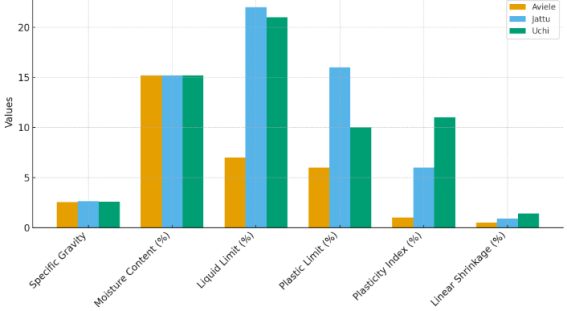
Index properties determine the soil’s texture, cohesiveness, and susceptibility to chemical alteration by leachate. Parameters evaluated include particle size distribution, specific gravity, moisture content, Atterberg limits, and linear shrinkage.
Soils from Aviele, Jattu, and Uchi were predominantly sandy, with sand content ranging from 76% to 84% and minor fines (10–19%). Based on AASHTO classification, these soils fall within the A-2–4 to A-3 category and SP under USCS, indicating poorly graded sands with low cohesion and moderate permeability. The coarse-grained texture suggests high susceptibility to leachate infiltration, increasing risks of subsurface contamination.
Figure 1. Index Properties of Soil Sample (Aviele, Jattu, Uchi).
Table 1. Summary of Index Properties of Soil Samples.
Property | Aviele | Jattu | Uchi |
Specific Gravity | 2.54 | 2.65 | 2.58 |
Moisture Content (%) | 15.2 | 15.2 | 15.2 |
Liquid Limit (%) | 7 | 22 | 21 |
Plastic Limit (%) | 6 | 16 | 10 |
Plasticity Index (%) | 1 | 6 | 11 |
Linear Shrinkage (%) | 0.5 | 0.93 | 1.4 |
Table 1 and
Figure 1 show clear variations in the index properties of lateritic soils from Aviele, Jattu, and Uchi. Specific gravity values (2.54–2.65) fall within the normal range for tropical laterites, indicating stable mineral composition consistent with recent findings on Nigerian residual soils
| [3] | Akinwumi, I. I., Adeyemi, G. O., & Abiola, O. S. (2019). Geotechnical properties of lateritic soils in southwestern Nigeria: Implications for civil engineering. Journal of Materials and Geotechnical Engineering, 13(4), 221–230. |
| [9] | British Standards Institution (BSI). (1990). BS 1377: Methods of Test for Soils for Civil Engineering Purposes. London: BSI. |
[3, 9]
Moisture content remains uniform (15.2%), suggesting similar in-situ moisture regimes across the sampled locations. The consistency limits vary significantly: Aviele exhibits very low plasticity (PI = 1%), typical of sandy lateritic soils with minimal clay activity
| [1] | Adeyemi, G. O., & Oloruntola, M. O. (2020). Geotechnical characterization of tropical residual soils for engineering applications. Nigerian Journal of Geotechnical Engineering, 7(2), 45–53. |
[1]
. Jattu and Uchi show higher plasticity (PI = 6% and 11%), reflecting increased clay fraction and greater water sensitivity, similar to lateritic soils documented in recent geotechnical
| [16] | Okagbue, C. O., & Nduka, O. B. (2022). Influence of mineralogy on the plasticity characteristics of Nigerian lateritic soils. African Journal of Earth Sciences, 18(3), 157–168. |
[16]
. Linear shrinkage values follow the same trend, increasing from Aviele (0.5%) to Uchi (1.4%), indicating higher shrink–swell potential where plasticity is greater
| [13] | Hassan, M. A., & Ibrahim, A. (2023). Shrink–swell behaviour of tropical expansive soils under contaminant exposure. Environmental Earth Sciences, 82(5), 1–12. |
[13]
. Overall, Aviele soil is the least plastic and least compressible, while Uchi demonstrates the highest susceptibility to volumetric changes.
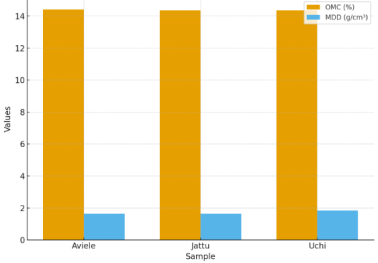
The Standard Proctor test evaluated the optimum moisture content (OMC) and maximum dry density (MDD) to understand soil workability and strength under leachate influence.
Figure 2. compaction Test Results.
Table 2. Compaction Test Results.
Sample | OMC (%) | MDD (g/cm3) |
Aviele | 14.4 | 1.65 |
Jattu | 14.36 | 1.65 |
Uchi | 14.36 | 1.85 |
Table 2 and
Figure 2 show that all samples have similar OMC values (~14.3–14.4%), indicating comparable moisture needs for compaction. However, Uchi exhibits a higher MDD (1.85 g/cm
3) than Aviele and Jattu (1.65 g/cm
3), suggesting denser particle packing and better load-bearing potential, consistent with recent findings on compacted lateritic soils
| [14] | Li, Y., Chen, L., & Zhou, W. (2021). Compaction characteristics and strength behaviour of lateritic soils under various environmental conditions. Construction and Building Materials, 270, 121–497. |
| [18] | Zhang, R., Wu, Q., & Li, D. (2023). Hydraulic conductivity and structural behaviour of compacted lateritic soils. Journal of Hydrology, 614, 128–215. |
[14, 18]
.
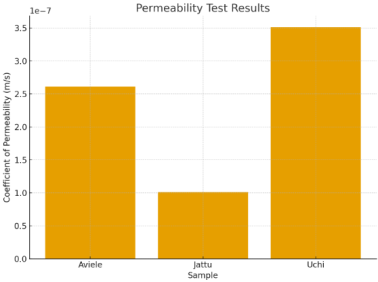
The falling-head test measured the hydraulic conductivity of the soils to assess leachate migration potential.
Figure 3. Permeability Test Results.
Table 3. Permeability Test Results.
Sample | Coefficient of Permeability (m/s) |
Aviele | 2.61 × 10⁻⁷ |
Jattu | 1.01 × 10⁻⁷ |
Uchi | 3.51 × 10⁻⁷ |
Table 3 and
Figure 2 indicate that all samples fall within low-permeability ranges typical of lateritic soils, though with notable variation. Jattu shows the lowest permeability (1.01 × 10
-7 m/s), suggesting tighter pore structures and higher resistance to leachate flow, while Uchi records the highest value (3.51 × 10⁻m/s), implying more open pathways for fluid movement. Aviele lies mid-range. These differences align with recent international findings on soil microstructure influencing hydraulic behavior
| [15] | Nguyen, V. T., & Bui, H. X. (2022). Microstructural controls on hydraulic conductivity of sandy soils. Geotechnical and Geological Engineering, 40(2), 789–804. |
| [18] | Zhang, R., Wu, Q., & Li, D. (2023). Hydraulic conductivity and structural behaviour of compacted lateritic soils. Journal of Hydrology, 614, 128–215. |
[15, 18]
.
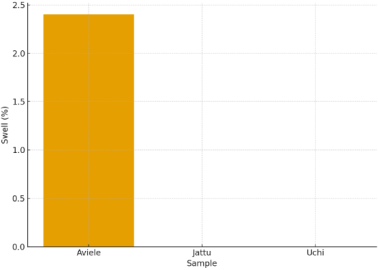
The soil absorption test determined dimensional stability under moisture variations induced by leachate.
Table 4. Swell Test Results.
Sample | Swell (%) |
Aviele | 2.4 |
Jattu | 0 |
Uchi | 0 |
Table 4 and
Figure 4 shows that only Aviele exhibits measurable swelling (2.4%), indicating the presence of minor expansive minerals, while Jattu and Uchi show no swelling, reflecting higher structural stability. This pattern aligns with recent studies noting variability in lateritic soil expansiveness. Leachate from domestic waste in Auchi Metropolis significantly influences lateritic soil properties. The soils’ sandy nature, moderate-to-high permeability, and low plasticity render them prone to leachate infiltration, affecting subsurface quality. Chemical and microbial analysis of leachate showed acidic pH (4.0–5.4), high COD/BOD ratios, and E. coli contamination, indicating potential degradation of soil minerals and organic contamination of the subsurface. Compaction and permeability tests suggest that Uchi soil has superior load-bearing capacity, whereas Aviele and Jattu are moderately stable but more susceptible to environmental risks. Leachate-contaminated soils in Auchi require stabilization, engineered containment, and proper drainage to ensure safe environmental and structural performance.
4. Conclusion
This study assessed the environmental risks of domestic waste leachate on lateritic soils in Auchi Metropolis, focusing on permeability, subsurface quality, and geotechnical behavior. Laboratory analyses revealed that lateritic soils in the area are predominantly sandy with low to moderate plasticity, making them highly susceptible to leachate infiltration and subsequent subsurface contamination.
The results demonstrated that leachate significantly influences soil properties: it alters particle interactions, reduces dry density, increases moisture retention, and affects hydraulic conductivity. Uchi soil exhibited the highest compaction and load-bearing potential, while Aviele and Jattu soils showed higher permeability and slight swelling tendencies, indicating a greater risk of leachate-induced environmental degradation. Chemical and microbial analyses of leachate indicated acidic conditions, high organic load, and microbial contamination, further emphasizing the potential threat to soil and groundwater quality.
The study confirms that uncontrolled domestic waste disposal in Auchi poses substantial risks to subsurface environmental quality and soil stability. To mitigate these risks, proper waste management strategies, soil stabilization, engineered containment systems, and effective drainage measures are recommended. These findings provide valuable insights for sustainable land-use planning, environmental protection, and safe geotechnical practices in areas affected by domestic waste leachate.
Abbreviations
BOD | Biological Oxygen Demand Over 5 days (mg/L) |
COD | Chemical Oxygen Demand (mg/L) |
CFU | Colony Forming Units (microbial count) |
DO1 | Initial Dissolved Oxygen (mg/L) |
DO2 | Dissolved Oxygen After 5-day Incubation (mg/L) |
L | Length of Soil Specimen (m) |
LL | Liquid Limit (%) |
MDD | Maximum Dry Density (g/cm3) |
OMC | Optimum Moisture Content (%) |
PI | Plasticity Index (%) |
PL | Plastic Limit (%) |
SPG | Specific Gravity (Dimensionless) |
t | Time Interval for Hydraulic Head Drop (s) |
AASHTO | American Association of State Highway and Transportation Officials |
APA | American Psychological Association |
ASTM | American Society for Testing and Materials |
BS | British Standard |
CFU/mL | Colony Forming Units Per Milliliter |
COD | Chemical Oxygen Demand |
DO | Dissolved Oxygen |
LL | Liquid Limit |
LS | Linear Shrinkage |
MDD | Maximum Dry Density |
MSW | Municipal Solid Waste |
OMC | Optimum Moisture Content |
PSD | Particle Size Distribution |
SP | Poorly Graded Sand (Unified Soil Classification System) |
USCS | Unified Soil Classification System |
Acknowledgments
The authors would like to thank the Department of Civil Engineering, Edo State University, Iyamho, Nigeria, for providing the facilities used in conducting this research. Appreciation is also extended to the laboratory staff for their technical support.
Author Contributions
Jerome Sidi Suleiman: Data curation, Methodology
John Wasiu: Supervision
Ibrahim Abdulrazaq Olayinka: Validation
Adelowo Tofunmi Caleb: Funding
Igbadumhe Oshioke Anthony: Visualization
Conflicts of Interest
The authors declare that no conflicts of interest.
References
| [1] |
Adeyemi, G. O., & Oloruntola, M. O. (2020). Geotechnical characterization of tropical residual soils for engineering applications. Nigerian Journal of Geotechnical Engineering, 7(2), 45–53.
|
| [2] |
Ahmed, A. (2023). Effects of leachate contamination on the engineering behaviour of lateritic soils. Environmental Geotechnics, 10(1), 112–124.
|
| [3] |
Akinwumi, I. I., Adeyemi, G. O., & Abiola, O. S. (2019). Geotechnical properties of lateritic soils in southwestern Nigeria: Implications for civil engineering. Journal of Materials and Geotechnical Engineering, 13(4), 221–230.
|
| [4] |
ASTM D2216. (2010). Standard Test Methods for Laboratory Determination of Water (Moisture) Content of Soil and Rock by Mass. ASTM International.
|
| [5] |
ASTM D4318. (2010). Standard Test Methods for Liquid Limit, Plastic Limit, and Plasticity Index of Soils. ASTM International.
|
| [6] |
ASTM D698. (2012). Standard Test Methods for Laboratory Compaction Characteristics of Soil Using Standard Effort. ASTM International.
|
| [7] |
ASTM D854. (2014). Standard Test Methods for Specific Gravity of Soil Solids by Water Pycnometer. ASTM International.
|
| [8] |
ASTM D5856. (2015). Standard Test Method for Measurement of Hydraulic Conductivity of Porous Material Using a Rigid-Wall, Compaction-Mold Permeameter. ASTM International.
|
| [9] |
British Standards Institution (BSI). (1990). BS 1377: Methods of Test for Soils for Civil Engineering Purposes. London: BSI.
|
| [10] |
Eyo, E. U., & Amadi, A. N. (2021). Characterization of tropical lateritic soils for geotechnical design. International Journal of Civil Engineering Research, 9(1), 25–34.
|
| [11] |
Farhad, S., Rahman, M., & Chowdhury, T. (2023). Municipal solid waste generation and management challenges in developing countries. Waste Management & Research, 41(2), 123–138.
|
| [12] |
George, M., & Beena, K. S. (2016). Engineering behavior of lateritic soil contaminated with landfill leachate. International Journal of Geotechnical Engineering, 10(3), 237–244.
|
| [13] |
Hassan, M. A., & Ibrahim, A. (2023). Shrink–swell behaviour of tropical expansive soils under contaminant exposure. Environmental Earth Sciences, 82(5), 1–12.
|
| [14] |
Li, Y., Chen, L., & Zhou, W. (2021). Compaction characteristics and strength behaviour of lateritic soils under various environmental conditions. Construction and Building Materials, 270, 121–497.
|
| [15] |
Nguyen, V. T., & Bui, H. X. (2022). Microstructural controls on hydraulic conductivity of sandy soils. Geotechnical and Geological Engineering, 40(2), 789–804.
|
| [16] |
Okagbue, C. O., & Nduka, O. B. (2022). Influence of mineralogy on the plasticity characteristics of Nigerian lateritic soils. African Journal of Earth Sciences, 18(3), 157–168.
|
| [17] |
Pokhrel, D. (2006). Leachate contamination and its environmental impacts. Journal of Environmental Hydrology, 14(2), 1–11.
|
| [18] |
Zhang, R., Wu, Q., & Li, D. (2023). Hydraulic conductivity and structural behaviour of compacted lateritic soils. Journal of Hydrology, 614, 128–215.
|
Cite This Article
-
APA Style
Suleiman, J. S., Wasiu, J., Olayinka, I. A., Caleb, A. T., Anthony, I. O. (2026). Environmental Risk Assessment of Domestic Waste Leachate on Lateritic Soil Permeability and Subsurface Quality in Auchi Metropolis. American Journal of Biological and Environmental Statistics, 12(3), 50-56. https://doi.org/10.11648/j.ajbes.20261203.12
 Copy
|
Copy
|
 Download
ACS Style
Suleiman, J. S.; Wasiu, J.; Olayinka, I. A.; Caleb, A. T.; Anthony, I. O. Environmental Risk Assessment of Domestic Waste Leachate on Lateritic Soil Permeability and Subsurface Quality in Auchi Metropolis. Am. J. Biol. Environ. Stat. 2026, 12(3), 50-56. doi: 10.11648/j.ajbes.20261203.12
Copy
|
Download
AMA Style
Suleiman JS, Wasiu J, Olayinka IA, Caleb AT, Anthony IO. Environmental Risk Assessment of Domestic Waste Leachate on Lateritic Soil Permeability and Subsurface Quality in Auchi Metropolis. Am J Biol Environ Stat. 2026;12(3):50-56. doi: 10.11648/j.ajbes.20261203.12
Copy
|
Download
-
@article{10.11648/j.ajbes.20261203.12,
  author = {Jerome Sidi Suleiman and John Wasiu and Ibrahim Abdulrazaq Olayinka and Adelowo Tofunmi Caleb and Igbadumhe Oshioke Anthony},
  title = {Environmental Risk Assessment of Domestic Waste Leachate on Lateritic Soil Permeability and Subsurface Quality in Auchi Metropolis},
  journal = {American Journal of Biological and Environmental Statistics},
  volume = {12},
  number = {3},
  pages = {50-56},
  doi = {10.11648/j.ajbes.20261203.12},
  url = {https://doi.org/10.11648/j.ajbes.20261203.12},
  eprint = {https://article.sciencepublishinggroup.com/pdf/10.11648.j.ajbes.20261203.12},
  abstract = {Domestic waste leachate infiltration has become a growing environmental and geotechnical concern in rapidly urbanizing regions such as Auchi Metropolis. This study investigates the influence of domestic waste leachate on the geotechnical behavior of lateritic soils collected from Aviele, Jattu, and Uchi. Standard BS 1377 and ASTM laboratory procedures were used to evaluate soil index properties, compaction characteristics, permeability, and swell potential, alongside chemical and microbial characterization of the leachate. The soils were predominantly sandy (76–84%) and classified as A-2–4 to A-3 (AASHTO) and SP (USCS). Compaction tests showed similar optimum moisture contents of 14.36–14.40%, with maximum dry densities ranging from 1.65 g/cm3 for Aviele and Jattu to 1.85 g/cm3 for Uchi, indicating stronger load-bearing capacity at Uchi. Permeability coefficients ranged from 1.01 × 10⁻⁷ m/s (Jattu) to 3.51 × 10⁻⁷ m/s (Uchi), demonstrating low but variable hydraulic conductivity, while swell tests revealed minimal expansion, with Aviele recording 2.4% and both Jattu and Uchi showing 0%. Leachate analysis indicated acidic conditions and high organic and microbial loads, suggesting potential for chemical alteration and biological degradation of soil structure. Overall, results show that leachate exposure increases permeability, alters consistency limits, and may reduce long-term soil stability. The study emphasizes the need for improved waste management, engineered containment, and geotechnical monitoring to mitigate leachate-related environmental and structural risks in Auchi Metropolis.},
 year = {2026}
}
Copy
|
Download
-
TY  - JOUR
T1  - Environmental Risk Assessment of Domestic Waste Leachate on Lateritic Soil Permeability and Subsurface Quality in Auchi Metropolis
AU  - Jerome Sidi Suleiman
AU  - John Wasiu
AU  - Ibrahim Abdulrazaq Olayinka
AU  - Adelowo Tofunmi Caleb
AU  - Igbadumhe Oshioke Anthony
Y1  - 2026/08/27
PY  - 2026
N1  - https://doi.org/10.11648/j.ajbes.20261203.12
DO  - 10.11648/j.ajbes.20261203.12
T2  - American Journal of Biological and Environmental Statistics
JF  - American Journal of Biological and Environmental Statistics
JO  - American Journal of Biological and Environmental Statistics
SP  - 50
EP  - 56
PB  - Science Publishing Group
SN  - 2471-979X
UR  - https://doi.org/10.11648/j.ajbes.20261203.12
AB  - Domestic waste leachate infiltration has become a growing environmental and geotechnical concern in rapidly urbanizing regions such as Auchi Metropolis. This study investigates the influence of domestic waste leachate on the geotechnical behavior of lateritic soils collected from Aviele, Jattu, and Uchi. Standard BS 1377 and ASTM laboratory procedures were used to evaluate soil index properties, compaction characteristics, permeability, and swell potential, alongside chemical and microbial characterization of the leachate. The soils were predominantly sandy (76–84%) and classified as A-2–4 to A-3 (AASHTO) and SP (USCS). Compaction tests showed similar optimum moisture contents of 14.36–14.40%, with maximum dry densities ranging from 1.65 g/cm3 for Aviele and Jattu to 1.85 g/cm3 for Uchi, indicating stronger load-bearing capacity at Uchi. Permeability coefficients ranged from 1.01 × 10⁻⁷ m/s (Jattu) to 3.51 × 10⁻⁷ m/s (Uchi), demonstrating low but variable hydraulic conductivity, while swell tests revealed minimal expansion, with Aviele recording 2.4% and both Jattu and Uchi showing 0%. Leachate analysis indicated acidic conditions and high organic and microbial loads, suggesting potential for chemical alteration and biological degradation of soil structure. Overall, results show that leachate exposure increases permeability, alters consistency limits, and may reduce long-term soil stability. The study emphasizes the need for improved waste management, engineered containment, and geotechnical monitoring to mitigate leachate-related environmental and structural risks in Auchi Metropolis.
VL  - 12
IS  - 3
ER  -
Copy
|
Download





 Share This Article
 Twitter
 Linked In
 Facebook