Gestational diabetes mellitus adversely affects maternal health, fetal development, and long-term neurobehavioral outcomes. This study evaluated the impact of experimentally induced gestational diabetes on fetomaternal parameters, exploratory behavior, and emotional reactivity in rat offspring. Pregnant Wistar rats were treated on gestational day 6 with alloxan at 100 mg/kg, 120 mg/kg, or vehicle (control). Blood glucose levels were measured 72 h post-injection. Behavioral assessments were performed in 9 offspring from partially diabetic dams (from 4 litters) and 9 offspring from control dams (selected from 6 control litters) on postnatal days 10, 15, 20, 25, and 30 using a hole-board test. Alloxan injection successfully induced dose-dependent metabolic disturbances. Blood glucose levels were significantly higher in diabetic (, ) and partially diabetic rats (, ) compared to control animals (). While no maternal deaths occurred in the 100 mg/kg group, all severely diabetic dams in the 120 mg/kg group died during gestation. Moderate hyperglycemia in PDR dams permitted full-term pregnancy but resulted in increased postnatal offspring mortality ( deaths out of pups) and morphological abnormalities, specifically tail shortening. Neurobehaviorally, exploratory activity demonstrated a non-linear developmental trajectory, peaking at PND 20 and declining thereafter, without significant differences between control and PDR offspring. Emotional defecation differed significantly at PND 15 (); however, this isolated finding should be interpreted cautiously because the overall treatment effect was not significant. In conclusion, maternal hyperglycemia severely compromises fetal viability and morphological development, whereas no clear evidence of persistent alterations in exploratory activity or emotional reactivity was observed following moderate prenatal hyperglycemia.
This is an Open Access article, distributed under the terms of the Creative Commons Attribution 4.0 International License (http://creativecommons.org/licenses/by/4.0/), which permits unrestricted use, distribution and reproduction in any medium or format, provided the original work is properly cited.
Gestational Diabetes, Fetomaternal Parameters, Exploratory Activity, Emotional Reactivity, Rat Offspring
1. Introduction
Maternal hyperglycemia during pregnancy is a major metabolic disturbance that can affect both maternal health and fetal development
[1]
HAPO Study Cooperative Research Group et al. “Hyperglycemia and adverse pregnancy outcomes.” The New England journal of medicine vol. 358, 19. 2008: 1991-2002.
Ye W, Luo C, Huang J, Li C, Liu Z, Liu F. Gestational diabetes mellitus and adverse pregnancy outcomes: systematic review and meta-analysis. BMJ. 2022; 377: e067946.
. It may result from pre-existing diabetes or from diabetes first recognized during pregnancy
[3]
American Diabetes Association Professional Practice Committee, ElSayed NA, McCoy RG, et al. Diagnosis and classification of diabetes: standards of care in diabetes—2026. Diabetes Care. 2026; 48(Suppl 1): S27-S49.
, and it is associated with obstetric complications, fetal growth abnormalities, congenital malformations, and long-term developmental consequences in offspring
[4]
Burguet A. Long-term outcome in children of mothers with gestational diabetes. Diabetes Metab. 2010; 36(6 Pt 2): 682-694.
Bánhidy F, Acs N, Puhó EH, Czeizel AE. Congenital abnormalities in the offspring of pregnant women with type 1, type 2 and gestational diabetes mellitus: a population-based case-control study. Congenit Anom (Kyoto). 2010; 50(2): 115-121.
The prevalence of diabetes continues to rise worldwide, increasing the number of women of reproductive age who may enter pregnancy with abnormal glucose metabolism
[6]
International Diabetes Federation. IDF Diabetes Atlas. 11th ed. Brussels: International Diabetes Federation; 2025.
[7]
Genitsaridi I, Salpea P, Salim A, et al. 11th edition of the IDF Diabetes Atlas: global, regional, and national diabetes prevalence estimates for 2024 and projections for 2050. Lancet Diabetes Endocrinol. 2026; 14(2): 149-156.
. During gestation, excess maternal glucose crosses the placental barrier and exposes the fetus to a hyperglycemic intrauterine environment
[8]
Zhong J, Zhang H, Wu J, Zhang B, Lan L. Analysis of risk factors associated with gestational diabetes mellitus: a retrospective case-control study. Int J Gen Med. 2024; 17: 4229-4238.
Stern C, Schwarz S, Moser G, Cvitic S, Jantscher-Krenn E, Gauster M, Hiden U. Placental endocrine activity: adaptation and disruption of maternal glucose metabolism in pregnancy and the influence of fetal sex. Int J Mol Sci. 2021; 22(23): 12722.
. In addition, the intrauterine metabolic environment plays a crucial role in programming the developing central nervous system, and early exposure to maternal hyperglycemia may influence brain maturation and later behavioral outcomes in offspring
[11]
Márquez-Valadez B, Valle-Bautista R, García-López G, Díaz NF, Molina-Hernández A. Maternal diabetes and fetal programming toward neurological diseases: beyond neural tube defects. Front Endocrinol (Lausanne). 2018; 9: 664.
Lippert RN, Brüning JC. Maternal metabolic programming of the developing central nervous system: unified pathways to metabolic and psychiatric disorders. Biol Psychiatry. 2022; 91(10): 898-906.
The study of exploratory behavior and emotional reactivity in young rats provides a relevant indicator of the functional development of the nervous system. Exploratory activity reflects the animal's ability to interact with its environment and depends on neural circuits involved in spatial exploration and behavioral adaptation, particularly those involving the hippocampus and cortex
[13]
Thompson SM, Berkowitz LE, Clark BJ. Behavioral and neural subsystems of rodent exploration. Learn Motiv. 2018; 61: 3-15.
. Emotional defecation is often used as an indicator of emotional reactivity and anxiety-like responses in rodents
[15]
Russell KH, Hagenmeyer-Houser SH, Sanberg PR. Haloperidol-induced emotional defecation: a possible model for neuroleptic anxiety syndrome. Psychopharmacology (Berl). 1987; 91(1): 45-49.
. Although alloxan-induced diabetes is primarily based on pancreatic β-cell toxicity and insulin deficiency, it remains a useful experimental approach to investigate how maternal hyperglycemia during gestation affects fetal, maternal, and postnatal outcomes
[16]
Livingston Raja N, Sundaranathavalli S, Jeya Ananthi J, Nirmaladevi J, Kumarappan C, Kumaraguruparan P, Yaseen K. Antihyperglycaemic activity of aqueous extract of Vinca rosea Linn in alloxan-induced diabetic rats. Pharmacologyonline. 2008; 3: 354-362.
[18]
Szkudelski T. The mechanism of alloxan and streptozotocin action in β cells of the rat pancreas. Physiol Res. 2001; 50(6): 537-546.
. Thus, the present study aimed to evaluate the effects of experimentally induced gestational diabetes in pregnant rats on fetal and maternal parameters, as well as on exploratory behavior and emotional reactivity in pups during the postnatal period.
2. Materials and Methods
2.1. Biological Material
The experiments were conducted at the Neuroscience Laboratory on Wistar strain rats (Rattus norvegicus). The rats were raised in the vivarium of the Ecole Normale Superieure in Abidjan (Côte d'Ivoire) at room temperature. The animals were fed and watered ad libitum throughout the experiment. These rats were bred at body weights ranging from 160 to 220g for females and from 200 to 250g for males. For breeding, cages were used, each containing one male for every two females.
All experimental procedures were conducted in accordance with institutional guidelines for the care and use of laboratory animals (NIH Guide for the Care and Use of Laboratory Animals).
2.2. Diabetes Induction Method
The induction of diabetes mellitus by alloxan is carried out according to the method described by Livingston et al. with a slight modification
[16]
Livingston Raja N, Sundaranathavalli S, Jeya Ananthi J, Nirmaladevi J, Kumarappan C, Kumaraguruparan P, Yaseen K. Antihyperglycaemic activity of aqueous extract of Vinca rosea Linn in alloxan-induced diabetic rats. Pharmacologyonline. 2008; 3: 354-362.
[16]
. The female rats were first bred with healthy, fertile males of the same strain. The day sperm was detected in the vaginal smear was considered day 1 of gestation. Before inducing diabetes, the blood glucose level of each female rat was measured. The control rats, previously fasted for 16 hours, each received a 0.9% NaCl solution on day 6 of gestation. On day 6 of gestation, the rats in experimental groups were also fasted for 16 hours and then divided into two subgroups. Group 1 received alloxan at a dose of 100 mg/kg, while Group 2 was treated with the same product at a dose of 120 mg/kg. The blood glucose level of each female rat was measured 72 hours after alloxan injection to assess their condition using an On Call Extra glucometer (ACON Laboratory, San Diego, USA).
2.3. Measurement of Fetal-maternal Parameters
The weight and blood glucose levels of pregnant rats were measured every three days, starting on day 1 of gestation. In addition, the offspring's weight at parturition, the number of postnatal deaths, and the number of malformations were measured after parturition.
2.4. Hole-board Test
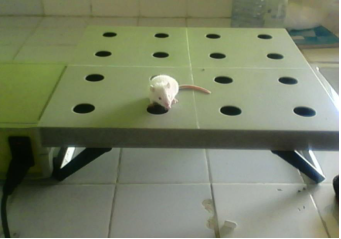
The material used was a plexiglass sheet with a 36 × 36 cm base and a thickness of 5.2 cm. The sheet had 16 equally spaced holes (4 × 4) with a diameter of 2.6 cm each (Figure 1). Electrical photocells located directly inside each hole provided automated measurements of the number of head dips. This device allowed measurement of exploratory activity and emotional defecation. Because of high maternal and fetal mortality in the 120 mg/kg group, behavioral tests were performed only in control pups and pups born to partially diabetic dams. In the PDR group, approximately 20 pups were born from four partially diabetic dams, and 11 postnatal deaths were recorded; therefore, all nine surviving PDR pups were included in the behavioral assessment. For comparison, nine control pups were randomly selected from the six control litters, with representation from different litters whenever possible, to obtain a sample size comparable to that of the PDR group. Measurements were taken on postnatal days 10, 15, 20, 25, and 30.
Each pup was placed in the center of the board and observed for five minutes. The number of head dips into the holes was counted during each trial. Only one five-minute trial was conducted at each age, allowing exploratory activity to be measured at each developmental stage.
2.4.2. Measuring Emotional Reaction
The contextual environment of the hole-board created a novel situation that caused anxiety in the animal. This anxiety could induce defecation in the animal
[17]
Boissier JR. Situation libre et psychotropes. In: Mikhelson MY, Longo VG, Voltava Z, editors. Pharmacology of Conditioning, Learning and Retention. New York: Pergamon Press; 1965. p. 25-46.
[17]
. Thus, as soon as the animal was placed on the board, the timer started and the number of droppings produced during the 5 minutes was measured. After each animal's passage, the board was carefully cleaned with 70% diluted alcohol.
2.5. Statistical Analysis
Data were processed using GraphPad Prism 8.0.1 software (San Diego, California, USA). Results are expressed as mean ± standard error of the mean (SEM). Blood glucose levels and fetal-maternal parameters were compared between groups using analysis of variance followed, when appropriate, by post hoc comparisons. Behavioral data collected across postnatal ages were analyzed using two-way analysis of variance with age and treatment as factors. Student’s t-tests were used for targeted comparisons at specific postnatal days when indicated. Differences were considered statistically significant at p < 0.05. The number of dams and pups included in each analysis is reported in the corresponding tables and figure legends.
3. Results
3.1. Observations and Blood Glucose Levels in Rats During Gestation
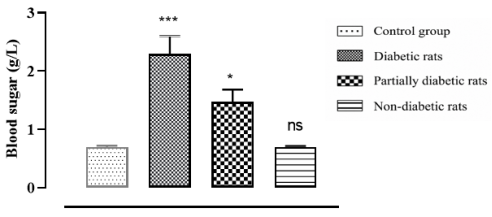
It appears that among the six (6) rats treated with the 100 mg/kg dose of alloxan, two (2) rats had a blood glucose level of 2.1 ± 0.3 g/L (diabetic rats), three (3) rats had a blood glucose level of 1.43 ± 0.20 g/L (partially diabetic rats), and one (1) non-diabetic rat had a normal blood glucose level of 0.71 g/L. Furthermore, among the six (6) rats in the 120 mg/kg subgroup, four (4) rats had a blood glucose level of 2.39 ± 0.21 g/L (diabetic rats), one (1) rat had a blood glucose level of 1.58 g/L (partially diabetic rat), and one (1) non-diabetic rat had a normal blood glucose level of 0.69 g/L. No rats died in the 100 mg/kg body weight subgroup. However, in the subgroup treated with 120 mg/kg alloxan, all diabetic rats died during gestation (Table 1).
Comparative analysis of the results in Figure 2 showed a highly significant difference (p<0.001) between the blood glucose levels of the control rats and those of the diabetic rats. Another, slightly significant difference (p<0.05) was observed between the blood glucose levels of the control group and those of the partially diabetic rats.
Table 1. Observations in rats treated during gestation.
Number of female rats (n)
Treatment (mg/kg)
Total
Diabetic rats
Partially diabetic rats
Non-diabetic rats
Rats died during gestation
Control group
6
0
0
6
0
Alloxan 100
6
2
3
1
0
Alloxan 120
6
4
1
1
4
Values are means ± SEM. *p < 0.05, ***p < 0.001; ns: not significant.
Figure 2. Blood glucose levels of female rats 72 h after alloxan injection.
3.2. Effect of Gestational Diabetes on Fetal Parameters
All six diabetic rats experienced pregnancy loss. Among these animals, four subsequently died during gestation. In partially diabetic rats, no pregnancy interruption was observed; however, increased postnatal mortality was recorded among the offspring (11 pups). Three cases of marked tail shortening were also observed in offspring from partially diabetic dams (Table 2).
3.3. Effects of Gestational Diabetes on Neurobehavioral Development in Rat Pups
Because of the high maternal and fetal mortality observed in the 120 mg/kg group and among severely diabetic dams, neurobehavioral parameters were measured only in control pups and pups born to partially diabetic dams (PDR) from postnatal day 10 to postnatal day 30. In the PDR group, all surviving pups were included in the behavioral assessment (n = 9). In the control group, nine pups were randomly selected from the six control litters, with representation from different litters whenever possible, to obtain a comparable sample size (n = 9).
3.3.1. Exploratory Activity
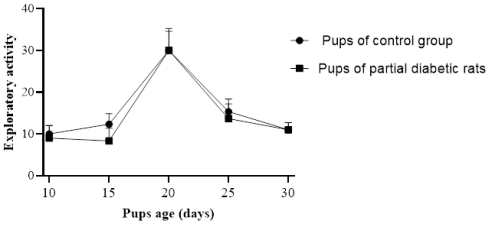
Analysis of exploratory activity showed a significant age-related variation [F(4, 64) = 28.87, p < 0.0001], but no significant treatment effect between control pups and pups from partially diabetic dams [F(1, 16) = 0.6162, p = 0.4417], and no significant age × treatment interaction [F(4, 64) = 0.6002, p = 0.6668]. The pattern observed in Figure 3 was non-linear: exploratory activity increased from PND 10 to PND 20, reached a peak around PND 20, and then decreased markedly at PND 25 and PND 30. Thus, exploratory activity varied with postnatal age but was not significantly altered by partial maternal diabetes.
3.3.2. Emotional Defecation
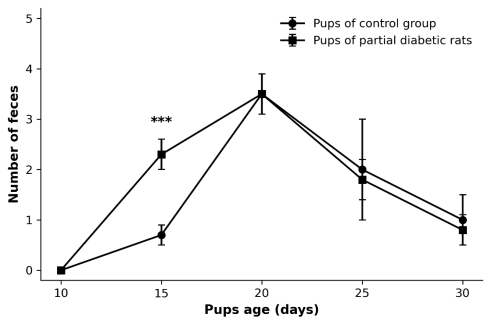
Analysis of emotional defecation showed a significant age-related change [F(4, 64) = 14.20, p < 0.0001], with no significant overall treatment effect [F(1, 16) = 0.6957, p = 0.4165] and no significant age × treatment interaction [F(4, 64) = 1.275, p = 0.3165]. A targeted comparison showed a significant difference between control pups and pups from partially diabetic dams on postnatal day 15 (p < 0.001). Because this difference was observed at a single time point in the absence of a significant overall treatment effect or age × treatment interaction, it should be interpreted cautiously (Figure 4).
Table 2. Effects of gestational diabetes on fetal parameters.
Status of the rats
Interruption of pregnancy
Weight of pups at birth (g)
Number of pups
Malformation cases
Postnatal mortalities
Control group (n=6)
0
7.90 ± 0.085
9 ± 2.60
0
0
Diabetic rats (n=6)
6
N/A
N/A
N/A
N/A
Partially diabetic rats (n=4)
0
7.74 ± 0.118
5 ± 1.82
3
11
Values are means ± SEM. Control group: pups from untreated dams (n = 9); PDR group: pups from partially diabetic dams (n = 9).
Figure 4. Development of emotional defecation and emotional reactivity.
Values are means ± SEM. Control group: pups from untreated dams (n = 9); PDR group: pups from partially diabetic dams (n = 9). *p < 0.05, **p < 0.01, ***p < 0.001.
4. Discussion
The results obtained show that doses of 100 mg/kg and 120 mg/kg of alloxans induced hyperglycemia in some pregnant rats. This is characteristic of a diabetic or partially diabetic state. Indeed, several rats exhibited blood glucose levels exceeding 2 g/L, the threshold generally used to characterize experimental diabetes in rats. These results are consistent with the work of Szkudelski and Akbarzadeh et al., who showed that the experimental induction of diabetes in rats causes a significant increase in blood glucose levels exceeding 2 g/L
[18]
Szkudelski T. The mechanism of alloxan and streptozotocin action in β cells of the rat pancreas. Physiol Res. 2001; 50(6): 537-546.
Akbarzadeh A, Norouzian D, Mehrabi MR, Jamshidi S, Farhangi A, Verdi AA, Mofidian SM, Rad BL. Induction of diabetes by streptozotocin in rats. Indian J Clin Biochem. 2007; 22(2): 60-64.
. This reflects an alteration in glucose metabolism linked to insulin deficiency or resistance to this hormone.
The highly significant difference observed between the blood glucose levels of control rats and those of diabetic rats confirms the effective establishment of a hyperglycemic state. Similar results were reported by Rees and Alcolado and Chen et al., who indicate that maternal hyperglycemia during gestation is one of the main factors responsible for physiological disturbances in both mother and offspring
[20]
Rees DA, Alcolado JC. Animal models of diabetes mellitus. Diabet Med. 2005; 22(4): 359-370.
Chen F, Ge L, Jiang X, Lai Y, Huang P, Hua J, Lin Y, Lin Y, Jiang X. Construction of the experimental rat model of gestational diabetes. PLoS One. 2022; 17(9): e0273703.
. Regarding the course of pregnancy, the results show that all diabetic rats experienced pregnancy loss, with a high mortality rate. These observations are consistent with studies by Erikson, Phoswa and Khaliq, which demonstrated that uncontrolled gestational diabetes in rodents leads to increased oxidative stress and metabolic disturbances that can cause gestational complications, such as embryonic resorption, spontaneous abortion, or maternal mortality
Phoswa WN, Khaliq OP. The role of oxidative stress in hypertensive disorders of pregnancy and metabolic disorder of pregnancy. Oxid Med Cell Longev. 2021; 2021: 5581570.
In partially diabetic rats, the absence of abortion but the presence of postnatal mortality and malformations in pups suggest that moderate maternal hyperglycemia can affect embryonic and neonatal development. These results corroborate those of Ornoy, who demonstrated that fetal exposure to a hyperglycemic environment increases the risk of congenital malformations and neonatal mortality
[24]
Ornoy A. Prenatal origin of obesity and related complications: gestational diabetes, maternal overweight and the paradoxical effects of fetal growth restriction and macrosomia. Reprod Toxicol. 2011; 32(2): 205-212.
. The author also emphasizes that maternal hyperglycemia can disrupt morphogenesis by affecting cell differentiation during embryonic development.
The observed malformations, including tail shortening in some pups, have also been described in several experimental models of gestational diabetes. According to Sadler
[25]
Sadler TW. Langman’s Medical Embryology. 12th ed. Philadelphia: Lippincott Williams & Wilkins; 2012.
[25]
, maternal hyperglycemia can cause developmental abnormalities of the nervous system and axial skeleton due to metabolic imbalance and increased free radical production. Evaluation of postnatal behavioral parameters showed that exploratory activity followed a non-linear developmental pattern, increasing from PND 10 to PND 20 and then decreasing at later postnatal stages. This profile may reflect maturational changes in locomotor activity, exploratory motivation, or habituation to the testing environment during postnatal development. This interpretation is consistent with developmental studies showing that exploratory behavior changes across postnatal maturation rather than increasing uniformly over time
[26]
Fox WM. Reflex-ontogeny and behavioural development of the mouse. Anim Behav. 1965; 13(2): 234-241.
. However, the lack of significant difference between control offspring and those from partially diabetic rats suggests that moderate gestational diabetes did not significantly alter this behavioral function.
Emotional defecation differed between groups on postnatal day 15, but the overall treatment effect and the age × treatment interaction were not significant. Emotional defecation is commonly used as an indicator of emotional reactivity or anxiety-like responses in rodents.
[27]
Archer J. Tests for emotionality in rats and mice: a review. Anim Behav. 1973; 21(2): 205-235.
Therefore, the isolated difference observed at PND 15 may indicate a time-specific change in this parameter, but it does not provide sufficient evidence to conclude that partial maternal diabetes consistently altered emotional reactivity across postnatal development.
Prenatal exposure to moderate maternal hyperglycemia may influence some neurobehavioral parameters; however, the behavioral evidence in the present study remains limited
[28]
Plagemann A. Perinatal programming and functional teratogenesis: impact on body weight regulation and obesity. Physiol Behav. 2005; 86(5): 661-668.
Sullivan EL, Smith MS, Grove KL. Perinatal exposure to high-fat diet programs energy balance, metabolism and behavior in adulthood. Neuroendocrinology. 2011; 93(1): 1-8.
. The significant difference observed for emotional defecation at PND 15 should be considered exploratory and interpreted considering the non-significant overall treatment effect. Further studies with larger litter-based samples and appropriately controlled repeated-measures analysis are needed to determine whether maternal hyperglycemia produces reliable changes in emotional reactivity.
5. Limitations and Future Directions
The present study has some limitations that should be considered when interpreting the findings. First, behavioral analyses were conducted on a relatively small number of offspring because substantial maternal and postnatal mortality reduced the number of animals available for study. In the PDR group, all surviving offspring were included, whereas control offspring were selected from a larger pool of available litter. Although control pups were randomly selected with representation from different litters whenever possible, this sampling strategy may have introduced variability that could influence behavioral outcomes. Second, behavioral assessment focuses on exploratory activity and emotional defecation measured using the hole-board test. Additional paradigms evaluating locomotor activity, anxiety-like behavior, learning, memory, and social interactions would provide a more comprehensive characterization of neurobehavioral development following prenatal exposure to maternal hyperglycemia. Third, behavioral differences in emotional defecation were observed only at postnatal day 15, whereas the overall treatment effect and the age × treatment interaction were not significant. Consequently, this isolated finding should be interpreted cautiously until replicated in larger cohorts.
Future studies should include larger litter-based samples, account explicitly for litter effects in statistical analyses, evaluate male and female offspring separately, and investigate the neurobiological mechanisms underlying the potential effects of maternal hyperglycemia on offspring brain development and behavior.
6. Conclusion
Experimentally induced gestational diabetes severely impaired fetomaternal outcomes in a dose-dependent manner. Severe maternal hyperglycemia caused pregnancy loss and maternal mortality, whereas moderate hyperglycemia (partially diabetic group) allowed pregnancies to reach term but increased postnatal offspring mortality and morphological abnormalities, notably tail shortening. Neurobehavioral evaluation revealed typical age-dependent trajectories in exploratory activity across all groups. Although emotional defecation transiently differed at PND 15, the lack of an overall treatment effect indicates that moderate prenatal hyperglycemia did not persistently alter neurodevelopment. Overall, while maternal hyperglycemia profoundly compromises fetal and neonatal viability, its subtle long-term effects on offspring neurobehavior require further investigation in larger cohorts.
Abbreviations
PDR
Offspring Born to Partially Diabetic Rats (or Pups from Partially Diabetic Dams)
Yacouba Ouattara: Data curation, Formal Analysis, Visualization, Writing – original draft, Writing – review & editing
Neme Antoine Tako: Project administration, Supervision
Conflicts of Interest
The authors declare no conflicts of interest.
References
[1]
HAPO Study Cooperative Research Group et al. “Hyperglycemia and adverse pregnancy outcomes.” The New England journal of medicine vol. 358, 19. 2008: 1991-2002.
Ye W, Luo C, Huang J, Li C, Liu Z, Liu F. Gestational diabetes mellitus and adverse pregnancy outcomes: systematic review and meta-analysis. BMJ. 2022; 377: e067946.
American Diabetes Association Professional Practice Committee, ElSayed NA, McCoy RG, et al. Diagnosis and classification of diabetes: standards of care in diabetes—2026. Diabetes Care. 2026; 48(Suppl 1): S27-S49.
Bánhidy F, Acs N, Puhó EH, Czeizel AE. Congenital abnormalities in the offspring of pregnant women with type 1, type 2 and gestational diabetes mellitus: a population-based case-control study. Congenit Anom (Kyoto). 2010; 50(2): 115-121.
International Diabetes Federation. IDF Diabetes Atlas. 11th ed. Brussels: International Diabetes Federation; 2025.
[7]
Genitsaridi I, Salpea P, Salim A, et al. 11th edition of the IDF Diabetes Atlas: global, regional, and national diabetes prevalence estimates for 2024 and projections for 2050. Lancet Diabetes Endocrinol. 2026; 14(2): 149-156.
Zhong J, Zhang H, Wu J, Zhang B, Lan L. Analysis of risk factors associated with gestational diabetes mellitus: a retrospective case-control study. Int J Gen Med. 2024; 17: 4229-4238.
Stern C, Schwarz S, Moser G, Cvitic S, Jantscher-Krenn E, Gauster M, Hiden U. Placental endocrine activity: adaptation and disruption of maternal glucose metabolism in pregnancy and the influence of fetal sex. Int J Mol Sci. 2021; 22(23): 12722.
Lippert RN, Brüning JC. Maternal metabolic programming of the developing central nervous system: unified pathways to metabolic and psychiatric disorders. Biol Psychiatry. 2022; 91(10): 898-906.
Russell KH, Hagenmeyer-Houser SH, Sanberg PR. Haloperidol-induced emotional defecation: a possible model for neuroleptic anxiety syndrome. Psychopharmacology (Berl). 1987; 91(1): 45-49.
Livingston Raja N, Sundaranathavalli S, Jeya Ananthi J, Nirmaladevi J, Kumarappan C, Kumaraguruparan P, Yaseen K. Antihyperglycaemic activity of aqueous extract of Vinca rosea Linn in alloxan-induced diabetic rats. Pharmacologyonline. 2008; 3: 354-362.
[17]
Boissier JR. Situation libre et psychotropes. In: Mikhelson MY, Longo VG, Voltava Z, editors. Pharmacology of Conditioning, Learning and Retention. New York: Pergamon Press; 1965. p. 25-46.
[18]
Szkudelski T. The mechanism of alloxan and streptozotocin action in β cells of the rat pancreas. Physiol Res. 2001; 50(6): 537-546.
Akbarzadeh A, Norouzian D, Mehrabi MR, Jamshidi S, Farhangi A, Verdi AA, Mofidian SM, Rad BL. Induction of diabetes by streptozotocin in rats. Indian J Clin Biochem. 2007; 22(2): 60-64.
Chen F, Ge L, Jiang X, Lai Y, Huang P, Hua J, Lin Y, Lin Y, Jiang X. Construction of the experimental rat model of gestational diabetes. PLoS One. 2022; 17(9): e0273703.
Phoswa WN, Khaliq OP. The role of oxidative stress in hypertensive disorders of pregnancy and metabolic disorder of pregnancy. Oxid Med Cell Longev. 2021; 2021: 5581570.
Ornoy A. Prenatal origin of obesity and related complications: gestational diabetes, maternal overweight and the paradoxical effects of fetal growth restriction and macrosomia. Reprod Toxicol. 2011; 32(2): 205-212.
Sullivan EL, Smith MS, Grove KL. Perinatal exposure to high-fat diet programs energy balance, metabolism and behavior in adulthood. Neuroendocrinology. 2011; 93(1): 1-8.
Doubran, P. J. D., Fossou, A. F., Allo, Y. F., Ouattara, Y., Tako, N. A. (2026). Effects of Experimentally Induced Gestational Diabetes on Fetomaternal Parameters, Exploratory Behavior and Emotional Reactivity in Rat Offspring. Journal of Diseases and Medicinal Plants, 12(3), 128-135. https://doi.org/10.11648/j.jdmp.20261203.14
Doubran, P. J. D.; Fossou, A. F.; Allo, Y. F.; Ouattara, Y.; Tako, N. A. Effects of Experimentally Induced Gestational Diabetes on Fetomaternal Parameters, Exploratory Behavior and Emotional Reactivity in Rat Offspring. J. Dis. Med. Plants2026, 12(3), 128-135. doi: 10.11648/j.jdmp.20261203.14
Doubran PJD, Fossou AF, Allo YF, Ouattara Y, Tako NA. Effects of Experimentally Induced Gestational Diabetes on Fetomaternal Parameters, Exploratory Behavior and Emotional Reactivity in Rat Offspring. J Dis Med Plants. 2026;12(3):128-135. doi: 10.11648/j.jdmp.20261203.14
@article{10.11648/j.jdmp.20261203.14,
  author = {Prisca Joelle Djoman Doubran and Assamala Françoise Fossou and Yapo Fulgence Allo and Yacouba Ouattara and Neme Antoine Tako},
  title = {Effects of Experimentally Induced Gestational Diabetes on Fetomaternal Parameters, Exploratory Behavior and Emotional Reactivity in Rat Offspring},
  journal = {Journal of Diseases and Medicinal Plants},
  volume = {12},
  number = {3},
  pages = {128-135},
  doi = {10.11648/j.jdmp.20261203.14},
  url = {https://doi.org/10.11648/j.jdmp.20261203.14},
  eprint = {https://article.sciencepublishinggroup.com/pdf/10.11648.j.jdmp.20261203.14},
  abstract = {Gestational diabetes mellitus adversely affects maternal health, fetal development, and long-term neurobehavioral outcomes. This study evaluated the impact of experimentally induced gestational diabetes on fetomaternal parameters, exploratory behavior, and emotional reactivity in rat offspring. Pregnant Wistar rats were treated on gestational day 6 with alloxan at 100 mg/kg, 120 mg/kg, or vehicle (control). Blood glucose levels were measured 72 h post-injection. Behavioral assessments were performed in 9 offspring from partially diabetic dams (from 4 litters) and 9 offspring from control dams (selected from 6 control litters) on postnatal days 10, 15, 20, 25, and 30 using a hole-board test. Alloxan injection successfully induced dose-dependent metabolic disturbances. Blood glucose levels were significantly higher in diabetic (, ) and partially diabetic rats (, ) compared to control animals (). While no maternal deaths occurred in the 100 mg/kg group, all severely diabetic dams in the 120 mg/kg group died during gestation. Moderate hyperglycemia in PDR dams permitted full-term pregnancy but resulted in increased postnatal offspring mortality ( deaths out of  pups) and morphological abnormalities, specifically tail shortening. Neurobehaviorally, exploratory activity demonstrated a non-linear developmental trajectory, peaking at PND 20 and declining thereafter, without significant differences between control and PDR offspring. Emotional defecation differed significantly at PND 15 (); however, this isolated finding should be interpreted cautiously because the overall treatment effect was not significant. In conclusion, maternal hyperglycemia severely compromises fetal viability and morphological development, whereas no clear evidence of persistent alterations in exploratory activity or emotional reactivity was observed following moderate prenatal hyperglycemia.},
 year = {2026}
}
TY  - JOUR
T1  - Effects of Experimentally Induced Gestational Diabetes on Fetomaternal Parameters, Exploratory Behavior and Emotional Reactivity in Rat Offspring
AU  - Prisca Joelle Djoman Doubran
AU  - Assamala Françoise Fossou
AU  - Yapo Fulgence Allo
AU  - Yacouba Ouattara
AU  - Neme Antoine Tako
Y1  - 2026/08/27
PY  - 2026
N1  - https://doi.org/10.11648/j.jdmp.20261203.14
DO  - 10.11648/j.jdmp.20261203.14
T2  - Journal of Diseases and Medicinal Plants
JF  - Journal of Diseases and Medicinal Plants
JO  - Journal of Diseases and Medicinal Plants
SP  - 128
EP  - 135
PB  - Science Publishing Group
SN  - 2469-8210
UR  - https://doi.org/10.11648/j.jdmp.20261203.14
AB  - Gestational diabetes mellitus adversely affects maternal health, fetal development, and long-term neurobehavioral outcomes. This study evaluated the impact of experimentally induced gestational diabetes on fetomaternal parameters, exploratory behavior, and emotional reactivity in rat offspring. Pregnant Wistar rats were treated on gestational day 6 with alloxan at 100 mg/kg, 120 mg/kg, or vehicle (control). Blood glucose levels were measured 72 h post-injection. Behavioral assessments were performed in 9 offspring from partially diabetic dams (from 4 litters) and 9 offspring from control dams (selected from 6 control litters) on postnatal days 10, 15, 20, 25, and 30 using a hole-board test. Alloxan injection successfully induced dose-dependent metabolic disturbances. Blood glucose levels were significantly higher in diabetic (, ) and partially diabetic rats (, ) compared to control animals (). While no maternal deaths occurred in the 100 mg/kg group, all severely diabetic dams in the 120 mg/kg group died during gestation. Moderate hyperglycemia in PDR dams permitted full-term pregnancy but resulted in increased postnatal offspring mortality ( deaths out of  pups) and morphological abnormalities, specifically tail shortening. Neurobehaviorally, exploratory activity demonstrated a non-linear developmental trajectory, peaking at PND 20 and declining thereafter, without significant differences between control and PDR offspring. Emotional defecation differed significantly at PND 15 (); however, this isolated finding should be interpreted cautiously because the overall treatment effect was not significant. In conclusion, maternal hyperglycemia severely compromises fetal viability and morphological development, whereas no clear evidence of persistent alterations in exploratory activity or emotional reactivity was observed following moderate prenatal hyperglycemia.
VL  - 12
IS  - 3
ER  -
Doubran, P. J. D., Fossou, A. F., Allo, Y. F., Ouattara, Y., Tako, N. A. (2026). Effects of Experimentally Induced Gestational Diabetes on Fetomaternal Parameters, Exploratory Behavior and Emotional Reactivity in Rat Offspring. Journal of Diseases and Medicinal Plants, 12(3), 128-135. https://doi.org/10.11648/j.jdmp.20261203.14
Doubran, P. J. D.; Fossou, A. F.; Allo, Y. F.; Ouattara, Y.; Tako, N. A. Effects of Experimentally Induced Gestational Diabetes on Fetomaternal Parameters, Exploratory Behavior and Emotional Reactivity in Rat Offspring. J. Dis. Med. Plants2026, 12(3), 128-135. doi: 10.11648/j.jdmp.20261203.14
Doubran PJD, Fossou AF, Allo YF, Ouattara Y, Tako NA. Effects of Experimentally Induced Gestational Diabetes on Fetomaternal Parameters, Exploratory Behavior and Emotional Reactivity in Rat Offspring. J Dis Med Plants. 2026;12(3):128-135. doi: 10.11648/j.jdmp.20261203.14
@article{10.11648/j.jdmp.20261203.14,
  author = {Prisca Joelle Djoman Doubran and Assamala Françoise Fossou and Yapo Fulgence Allo and Yacouba Ouattara and Neme Antoine Tako},
  title = {Effects of Experimentally Induced Gestational Diabetes on Fetomaternal Parameters, Exploratory Behavior and Emotional Reactivity in Rat Offspring},
  journal = {Journal of Diseases and Medicinal Plants},
  volume = {12},
  number = {3},
  pages = {128-135},
  doi = {10.11648/j.jdmp.20261203.14},
  url = {https://doi.org/10.11648/j.jdmp.20261203.14},
  eprint = {https://article.sciencepublishinggroup.com/pdf/10.11648.j.jdmp.20261203.14},
  abstract = {Gestational diabetes mellitus adversely affects maternal health, fetal development, and long-term neurobehavioral outcomes. This study evaluated the impact of experimentally induced gestational diabetes on fetomaternal parameters, exploratory behavior, and emotional reactivity in rat offspring. Pregnant Wistar rats were treated on gestational day 6 with alloxan at 100 mg/kg, 120 mg/kg, or vehicle (control). Blood glucose levels were measured 72 h post-injection. Behavioral assessments were performed in 9 offspring from partially diabetic dams (from 4 litters) and 9 offspring from control dams (selected from 6 control litters) on postnatal days 10, 15, 20, 25, and 30 using a hole-board test. Alloxan injection successfully induced dose-dependent metabolic disturbances. Blood glucose levels were significantly higher in diabetic (, ) and partially diabetic rats (, ) compared to control animals (). While no maternal deaths occurred in the 100 mg/kg group, all severely diabetic dams in the 120 mg/kg group died during gestation. Moderate hyperglycemia in PDR dams permitted full-term pregnancy but resulted in increased postnatal offspring mortality ( deaths out of  pups) and morphological abnormalities, specifically tail shortening. Neurobehaviorally, exploratory activity demonstrated a non-linear developmental trajectory, peaking at PND 20 and declining thereafter, without significant differences between control and PDR offspring. Emotional defecation differed significantly at PND 15 (); however, this isolated finding should be interpreted cautiously because the overall treatment effect was not significant. In conclusion, maternal hyperglycemia severely compromises fetal viability and morphological development, whereas no clear evidence of persistent alterations in exploratory activity or emotional reactivity was observed following moderate prenatal hyperglycemia.},
 year = {2026}
}
TY  - JOUR
T1  - Effects of Experimentally Induced Gestational Diabetes on Fetomaternal Parameters, Exploratory Behavior and Emotional Reactivity in Rat Offspring
AU  - Prisca Joelle Djoman Doubran
AU  - Assamala Françoise Fossou
AU  - Yapo Fulgence Allo
AU  - Yacouba Ouattara
AU  - Neme Antoine Tako
Y1  - 2026/08/27
PY  - 2026
N1  - https://doi.org/10.11648/j.jdmp.20261203.14
DO  - 10.11648/j.jdmp.20261203.14
T2  - Journal of Diseases and Medicinal Plants
JF  - Journal of Diseases and Medicinal Plants
JO  - Journal of Diseases and Medicinal Plants
SP  - 128
EP  - 135
PB  - Science Publishing Group
SN  - 2469-8210
UR  - https://doi.org/10.11648/j.jdmp.20261203.14
AB  - Gestational diabetes mellitus adversely affects maternal health, fetal development, and long-term neurobehavioral outcomes. This study evaluated the impact of experimentally induced gestational diabetes on fetomaternal parameters, exploratory behavior, and emotional reactivity in rat offspring. Pregnant Wistar rats were treated on gestational day 6 with alloxan at 100 mg/kg, 120 mg/kg, or vehicle (control). Blood glucose levels were measured 72 h post-injection. Behavioral assessments were performed in 9 offspring from partially diabetic dams (from 4 litters) and 9 offspring from control dams (selected from 6 control litters) on postnatal days 10, 15, 20, 25, and 30 using a hole-board test. Alloxan injection successfully induced dose-dependent metabolic disturbances. Blood glucose levels were significantly higher in diabetic (, ) and partially diabetic rats (, ) compared to control animals (). While no maternal deaths occurred in the 100 mg/kg group, all severely diabetic dams in the 120 mg/kg group died during gestation. Moderate hyperglycemia in PDR dams permitted full-term pregnancy but resulted in increased postnatal offspring mortality ( deaths out of  pups) and morphological abnormalities, specifically tail shortening. Neurobehaviorally, exploratory activity demonstrated a non-linear developmental trajectory, peaking at PND 20 and declining thereafter, without significant differences between control and PDR offspring. Emotional defecation differed significantly at PND 15 (); however, this isolated finding should be interpreted cautiously because the overall treatment effect was not significant. In conclusion, maternal hyperglycemia severely compromises fetal viability and morphological development, whereas no clear evidence of persistent alterations in exploratory activity or emotional reactivity was observed following moderate prenatal hyperglycemia.
VL  - 12
IS  - 3
ER  -




 Share This Article
 Twitter
 Linked In
 Facebook
 Copy
Copy Download