
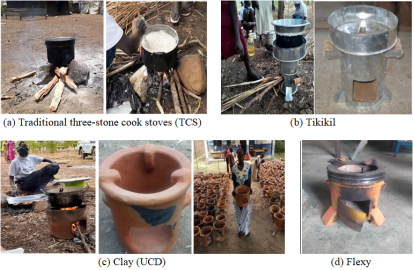
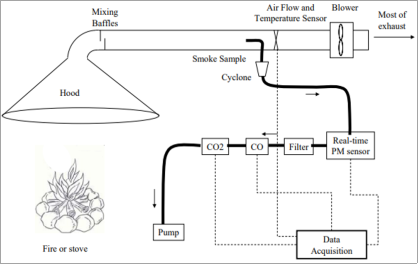
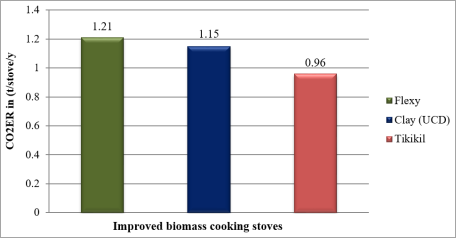
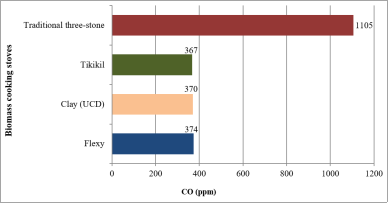
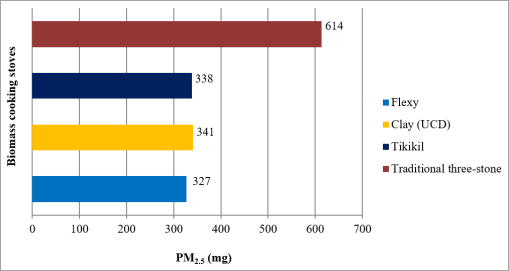
In many countries of the world, households burn firewood or biomass to fulfill their cooking and heating needs. The excessive reliance on biomass fuels by inefficient traditional cookstove produces and emits substantial amount of smoke which brings effects associated with high indoor air pollution, deforestation, climate change and losses productivity. Therefore, this study focused on carbon emission reduction potentials of improved biomass cookstoves used in Gambella refugee camps and compares it with traditional open-fire stove. For this study, Water Boiling Test (WBT) was carried out at laboratory level. The most commonly used improved biomass cookstoves and the three stone traditional cook stove were selected for the assessment and comparison. The emission of greenhouse gasses (carbon monoxide, carbon dioxide and particulate matters) was used as indicators to compare the emissions of each stove. The results indicated that, three-stone open-fire traditional stove, Clay (User Centered Design-UCD), Flexy and Tikikil stoves were found to be the preferred mode of biomass cooking stove used by most refugees. From the experimental test results, the performance model showed a significant reduction in greenhouse gasses and/or pollutant (CO2, CO, and PM2.5) concentrations. The use of one Flexy stove could avoid the emission of 1.21 tons, Clay 1.15 tons, and Tikikil 0.96 tons of CO2e per stove per year. The average amount of CO emission from the three-stone stove was 1105ppm and from ICS was 370.3 ppm. Particulate matter (PM2.5) emissions of Flexy, Clay, Tikikil and Traditional cookstoves were recorded as 329, 339, 337, 614 mg respectively. Therefore, it can be conclude that improved biomass cook stoves can produce less smoke and reduce greenhouse gas emissions and health effects. Thus, concerned organizations should disseminate and monitor improved biomass cooking stoves for the refugees so as to protect individuals from negative impact of traditional three-stone cookstoves.
| Published in | Journal of Energy, Environmental & Chemical Engineering (Volume 11, Issue 1) |
| DOI | 10.11648/j.jeece.20261101.11 |
| Page(s) | 1-11 |
| Creative Commons |
This is an Open Access article, distributed under the terms of the Creative Commons Attribution 4.0 International License (http://creativecommons.org/licenses/by/4.0/), which permits unrestricted use, distribution and reproduction in any medium or format, provided the original work is properly cited. |
| Copyright |
Copyright © The Author(s), 2026. Published by Science Publishing Group |
Emission Reduction, Gambella, Improved Biomass Cookstoves, Refugee, Water Boiling Test
Parameter | Type of biomass cookstoves | |||
|---|---|---|---|---|
Flexy | Clay (UCD) | Tikikil | TCS | |
Emission of CO in ppm | 517 | 547 | 679 | 1187 |
692 | 697 | 554 | 1876 | |
704 | 619 | 479 | 1834 | |
532 | 548 | 483 | 1621 | |
471 | 374 | 421 | 1460 | |
372 | 329 | 313 | 1345 | |
231 | 268 | 294 | 1213 | |
143 | 163 | 208 | 205 | |
54 | 96 | 142 | 168 | |
24 | 59 | 97 | 141 | |
Average | 374 | 370 | 367 | 1105 |
CDM | Clean Development Mechanism |
CO | Carbon Monoxide |
CO2 | Carbon Dioxide |
CO2e | Carbon Dioxide Equivalents |
CRGE | Climate Resilient Green Economy |
GHG | Greenhouse Gas |
GoE | Government of Ethiopia |
IBCS | Improved Biomass Cook Stoves |
ICS | Improved Cook Stoves |
MEI | Moving Energy Initiative |
MoWIE | Ministry of Water, Irrigation and Energy |
PM2.5 | Fine Particulate Matter |
TCS | Traditional Cookstoves |
UCD | User Center Design |
WBT | Water Boiling Test |
| [1] | Adem KD, Ambie DA. (2017). Performance and emission reduction potential of micro-gasifier improved through better design. AIMS Energy. 1; 5(1): 63-76. |
| [2] | Agbro EB, Ogie NA. (2012). A comprehensive review of biomass resources and biofuel production potential in Nigeria. Research journal in engineering and applied sciences. 1(3): 149-55. |
| [3] | Anenberg SC, Balakrishnan K, Jetter J, Masera O, Mehta S, Moss J, Ramanathan V. (2013). Cleaner cooking solutions to achieve health, climate, and economic cobenefits. Environmental Science and Technology, 47(9), 3944-3952. |
| [4] | Bailis R., Drigo R., Ghilardi A. and Masera O. (2015). The carbon footprint of traditional woodfuels. Nature Climate Change, 5(3), pp. 266-272. |
| [5] | Barbour M., Udesen D., Bentson S., Pundle A., Tackman C., Evitt D., Means P., Scott P., Still D., Kramlich J. and Posner J. D., (2021). Development of wood-burning rocket cookstove with forced air-injection. Energy for Sustainable Development, 65, pp. 12-24. |
| [6] | Barpatragohain R., Bharali N. and Dutta P. P. (2021). Thermal performance evaluation of an improved biomass cookstove for domestic applications. In Proceedings of International Conference on Thermofluids: KIIT Thermo 2020 (pp. 579-590). Springer Singapore. |
| [7] | Bensch G. and Peters J. (2013). Alleviating deforestation pressures? Impacts of improved stove dissemination on charcoal consumption in urban Senegal. Land Economics, 89(4), pp. 676-698. |
| [8] | Beyene A., Bluffstone R. A., Gebreegzhiaber Z., Martinsson P., Mekonnen A. and Vieider F. (2015). Do improved biomass cookstoves reduce fuelwood consumption and carbon emissions? Evidence from rural Ethiopia using a randomized treatment trial with electronic monitoring. Evidence from Rural Ethiopia Using a Randomized Treatment Trial with Electronic Monitoring (June 22, 2015). World Bank Policy Research Working Paper, (7324). |
| [9] | Boafo-Mensah G., Darkwa K. M. and Laryea G. (2020). Effect of combustion chamber material on the performance of an improved biomass cookstove. Case Studies in Thermal Engineering, 21, p. 100688. |
| [10] | Bond T. C., Doherty S. J., Fahey D. W., Forster P. M., Berntsen T., DeAngelo B. J., Flanner M. G., Ghan S., Kärcher B., Koch D. and Kinne S. (2013). Bounding the role of black carbon in the climate system: A scientific assessment. Journal of geophysical research: Atmospheres, 118(11), pp. 5380-5552. |
| [11] | Chafe Z. A., Brauer M., Klimont Z., Van Dingenen R., Mehta S., Rao S., Riahi K., Dentener F. and Smith K. R. (2014). Household cooking with solid fuels contributes to ambient PM2.5 air pollution and the burden of disease. Environmental health perspectives, 122(12), pp. 1314-1320. |
| [12] |
Dam J. V. (2017). The charcoal transition: greening the charcoal value chain to mitigate climate change and improve local livelihoods.
https://www.cabidigitallibrary.org/doi/full/10.5555/20183237937 |
| [13] | DGB Group (2022). Cookstoves for carbon reduction. Sustainability simplified: Carbon footprinting for beginners. |
| [14] | Dresen E., DeVries B., Herold M., Verchot L. and Müller R. (2014). Fuelwood savings and carbon emission reductions by the use of improved cooking stoves in an Afromontane Forest, Ethiopia. Land, 3(3), pp. 1137-1157. |
| [15] | Duguma L. A., Minang P. A., Freeman O. E. and Hager H. (2014). System wide impacts of fuel usage patterns in the Ethiopian highlands: Potentials for breaking the negative reinforcing feedback cycles. Energy for Sustainable Development, 20, pp. 77-85. |
| [16] |
EnDev (2014). Energising Development (EnDev) Ethiopia. Improved Cook Stoves (ICS).
https://energypedia.info/images/8/80/Improved_Cookstoves_in_Ethiopia_%28EnDev%29.pdf |
| [17] | Ethiopia CSA (2012). Population Statistics Abstract. |
| [18] |
FDRE (2011). Ethiopia’s climate-resilient green Economy (CRGE). Federal Democratic Republic of Ethiopia, Addis Ababa, Ethiopia, 188.
https://www.epa.gov.et/images/Polices/CRGE_Strategy_Final.pdf |
| [19] |
FDRE (2014). Ethiopia’s Climate-Resilient Green Economy Climate Resilience Strategy: Water and Energy, Ministry of Water, Irrigation and Energy, Federal Democratic Republic of Ethiopia (FDRE).
https://info.undp.org/docs/pdc/Documents/ETH/CRGE%20PRODOC_.pdf |
| [20] |
Global Alliance for Clean Cookstoves (GACC) (2014). The Water Boiling Test Version 4.2.3 Cookstove Emissions and Efficiency in a Controlled Laboratory Setting,
https://cleancooking.org/binary-data/DOCUMENT/file/000/000/399-1.pdf |
| [21] | Gebreegziabher Z., Beyene A. D., Bluffstone R., Martinsson P., Mekonnen A. and Toman M. A. (2018). Fuel savings, cooking time and user satisfaction with improved biomass cookstoves: Evidence from controlled cooking tests in Ethiopia. Resource and Energy Economics, 52, pp. 173-185. |
| [22] | Getahun E., Tessema D. and Gabbiye N. (2019). Design and development of household gasifier cooking stoves: natural versus forced draft. In Advances of Science and Technology: 6th EAI International Conference, ICAST 2018, Bahir Dar, Ethiopia, October 5-7, 2018, Proceedings 6 (pp. 298-314). Springer International Publishing. |
| [23] | IEA,(2012). World Energy Outlook. International Energy Agency, Paris. |
| [24] | IEA (2018a). World Energy Outlook. International Energy Agency, IEA, Paris. |
| [25] |
IPCC (2006). IPCC guidelines for national greenhouse gas inventories. Institute for Global Environmental Strategies, Hayama, Kanagawa, Japan.
https://www.ipcc-nggip.iges.or.jp/meeting/pdfiles/Washington_Report.pdf |
| [26] | IS-Indian Standards (2013). BIS IS 13152-1 Portable Solid Biomass Cookstove (Chulha) Specificaition. |
| [27] | Islam R., Sheba N. H., Siddique R. F., Hannan J. M. A. and Hossain S. (2023). Association of household fuel use with hypertension and blood pressure among adult women in rural Bangladesh: A cross‐sectional study. American Journal of Human Biology, 35(8), p. e23899. |
| [28] | Lahn G. and Grafham O. (2015). Heat, light and power for refugees: saving lives, reducing costs. |
| [29] | Lambe F., Jürisoo M., Wanjiru H. and Senyagwa J. (2015). Bringing clean, safe, affordable cooking energy to households across Africa: an agenda for action. Prepared by the Stockholm Environment Institute, Stockholm and Nairobi, for the new climate economy, 32. |
| [30] | Lee C. M., Chandler C., Lazarus M. and Johnson F. X. (2013). Assessing the climate impacts of cookstove projects: issues in emissions accounting. Challenges in Sustainability, 1(2), pp. 53-71. |
| [31] | MacCarty N., Still D. and Ogle D. (2010). Fuel use and emissions performance of fifty cooking stoves in the laboratory and related benchmarks of performance. Energy for sustainable development, 14(3), pp. 161-171. |
| [32] | Mamuye F., Lemma B. and Woldeamanuel T. (2018). Emissions and fuel use performance of two improved stoves and determinants of their adoption in Dodola, southeastern Ethiopia. Sustainable Environment Research, 28(1), pp. 32-38. |
| [33] | Manaye A., Amaha S., Gufi Y., Tesfamariam B., Worku A. and Abrha H. (2022). Fuelwood use and carbon emission reduction of improved biomass cookstoves: evidence from kitchen performance tests in Tigray, Ethiopia. Energy, Sustainability and Society, 12(1), p. 28. |
| [34] | Mekonnen B. A., Liyew K. W. and Tigabu M. T. (2020). Solar cooking in Ethiopia: Experimental testing and performance evaluation of SK14 solar cooker. Case Studies in Thermal Engineering, 22, p. 100766. |
| [35] | Mekonnen B. A. (2022). Thermal efficiency improvement and emission reduction potential by adopting improved biomass cookstoves for sauce-cooking process in rural Ethiopia. Case Studies in Thermal Engineering, 38, p. 102315. |
| [36] | Mercy Corps (2010). Basic Guide to Fuel Effcient Stoves and Emission Testing, Portland OR 97204, USA; Edinburgh, EH9 1NJ, UK. |
| [37] | Mondal M. A. H., Bryan E., Ringler C., Mekonnen D. and Rosegrant M. (2018). Ethiopian energy status and demand scenarios: prospects to improve energy efficiency and mitigate GHG emissions. Energy, 149, pp. 161-172. |
| [38] | Mopoung S. and Udeye V. (2017). Characterization and evaluation of charcoal briquettes using banana peel and banana bunch waste for household heating. Am. J. Eng. Appl. Sci, 10(2), pp. 353-365. |
| [39] | MoWIE-Ethiopia (2017). Energy Balance and Statistics for Years 2010/11–2016/17. Available online: |
| [40] | Mulu Getachew Mengistu M. G. M., Belay Simane B. S., Getachew Eshete G. E. and Workneh, T. S. (2016). The environmental benefits of domestic biogas technology in rural Ethiopia. |
| [41] | Onyeneke R. U., Nwajiuba C. U., Mmagu C. J., Aligbe J. O., Uwadoka C. O., Igberi C. O. and Amadi M. U. (2018). Impact of adoption of improved cook‐stove on different components of household welfare in rural communities in Nigeria: The case of Save80 cook‐stove in Kaduna. Environmental Progress & Sustainable Energy, 37(4), pp. 1327-1338. |
| [42] | Rasoulkhani M., Ebrahimi-Nik M., Abbaspour-Fard M. H. and Rohani A. (2018). Comparative evaluation of the performance of an improved biomass cook stove and the traditional stoves of Iran. Sustainable Environment Research, 28(6), pp. 438-443. |
| [43] | Roden C. A., Bond T. C., Conway S. and Pinel A. B. O. (2006). Emission factors and real-time optical properties of particles emitted from traditional wood burning cookstoves. Environmental science & technology, 40(21), pp. 6750-6757. |
| [44] | Saatchi S. S., Harris N. L., Brown S., Lefsky M., Mitchard E. T., Salas W., Zutta B. R., Buermann W., Lewis S. L., Hagen S. and Petrova S. (2011). Benchmark map of forest carbon stocks in tropical regions across three continents. Proceedings of the national academy of sciences, 108(24), pp. 9899-9904. |
| [45] | Sharma D. and Jain S. (2019). Impact of intervention of biomass cookstove technologies and kitchen characteristics on indoor air quality and human exposure in rural settings of India. Environment international, 123, pp. 240-255. |
| [46] | Sutar K. B. (2022). Energy Efficiency, Emissions and Adoption of Biomass Cookstoves. In. Alternative Energies and Efficiency Evaluation. IntechOpen. |
| [47] | Teka K., Welday Y. and Haftu M., (2018). Analysis of household's energy consumption, forest degradation and plantation requirements in Eastern Tigray, Northern Ethiopia. African journal of ecology, 56(3), pp. 499-506. |
| [48] | Thomas E., Wickramasinghe K., Mendis S., Roberts N. and Foster C., (2015). Improved stove interventions to reduce household air pollution in low and middle income countries: a descriptive systematic review. BMC public health, 15, pp. 1-15. |
| [49] | Tigabu A. (2014). Factors Affecting Adoption of Improved Cookstoves in Rural Areas: Evidence from ‘Mirt’ Injera Baking Stove (The Survey of Dembecha Woreda, Amhara Regional State, Ethiopia) (Doctoral dissertation, Mekelle University). |
| [50] |
UNFCCC (2012). CDM, Small-Scale Methodology: Energy Efficiency Measures in Thermal Applications of non-renewable biomass (AMS-II.G).
https://cdm.unfccc.int/UserManagement/FileStorage/SG39AKEL4B2H5UJVPD86XN0I7OR1ZQ |
| [51] | UNSD (2013). Energy Statistics Yearbook. |
| [52] | Van der Werf G. R., Morton D. C., DeFries R. S., Olivier J. G., Kasibhatla P. S., Jackson R. B., Collatz G. J. and Randerson J. T. (2009). CO2 emissions from forest loss. Nature geoscience, 2(11), pp. 737-738. |
| [53] | Wassie Y. T. and Adaramola M. S. (2021). Analysis of potential fuel savings, economic and environmental effects of improved biomass cookstoves in rural Ethiopia. Journal of cleaner production, 280, p. 124700. |
| [54] | Wathore R., Mortimer K. and Grieshop A. P. (2017). In-use emissions and estimated impacts of traditional, natural-and forced-draft cookstoves in rural Malawi. Environmental science & technology, 51(3), pp. 1929-1938. |
| [55] | WHO (2016). Household air pollution and health – Fact Sheet N292. World Health Organization. |
| [56] |
WHO (2022). Household air pollution.
https://www.who.int/news-room/fact-sheets/detail/household-air-pollution-and-health |
| [57] | World Vison Ethiopia (2013). Energy Efficient Stoves Program, CDM Program of Activities Design Document. |
| [58] | Ye W., Thangavel G., Pillarisetti A., Steenland K., Peel J. L., Balakrishnan K., Jabbarzadeh S., Checkley W., Clasen T. and Hapin Investigators (2022). Association between personal exposure to household air pollution and gestational blood pressure among women using solid cooking fuels in rural Tamil Nadu, India. Environmental research, 208, p. 112756. |
| [59] | Yip F., Christensen B., Sircar K., Naeher L., Bruce N., Pennise D., Lozier M., Pilishvili T., Farrar J. L., Stanistreet D. and Nyagol R. (2017). Assessment of traditional and improved stove use on household air pollution and personal exposures in rural western Kenya. Environment international, 99, pp. 185-191. |
| [60] | Zhou Y., Zhang Z., Zhang Y., Wang Y., Yu Y., Ji F., Ahmad R. and Dong R. (2016). A comprehensive review on densified solid biofuel industry in China. Renewable and Sustainable Energy Reviews, 54, pp. 1412-1428. |
| [61] | IEA (2020). Energy policy review. International Energy Agency |
APA Style
Destaw, F., Gurmessa, A., Birhanu, A., Biel, N., Tadesse, G., et al. (2026). Carbon Emission Reduction Potentials of Improved Biomass Cookstoves Used in Gambella Refugee Camps, Southwest Ethiopia. Journal of Energy, Environmental & Chemical Engineering, 11(1), 1-11. https://doi.org/10.11648/j.jeece.20261101.11
ACS Style
Destaw, F.; Gurmessa, A.; Birhanu, A.; Biel, N.; Tadesse, G., et al. Carbon Emission Reduction Potentials of Improved Biomass Cookstoves Used in Gambella Refugee Camps, Southwest Ethiopia. J. Energy Environ. Chem. Eng. 2026, 11(1), 1-11. doi: 10.11648/j.jeece.20261101.11
AMA Style
Destaw F, Gurmessa A, Birhanu A, Biel N, Tadesse G, et al. Carbon Emission Reduction Potentials of Improved Biomass Cookstoves Used in Gambella Refugee Camps, Southwest Ethiopia. J Energy Environ Chem Eng. 2026;11(1):1-11. doi: 10.11648/j.jeece.20261101.11
@article{10.11648/j.jeece.20261101.11,
  author = {Fikre Destaw and Alemayehu Gurmessa and Amansisa Birhanu and Nyagoa Biel and Girma Tadesse and Kuey Peter},
  title = {Carbon Emission Reduction Potentials of Improved Biomass Cookstoves Used in Gambella Refugee Camps, Southwest Ethiopia},
  journal = {Journal of Energy, Environmental & Chemical Engineering},
  volume = {11},
  number = {1},
  pages = {1-11},
  doi = {10.11648/j.jeece.20261101.11},
  url = {https://doi.org/10.11648/j.jeece.20261101.11},
  eprint = {https://article.sciencepublishinggroup.com/pdf/10.11648.j.jeece.20261101.11},
  abstract = {In many countries of the world, households burn firewood or biomass to fulfill their cooking and heating needs. The excessive reliance on biomass fuels by inefficient traditional cookstove produces and emits substantial amount of smoke which brings effects associated with high indoor air pollution, deforestation, climate change and losses productivity. Therefore, this study focused on carbon emission reduction potentials of improved biomass cookstoves used in Gambella refugee camps and compares it with traditional open-fire stove. For this study, Water Boiling Test (WBT) was carried out at laboratory level. The most commonly used improved biomass cookstoves and the three stone traditional cook stove were selected for the assessment and comparison. The emission of greenhouse gasses (carbon monoxide, carbon dioxide and particulate matters) was used as indicators to compare the emissions of each stove. The results indicated that, three-stone open-fire traditional stove, Clay (User Centered Design-UCD), Flexy and Tikikil stoves were found to be the preferred mode of biomass cooking stove used by most refugees. From the experimental test results, the performance model showed a significant reduction in greenhouse gasses and/or pollutant (CO2, CO, and PM2.5) concentrations. The use of one Flexy stove could avoid the emission of 1.21 tons, Clay 1.15 tons, and Tikikil 0.96 tons of CO2e per stove per year. The average amount of CO emission from the three-stone stove was 1105ppm and from ICS was 370.3 ppm. Particulate matter (PM2.5) emissions of Flexy, Clay, Tikikil and Traditional cookstoves were recorded as 329, 339, 337, 614 mg respectively. Therefore, it can be conclude that improved biomass cook stoves can produce less smoke and reduce greenhouse gas emissions and health effects. Thus, concerned organizations should disseminate and monitor improved biomass cooking stoves for the refugees so as to protect individuals from negative impact of traditional three-stone cookstoves.},
 year = {2026}
}
TY  - JOUR
T1  - Carbon Emission Reduction Potentials of Improved Biomass Cookstoves Used in Gambella Refugee Camps, Southwest Ethiopia
AU  - Fikre Destaw
AU  - Alemayehu Gurmessa
AU  - Amansisa Birhanu
AU  - Nyagoa Biel
AU  - Girma Tadesse
AU  - Kuey Peter
Y1  - 2026/02/06
PY  - 2026
N1  - https://doi.org/10.11648/j.jeece.20261101.11
DO  - 10.11648/j.jeece.20261101.11
T2  - Journal of Energy, Environmental & Chemical Engineering
JF  - Journal of Energy, Environmental & Chemical Engineering
JO  - Journal of Energy, Environmental & Chemical Engineering
SP  - 1
EP  - 11
PB  - Science Publishing Group
SN  - 2637-434X
UR  - https://doi.org/10.11648/j.jeece.20261101.11
AB  - In many countries of the world, households burn firewood or biomass to fulfill their cooking and heating needs. The excessive reliance on biomass fuels by inefficient traditional cookstove produces and emits substantial amount of smoke which brings effects associated with high indoor air pollution, deforestation, climate change and losses productivity. Therefore, this study focused on carbon emission reduction potentials of improved biomass cookstoves used in Gambella refugee camps and compares it with traditional open-fire stove. For this study, Water Boiling Test (WBT) was carried out at laboratory level. The most commonly used improved biomass cookstoves and the three stone traditional cook stove were selected for the assessment and comparison. The emission of greenhouse gasses (carbon monoxide, carbon dioxide and particulate matters) was used as indicators to compare the emissions of each stove. The results indicated that, three-stone open-fire traditional stove, Clay (User Centered Design-UCD), Flexy and Tikikil stoves were found to be the preferred mode of biomass cooking stove used by most refugees. From the experimental test results, the performance model showed a significant reduction in greenhouse gasses and/or pollutant (CO2, CO, and PM2.5) concentrations. The use of one Flexy stove could avoid the emission of 1.21 tons, Clay 1.15 tons, and Tikikil 0.96 tons of CO2e per stove per year. The average amount of CO emission from the three-stone stove was 1105ppm and from ICS was 370.3 ppm. Particulate matter (PM2.5) emissions of Flexy, Clay, Tikikil and Traditional cookstoves were recorded as 329, 339, 337, 614 mg respectively. Therefore, it can be conclude that improved biomass cook stoves can produce less smoke and reduce greenhouse gas emissions and health effects. Thus, concerned organizations should disseminate and monitor improved biomass cooking stoves for the refugees so as to protect individuals from negative impact of traditional three-stone cookstoves.
VL  - 11
IS  - 1
ER  -
College of Agriculture and Natural Resource, Gambella University, Gambella, Ethiopia
College of Agriculture and Natural Resource, Gambella University, Gambella, Ethiopia
College of Agriculture and Natural Resource, Gambella University, Gambella, Ethiopia
College of Agriculture and Natural Resource, Gambella University, Gambella, Ethiopia
College of Engineering and Technology, Gambella University, Gambella, Ethiopia
College of Natural and Computational Science, Gambella University, Gambella, Ethiopia

Information



 Share This Article
 Twitter
 Linked In
 Facebook
 Copy
Copy Download