Research Article | | Peer-Reviewed

Seasonal Variation in Hematological Disorders with Respect to Cytogenetic Abnormalities - A 12 Year Single-Center Perspective

Received: 29 July 2026     Accepted: 20 August 2026     Published: 14 October 2026
Views:       Downloads:
Abstract

This retrospective cross-sectional single-center study, conducted at the National Institute of Blood Diseases and Bone Marrow Transplantation (NIBD and BMT) in Karachi, Pakistan, aimed to investigate the relationship between seasonal variations and their effects on bone marrow cytogenetics leading to hematological abnormalities. By analyzing a 12-year dataset of hematological disorders including Aplastic Anemia (AA), Acute Lymphoblastic Leukemia (ALL), Acute Myeloid Leukemia (AML), and Myeloproliferative Neoplasms (MPN), cases were categorized by diagnosis season using retrospectively collected bone marrow trephine and cytogenetics reports. Among the 2,229 investigated patients (mean age: 36.81 ± 18.91 years; 61.6% male), abnormal cytogenetic findings were identified in 41.2% (n=919), demonstrating a highly significant association with age (p< 0.001), with adults exhibiting a higher frequency of abnormalities. While the incidence of CML, ALL, MDS, and AA peaked during the summer months (ranging from 31.1% to 33.3%), AML cases reached their highest frequency in the winter (31.6%), and all diseases recorded their lowest occurrences in the autumn. Notably, a significant seasonal association regarding abnormal cytogenetic findings was observed specifically in acute myeloid leukemia (p = 0.01). Ultimately, these findings highlight the substantial impact of both demographic factors and seasonal variations on the incidence patterns and cytogenetic profiles of hematological disorders.

Published in Science Discovery Immunology (Volume 1, Issue 1)
DOI 10.11648/j.sdimmunol.20260101.11
Page(s) 1-7
Creative Commons

This is an Open Access article, distributed under the terms of the Creative Commons Attribution 4.0 International License (http://creativecommons.org/licenses/by/4.0/), which permits unrestricted use, distribution and reproduction in any medium or format, provided the original work is properly cited.

Copyright

Copyright © The Author(s), 2026. Published by Science Publishing Group

Previous article
Keywords

Seasonal Variation, Hematological Disorders, Cytogenetics, Acute Lymphoblastic Leukemia, Acute Myeloid Leukemia, Aplastic Anemia, Chronic Myeloid Leukemia, Cytogenetic Abnormalities

1. Introduction
The remarkable progress in the field of cytogenetics has led to a better understanding of the molecular basis of genes involved in cytogenetic abnormalities. It has been acknowledged through various studies that cytogenetic analysis is the most important diagnostic as well as prognostic parameter for gene variations, used by clinicians for the treatment of patients with hematological diseases over the last three decades .
In cytogenetic testing, GTG banding is considered as a gold standard . Chromosomal banding technique along with FISH and microarray techniques have become increasingly important in evaluating and managing patients with hematological disorders . Bone marrow sample is the recommended specimen of choice for chromosomal analysis. Peripheral blood is only worthwhile when there is a significant level of disease in circulation .
Hematological disorders are associated with neoplasm of hematopoietic stem cells caused by mutations and chromosomal aberrations. With respect to incidence and mortality, hematological malignancies ranked amongst the top 10 malignant diseases. They account for approximately 9% of annual worldwide cancer . Recent studies have found significant association of seasonal variations in hematological disorders, including aplastic anemia (AA), acute myeloid leukemia (AML) acute lymphoblastic leukemia (ALL), and immune thrombocytopenic purpura (ITP) .
The etiologies of hematological disorders have been under discussion for decades but still the main causative agent is unidentified. The expression of genes in an individual can be influenced by external environment and the internal physiological conditions as well .
The most common causes of malignancies other than hereditary genetic abnormalities are infection, environmental factors and bad living habits. The importance of environment in biology cannot be denied. Environmental factors such as diet, temperature, oxygen levels, humidity, light cycles, and the presence of mutagens can all have an impact on human genes, which ultimately affect the human phenotype .
Seasonal variations between months of a year may influence the rate of infection and vitamin D deficiency attributed to seasonal UV changes, humidity and temperature. As we all know that vitamin D has been shown to have a role in DNA repair too. Hence, exposure with the mentioned factors can lead to genetic mutations thus leading to chromosomal abnormality .
Geographically Pakistan lies between 23ᴼ-37ᴼ north latitude and 60ᴼ-77ᴼ east longitude. Climatically, Pakistan has a considerable measure of variety in seasons. Four seasons are recognized that include a cool, dry winter from December through February; a hot, dry spring from March through May; the summer rainy season, from June through September; and autumn from October till November.
As per our knowledge, no study has yet been conducted in Pakistan as well as internationally that has covered above mentioned findings with respect to seasons and cytogenetic abnormalities in hematological disorders.
2. Materials & Methods
This is a retrospective cross-sectional single center study in which we analyzed the 12-year data of hematological disorders including AA, ALL, AML, MDS, and CML, in the department of Cytogenetics of National Institute of Blood diseases and Bone marrow Transplantation (NIBD and BMT), Karachi, Pakistan, from the year 2010 to 2022. The study was approved by the Institutional Review Board (IRB# NIBD/IRD-259/04-2023).
The cases were diagnosed and classified according to the WHO Classification of Hematopoietic and Lymphoid Neoplasms (2001 and 2008) . All the 2229 patients included in this study were newly diagnosed with the disease. The definition of newly diagnosed for this study includes patients presented for the first time at our center for the purpose of diagnosis and did not go through any intervention for the particular disease at any other center.
Five hematological disorders (AA, ALL, AML, MDS and CML) were categorized on the basis of seasonal variations as per the four seasons observed in the region of Pakistan in which they were diagnosed, such as winter (December-February), spring (March-May), summer (June-September), and autumn (October and November).
Statistical analysis was performed by using SPSS version 25.0. Descriptive statistics, that is, mean and standard deviation was applied on age (years) whereas frequency or percentage was applied on all categorical variables including gender, seasonal variations, and cytogenetic abnormalities. However, association was assessed via computing of the chi-square on categorical data. Results were found to be statistically significant when p-value is <0.05. In this study, abnormal cytogenetics refers to the presence of any numerical or structural changes in the chromosomes of an individual.
3. Results
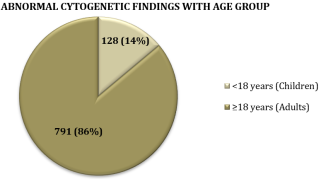
A total of 2229 patients with hematological disorders were investigated for cytogenetic analysis. 1374(61.6%) of the total study group were male and 855(38.4%) were female. The mean age of the cohort was 36.81±18.91 years. A highly significant association was found between age groups and abnormal cytogenetic findings (p-value <0.001; Chi-square test, X2=33.53). The frequency of cytogenetic abnormalities was significantly higher in adults (≥18years; n=791, 86%) as compared to children (<18years; n=128, 14%). (Figure 1)
Figure 1. Frequency of abnormal cytogenetic findings categorized on the basis of age groups (Children: <18 years vs. Adults: ≥18years). Data are represented as counts and percentages, N (%). Statistical significance was evaluated using the Pearson Chi-square test with a threshold of p<0.05 considered statistically significant.
However, when the frequency of hematological disorders was assessed on the basis of gender, an insignificant association was observed, with a p-value >0.05.
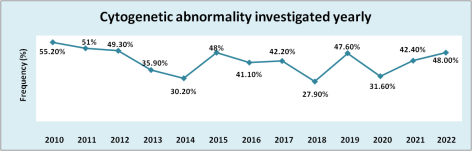
Out of the total cohort, 919(41.2%) abnormal cytogenetic findings were identified among patients diagnosed with hematological disorders, as demonstrated in the yearly trend analysis from 2010 to 2022, in Figure 2.
Figure 2. Yearly frequency (%) of investigated cytogenetic abnormalities from 2010 to 2022. Data points represent the percentage of abnormal cases relative to the total annual evaluated cases.
Annual assessment across the 12-year period (2010-2022) revealed that the majority of the cases were reported in the year 2020 (n=269) followed closely by the year 2019 (n=252). Further cross-tabulation using the chi-square test showed a significant association in all diseases on an annual basis with p-value <0.001. However, no statistically significant change was observed in the year 2014 (p= 0.908, X2=2.74) and 2010 due to sharply reduced data set, as depicted in Table 1.
Table 1. Incidence of cytogenetic abnormalities in diseased patients on a yearly basis.

Year

Total Annual cases

AA

AML

ALL

APML

MPN

LPD

MDS

MM

P-value & Chi-square value

2010

N=29

-

-

-

-

16

(55.2%)

-

-

-

N/A

2011

N=96

1

(20%)

6

(66.7%)

9

(39.1%)

3

(100%)

27

(79.4%)

1

(25%)

2

(13.3%)

-

p=0.028 (X2=14.1, df=6)

2012

N=146

-

16

(80%)

6

(30%)

3

(100%)

41

(75.9%)

-

6

(42.9%)

-

p<0.001* (X2=32.8, df=7)

2013

N=220

-

7

(26.9%)

15

(24.2%)

4

(100%)

45

(78.9%)

2

(16.7%)

4

(26.7%)

-

p<0.001* (X2=26.9, df=7)

2014

N=53

1

(14.3%)

2

(22.2%)

5

(33.3%)

-

8

(66.7%)

-

-

-

p=0.908 (X2=2.7, df=7)

2015

N=148

1

(20%)

9

(47.4%)

14

(31.8%)

10

(100%)

30

(66.7%)

2

(40%)

5(29.4%)

-

p=0.005* (X2=20.2, df=7)

2016

N=151

-

6

(40%)

11

(30.6%)

6

(75%)

35

(64.8%)

-

3

(21.4%)

1

(20%)

p=0.015* (X2=17.3, df=7)

2017

N=204

1

(5.9%)

14 (32.6%)

17

(34%)

1

(100%)

43

(72.9%)

3

(27.3%)

7

(50%)

-

p=0.068 (X2=13.1, df=7)

2018

N=208

1

(3%)

17

(33.3%)

5

(14.7%)

3

(75%)

27

(58.7%)

-

4(22.2%)

-

p=0.001* (X2=23.6, df=7)

2019

N=252

4

(13.8%)

18

(40%)

21

(36.2%)

8

(100%)

54

(78.3%)

5

(27.8%)

7

(63.6%)

-

p<0.001* (X2=25.0, df=7)

2020

N=269

1

(2%)

17

(34%)

12

(21.8%)

4

(100%)

36

(62.1%)

4

(26.7%)

8

(62.1%)

2

(13.3%)

p<0.001* (X2=37.9, df=7)

2021

N=224

6

(20%)

20 (48.8%)

10

(28.6%)

4

(100%)

41

(70.7%)

3

(14.2%)

4

(30.8%)

3

(30%)

p=0.057 (X2=13.7, df=7)

2022

N=229

6

(26.1%)

18

(46.2%)

16

(34%)

4

(80%)

50

(76.9%)

5

(23.8%)

9

(60%)

1

(10%)

p=0.060 (X2=13.5, df=7)

Note: The software could not process the p-value for 2010 due to reduced data set.

Table 1: Data are strictly expressed as counts and percentages, N (%), relative to the total disease cohort sub-population per year. Statistical interactions across diagnostic lineages were mapped using Pearson's Chi-square test, where p<0.05 denotes statistical significance.
* Indicates statistically significant differences (p<0.05).
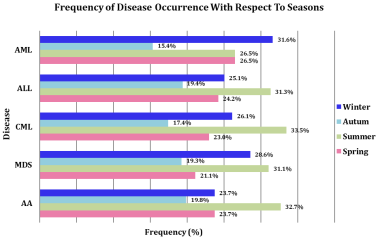
Association of all seasons with diagnosis showed that the highest occurrence of cases received for cytogenetic analysis was during the summer months (CML 33.5%, AA 32.7%, ALL 31.3%, MDS 31.1% and 26.5% AML). In contrast, winter presentations for AML cases had the highest peak (31.6%) followed by MDS (28.6%), CML (26.1%), ALL (25.1%) and AA (23.7%). The lowest clinical frequency among all hematological disorders consistently occurred during autumn (AA 19.8%, ALL 19.4%, MDS 19.3%, CML 17.4%, and AML 15.4%) (Figure 3).
Figure 3. Stratification of hematological disease occurrence and referral frequency with respect to seasonal variations. Values are represented as percentages (%) within each disease category.
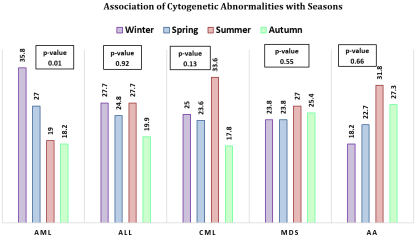
However, among all the diagnosed hematological malignancies, patients who exhibited abnormal cytogenetic findings were further assessed with respect to seasons and demonstrated a significant association in the AML sub-group, with p-value=0.01, X2=8.355, df=3 (as demonstrated in Figure 4).
Figure 4. Association of cytogenetic abnormalities with seasonal trends within AML cohort. Data represent distribution parameters evaluated via Pearson’s Chi-square test (X2=8.355, df =3), demonstrating significant variations across seasons (p<0.05).
4. Discussion
Genes and environmental variations can affect human genetics through direct interaction with each other . Therefore, we believe that seasonal variation may have an influence on the occurrence of cytogenetic abnormalities in hematological malignancies. Still the effect of seasonal variation is not clear either it has direct impact on hematological disorders or any other factors related to change in environment could affect the cytogenetics of the malignancy. The focus of this study was to identify the probable association of seasonal variation and its effect on human genetics, resulting in atypical cytogenetic findings in hematological disorders.
In this study, we evaluated the relationship between seasonal variation and cytogenetic abnormalities reported in hematological disorders which clearly revealed a significant finding in the frequency of cases diagnosed as AML and MPN. The findings in our data of 12 years have revealed that four out of five disorders (ALL, CML, MDS and AA) were significantly reported in summer period which coincides with Hassan J et. al’s findings that showed high incidence (34.1%, p-value 0.001) during southwest monsoon (summer) among ALL, AML, AA and ITP . The least reported abnormalities in both studies were in autumn season. However, in our study, the highest incidence rate of diagnosis was reported for AML in the winter. Such a high incidence rate of AML in winter correlates with the study conducted in Spain by Sanchez F et. al .
This study is data-based and we analyzed the cytogenetic findings as they were reported at our center during specific seasonal period. It is conceivable that since the rate of AML diagnoses at our center was high in winter, more abnormal cytogenetics could have been reported, irrespective to the seasonality of their diagnoses. The possibility of occurrence of abnormal cytogenetics findings in a particular season still persist which might be due to the interaction of genes with certain climatic factors.
We observed significant association among all diseases annually, whereas no significant change was observed in the year 2014 and 2010 due to reduced data.
Seasonality in cohorts from various geographical regions may be useful in determining the impact of latitude and climate on the incidence of abnormal cytogenetics in AML. Our study's evidence of seasonality strongly suggests that seasonal factors, such as infectious agents or environmental triggers, influence the emergence of an abnormality in certain hematological disorders .
There is no study available to our knowledge that covers the association of seasonal effect on cytogenetic findings in hematological disorders as well as covering AA, ALL, AML, CML and MDS altogether. Although our study provides extensive longitudinal insights into the cytogenetic patterns and seasonal variations across a large cohort of hematological disorders, the limitations must also be acknowledged. Firstly, it is a single center study based in Pakistan, which may restrict the generalizability of these findings to broader national or international populations with differing geographic and climatic profiles. Secondly, due to the retrospective nature of the study design, detailed patient-level environmental exposures, occupation-based chemical interactions and lifestyle factors could not be correlated with the observed seasonal peaks. Future prospective, multi-center studies are recommended to further validate these seasonal dynamics.
5. Conclusion
This study was able to highlight the high incidence rate of most hematological malignancies in summers while lowest cases were reported in autumn season. Moreover, cases of acute myeloid leukemia had evident abnormal cytogenetic findings in winter, enabling the future studies to focus on the etiology of abnormal cytogenetics in certain seasonality which could lead to a deep insight into the impact of gene-environment interaction.
6. Recommendation
Based on the findings of this study, clinical protocols should prioritize intensive cytogenetic screening for adult populations, who exhibit a significantly higher frequency of abnormalities, with particular attention to AML cases presenting during winter months. Moreover, future research should investigate potential environmental, lifestyle, or viral triggers driving these seasonal variations, utilizing prospective, multicenter studies to validate these trends and better understand the underlying pathophysiology across broader geographic regions.
Abbreviations

GTG

G-banding by Trypsin Using Giemsa

FISH

Fluorescence In-situ Hybridization

AA

Aplastic Anemia

AML

Acute Myeloid Leukemia

ALL

Acute Lymphoblastic Leukemia

ITP

Immune Thrombocytopenic Purpura

MDS

Myelodysplastic Syndrome

CML

Chronic Myeloid Leukemia

WHO

World Health Organization

Acknowledgments
The authors would like to express their sincere gratitude to the patients whose clinical records made this 12-year retrospective study possible. We also extend our appreciation to the technical and administrative staff at the clinical laboratory for their invaluable assistance in maintaining the data archives and facilitating the extraction of electronic medical records.
Author Contributions
Jawad Hassan: Conceptualization, Supervision
Aeman Muzammil: Data curation, Writing – original draft
Sarah Javed: Visualization, Writing – review & editing
Saira Shan: Investigation
Madiha Abid: Formal Analysis
Data Availability Statement
The data supporting the outcome of this research work has been reported in this manuscript.
Conflicts of Interest
The authors declare no conflicts of interest.
References
[1] Malakzai H A, Rahmani S, Haidary A M, Noor S, Ahmad M, et al. Complex Cytogenetic Abnormalities in Chronic Myeloid Leukemia Resulting in Early Progression to Blast Crisis: A Case Report. Journal of Medical Case Reports. 2020, 14, 231.
[2] Haase D. Cytogenetic Features in Myelodysplastic Syndromes. Ann. Hematol. 2008, 7, 515-526.
[3] Liehr T, Claussen U. Current Developments in Human Molecular Cytogenetic Techniques. Curr. Mol. Med. 2002, 2(3), 283-297.
[4] Kalkan, R. The Use of Molecular Cytogenetic Techniques for the Identification of Chromosomal Abnormalities. In. Tech. 2017.
[5] Cherry AM, Slovak ML, Campbell LJ, Chun K, Eclache V, et al. Will a peripheral blood (PB) sample yield the same diagnostic and prognostic cytogenetic data as the concomitant bone marrow (BM) in myelodysplasia? Leuk Res. 2012, 36(7), 832-840.
[6] Siegel, R., Ward, E., Brawley, O. and Jemal, A. The Impact of Eliminating Socioeconomic and Racial Disparities on Premature Cancer Deaths. CA: A Cancer Journal for Clinicians. 2011, 61, 212-236.
[7] Hassan J, Adil SO, Haider Z, Zaheer S, Anwar N, et al. Seasonal Variations in Hematological Disorders: A 10-year single-center experience. Int J Lab Hematol. 2020, 43(1), 93-98.
[8] Linabery AM, Ross JA. Trends in Childhood Cancer Incidence in the U.S. (1992-2004). Cancer. 2008, 112(2), 416-432.
[9] Nature Education. Environment controls gene expression: Sex Determination and the Onset of Genetic Disorders. Available from:
[10] Azzi A, Dallmann R, Casserly A, Rehrauer H, Patrignani A, et al. Circadian Behavior is Light-Reprogrammed by Plastic DNA Methylation. Nat Neurosci. 2014, 17(3), 377-382.
[11] Weinkauf B, Rukwied R, Quiding H, Dahllund L, Johansson P, et al. Local Gene Expression Changes after UV-Irradiation of Human Skin. PLOS ONE. 2012, 7(6), e39411.
[12] Jaffe ES, Harris NL, Stein H, Verdiman JW. WHO Classification of Tumors. 3. IARC Press, Lyon, France; 2001, pp. 210-255.
[13] Swerdlow SH, Campo E, Harris NL, Jaffe ES, Pileri SA, Stein H. WHO classification of tumours of haematopoietic and lymphoid tissues. 4. IARC Press, Lyon, France; 2008.
[14] Virolainen SJ, VonHandorf A, Viel KCMF, Weirauch MT, Kottyan LC. Gene-environment interactions and their impact on human health. Genes Immun. 2023, 24(1), 1-11.
[15] Sánchez-Vizcaíno F, Tamayo C, Ramos F, Láinez-González D, Serrano-López J, et al. Identification of seasonal variation in the diagnosis of acute myeloid leukaemia: a population-based study. Br J Haematol. 2022, 198, 545-555.
Cite This Article
  • APA Style

    Hassan, J., Muzammil, A., Javed, S., Shan, S., Abid, M. (2026). Seasonal Variation in Hematological Disorders with Respect to Cytogenetic Abnormalities - A 12 Year Single-Center Perspective. Science Discovery Immunology, 1(1), 1-7. https://doi.org/10.11648/j.sdimmunol.20260101.11

    Copy | Download

    ACS Style

    Hassan, J.; Muzammil, A.; Javed, S.; Shan, S.; Abid, M. Seasonal Variation in Hematological Disorders with Respect to Cytogenetic Abnormalities - A 12 Year Single-Center Perspective. Sci. Discov. Immunol. 2026, 1(1), 1-7. doi: 10.11648/j.sdimmunol.20260101.11

    Copy | Download

    AMA Style

    Hassan J, Muzammil A, Javed S, Shan S, Abid M. Seasonal Variation in Hematological Disorders with Respect to Cytogenetic Abnormalities - A 12 Year Single-Center Perspective. Sci Discov Immunol. 2026;1(1):1-7. doi: 10.11648/j.sdimmunol.20260101.11

    Copy | Download

  • @article{10.11648/j.sdimmunol.20260101.11,
      author = {Jawad Hassan and Aeman Muzammil and Sarah Javed and Saira Shan and Madiha Abid},
      title = {Seasonal Variation in Hematological Disorders with Respect to Cytogenetic Abnormalities - A 12 Year Single-Center Perspective},
      journal = {Science Discovery Immunology},
      volume = {1},
      number = {1},
      pages = {1-7},
      doi = {10.11648/j.sdimmunol.20260101.11},
      url = {https://doi.org/10.11648/j.sdimmunol.20260101.11},
      eprint = {https://article.sciencepublishinggroup.com/pdf/10.11648.j.sdimmunol.20260101.11},
      abstract = {This retrospective cross-sectional single-center study, conducted at the National Institute of Blood Diseases and Bone Marrow Transplantation (NIBD and BMT) in Karachi, Pakistan, aimed to investigate the relationship between seasonal variations and their effects on bone marrow cytogenetics leading to hematological abnormalities. By analyzing a 12-year dataset of hematological disorders including Aplastic Anemia (AA), Acute Lymphoblastic Leukemia (ALL), Acute Myeloid Leukemia (AML), and Myeloproliferative Neoplasms (MPN), cases were categorized by diagnosis season using retrospectively collected bone marrow trephine and cytogenetics reports. Among the 2,229 investigated patients (mean age: 36.81 ± 18.91 years; 61.6% male), abnormal cytogenetic findings were identified in 41.2% (n=919), demonstrating a highly significant association with age (p< 0.001), with adults exhibiting a higher frequency of abnormalities. While the incidence of CML, ALL, MDS, and AA peaked during the summer months (ranging from 31.1% to 33.3%), AML cases reached their highest frequency in the winter (31.6%), and all diseases recorded their lowest occurrences in the autumn. Notably, a significant seasonal association regarding abnormal cytogenetic findings was observed specifically in acute myeloid leukemia (p = 0.01). Ultimately, these findings highlight the substantial impact of both demographic factors and seasonal variations on the incidence patterns and cytogenetic profiles of hematological disorders.},
     year = {2026}
    }
    

    Copy | Download

  • TY  - JOUR
    T1  - Seasonal Variation in Hematological Disorders with Respect to Cytogenetic Abnormalities - A 12 Year Single-Center Perspective
    AU  - Jawad Hassan
    AU  - Aeman Muzammil
    AU  - Sarah Javed
    AU  - Saira Shan
    AU  - Madiha Abid
    Y1  - 2026/10/14
    PY  - 2026
    N1  - https://doi.org/10.11648/j.sdimmunol.20260101.11
    DO  - 10.11648/j.sdimmunol.20260101.11
    T2  - Science Discovery Immunology
    JF  - Science Discovery Immunology
    JO  - Science Discovery Immunology
    SP  - 1
    EP  - 7
    PB  - Science Publishing Group
    UR  - https://doi.org/10.11648/j.sdimmunol.20260101.11
    AB  - This retrospective cross-sectional single-center study, conducted at the National Institute of Blood Diseases and Bone Marrow Transplantation (NIBD and BMT) in Karachi, Pakistan, aimed to investigate the relationship between seasonal variations and their effects on bone marrow cytogenetics leading to hematological abnormalities. By analyzing a 12-year dataset of hematological disorders including Aplastic Anemia (AA), Acute Lymphoblastic Leukemia (ALL), Acute Myeloid Leukemia (AML), and Myeloproliferative Neoplasms (MPN), cases were categorized by diagnosis season using retrospectively collected bone marrow trephine and cytogenetics reports. Among the 2,229 investigated patients (mean age: 36.81 ± 18.91 years; 61.6% male), abnormal cytogenetic findings were identified in 41.2% (n=919), demonstrating a highly significant association with age (p< 0.001), with adults exhibiting a higher frequency of abnormalities. While the incidence of CML, ALL, MDS, and AA peaked during the summer months (ranging from 31.1% to 33.3%), AML cases reached their highest frequency in the winter (31.6%), and all diseases recorded their lowest occurrences in the autumn. Notably, a significant seasonal association regarding abnormal cytogenetic findings was observed specifically in acute myeloid leukemia (p = 0.01). Ultimately, these findings highlight the substantial impact of both demographic factors and seasonal variations on the incidence patterns and cytogenetic profiles of hematological disorders.
    VL  - 1
    IS  - 1
    ER  - 

    Copy | Download

Author Information
  • Department of Hematology Laboratory, National Institute of Blood Diseases and Bone Marrow Transplantation, Karachi, Pakistan;Department of Cytogenetics, National Institute of Blood Diseases and Bone Marrow Transplantation, Karachi, Pakistan
  • Department of Cytogenetics, National Institute of Blood Diseases and Bone Marrow Transplantation, Karachi, Pakistan

  • Department of Cytogenetics, National Institute of Blood Diseases and Bone Marrow Transplantation, Karachi, Pakistan

  • Department of Cytogenetics, National Institute of Blood Diseases and Bone Marrow Transplantation, Karachi, Pakistan

  • Research Department, National Institute of Blood Diseases and Bone Marrow Transplantation, Karachi, Pakistan