
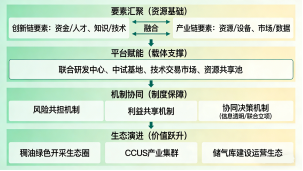
Deepening the integration of the innovation chain and industrial chain ("Dual-Chain Integration") is a core strategic pathway to overcome the sustainable development bottlenecks of mature oilfields, cultivate new quality productivity forces, and ensure national energy security. Taking Oilfield L as a typical case, this paper first constructs an analytical framework encompassing "Factor Aggregation—Platform Empowerment—Mechanism Synergy—Ecosystem Evolution." Through field research and policy text analysis, it systematically diagnoses the prominent challenges faced by Oilfield L in the process of Dual-Chain Integration. A coupled System Dynamics and Agent-Based Modeling (ABM-SD) framework is designed: the upper-level SD module simulates the evolution of macro-level resource constraints and policy environments, while the lower-level ABM module simulates the micro-level game-playing and strategy learning processes of three types of agents—research institutions, production units, and coordination platforms. Multi-agent reinforcement learning is employed to derive flexible organizational models featuring risk-sharing and benefit-sharing mechanisms. Parameter calibration and scenario simulations are conducted based on empirical data from Oilfield L. The findings reveal that: (1) establishing a substantive collaborative innovation platform improves overall system efficiency by approximately 21.6%; (2) technology transfer rates reach an optimal equilibrium when the risk-sharing ratio is optimized to 32% for research institutions and 68% for production units; and (3) building industrial innovation ecosystems around characteristic areas such as heavy oil green development and CCUS can effectively break the structural barrier of a weak pilot-scale testing phase. This study provides a replicable micro-level practical paradigm for resource-based state-owned enterprises to achieve kinetic energy conversion through Dual-Chain Integration.
| Published in | Science Innovation (Volume 14, Issue 3) |
| DOI | 10.11648/j.si.20261403.14 |
| Page(s) | 84-89 |
| Creative Commons |
This is an Open Access article, distributed under the terms of the Creative Commons Attribution 4.0 International License (http://creativecommons.org/licenses/by/4.0/), which permits unrestricted use, distribution and reproduction in any medium or format, provided the original work is properly cited. |
| Copyright |
Copyright © The Author(s), 2026. Published by Science Publishing Group |
Dual-Chain Integration (Innovation-Chain and Industrial-Chain), Resource-based SOEs, ABM-SD Coupling Model, Multi-Agent Reinforcement Learning, New Quality Productivity Forces
| [1] | 刘海涛, 陈世青, 张玲. 聚焦新质生产力: 知识产权驱动资源型国有企业产业链知识图谱式布局 [J]. 青海师范大学学报(社会科学版), 2025(4): 1-12. |
| [2] | 刘江鹏. 油气田企业基于资源优化配置的一体化体系研究[J]. 中国总会计师, 2023(10): 27-32. |
| [3] | 毛丰付, 陈强, 郭子彤. 数据要素驱动创新链与产业链融合的机制研究——基于创新生态系统视角 [J/OL]. 科研管理, 1-15 [2026-03-17]. |
| [4] | 赵佳. 创新链与产业链融合发展的机制与路径研究 [J]. 科学管理研究, 2022, 40(3): 56-62. |
| [5] | 周愉峰, 张熙培, 李志. 血液供应链绩效演进与评价研究: 基于ABM+SD耦合建模与仿真 [J]. 供应链管理, 2023, 4(3): 18-35. |
| [6] | 聂常虹, 何雨轩, 李钏. 中国“四链”融合发展的水平测度、问题分析与对策[J]. 中国科学院院刊, 2026, 41(1): 177-193. |
| [7] | 陈晓红, 唐湘博, 李大元. 基于多智能体仿真的环境政策评估研究综述 [J]. 系统工程理论与实践, 2021, 41(6): 1489-1500. |
| [8] | Hosseinnezhad D, Heavey C, Goodarzi F. Application of hybrid agent-based modeling and system dynamics simulation: Collaboration to improve supply chain resilience [C]//SW 2025 - OR Society 12th Simulation Workshop. Birmingham Operational Research Society, 2025. |
| [9] | Nguyen L K N, Howick S, Megiddo I. A framework for conceptualising hybrid system dynamics and agent-based simulation models [J]. European Journal of Operational Research, 2024, 315(3): 1153-1166. |
| [10] | 杜威, 丁世飞. 多智能体强化学习综述 [J]. 计算机科学, 2019, 46(8): 1-8. |
| [11] | 肖锋. 基于强化学习的库位优化算法在物料拉动系统中的研究与应用[D]. 成都: 西南交通大学, 2015. |
| [12] | 闫俊宇, 吴孟武. 基于MAPPO算法的串行多车间调度方法 [J]. 计算机应用研究, 2026, 43(2). |
| [13] | 姜兴宇, 陈嘉淇, 王立权, 等. 基于深度多智能体强化学习的机床混流装配线调度优化 [J]. 工业工程, 2025, 28(4): 15-23. |
| [14] | 孙海燕, 王建国. 资源型国企转型升级中的创新生态系统构建 [J]. 经济体制改革, 2024(2): 112-118. |
| [15] | 张家瑞, 王慧慧, 曾维华. 基于ABM+SD耦合模型的滇池流域水价政策仿真 [J]. 中国环境科学, 2017, 37(10): 3991-4000. |
| [16] | 黄璐, 任航, 刘明熹, 等. 融合大语言模型与动态图神经网络的产学研知识流动测度方法研究 [J/OL]. 中国管理科学, 1-16 [2026-03-17]. |
APA Style
Wu, Y., Li, S., Li, H., Wang, L. (2026). Breaking Barriers and System Construction for Innovation-Industrial Chain Integration in Resource-Based SOEs: A Case Study of L Oilfield. Science Innovation, 14(3), 84-89. https://doi.org/10.11648/j.si.20261403.14
ACS Style
Wu, Y.; Li, S.; Li, H.; Wang, L. Breaking Barriers and System Construction for Innovation-Industrial Chain Integration in Resource-Based SOEs: A Case Study of L Oilfield. Sci. Innov. 2026, 14(3), 84-89. doi: 10.11648/j.si.20261403.14
@article{10.11648/j.si.20261403.14,
  author = {Yueyang Wu and Shuangying Li and Han Li and Le Wang},
  title = {Breaking Barriers and System Construction for
Innovation-Industrial Chain Integration in Resource-Based SOEs: A Case Study of L Oilfield},
  journal = {Science Innovation},
  volume = {14},
  number = {3},
  pages = {84-89},
  doi = {10.11648/j.si.20261403.14},
  url = {https://doi.org/10.11648/j.si.20261403.14},
  eprint = {https://article.sciencepublishinggroup.com/pdf/10.11648.j.si.20261403.14},
  abstract = {Deepening the integration of the innovation chain and industrial chain ("Dual-Chain Integration") is a core strategic pathway to overcome the sustainable development bottlenecks of mature oilfields, cultivate new quality productivity forces, and ensure national energy security. Taking Oilfield L as a typical case, this paper first constructs an analytical framework encompassing "Factor Aggregation—Platform Empowerment—Mechanism Synergy—Ecosystem Evolution." Through field research and policy text analysis, it systematically diagnoses the prominent challenges faced by Oilfield L in the process of Dual-Chain Integration. A coupled System Dynamics and Agent-Based Modeling (ABM-SD) framework is designed: the upper-level SD module simulates the evolution of macro-level resource constraints and policy environments, while the lower-level ABM module simulates the micro-level game-playing and strategy learning processes of three types of agents—research institutions, production units, and coordination platforms. Multi-agent reinforcement learning is employed to derive flexible organizational models featuring risk-sharing and benefit-sharing mechanisms. Parameter calibration and scenario simulations are conducted based on empirical data from Oilfield L. The findings reveal that: (1) establishing a substantive collaborative innovation platform improves overall system efficiency by approximately 21.6%; (2) technology transfer rates reach an optimal equilibrium when the risk-sharing ratio is optimized to 32% for research institutions and 68% for production units; and (3) building industrial innovation ecosystems around characteristic areas such as heavy oil green development and CCUS can effectively break the structural barrier of a weak pilot-scale testing phase. This study provides a replicable micro-level practical paradigm for resource-based state-owned enterprises to achieve kinetic energy conversion through Dual-Chain Integration.},
 year = {2026}
}
TY  - JOUR
T1  - Breaking Barriers and System Construction for
Innovation-Industrial Chain Integration in Resource-Based SOEs: A Case Study of L Oilfield
AU  - Yueyang Wu
AU  - Shuangying Li
AU  - Han Li
AU  - Le Wang
Y1  - 2026/05/29
PY  - 2026
N1  - https://doi.org/10.11648/j.si.20261403.14
DO  - 10.11648/j.si.20261403.14
T2  - Science Innovation
JF  - Science Innovation
JO  - Science Innovation
SP  - 84
EP  - 89
PB  - Science Publishing Group
SN  - 2328-787X
UR  - https://doi.org/10.11648/j.si.20261403.14
AB  - Deepening the integration of the innovation chain and industrial chain ("Dual-Chain Integration") is a core strategic pathway to overcome the sustainable development bottlenecks of mature oilfields, cultivate new quality productivity forces, and ensure national energy security. Taking Oilfield L as a typical case, this paper first constructs an analytical framework encompassing "Factor Aggregation—Platform Empowerment—Mechanism Synergy—Ecosystem Evolution." Through field research and policy text analysis, it systematically diagnoses the prominent challenges faced by Oilfield L in the process of Dual-Chain Integration. A coupled System Dynamics and Agent-Based Modeling (ABM-SD) framework is designed: the upper-level SD module simulates the evolution of macro-level resource constraints and policy environments, while the lower-level ABM module simulates the micro-level game-playing and strategy learning processes of three types of agents—research institutions, production units, and coordination platforms. Multi-agent reinforcement learning is employed to derive flexible organizational models featuring risk-sharing and benefit-sharing mechanisms. Parameter calibration and scenario simulations are conducted based on empirical data from Oilfield L. The findings reveal that: (1) establishing a substantive collaborative innovation platform improves overall system efficiency by approximately 21.6%; (2) technology transfer rates reach an optimal equilibrium when the risk-sharing ratio is optimized to 32% for research institutions and 68% for production units; and (3) building industrial innovation ecosystems around characteristic areas such as heavy oil green development and CCUS can effectively break the structural barrier of a weak pilot-scale testing phase. This study provides a replicable micro-level practical paradigm for resource-based state-owned enterprises to achieve kinetic energy conversion through Dual-Chain Integration.
VL  - 14
IS  - 3
ER  -
Economics and Technology Research Institute, Petrochina Liaohe Oilfield Company, Panjin, China
Economics and Technology Research Institute, Petrochina Liaohe Oilfield Company, Panjin, China
Economics and Technology Research Institute, Petrochina Liaohe Oilfield Company, Panjin, China

Information



 Share This Article
 Twitter
 Linked In
 Facebook
 Copy
Copy Download