
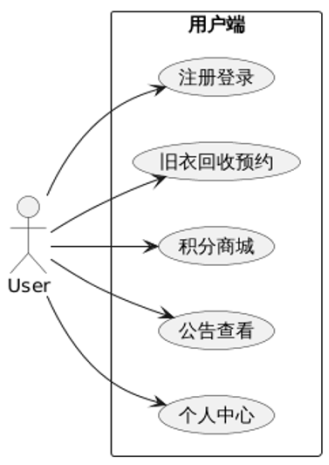
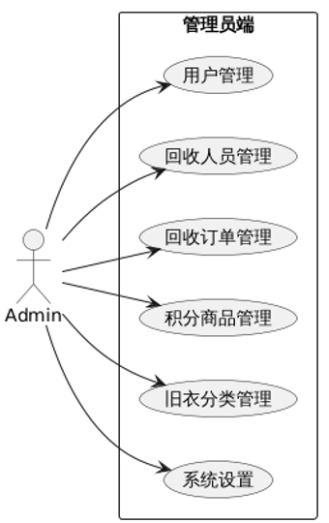
With the continuous enhancement of environmental awareness, the importance of recycling and reusing old clothes in communities is increasingly prominent. At present, the update speed of residents' clothing is continuously accelerating. Every year, tens of millions of tons of used textiles are generated in China. The traditional offline recycling bins and manual door-to-door collection models have problems such as lagging collection, chaotic management, and insufficient participation enthusiasm of residents. The existing online recycling platforms generally lack a complete points incentive system, which is difficult to meet the needs of standardized recycling management in communities. This article builds a B/S architecture community old clothing recycling points management system based on the SpringBoot, Vue, MySQL, MyBatis, and ElementUI technology stacks. The system is divided into two major modules: the resident user end and the administrator end. The user end integrates functions such as registration and login, old clothes recycling appointment, points mall, announcement viewing, and personal center. The administrator end realizes unified control over users, recyclers, recycling orders, points-based goods, used clothing classification, and system announcements. The article successively completed the system feasibility demonstration, requirement modeling, E-R database design, functional modules, business processes, temporal logic design, and completed the page development and black box functional testing. The test results show that the system operates stably. Relying on the points mechanism, it effectively enhances the participation of community residents in the recycling of old clothes, and can achieve digital closed-loop management of old clothes in the community, providing a complete implementation solution for the digital platform of the recycling of waste textiles.
| Published in | Science Research (Volume 14, Issue 5) |
| DOI | 10.11648/j.sr.20261405.18 |
| Page(s) | 319-327 |
| Creative Commons |
This is an Open Access article, distributed under the terms of the Creative Commons Attribution 4.0 International License (http://creativecommons.org/licenses/by/4.0/), which permits unrestricted use, distribution and reproduction in any medium or format, provided the original work is properly cited. |
| Copyright |
Copyright © The Author(s), 2026. Published by Science Publishing Group |
Circular Economy, Recycling of Old Clothes, Points Management "SpringBoot, "Vue, B/S Architecture
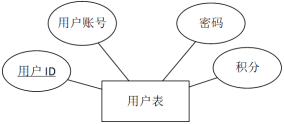
字段 | 类型 | 约束 | 说明 |
|---|---|---|---|
id | bigint | 主键、自增 | 用户唯一标识 |
addtime | timestamp | 默认当前时间 | 注册时间 |
yonghuzhanghao | varchar(200) | 唯一 | 登录账号 |
mima | varchar(200) | 非空 | 登录密码 |
jifen | int | 非空 | 当前积分 |
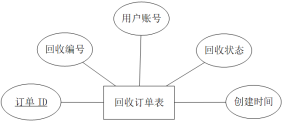
字段 | 类型 | 约束 | 说明 |
|---|---|---|---|
id | bigint | 主键自增 | 订单 ID |
huishoubianhao | varchar | 回收单号 | |
yonghuzhanghao | varchar | 外键 | 关联用户账号 |
huishouzhuangtai | varchar | 订单状态 |
| [1] | 来梓康, 佘梦静. 绿衣盎然旧衣物智能回收处理模式 [J]. 再生资源与循环经济, 2023, 16(09): 11-15. |
| [2] | 黄延果, 常世萌. 互联网技术赋能下旧衣回收平台设计与应用 [J]. 网络安全和信息化, 2023, (04): 74-75. |
| [3] | 范宏进, 孙明洋, 汪欣欣, 等.基于二维码技术和奖励机制的闲置衣物分享系统 [J]. 上海纺织科技, 2022, 50(11): 58-61. |
| [4] | 刘同超. 废旧物资回收再利用体系建设研究 [J]. 内蒙古科技与经济, 2022, (09): 29-32+51. |
| [5] | 高岩. 基于服务设计的废旧物资分类回收机设计研究 [D].哈尔滨: 哈尔滨理工大学,2023. |
| [6] | 胡婷. 社区自治视角下小区旧衣回收箱管理问题监督[J]. 住宅产业, 2022, (11): 76-78. |
| [7] | 杨鑫. Java数据库访问效率的优化策略分析 [J]. 集成电路应用, 2024, 41(10): 162-163. |
| [8] | 梁华, 邵丽, 周燕婷, 等. 实验室安全监督与隐患检查管理系统的设计与实现 [J]. 数字技术与应用, 2025, 43(2): 115-117. |
| [9] | 陈梦阳, 王俊红, 张艳雨. 基于多元线性回归的城市环境空气质量预报系统设计与实现 [J]. 黑龙江环境通报, 2025, 38(5): 16-18. |
| [10] | 郑嘉曦, 江麒. 大语言模型在数字化实习管理中的应用探索 [J]. 现代商贸工业, 2026, 47(8): 63-67. |
| [11] | 葛亮亮, 汤杰, 谢海琴, 等. 节能减排背景下苏州市居民旧衣物回收现状及对策研究 [J]. 低碳世界, 2024, 14(7): 184-186. |
| [12] | 肖相泽, 吕希, 林朗. 浙江省数智赋能降碳的系统性实践 [J].世界环境, 2026, (1): 59-62. |
| [13] | 韦劼群. 在线积分兑换环境与服务的应用研究 [J]. 广西广播电视大学学报, 2017, 28(4): 83-88. |
| [14] | 黄媛媛, 张错玲, 万谊丹, 等. 基于图像识别的社区旧衣物回收管理系统设计 [J]. 电脑知识与技术, 2023, 19(35):43-46. |
| [15] | 张东芳. 循环经济驱动下纺织服装供应链冗余资源管理的研究进展 [J]. 时代经贸, 2026, 23(7): 150-153. |
APA Style
Xiaoying, W. (2026). Design of Community Old Clothing Recycling Points Management System from the Perspective of Circular Economy. Science Research, 14(5), 319-327. https://doi.org/10.11648/j.sr.20261405.18
ACS Style
Xiaoying, W. Design of Community Old Clothing Recycling Points Management System from the Perspective of Circular Economy. Sci. Res. 2026, 14(5), 319-327. doi: 10.11648/j.sr.20261405.18
@article{10.11648/j.sr.20261405.18,
  author = {Wang Xiaoying},
  title = {Design of Community Old Clothing Recycling Points Management System from the Perspective of Circular Economy},
  journal = {Science Research},
  volume = {14},
  number = {5},
  pages = {319-327},
  doi = {10.11648/j.sr.20261405.18},
  url = {https://doi.org/10.11648/j.sr.20261405.18},
  eprint = {https://article.sciencepublishinggroup.com/pdf/10.11648.j.sr.20261405.18},
  abstract = {With the continuous enhancement of environmental awareness, the importance of recycling and reusing old clothes in communities is increasingly prominent. At present, the update speed of residents' clothing is continuously accelerating. Every year, tens of millions of tons of used textiles are generated in China. The traditional offline recycling bins and manual door-to-door collection models have problems such as lagging collection, chaotic management, and insufficient participation enthusiasm of residents. The existing online recycling platforms generally lack a complete points incentive system, which is difficult to meet the needs of standardized recycling management in communities. This article builds a B/S architecture community old clothing recycling points management system based on the SpringBoot, Vue, MySQL, MyBatis, and ElementUI technology stacks. The system is divided into two major modules: the resident user end and the administrator end. The user end integrates functions such as registration and login, old clothes recycling appointment, points mall, announcement viewing, and personal center. The administrator end realizes unified control over users, recyclers, recycling orders, points-based goods, used clothing classification, and system announcements. The article successively completed the system feasibility demonstration, requirement modeling, E-R database design, functional modules, business processes, temporal logic design, and completed the page development and black box functional testing. The test results show that the system operates stably. Relying on the points mechanism, it effectively enhances the participation of community residents in the recycling of old clothes, and can achieve digital closed-loop management of old clothes in the community, providing a complete implementation solution for the digital platform of the recycling of waste textiles.},
 year = {2026}
}
TY  - JOUR
T1  - Design of Community Old Clothing Recycling Points Management System from the Perspective of Circular Economy
AU  - Wang Xiaoying
Y1  - 2026/09/04
PY  - 2026
N1  - https://doi.org/10.11648/j.sr.20261405.18
DO  - 10.11648/j.sr.20261405.18
T2  - Science Research
JF  - Science Research
JO  - Science Research
SP  - 319
EP  - 327
PB  - Science Publishing Group
SN  - 2329-0927
UR  - https://doi.org/10.11648/j.sr.20261405.18
AB  - With the continuous enhancement of environmental awareness, the importance of recycling and reusing old clothes in communities is increasingly prominent. At present, the update speed of residents' clothing is continuously accelerating. Every year, tens of millions of tons of used textiles are generated in China. The traditional offline recycling bins and manual door-to-door collection models have problems such as lagging collection, chaotic management, and insufficient participation enthusiasm of residents. The existing online recycling platforms generally lack a complete points incentive system, which is difficult to meet the needs of standardized recycling management in communities. This article builds a B/S architecture community old clothing recycling points management system based on the SpringBoot, Vue, MySQL, MyBatis, and ElementUI technology stacks. The system is divided into two major modules: the resident user end and the administrator end. The user end integrates functions such as registration and login, old clothes recycling appointment, points mall, announcement viewing, and personal center. The administrator end realizes unified control over users, recyclers, recycling orders, points-based goods, used clothing classification, and system announcements. The article successively completed the system feasibility demonstration, requirement modeling, E-R database design, functional modules, business processes, temporal logic design, and completed the page development and black box functional testing. The test results show that the system operates stably. Relying on the points mechanism, it effectively enhances the participation of community residents in the recycling of old clothes, and can achieve digital closed-loop management of old clothes in the community, providing a complete implementation solution for the digital platform of the recycling of waste textiles.
VL  - 14
IS  - 5
ER  -
The Library of Guangdong Technology College, Zhaoqing, China

Information



 Share This Article
 Twitter
 Linked In
 Facebook




 Copy
Copy Download